Multiple domestication events: complex origins, multiple dispersals?
The following short review of the domestication of some Southeast Asian crops and pigs and chickens is discussed separately because it is a story that is not linked to the evidence at any one particular site or even any one region.
Rather, the evidence suggests a history of multiple domestication ‘events' and long-term human translocations of wild plants and animals, sometimes over long distances, ultimately leading to the emergence of phenotypes archaeologists identify as ‘domesticates'. What is also implied is that the ‘domestication' process is not fixed in time and space, but may be better viewed as processes that allow ‘domestication' multiple times in multiple locations. It is certainly not best seen or explained as a process that had one clear point of origin from which all ‘domesticates' later spread.Bananas
Most of the world's edible bananas derive from the Eumusa section and are either hybrids from Musa acuminata alone or have hybridized with Musa balbisiana.119 Their pathway from wild plants to domestication occurred in ISEA and has involved the reduction of seed production and sterility of their fruit. Perrier et al. undertook a detailed analysis of DNA and ploidy levels in wild bananas from across Southeast Asia and Melanesia, showing that there is no single origin of domesticated Musa sp. The modern Musa banana has arisen from hybridizations between M. acuminata subspecies derived from
ISEA and western Melanesia.[954] The most likely vectors moving the banana over these vast distances are human beings, translocating plants, probably via vegetative propagation between islands. The antiquity of this activity is completely unknown, is likely to have occurred many times in the past (perhaps as a process it has never really ceased), and may well extend back into the Pleistocene. While it is the fruit that is eaten widely today - it can be eaten raw, baked, or roasted, used as a source of sugars, or even fermented - this may not necessarily have been the primary target of human interest.
Bananas, like many species of palm, have a wide range of uses, with stem and leaves providing shelter and clothing, textiles, silage, rope, and cordage, and the stem of some varieties may also be eaten.1[955]1Taro and yams
Taro, Colocasia esculenta (L.), is another plant with a complex domestication history in ISEA that is now widely dispersed geographically and likely involved multiple domestication events in multiple loci as a result of longterm human engagement and movement.[956] Lebot considers it plausible that taro underwent multiple domestication events on either side of the Wallace Line from India, southern China, Melanesia, and northern Australia.[957] Taro, along with bananas, is one of the key plants associated with the earliest definitive agricultural levels at Kuk Swamp 6,400-7,000 years ago, but may also have been under cultivation as a wild plant as early as 10,000 years ago (see Chapter 17). The greater yam, Dioscorea alata, is another plant with a murky domestication history in this region. Some consider D. alata to be a true cultigen derived from several other species, while others[958] suggest that it might actually be a true species that has been brought into domestication more than once. A study of ‘wild' and ‘domesticated' yams in Africa shows the complexity of sorting out long-term human-plant interactions in the case of tubers. Scarcelli et al. undertook a genetic analysis of ‘wild' (in their terms) ‘predomesticated' plants (D. abyssinica and D. praehensilis) that reproduced sexually from the forest with cultivated varieties (D. cayenensis, D. rotundata) that were vegetatively propagated.[959] They found that nearly half the samples (47 per cent) considered to be ‘wild' contained genes from cultivated ‘domesticated' yams and that fourteen samples could be considered genetically intermediate between the ‘wild' and ‘domesticated' plants.
The mixture of genes from ‘wild' and ‘domesticated' varieties suggested ongoing hybridization, probably from feral plants abandoned in old fallows that have since returned to forest.[960]Pigs
Domesticated pigs first appear only at the end of the fifth millennium bp in peninsular Southeast Asia, in co-occurrence with the first evidence of sedentary agriculture.[961] Mitochondrial DNA sequences from wild, feral, and domesticated pigs in island Southeast Asia indicate that the basal lineages of Sus scrofa occur in the west of island Southeast Asia.1[962] Two distinct haplotypes found in Chinese wild boar are shared by several East Asian domestic pigs and suggest multiple domestication events in mainland and possibly insular Southeast Asia.1[963] Overall, the genetic evidence points to at least four separate, though possibly entangled, domestication pathways, one in India and three from wild boar populations that are indigenous to peninsular Southeast Asia.1[964] Repeated human movement of domestic pigs, and also regional ancient population dispersals of wild boar, complicate the record.[965] [966] For example, Larson et al. suggest that the current Pacific clade of domestic pigs was transported out of ISEA prior to a later population replacement in that region by new domestic pigs probably derived from central China.132 Analysis of mitochondrial DNA sequences of domestic pigs in Vanuatu suggests a putative origin of the Pacific clade in coastal Southeast Asia, possibly Vietnam.[967]
Chickens
Like the pig, the chicken appears to have complicated origins, involving a long history of human use and deliberate translocations of various landraces into different regions at different times. The chicken, Gallus gallus domesticus, is thought to derive from the Red Jungle Fowl, Gallus gallus, distributed across mainland Southeast Asia, Indonesia, and southern China, and was likely domesticated by at least 5,400 bp.[968] Mitochondrial DNA evidence indicates possible domestication events in southwestern China, Southeast Asia, and India.[969] [970] [971] The earliest archaeological remains of chickens outside China have been recovered at Khok Phnom Di, dated to around 4,000 years ago,136 though it is not certain whether these remains are from the wild jungle fowl or a domesticate.
Vegecultures of MSEA and ISEA
An important characteristic of agricultural systems in MSEA and ISEA is the diversity of approaches to cultivation broadly referred to as vegeculture. We do not yet have dates for the antiquity of these approaches, though as noted above, there is the possibility that some practices are quite ancient. Vegetative planting today is normally undertaken in cleared or semi-cleared areas referred to as ‘swiddens'. And however ‘agriculture' was introduced in MSEA and ISEA, swiddening is now one of the most widespread cropping systems in South and Southeast Asia, and remains dominant in Borneo and the hills of Thailand, Burma, Laos, Vietnam, Cambodia, and southwestern China.137
Swiddeners create forest patches in different ways, sometimes felling all timber, sometimes leaving tall timber, or even pollarding selected trees. Felled timber may be burned or left to rot in situ, and the newly cleared spaces planted with a mixture of annuals and perennials. Usually swiddens are left fallow for three to six years or even longer periods, during which time the vegetation is allowed to grow unchecked. By moving into a new patch, usually within a larger region following a cyclic schedule, the swiddener creates a meshwork of patches in different stages of regrowth. These patches may be anything from one to six years or even decades old, depending on family or village use of the landscape. These areas of secondary forest are not abandoned areas even though annuals are not planted; they represent important places for hunting and gathering plants.
Old swiddens provide food, medicines, materials for craft, fibres for clothing and rope, bark for walling houses or flooring or for the making of baskets, gums, resins for burning, mastics, caulking, incense, wood oils, dyes, hunting poisons, fuel, leaves for roofing, shingles, and wood for building and making tools, boats, and weapons.[972]
In this system, the swiddener manipulates and manages selected components of the forest, rather than radically transforming them, creating agricultural plots that mimic forest structure.[973] Harris considered that 'Swidden cultivation and fixed-plot horticulture...
come closer to simulating the structure, functional dynamics and equilibrium of the natural ecosystem than any other agricultural system man has devised.'[974] [975]In many parts of ISEA the swiddener is most definitely the partner of the rice farmer, providing food security as there are many factors in the tropics that may lead to failure of the rice crop, such as drought, pests, and severe weather.141 Plants that are commonly intercropped within swiddens include millet (Setaria italica), Job's Tears (Coix lachryma-jobi), corn (Zea mays), and
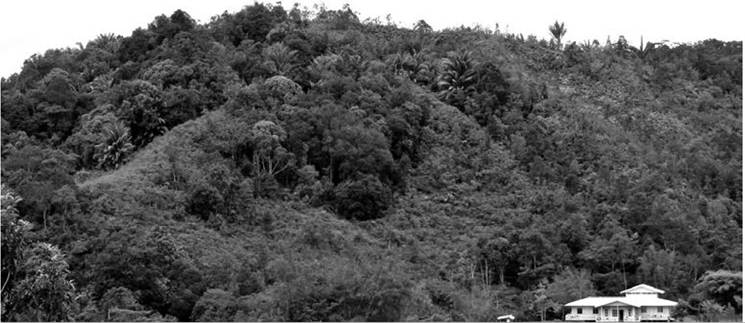
Figure 16.6 Landscape view of a typical homegarden (behind house) showing polycultural nature of mixed plantings that grades seamlessly into a secondary, managed forest, that itself has regenerated from an older slash-and-burn field (identified by the low areas of vegetation in the image)
root crops such as taro (Colocasia esculenta) and yams (Dioscorea alata, Dioscorea esculenta) (Figure 16.6).142