Island Southeast Asia
Island Southeast Asia (ISEA) is often characterized as a region with localscale, limited agriculture, or none at all, prior to the dispersal of East Asian agricultural practices focused on rice, other crop plants, and domesticated animals after c.
4,000 years ago.[913] There is no direct evidence of agriculture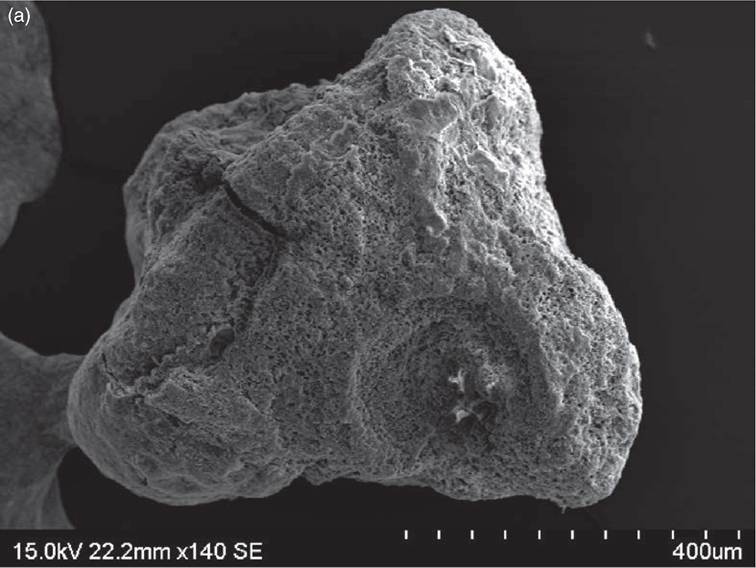
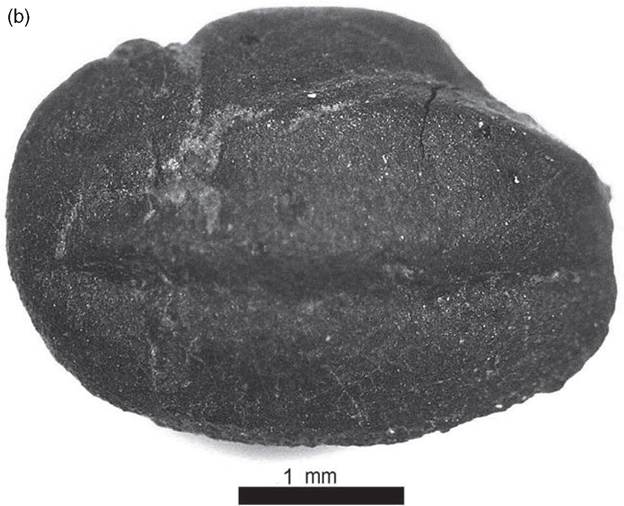
Figure 16.3 Rice remains from ‘Neolithic' sites in Thailand: (a) domesticated rice spikelet base from Khao Sam Kaeo TP43 US4, dating to 383-203 bce (WK18769); (b) rice caryopsis from Khao Sam Kaeo TP57 US16, dating to 359-57 bce (WK21175); (c) rice caryopsis from Ban Non Wat K500 4.2 GEN, direct AMS date of 441-203 bce (BA121030); (d) rice caryopsis from Phu Khao Thong S7 US4, dating to 36 bce to 125 ce (OXA26629).
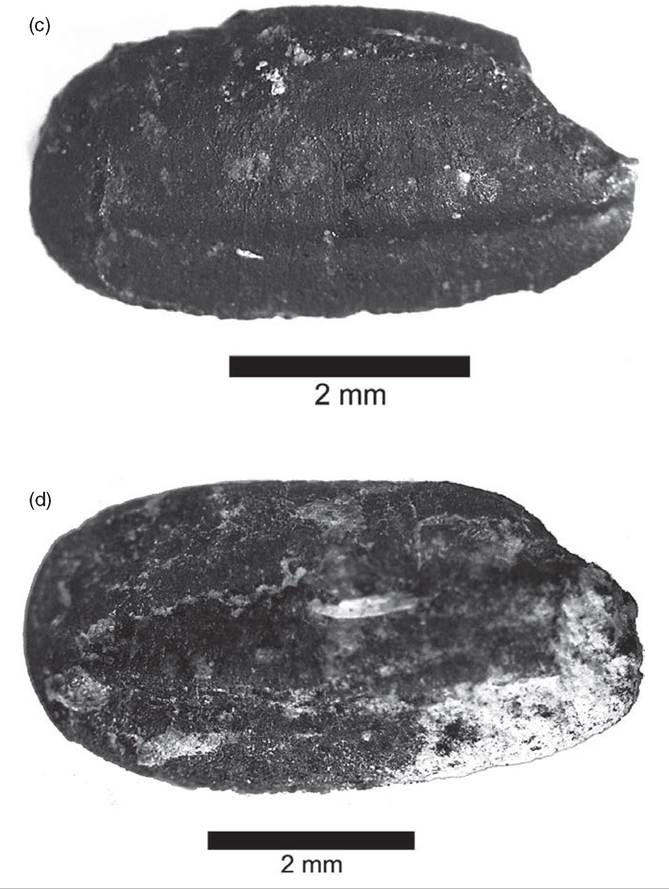
Figure 16.3 (cont.)
prior to the purported Austronesian dispersal, but then there is no direct evidence of agriculture after this either. Until much later in the Holocene, there is no archaeology of ‘agriculture' anywhere in ISEA.
Rice is first identified at the site of Andarayan in Taiwan as a few husk and stem inclusions in pottery fabric dated to 1700 bce.[914] Rice husk remains in sediments and inclusions of rice in pottery from the cave site of Gua Sireh on the north coast of Borneo date to 2800-2100 bce,[915] and rice remains from Leang Burung in Sulawesi date to c. 2000 bce[916] and from Ulu Leang to between 100 and 1000 CE.[917]1 Rice grains from Maros Cave, Sulawesi, remain securely dated to 500 ce. To date, quantities of rice recovered from ISEA archaeological sites remain very small and primarily restricted to inclusions in pottery.
To complicate matters, where rice has been identified, the species of rice has been inferred rather than demonstrated.[918] Domesticated rice, Oryza sativa, did not arrive into a region devoid of wild species of rice. There are many species of wild rice found growing in wetland areas (especially O. rufipogon - an important wild precursor of the domesticated rice complex in southern China) and in secondary forests.[919] Rice certainly moved out of Taiwan/MSEA during the early third millennium bce, but in what context and for what purpose (i.e. was it primarily a food or a marker of status?) remains to be resolved.[920]As mentioned above, the putative dispersal of East Asian agriculture, and other Neolithic characteristics, into ISEA is argued to have occurred from Taiwan or mainland China and is often linked to the spread of Austronesian languages.[921] The material culture of the early Neolithic in Taiwan, 4000-3000 bce, consisted of cord-marked pottery, polished stone adzes, and slate spearheads, and by 3000 bce included rice along with evidence of forest clearance.[922] Overall, pottery assemblages are seen as having strong links with southern China. Between 2500 and 1500 bce elements of this cultural package, including the presence of domesticated pigs and chickens, occur south of Taiwan in the Philippines, Sulawesi, northern Borneo, and Halmahera. Early pottery decoration is varied, and consistently 'red-slipped' rather than cord- marked.[923]
The Batanes Islands lie on the northern edge of the tropics, 150 km from the southern tip of Taiwan and 200 km from the north coast of Luzon, Philippines. Human occupation of these islands dates from c. 2000 bce and consists of red-slipped pottery in the earliest levels, but again there is no evidence of rice cultivation. By soon after 1500 bce, at Sunget, Savidug, and Anaro, for the first time there is evidence of Taiwan nephrite and slate, domestic pigs and dogs, red-slipped and stamped pottery, pottery spindle whorls, side-notched stone net sinkers, and grooved and stepped trapezoidal stone adzes (Type 1A in Duffis 1970 catalogue) providing evidence for much stronger cultural links with Taiwan at this time.[924] A few waisted stone tools, interpreted as probably hoes, were also recovered from Itbayat, dating to c.
2000-1500 bce.[925] [926] Analysis of faunal material shows the presence of introduced pigs on the island of Sabtang by 1200 bce and of dogs in Batanes by90
500 BCE.
Outside of Taiwan the evidence for rice agriculture rapidly diminishes, as does the cohesion of any 'monothetic' cultural package. As Matthew Spriggs notes, 'In much of the region we have generally fragmentary and poorly- dated Neolithic assemblages, often considerably disturbed, and a distribution of sites that are spread over nearly 2000 years from their first appearance 4000 years ago until c. 2300/2100 bp.'[927] Few assemblages contain the full suite of items that might be considered the classic Neolithic 'package' of, for example, red-slipped pottery, quadrangular stone adzes, slate adzes, certain forms of shell bead, spindle whorls, barkcloth beaters, and domesticated rice, pigs, and chickens. More typically, some elements are present (in varying quantities) while others are absent in the early levels or never appear at all.92 Spriggs explains the apparent fragmentation of the Austronesian-borne cultural package throughout the region as the predictable result of negotiated transfers of items, ideas, and technologies between indigenous groups and migrants, where 'things' are accepted or rejected based on cultural interests or particular environmental tolerances.[928] The spread of domesticated rice is also no longer seen as central to this purported demic expansion, where ‘The real Neolithic “package” or process of “Neolithization” did not necessarily involve agriculture at all. But it certainly did involve pottery, its complex vessel forms and surface finish surely betokening new social relations; it certainly did involve a suite of shell artefacts with equally novel meanings, and also new technologies of cloth and barkcloth... One participated in this new world by speaking the new (Austronesian) language.'[929] In making this statement Spriggs shifts the focus of the Neolithic and of ‘Neolithization' from the spread of systems of food production to the spread of new systems of social organization within which material things and technologies were embedded, but were not themselves the drivers of change.
The clearest analogy for this must be the spread of Pama-Nyungan languages across a continent of hunter-gatherers in Australia during the mid-Holocene. It is hypothesized that this occurred in three waves, beginning around 5,000-4,000 years ago, moving down the east and west coasts of Australia and finally into the semi-arid and arid interior by 3,000-2,000 years ago.[930] What ultimately facilitates the language spread is not demic diffusion, but an attractive shift in social structures where small, endogamous, and inward-looking groups begin to participate in wider social worlds through new alliances facilitated by ceremony, exogamous marriage, and larger-scale exchange networks.[931] Possibly these new linkages provided new ways for individuals to acquire status and prestige within their own groups and in the eyes of rivals not yet participating in these new social arrangements. In the same way, Spriggs is suggesting that deeper social transformations may lie at the heart of an Austronesian spread of languages and of material objects across ISEA: an indigenous process of social transformation may have been just as important as the arrival of new material things. It might also be inferred that, while there may have been some degree of inter-island contact prior to contact with Austronesian migrants, plausibly extending back to the Pleistocene, the level of regional human interaction was significantly ramped up at this time.[932]Niah Cave on the northwest coast of Borneo and its Neolithic cemetery sequence are a good example of a rich cultural sequence that shows - beyond the introduction of earthenware pottery - ‘fragmentation' of the purported Austronesian Neolithic package outside Taiwan and the northern Philippines. The Neolithic cemetery at Niah is one of the largest in ISEA, certainly the largest single collection of human remains known in Borneo, with a cultural sequence that begins at least 45,000 years ago.[933] The Neolithic at Niah Cave is marked by the appearance of a series of inhumations and the beginnings of a long phase of burial dating from c.
3,500-3,300 bp (c. 1500 bce ) until c. 2,000 bp, following a significant hiatus of occupation of some 4,000 years.[934] [935] [936] The lithic assemblage already shows evidence of increasing levels of sedentism from c. 12,000 years ago with the introduction of pebble mortars and pestles and grinding stones.100 During the midHolocene, the cave mouth seems to have been primarily a focus for burial, not a site of occupation, as it was up to the beginning of the Holocene.Neolithic material culture includes earthenware pottery (mostly plain, paddle-made), polished quadrangular (Type 2A-D in Duffis 1970 catalogue) and lenticular stone adzes (though rare), pigmented shell (worked and unworked), some shell beads and arm-rings, metal-work, textiles, and burial furniture (Figure 16.4). 101 Ceramics were mostly recovered from the cemetery phase of the site and include a variety of vessel forms such as large and small jars, large urns, bowls, and bottles, as well as distinctive but rare doublespouted vessels.[937] Vessel decoration consists primarily of plain wares with some incised and impressed wares and some basket- and cord-marked ware, mostly paddle-impressed. Red-slipped pottery is absent from this site, and doesn't appear in later sequences either. Metal Age deposits dating from 2,000 years ago are similar and incised or impressed decoration is rare. Some rice remains were found as inclusions in 14 pottery sherds, though more than 1,500 pieces needed to be sampled in order to find this evidence.[938] It is
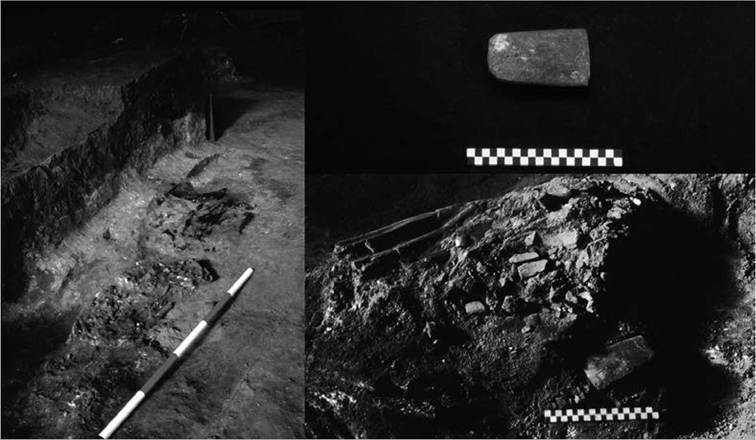
Figure 16.4 Niah Cave, flexed burial B205, looking northeast (left, scale = ι m), with a close-up view (top right) showing a Neolithic polished quadrangular adze that was buried with it (bottom right, black and white scales in cm).
not until the Metal Age (late first millennium b ce) that rice husk is seen for the first time as pottery temper.
Krigbaum assessed the ratio of C3 to C4 from a sample of pre-Neolithic and Neolithic human remains to gauge changes in the diet at the site.[939] His results showed an increase in C3 values from the Mesolithic (pre-pottery) to Neolithic (pottery) sample. Given the general absence of rice remains at this site, which otherwise yielded good overall organic preservation, the isotope values have been interpreted as showing a shift from closed-canopy living to a population spending more time in open, cleared environments, rather than a shift in diet towards C3 plants such as rice. A gradual increase in the intensity of vegecul- tural modes of plant cultivation, perhaps towards forms of swidden-type cultivation seen at Kukby 10,000 bp, may also explain these results.
Analysis of skull morphologies by Jessica Manser aimed to identify the presence of any significant shifts in skeletal features occurring as a result of new migrants entering the region.[940] Her analyses did not show any evidence for this; rather they reflected a pattern of long-term continuity, with no statistically significant differences between pre-Neolithic and Neolithic populations.[941] Interestingly this reinforces the findings of Bulbeck twenty years earlier, who assessed a sample of human remains from MSEA and ISEA and also found no clear evidence of population replacement.[942]
Lapita
Generally thought to derive from the red-slipped pottery tradition of ISEA, the phenomenon of Lapita pottery is yet another hotly contested archaeological expression of the ‘Neolithic'.[943] Lapita is characterized by highly ornate dentate-stamped or incised pottery that is first seen in the Bismarck archipelago c. 3,300 bp, spreading rapidly from there into Near and Remote Oceania within about 200 years.[944] [945] [946] With the shorter timescale involved in its dispersal, Lapita appears far more coherent and ‘monothetic' as evidence of Neolithic population migration.
A good example of what Lapita consists of, and may represent, is the fabulous and unique Lapita cemetery, Teouma, on the south coast of Efate, Vanuatu, dating from c. 3,300-3,200 bp. Interpreted as a burial site of the earliest colonists in the region, it consists of a rich assemblage of ornate dentate-stamped pottery in a variety of forms, including large carinated burial vessels, rare flat-bottomed vessels, cylinder stands, and double-rimmed forms.110 Burials hint at elaborate pre- and post-burial rituals consisting of primary interment and some secondary burial. None of the burials have skulls in articulation with the body and there is evidence of skull removal and the reorientation and recombination of some individuals (Figure 16.5).111
The magnificent pottery of this site, though, is short-lived. Over the next two hundred years the pottery assemblage changes, with a dramatic restriction in vessel form and vessels that maintain little evidence for decoration apart from notching on the lip.112 This decay of design systems over 200 to 300 years following the initial period of colonization is a pattern that seems to
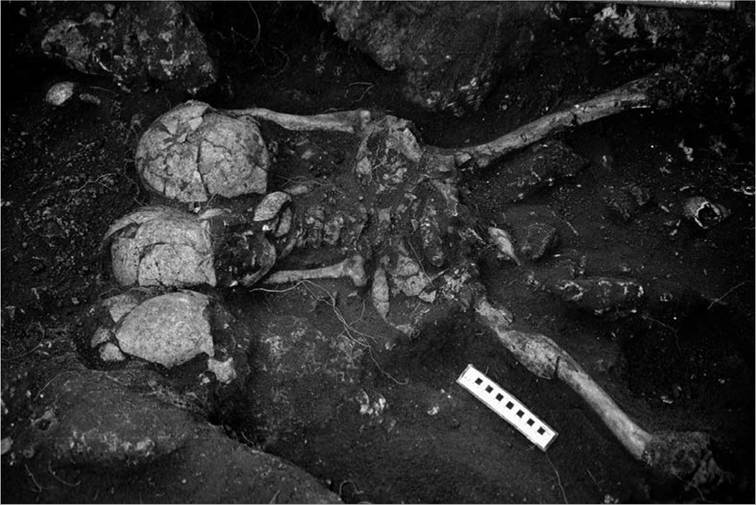
Figure 16.5 Three skulls placed on the chest of a single burial at Teouma, Vanuatu.
be broadly repeated across all Lapita sites.[947] [948] [949] [950] Clark and Murray suggest that ‘The designs applied to Lapita ceramics, and probably to other objects, including the human body by tattooing, were more complex in the early migration phase, when computer simulation of colonization specifies intergroup contact, particularly for non-related marriage partners, was essential to demographic success.'114
It is hard to imagine that the rather short-lived phenomenon of Lapita pottery is in any way related to the first appearance of red-slipped pottery in the Batanes Islands some 800 years earlier.115 Lapita peoples were originally thought to have practised some form of horticulture involving root crops such as yams and taros as well as utilizing nuts and other tree crops.116 Recent isotopic studies of human remains from Teouma reveal far greater dependence on protein sources (marine and terrestrial) than expected, suggesting that during early phases of island colonization people were not greatly reliant on horticulture.[951] [952] [953] From the Bismarcks colonists had to pass through populations of islanders that had inhabited New Ireland, New Britain, and the Solomon Islands since the late Pleistocene before stepping off into the unknown. Within 400 years they had reached Fiji.118