Mainland Southeast Asia
Post-Glacial hunter-gatherer populations were widely dispersed throughout the region. Group size was probably small, perhaps simply the family unit. The degree of residential mobility is unknown, but if communities were following game, such as wild pigs and deer, they are likely to have ranged widely, collecting other small game and tubers, nuts, and fruits.19 Typical stone tool assemblages of MSEA from terminal Pleistocene sites consist of
informal flake assemblages and characteristically flaked pebble tools, termed Hoabinhian.
These are unifacially or bifacially flaked lenticular river pebbles, often flaked around the entire circumference of the piece, named after sites in northern Veitnam where they were first described.[860] Hoabinhian assemblages from the early Holocene appear to overlap at some locations in northern Veitnam with the earliest evidence of pottery and quadrangular stone adzes, though not in Thailand or peninsular Malaysia.[861]Chester Gorman's excavations of Spirit Cave in 1965 and 1970, located in the uplands of northern Thailand, remain the best evidence of the subsistence practices of terminal Pleistocene foragers in MSEA. The site appears to have been initially occupied by at least 12,000 years ago, with occupation continuing over the next 6,000 years.[862] Botanical remains from layers dating to around 10,000 years ago yielded remains of about twenty-two genera of plants, including sources of gum, resins, and poisons.[863] Smashed fragments of the genus Canarium were by far the most common, but the assemblage also included Chinese water chestnut, Trapa sp., bottle gourd, Lagenaria sp., Pepper, Piper sp., and a type of cucumber, Cucumis sp.[864] The presence of Lagenaria, Cucumis, Trapa, and the legumes suggested to Gorman the possibility of horticulture rather than just simply plant-gathering.[865] Analysis of the faunal remains from Spirit Cave also revealed evidence of arboreal species and raised the possibility of the use of poisons (Madhuca, Euphorbiaceae) in association with ballistic weaponry.[866]
For the early Holocene there is good evidence from several coastal and inland regions in southern China, Vietnam, and Thailand of the existence of relatively sedentary groups of hunter-gatherers.
Some of these groups appear to have been making and using simple pottery as well as making polished stone tools.[867] Sites of early pottery use date from 12,000-8,000 bp in southern China at the sites of Zengpiyan, Gexinqiao, Baida, and Kantun. PotteryEarly agriculture in Southeast Asia and the Pacific vessels from Zengpiyan are characteristically thick-walled and tempered with quartz grit.[868] The oldest pottery is either plain or combed with a multiple-toothed tool to form parallel rib-like striations over the surface. Later pottery is cord-impressed.[869] Recovered plant macro-remains reveal a diet of wild berries, nuts, and seeds, as well as some unidentified tubers.[870]
Early Neolithic occupation sites in MSEA date from the late third and first half of the second millennia bce. For the most part, subsistence strategies are characterized by varying combinations and emphases on foraging and food production. There is no sweeping change towards farming, but rather a patchy uptake of food production, including rice and millets, and ongoing reliance on the gathering of local shellfish and plants and the hunting of game. It is generally thought that the first farmers in the region began moving southwards from southern China, northern Vietnam, and Thailand. In the southern region of Fujian the earliest rice remains are dated to 2870-2340 bce, and from the Shixia site in northern Guandong province, deposits containing rice grains and stalks range from 3000-2500 bce. A review of dated sites containing evidence of rice and millets by Zhang and Hung in southwestern China suggests that rice cultivation postdates 2500 bce in that region, spreading further southwards into MSEA after 2300-2000 bce.[871]
Along the southwestern subtropical coastline of Guandong province, the earliest sedentary communities are generally thought to have been pottery-using coastal hunter-gatherer-fisher communities living in postbuilt dwellings, burying their dead, and possessing a material culture characterized by sand-tempered pottery and stone tools, including grinding slabs and pestles, grooved pebbles, net weights, and pierced pebble sinkers for fishing.[872] At the coastal site of Xincun, Guandong province, a stone tool assemblage of pebble tools and grinding stones dating between 3500 and 2500 bce was analysed for starch remains, as other approaches to recover archae- obotanical data had failed.[873] This study revealed a suite of plants, including sago palms, bananas, fern roots, freshwater roots, and Job's Tears.34 It is not possible to determine whether these communities were engaged in any form of ‘horticulture' or were still essentially foragers; however, the suite of plants
found here is consistent with known practices of swiddening and vegecul- tural cultivation elsewhere in MSEA.
Evidence for domestic rice in the form of bilobate rice phytoliths was recovered from tool sediments dating to c. 2500 BCE,[874] but its low frequency arguably shows that this plant was not yet a major component of the subsistence system.Evidence of a 'pre-Neolithic' emerges in Vietnam between around ιι,000-7,000 bp along the Hong (Red) River. These sites are considered by some to be a late phase of the Hoabinhian, containing edge-ground axes and paddle-impressed cord-marked pottery.[875] The dead were buried within occupation sites, and sprinkled with ochre and sometimes with stone and shell ornaments.[876] Pottery appears more widely during the mid-Holocene in northern Vietnam at Da But cultural sites dating between 4500 and 2500 bce, prior to the emergence of ‘agriculture'.[877] Da But sites are generally characterized by large shell midden deposits, some degree of sedentism, burial of the dead, edge-ground pebble axes, pebble net sinkers, and very coarse sand-tempered, cord-marked pottery.[878] As with sites in coastal China such as Xincun, these communities are described as pre-Neolithic because they lack clear evidence of a shift in subsistence from hunting and gathering to agriculture, even though pottery and polished stone tools are present. Pottery and polished stone tools have also been found in some Hoabinhian assemblages inland in caves/rock shelters dating to 4200-2000 bce, suggesting use of these technologies by more mobile communities of huntergatherers as well.[879] This has prompted the use of the term Pre-Neolithic Pottery-using Cultures (PNPC - distinct from the PPNC or Pre-Pottery Neolithic of the Near East) to describe cultural adaptations at this time.[880]
In northern Vietnam, sites of the Phung Nguyen Complex (2500/2000-1500 BCE) occur on raised terrain near freshwater streams along the lower reaches of the Red River.
Pottery at these sites is sand-tempered, ranging widely in colour from yellow to red to grey-black. Decoration is simple, consisting of incision on the neck, impressing, comb-marking, and cord-marking.[881] Other artefacts include clay spindle whorls, clay balls, quadrangular polished stone adzes, a few shouldered adze forms, stone arrowheads, stone bracelets, and ground stone (including pieces with linear grooves that may have been used for jewellery manufacture).[882] As with other early settlement sites, there is still no direct evidence for the cultivation of rice or of other crops.The earliest known ‘Neolithic' sites in southern Vietnam are located along the Vam Co Dong, Vam Co Tay, and Dong Nai drainage systems near the Mekong delta, and date from c. 2000 to 1500 bce.[883] Early occupation sites appear in protected coastal or near-coastal locations with access to freshwater. Artefacts recovered include spindle whorls, bone harpoons for hunting, clay bow pellets, whetstones, stone bangles, barkcloth beaters, and a variety of polished stone adzes, primarily of quadrangular cross-sectional form with parallels from southern China and northeast and central Thailand, suggesting cultural connections to the north and west.[884] The site of Tach Lac, Ha Tinh province (3000-2700 bce), also appears to have been occupied initially by pottery-using hunter-gatherers. Following a short hiatus in habitation, the pottery assemblage changes with the introduction of pedestalled and decorated pottery, quadrangular-sectioned and shouldered stone adzes, grinding stones, and bone artefacts c. 1500 bce.[885]
Settlements such as those at An Son (2200-1200 bce) and Loc Giang (2200 bce) consist of raised platforms made from alluvial silts and loams, and at Rach Nui (1600-1200 bce) foundations were laid with ceramics and shell lime mortar. While details of above-ground construction remain poorly understood, it is likely that ground-level habitations were constructed at An Son and Loc Giang, and perhaps ground-level and stilted houses were built on the raised platforms at Rach Nui.
At Rach Nui light wooden fences (perhaps even daubed) were built around the margins of the platforms, to separate the house plots from surrounding communal activity spaces.[886] At An Son faunal remains indicate the presence of domesticated dogs and pigs from 2100 bce. The presence of cut marks on the dog bones and their relatively haphazard pattern of discard throughout the site suggest they were primarily used as a source of food here. Analysis of the pig remains from An Son also identified a strong selection pattern of individuals two years and younger, suggesting the existence of a managed population.[887]The emergence of the Neolithic in Thailand is currently dated approximately to the early to mid third millennium bce[888] and is marked by increasing levels of sedentism, incised and impressed pottery, polished stone adzes, and domesticated pigs, chickens, and rice.[889] By the very end of the midHolocene, in the late third millennium bce, mixed mortuary/occupation sites of settled societies that cultivated plants and raised domestic stock appear in several interior parts of MSEA.[890]1 By the late third/early second millennium bce in southern Thailand, sites located near or on the coast are characterized by the presence of settled societies with a maritime adaptation, again without clear signs of agriculture.[891] Settlements at these sites are generally located on slightly elevated ground, adjacent to tracts of low- terrace soil in the middle course of tributary streams.[892]
The Khorat plateau in central Thailand contains a number of important early Neolithic sites ranging from relatively small low mounds (0.8 to 5 ha) up to defended settlements greater than 100 ha.[893] The plateau is bounded north and east by the Mekong River and contains floodplains, river terraces, flanking hills, and some igneous rocky outcrops.
Sites were originally detected here based on pottery eroding from low mounds and the occasional discovery of human remains beneath settlements.[894] Key early Neolithic sites include Non Nok Tha, Ban Chiang, and Ban Na Di, and were excavated during the 1960s and early 1970s. Non Nok Tha is located at the confluence of two streams and was used as a burial ground from 3000/2500 until around 500 bce.56 The lowest levels included burials of adults and children with a range of grave goods, including pottery, small polished quadrangular stone adzes, shell bracelets, shell disc beads, and a single bronze axe.[895] A practice of interring humans and animals emerges for the first time with the burial of a child interred with three pottery vessels; the rear limbs and jaw of a young pig were placed on the chest, and beyond the feet lay the remains of a dog.[896] Two additional burials were also found with complete and fragmentary animal remains and complex depositional patterns. One of these, Burial 14, contained the remains of a child interred with four complete cord-marked pottery vessels. After this the body was covered in a layer of smashed pottery sherds that appear to have been deliberately broken over the body. Rows of shell beads were placed around the body and a bone spatula was placed on the left thigh. An entire pig and the fore limb of a bovid were placed in the grave near the head, and the fore and rear limbs of a pig were placed on the shoulders and ankles.[897] This practice of human-animal burial was carried out at other similar sites, including Ban Non Wat (Figure 16.2).Ban Chiang dates from 3500 / 3000 bce to the start of the first millennium c e and is located in rolling lowlands near three streams. This site was excavated several times from 1967 up to 1975 to clarify issues of stratigraphy and allow specialists in soils, pollen, zoology, and physical anthropology direct access to the site. Excavations in 1973 by Nikhom Suthiragasa opened several squares, one of which contained a 4 m stratigraphic sequence. At the base he noted impressions of cloth, ash lenses, and rice remains.[898] Later excavations in 1974-5 by a combined team from the Thai Fine Arts Department and the University of Pennsylvania revealed several mortuary layers. The lowest contained various forms of polished, incised, and cord-marked wares in association with extended and inhumed burials.[899] Excavation also recovered rice remains that may predate 2500 bce, but there is still disagreement about whether these represent domesticated or wild rices.62
An important transitional site in southern Thailand, Khok Phnom Di, appears to have supported populations of sedentary hunters and gatherers practising a mixed economy largely dependent upon foraging, with some evidence for agriculture in later phases.63 Khok Phnom Di is now located c. 22 km from the coast but would have been situated on a coastal barrier near
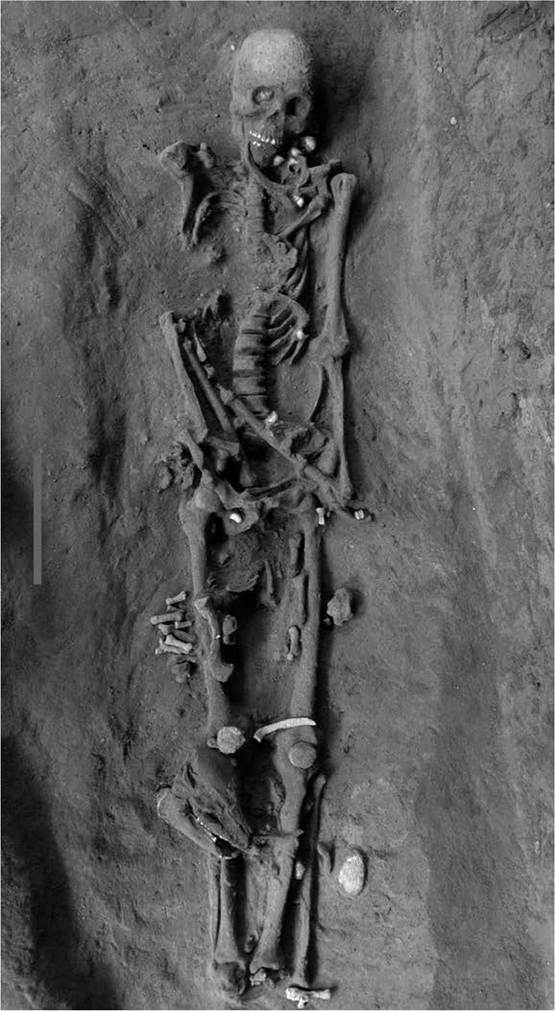
Figure 16.2 Burial 86 at Ban Non Wat, c. 1500 bce: individual interred with pig remains, including pig skull placed on right lower limb.
estuary mangroves and areas of freshwater.[900] The earliest occupation in the area dates from 4710-3960 bce, based on pollen and charcoal from cores indicating raised levels of burning and an increase in grasses and weeds known to be associated with rice fields, but there is no direct evidence of rice cultivation at this time.[901] From c. 2000 to 1400 bce Khok Phnom Di was used as a burial ground, with high quality pottery vessels, cord-marked or burnished; rice was present for the first time albeit in small quantities, otherwise subsistence remained heavily dependent on maritime resources.[902] By 1800-1700 cal bce stone hoes appear in the archaeological sequence along with shell knives - associated with local cultivation of rice - and the first appearance of domestic dogs.[903] There is a complex mortuary history at this site. In the lowest stratigraphic level (Zone A) excavators recovered a total of 104 inhumations of men, women, and infants, associated with post holes, small hearths, and, apart from one shell bead, a complete lack of burial goods.[904] In Zone B there are some significant changes, including four rich graves that interred a woman and three infants. Other burials contained modest grave goods and there is evidence of several above-ground mortuary structures. Zone C contained no burials but was rich in pottery, potterymaking implements, and faunal remains.
The search for the earliest rice and for clues to the diet in general has remained a key research interest in the region and, with the development of new techniques such as isotope analysis, is revealing new complexities. Recent examination of isotopic records from sites in the upper Mun River valley in central Thailand shows non-linear uptake of C3 plants (which include rice) from the second millennium bce.[905] During this period rice is thought to have been cultivated in low-lying areas irrigated by rainfall.[906] [907] The earliest Neolithic middens at Ban Non Wat contain evidence of rice chaff alongside freshwater fish bones, shellfish, and bones from wild game, including deer and wild bovids.71 Isotope data were derived from human teeth, primarily from the site of Ban Non Wat but with contributions from Noen U-Loke, Ban Lum Khao, and Ban Chiang. The results for Ban Non Wat and Noen U-Loke indicated a gradual increase in the consumption of rice during the early Bronze Age, followed by a decline throughout the rest of the second millennium, with increased consumption again during the later Iron Age.[908] Associated with this intensification in rice consumption is an increase in moat building at some sites to retain water (possibly for rice cultivation) and an increase in the symbolic importance of rice, apparent in its inclusion in burials. Several iron hoes were also recovered from Iron Age burials at Ban Non Wat.[909] The increase in rice consumption during the Bronze Age is also seen at sites in the Sakon Nakhon basin such as Ban Chiang and Ban Na Di, but the later rise during the Iron Age does not occur, nor is there evidence of moat construction at these locations.[910]
As part of the Thailand Archaeometallurgy Project in southern Thailand, Weber et al. undertook detailed archaeobotanical investigations at three sites in the Khao Wang Prachan valley, southern Thailand - Non Pa Wai, Nil Kham Maeng, and Nor Mak La - dating from the second millennium bce until the first millennium c e. They have recovered one of the largest samples of carbonized seeds in the region. Against expectation, from a total sample of 3,294 seeds they recovered fewer than 50 rice grains, and these were mostly from one site, Nil Kham Maeng. The majority of their samples consisted of millet (Setaria italica), some Panicum sp., and Coix sp.[911] AMS dating of seeds and charcoal at these sites was good, but complicated by issues of disturbance; however, they feel that the chronology indicates use of millets from the late third millennium bce with no evidence of rice in the foodways at any of these sites until the first millennium bce.[912] This again seems to indicate that while rice was present and possibly cultivated in the region by the second millennium bce, it remained a minor component of the diet (Figure 16.3).