Neolithic paradigms
The term ‘Neolithic' is often used to describe cultural and technological changes across MSEA and ISEA during the mid-Holocene from c. 3000 bce to c. 1500 bce that included sedentism, the spread of agriculture, and the introduction of new materials (including pottery and polished stone tools) and new technologies (such as weaving with spindle whorls), along with domesticated pigs and chickens.
Initially, it is argued, these communities spread south and west in China from villages along the lower Yangtze River, moving overland into the subtropical and tropical regions of MSEA and by sea routes into ISEA via Taiwan.1 Originally this spread of cultures and materials was thought of as a ‘package' of materials carried with migrant communities transforming or wiping out indigenous populations of hunter-gatherers as they moved into new landscapes.[841] [842] However, as seen in Chapters 12 and 14, the ‘package' is now more than a little disarticulated in time and space. Pottery first appears by 18,000 bp in China and Japan, though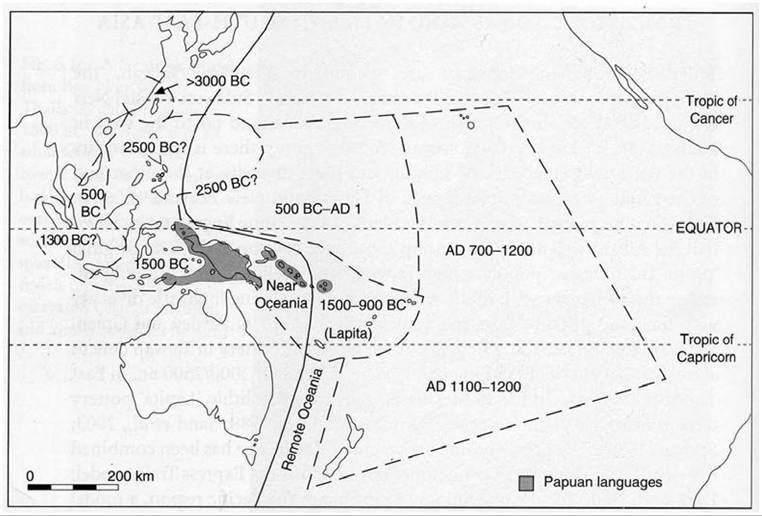
Figure 16.1 Peter Bellwood's model of the Austronesian dispersals of farmers from MSEA into ISEA.
it does not appear to spread widely across MSEA and ISEA until the midHolocene. Other items are also disarticulated from the original Neolithic ‘package', including sedentism, which appears to predate farming among some coastal hunter-gatherer groups in southern China, Vietnam, and southern Thailand.[843] Ground-edge pebble axes occur in Vietnam several thousand years ahead of any evidence of farming.[844] [845]
As envisaged by Peter Bellwood, the initial spread of agriculture was by peoples who were capable, driven, and brought with them an extremely flexible agricultural system that incorporated grains such as rice as well as the cultivation of root crops and trees (Figure ι6.ι).5
The early Austronesians began their ethnolinguistic career as subtropical coastal and riverine peoples with a Neolithic economy based on cereal and tuber cultivation and a set of domesticated animals.
Their ethnographic descendants in island Southeast Asia managed to create for themselves a much wider range of subsistence economies, including rainforest foraging and collection-for-trade; sea nomadism; varied forms of both irrigated and rain-fed rice cultivation; shifting cultivation of cereals, fruits and tubers; and even palm exploitation...[846]While compelling, this statement incorporates a number of key assumptions, some of which remain untested. First, it assumes a ‘farming' mentality that is unique to a group of people, a sort of ‘blueprint' for all forms of plant cultivation, that initially began with rice (see Chapter 12) but that is readily adapted to other forms of plant cultivation. Second, it wraps up two very different forms of plant cultivation, one based on the growth of annuals (rice and millets) and a very different approach that is based on the cultivation and management of perennials.[847] This latter system, broadly referred to as ‘vege- culture', involves root crops, palms, and trees in a wide variety of practices, involving mobile hunter-gatherers as well as sedentary farmers. Important differences between cereal farming and vegecultural modes of plant cultivation is that the former involves clearance of vegetation to create spaces to grow cereal crops, whereas the latter is often embedded within existing vegetation structures - it is often described as a ‘mimic' of forest structure - and can occur within forest with minimal clearance. The expansionist model of farming also attempts to accommodate modern-day observations that Austronesian languages are spoken by most of the cultural groups across MSEA and ISEA and that these peoples share Mongoloid (Asian) physical features.[848] Dates proposed for the arrival of Neolithic communities in MSEA include c. 3000 bce, the late third millennium bce,[849] and as late as c. 1650 bce.[850]
Using a maritime route into ISEA, occupation of the Philippines first occurred around 2000 bce and arguably spread rapidly south into Borneo and Indonesia and east into Sulawesi and other islands en route to New Guinea.11 Central to the expansionist argument is that no cultivation practices, or food production of any kind, existed before 3500 bce in MSEA and ISEA.1[851] [852] As Neolithic communities expanded outwards, indigenous populations of hunter-gatherers were either pushed aside and ignored or absorbed as farmers moved along the coastlines and down the big riverine floodplains of MSEA and by various routes into the big islands of Borneo, Sumatra, and Java and the smaller archipelagoes of Micronesia.
Ultimately these populations moved further eastwards to become part of the Lapita colonization of Near and Remote Oceania c. 1300 bce.1[853]Rice, though today seemingly the dominant food plant geographically, is not the only major crop or food staple in the region.[854] Farming across MSEA and ISEA incorporates a wide range of approaches in the cultivation of rice, with the creation and maintenance of cleared fields within which a plant like rice is a mono-crop (wet and dry), as well as vegetative modes within polycultural (mixed planting) modes of plant propagation. Vegecultural systems are distinctly different from seed-based forms of cultivation and it has even been suggested that rice, at least in ISEA, was actively resisted (or certainly adopted only slowly) by indigenous groups, at least as a staple food crop, for millennia, and was more likely gradually grafted into pre-existing vegecultural forms of plant management and cultivation.[855]
Key plants for this indigenous ‘agricultural' activity (and I use the word cautiously here, as defining cultivation outside of the use of cereal domesticates such as rice is problematic for reasons expanded on below) are roots and tubers such as taro and yams, sago palms, bananas, and bamboo. Proponents of this view accept the likelihood that vegetative modes of plant manipulation (including cultivation) are early and may have involved plants that have become domesticates as well as species that remain genetically wild today, including several different types of sago palm.[856] [857] [858] [859]
The best evidence currently of an early vegecultural agriculture lies in the intermontane valleys of New Guinea at the site of Kuk Swamp (see Chapter 17). Here there is demonstrable evidence of plant cultivation from at least 10,000 years ago, possibly even swiddening,17 and an even longer record of significant environmental manipulation of the vegetation in the highlands, involving clearance and fire in association with stone tools inferred to be digging tools dating from c.
25,000 years ago.18 Identification of vegecultural propagation systems will require distinguishing, via proxy evidence, between what some may term systems of plant ‘management' (practised by hunter-gatherers) as opposed to plant ‘cultivation' (practised by farmers). To make matters worse, there is unlikely to exist any clear dichotomy between ‘management' and ‘cultivation'; rather there will be a multitude of variations in the intensity of practices involving different plants and different polycultural systems. Adding to these difficulties, many plants that are utilized as food staples, such as sago palms (e.g. Metroxylon sagu Rott.), are not considered ‘domesticates', while those that are, e.g. Musa sp. (bananas), Dioscorea alata, and Colocasia esculenta (L.), have complex, unresolved domestication histories (see below).