Out of Africa 2
Out of Africa 2 is the name given to the expansion of our species, Homo sapiens, from Africa. Many researchers argue that the oldest evidence of our species in Africa is c. 190,000 years old from the Awash Valley, Ethiopia.[539] Outside Africa, the earliest skeletal evidence of our species dates from the last interglacial, c.
70,000-125,000 years ago, from the caves of Skhul and Qafzeh in Israel.[540] It appears to have been confined to the Levant, and c. 70,000 years ago was displaced by Neanderthals who may have been forced southwards by the increasingly harsh conditions of MIS 4.[541] After being present in the Levant for c. 50,000-60,000 years ago, these early populations of Homo sapiens became extinct, possibly because they were not as socially and cognitively advanced as later populations of Homo sapiens.[542] After an assumed increase of populations in Africa, Homo sapiens is thought to have expanded across southern Asia between 40,000 and 60,000 years ago (see Map 17.2).[543] Genetic studies of modern populations indicate that the modern inhabitants421
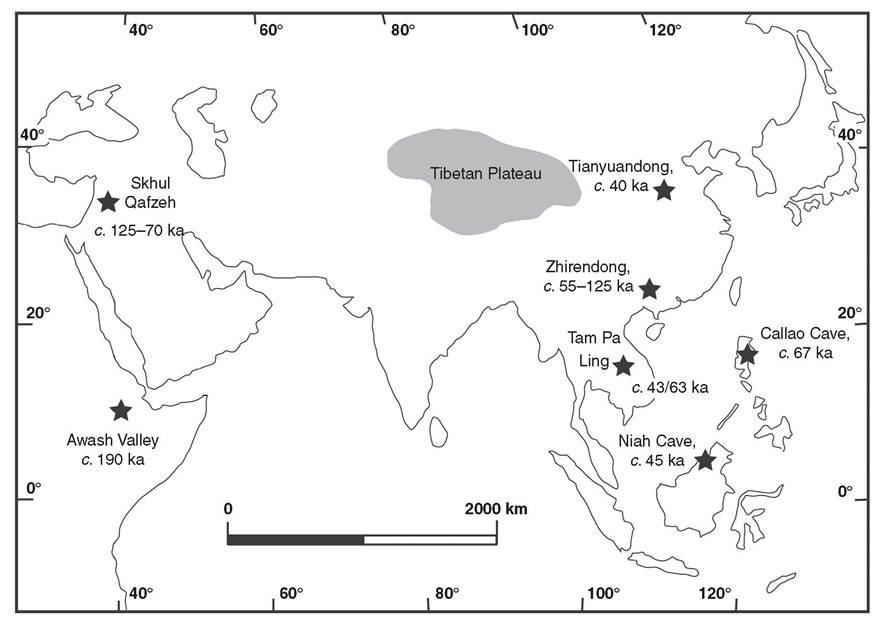
Map 17.2 Sites with the earliest skeletal evidence for Homo sapiens in Asia and northeast Africa. Note the absence of any relevant skeletal evidence for Homo sapiens between Arabia and Southeast Asia; ka = thousand years ago.
Downloaded from Cambridge Histories Online by IP 208.95.48.254 on Tue Jan 19 21:58:01 GMT 2016.
of South and East Asia probably arose from communities that arrived c. 50,000-60,000 years ago, and this estimate is consistent with the earliest dates for the arrival of our species in New Guinea and Australia, which would have been conjoined into a giant landmass (along with Tasmania) during the last glaciation when sea levels were lower than today.[544] In Israel, the earliest communities of Homo sapiens used a Middle Palaeolithic type of toolkit (that is, one in which cores were shaped by flaking prior to the detachment of the required type of flakes) similar to that used by Neanderthals, and only much later - after perhaps 45,000 years ago - developed an Upper Palaeolithic technology that utilised a large number of blades. In India, it is probable that the earliest immigrant communities of our species used a Middle Stone Age toolkit (roughly equivalent in Africa and India to the Middle Palaeolithic of Europe and Southwest Asia), although so far human skeletal remains have not been found.[545] Southeast Asia presents a very different picture, as the populations that are evidenced there after 40,000-50,000 years ago used a very simple stone technology that nevertheless appears to have been successful in enabling humans to utilise tropical rainforests for the first time.[546]
As with Out of Africa ι, a number of health warnings are necessary over Out of Africa 2.
The first is that there is almost no human skeletal evidence from Southwest Asia between 190,000 (when modern humans first appeared in East Africa) and 125,000-70,000 years ago, when they first appear in the Levant, and therefore, Homo sapiens may have left Africa before 125,000 years ago. Secondly, there is no human skeletal evidence between the Levant, c. 70,000 years ago, and Tam Pa Ling, Laos, c. 45,000 years ago and therefore we can only guess when our species first appeared in Arabia and India.[547] Thirdly, because those communities of Homo sapiens that inhabited the Levant c. 125,000 years ago have left no genetic signature in modern populations, it follows that modern humans in South and Southeast Asia may have a deeper antiquity than indicated by genetic studies of modern populations. The greatest impediment to understanding when our species left Africa is the lack of skeletal evidence between the Levant and Southeast Asia before 45,000 years ago, and from Southwest Asia before 125,000 years ago. We may yet discover that our species left Africa before 125,000 years ago, and dispersed across southern Asia before 60,000 years ago.[548]