Dispersals and climatic change
The hominin populations that have inhabited Asia in the past 1.75 million years would have had to respond to numerous cyclical climatic changes that occurred throughout the Pleistocene.
These changes occurred primarily because of variations in the earth's orbit, and are often known as Milankovic cycles, after their discoverer. As is now well known, the Early Pleistocene (2.5-0.8 million years ago) was characterised by frequent and usually minor fluctuations in precipitation and temperature, on an average cycle of one every 40,000 years. In the Middle Pleistocene, these fluctuations were much greater, and the last 600,000 years have been dominated by four lengthy and major periods of reduced temperature and precipitation, each lasting up to 100,000 years, and separated by relatively short interglacials that were warmer and moister (see Figure 17.1). In Europe, these cold periods are termed glaciations, and were dominated by the southwards advance of ice caps over Scandinavia and northern Britain. In Asia, ice sheets were never as extensive, and the equivalent of glaciations were periods when the summer monsoon over South, Southeast, and East Asia was severely weakened, leading to major reductions in rainfall. Because the winter monsoon (which drives cold, dry air southwards across these regions) was stronger, temperatures were also considerably cooler than today.These climatic shifts had profound effects on plant and animal communities, including hominins. In warm, moist periods, hominins and their
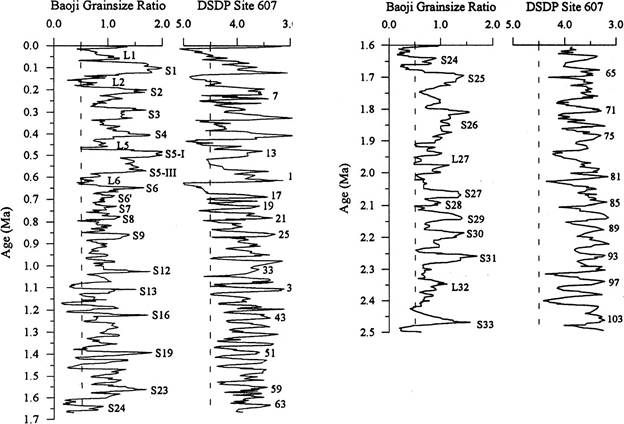
Figure 17.1 The climatic pulse of the Pleistocene. This shows the loess (dust) record from Baoji, central China, and the isotopic record of a sediment core from DSDP (deep-sea drilling program) site 607. Without going into the technical details of each, both show a remarkably similar record of climate change, with numerous low-amplitude changes before 600,000 years ago, and a few major, high-amplitude changes thereafter.
The odd numbers on the right of the DSDP record denote periods when the climate was warm and moist, like the present. In the Chinese record, “S” (for example, S16) denotes periods of soil formation, when rainfall was higher, and “L” (for example, L1) denotes dry, cold, and windy periods when the type of wind-blown soil known as loess accumulated. Our ancestors had to cope with a climate that was frequently highly unstable. Source: Tungsheng Liu, Zhonglli Ding, and Nat Rutter, “Comparison of Milankovitch periods between continental loess and deep sea records over the last 2.5 Ma.”, Quaternary Science Reviews 18 (1999), 1,205-12.resources could expand northwards and often longitudinally from source populations, and dispersals into neighbouring regions were often feasible: when these happened, populations could interbreed. Because conditions were favourable, population levels and densities could rise.[549] In cold, dry periods, populations had to retreat or become locally extinct, and surviving ones were confined to refugia. These fluctuations therefore shape the Palaeolithic settlement of Asia: ‘The early hominin settlement of Asia is...a repeated theme of regional expansion and contraction, colonisation and abandonment, integration and isolation as rainfall increased or decreased. When viewed in closer detail...much of the Asian Early Palaeolithic record is likely to comprise regional discontinuities and local extinctions, rather than long-term continuity and permanent residence.'[550] Figure 17.2 provides a simple summary of these types of population dynamics.
This type of climatically driven dispersal is best evidenced at the northern limits of the hominin range across the Eurasian landmass, from western Europe to northern China. One excellent example comes from Tajikistan in Central Asia, which has a long sequence of Palaeolithic sites from the last 900,000 years. Investigations showed that Palaeolithic occupation occurred only during warm, moist periods when soils could develop; in cold, dry periods, when dust storms were common and enormous deposits of loess (wind-blown dust) accumulated, hominins either retreated southwards or became extinct (see Figure 17.3).[551] A similar pattern of expansion and contraction is evident in Britain and western Europe, and likely also in north China.
This type of movement is not surprising as hominins are climatically sensitive, especially to lengthy sub-freezing winters.[552]In addition to Milankovic cycles of glacial-interglacial conditions (or their equivalent in monsoon-dominated regions), there were also shorter periods of abrupt climatic change, the reasons for which remain poorly known. In glacial periods, the most important are known as Heinrich events, when conditions suddenly became considerably colder for a few centuries or millennia. These must have had profound effects on hominin populations, but because most Palaeolithic sites >50,000 years old cannot be dated to within a margin of error of less than 5,000 or even 10,000 years, they cannot be correlated to these short-term events. However, it is sometimes possible to see the effects of short term climatic change on populations from the last 30,000 years. One excellent example is late glacial western Europe. Here,
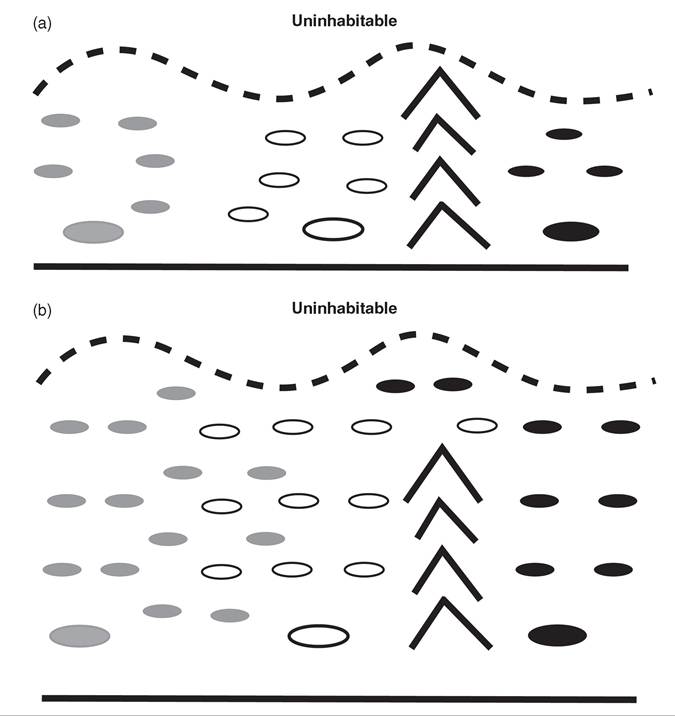
Figure 17.2 Summary model of population dynamics under the climatic shifts of the Pleistocene in continental Asia. This simple model envisages three populations, one of which is separated from the others by a mountain range. In (a), populations are confined to a small number of refugia during the equivalent of a glacial maximum, when conditions were much colder and drier than today. During these periods, populations are likely to have been at their lowest levels, and isolated from each other. In (b), populations are able to disperse northwards during the equivalent of an interglacial, when the climate was similar to today's. Under such conditions, they are also likely to have overlapped in parts of their range, thereby allowing exchange of mates, ideas, and techniques; and even in this case, some exchange between populations formerly isolated by a mountain range. The Tajik record (see Figure 17.3) provides a good example of this type of “regional expansion and contraction, colonisation and abandonment, integration and isolation as rainfall increased or decreased” (Dennell, The Palaeolithic Settlement of Asia, Cambridge: Cambridge University Press, 2009) in Central Asia.
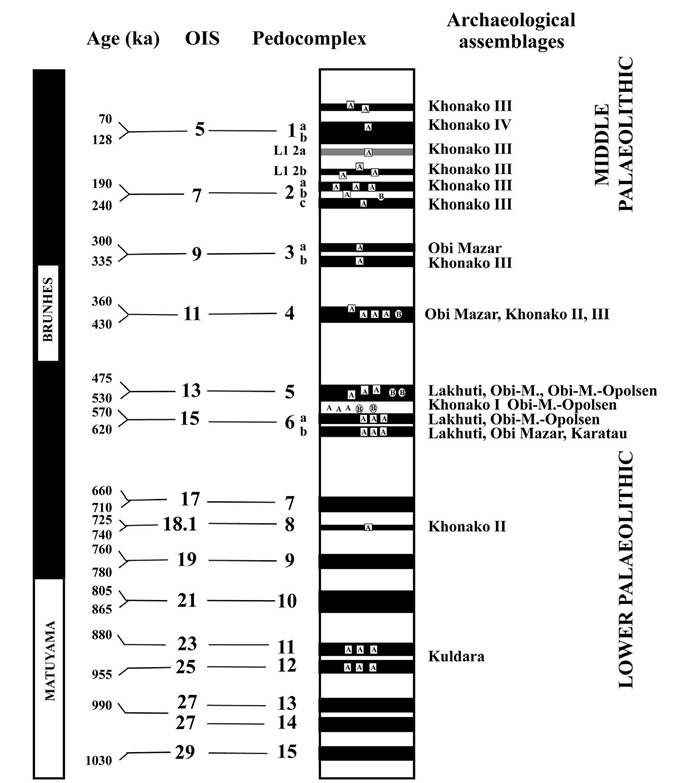
Figure 17.3 The Tajik loess and palaeosol record (reprinted from Quaternary Science Reviews, 18 (10-ιι), Tungsheng Liu, Zhonglli Ding, and Rutter, N., ‘Comparison of Milankovitch periods between continental loess and deep sea records over the last 2.5 Ma.', pp. 1205-12, copyright 1999, with permission from Elsevier). Blackbars denote interglacials, when soils formed; intervening white parts denote colder and drier periods when loess (wind-blown) dust was deposited. As is clear, hominins were present only during periods of soil formation. It was likely that this part of Central Asia was depopulated in cold, dry periods.
humans moved rapidly northwards from their refugia in southern Europe when the ice sheets began to contract after c. 15,000 years ago. Following a sudden re-advance of the ice sheets c. 12,000 years ago, populations once again retreated southwards, and the re-colonisation of northern Europe was delayed for two millennia.[553]
More on the topic Dispersals and climatic change:
- Dispersals and climatic change
- Much of human prehistory is about movement. Sometimes these movements involved the colonisation of a new niche brought about by environmental change, or when our ancestors crossed a behavioural threshold that enabled them to inhabit new regions that were previously beyond their capabilities.
- Christian D. (ed.). The Cambridge World History. Volume 1. Introducing World History, to 10,000 BCE. Cambridge University Press,2015. — 516 p., 2015
- The climatic setting
- Index
- FURTHER RBADING
- Pathways to agriculture
- Nature and scope of the migrations
- Asia and Africa
- Plague