Ritual buildings
Several structures have been unearthed at 'Ain Ghazal that clearly were not used as domestic dwellings: at least four from the LPPNB period and one from the Yarmoukian period. In addition, it is possible that three more LPPNB buildings served in some non-domestic way.
So far, all of the MPPNB structures excavated at the town appear to have been normal houses.Two or probably three different sorts of non-domestic building are known from the latter half of the eighth millennium bce (LPPNB). The apse buildings (one from the East Field, one from the Central Field, and one or two from the North Field), named after the curved ends of one of the rectangular buildings, are much smaller (c. 7.5 m2 interior floor space) than normal houses at 'Ain Ghazal for any of the occupational periods (Figure 9.9a).[491]
There are two circular cult buildings or ‘shrines' (Figure 9.9b) from the North Field, and both are smaller than the apsidal structures (less than 5 m2 each), and in this diminutive area the focus on the central hole and the character of the subfloor channels, the rare geometry, and the multiple reflooring episodes are all strong points to claim that the circular buildings were specially dedicated to cult activity associated with a particular kinship unit.[492] The cult activity undertaken in these smaller buildings may relate to ancestral veneration, a practice that may have become more private after the emergence of 'Ain Ghazal's megasite status.[493] In view of larger cultic buildings (see below), we prefer to call the smaller apsidal and circular buildings ‘shrines' to indicate a lower rank in a hierarchy of ritual buildings.
The remaining two ritual structures, which we term ‘temples', are located in the East Field across the Zarqa River from the main settlement (Figure 9.10).
In contrast to domestic structures from the PPNB (both middle and late), both buildings have unplastered dirt floors. The presence of three ‘standing stones', altars, and hearths surrounded by seven stones all point decidedly to structures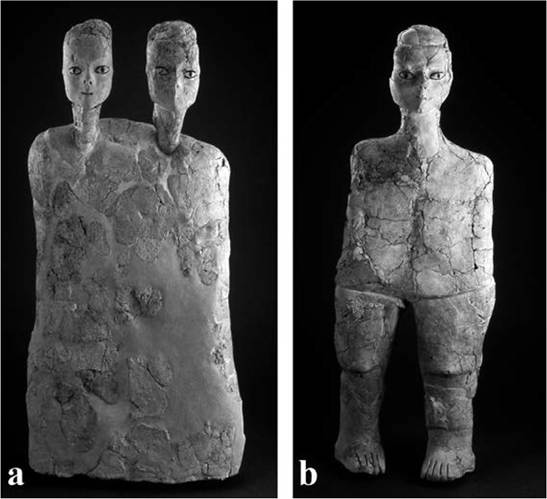
Figure 9.8 (a) One of three two-headed plaster busts from the cache excavated from 'Ain Ghazal in 1985 (height 95 cm); (b) one of two free-standing statues from the 1985 statue cache at 'Ain Ghazal (height 115 cm)
devoted to ritual activity. The two temples are separated by about 100 m, and while one has been dated to 7015 ± 131 bce, its temporal relationship to the other remains unknown.[494]
While the smaller apsidal buildings may have served individual corporate kinship groups to perform traditional rituals, the larger temples served the entire community to weld together social groups who otherwise threatened to split the settlement apart due to competition for scarce resources such as farmland and pasturage.[495] How this new ritual system operated is not known, but there may have been some special religious societies whose membership cross-cut kinship affiliations, sodalities whose objectives were to perform ritual duties and feasts that benefited all of the population rather than just segments of it.32
All of the Yarmoukian structures investigated so far appear to have been regular dwellings for nuclear families. However, one apsidal building in the
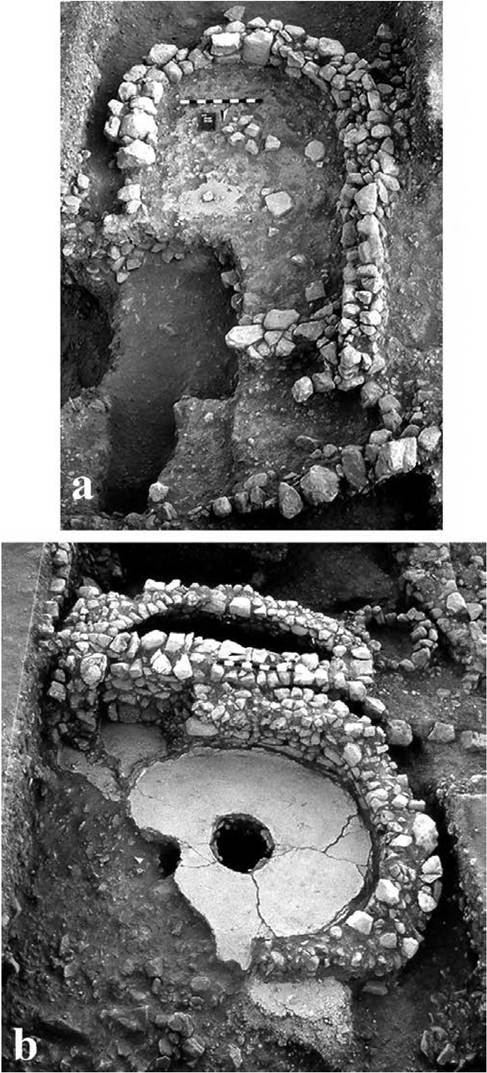
Figure 9.9 (a) An apsidal building originally constructed in the LPPNB period but later cleared and re-used by Yarmoukian residents at 'Ain Ghazal (c. 4.5 ? 3.5 m); (b) a circular ‘shrine' in the North Field at 'Ain Ghazal. The circular shape (2.5 m diameter) is the fourth phase of use, which began as an apsidal building.
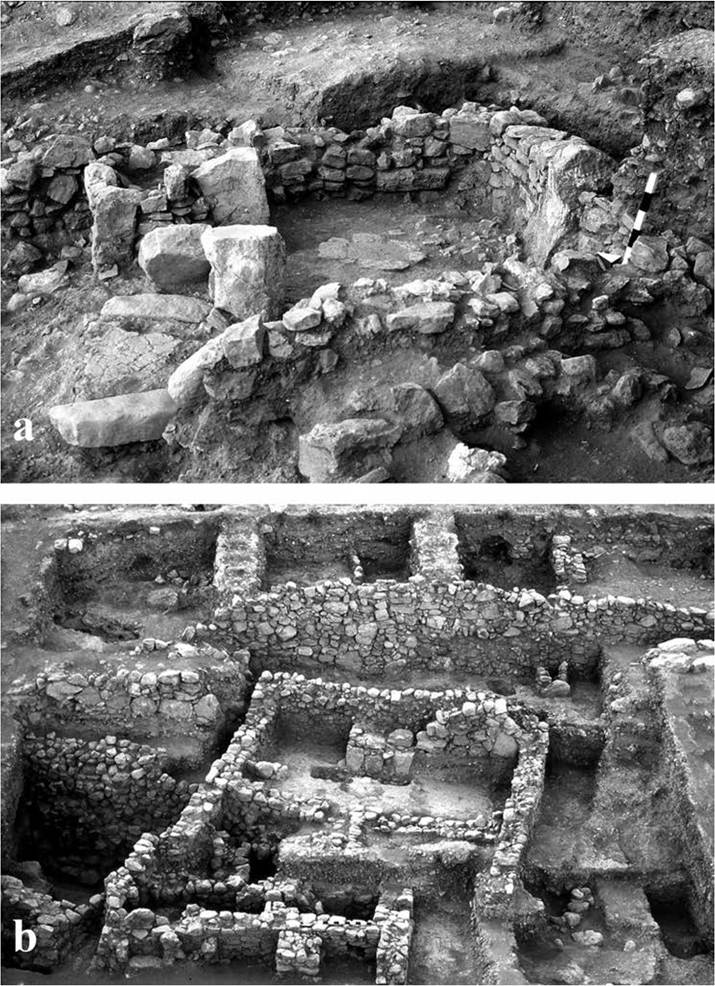
Figure 9.10 (a) View to the north of an LPPNB temple built high on the slope of the East Field. The standing stones are at top centre (the middle stone is tumbled over) and the red plaster hearth right centre. A burned clay ‘floor altar' lies just to the left of the standing stones. (b) The temple at the south end of the East Field was built above an earlier LPPNB house (lower third of the photo). The altar is against the rear (eastern) wall, in front of which is an unpainted plaster hearth.
Central Field from the LPPNB period was excavated and re-used by the Yarmoukians (Figure 9.9a). The exclusive presence of Yarmoukian fine-ware cups and small bowls and the absence of any coarser domestic pottery suggest that the oval-ended building served some public purpose, although the lack of any diagnostic artefacts (other than pottery) or features makes it difficult to suggest what that purpose might have been. The ritual sphere of the Yarmoukians is poorly known at 'Ain Ghazal, and there is no reason to suggest that the apsidal structure served as anything but a meeting place, perhaps for village council meetings.