Scientific Revolution
In the 1930s Sarton highlighted the seventeenth-century changes in science, which were collectively named “Scientific Revolution” by Alexandre Koyre, in the years he was teaching in Cairo.
In 1543 Nicholas Copernicus' De Revolutionibus had put the sun in the centre of the universe; in subsequent centuries historians put Europe in the centre of science. Copernicus and the historians together share motivations sometimes rational, sometimes arbitrary, and come up with results in part rooted in reality and in part distortions of that reality. As an icon, the mere fact of moving the sun to the centre may herald the dawn of modernity, but a scientist today would find little to embrace in De Revolutionibus except for the results, and perhaps the impressive trigonometry and the use of zero, the only two features distinguishing it from ancient Greek science. Without modern methods motivating it, Copernicus' breakthrough could have just as well come from luck, and European exceptionalism might then reduce to a genius for guessing. In fact, De Revolutionibus was both “the cradle and the coffin”[196] for Copernicus' system, but it caused problems whose solutions by later proto-scientists developed fundamental components of the Scientific Revolution: empiricism, the mathematicization of nature, the mechanical universe, and institutional supports for science, among others.This emergent science is a complex of technological, methodological, and social changes, so lacking an agreed-upon core that Steven Shapin can write “there was no such thing as the Scientific Revolution, and this is a book about it”.[197] When the debates' dust dies down, however, most undisputed is that science is European. Indeed, the early-modern volume of the Cambridge History of Science only pretends to step outside of Europe in its final chapter, “European Expansion and Self-definition”, but even here remains Euro-centric and introverted in its formulation.
McClellan and Doris' Science and Technology in World History, which won the World History Association's book prize, fulfils the obligations of its title by devoting seventy-seven pages to the “world's people”, but after a show-and-tell in which Ulugh Beg has presented his observatory, Montezuma I his zoo, Akbar his canal department, and the Ming their 1609 encyclopaedia, the book surrenders to the West, and science shines only on Europe and its colonial extensions. Institutionally, some historians of non-Western science have been forced out of history-of-science programs.[198]Despite and because of historians' focus on Europe, historians of science in the Wider World have found themselves unable to escape it. In the last century, the world has entered the historiography of science primarily through the “grand question” ofJoseph Needham (and earlier, of Max Weber): why did China, despite an apparent early advantage in technology, not develop modern science?[199] Replace technology with theory, and the same question could be asked for the medieval Islamicate world.
Some historians have sportingly taken up this question. We have sweeping works in comparison or synthesis, much in the old cosmopolitan spirit.[200] Such comparative work tends to accept a European scientific revolution, but explains it in terms of indirect accidental and contingent factors (inheritance of other traditions, educational institutions, commercial and geographical expansion) rather than in some essential European superiority. The list of answers and explanations for European exceptionalism has swelled, reflecting a lack of consensus on the very definition of modern science: the handiness of an alphabet, the concept of the corporation, the end of feudalism, greater curiosity, institutional support, the shock of Chinese technologies arriving in rapid succession, Islamic iconoclasm, the discovery of the Americas, neutral spaces of free enquiry, a moderate amount of scepticism, strong nation-states, and more.
Other responses to Needham involved denying the answerability and reasonableness of the question, or denying the coherence of China and the “West,” or the existence of any vast distance between them.[201] Instead, the more innovative if less explicitly ambitious scholarship looks deeply into (construction) or between (circulation) the more traditional places, categories, and objects.[202] Not least among the latter's insights is how the concept of “Western science” was developed, often outside the “West”, as a product of globalizing imperialism.[203] Recent attention to the global roots and branches of Euro-science has shifted the story from European revolution to global evolution.
Proponents of the roots of Western science in the Wider World tend to yell shrilly into the Euro-centricists' deaf ears, and the shrillness and deafness encourage each other. Still, the roots of modern science clearly run via Arabic-language texts that intermediate between Europe and south Asia even while introducing their own innovations. The zero and trigonometry that makes Copernicus something more than ancient Greek science have these extra-European origins, and Copernicus' aversion to the equant may also be inherited from Nasir al-Din al-Tusi. Bala offers a recent synthesis of research on the extra-European roots of Western science, as does Joseph's The Crest of the Peacock for mathematics. Many such assertions of influence entail only compounded possibilities: some minority view in China may have travelled to Europe where it may have been inhaled by some proto-scientist who may have incorporated it into some writing or device that may have played a role that may have been crucial in the Scientific Revolution. Joseph includes a chart (Figure 6.3), which shows possible and known lines of transmission of mathematical ideas. Scientific ideas followed similar paths, and the underlying idea here goes back to Sarton, who testified that “experimental science is a child not only of the West but also of the East; the East was its mother, the West was its father”.[204] Recent scholarship has suggested how Western knowledge is, potentially, anticipated (Copernicus by the thirteenth-century al-Tusi), informed (Locke by the twelfth-century Ibn Tufail's tabula rasa), and inspired (the formal rules of Saussure and Chomsky by the fourth-century bce Panini) by non-Western knowledge.[205] The reverse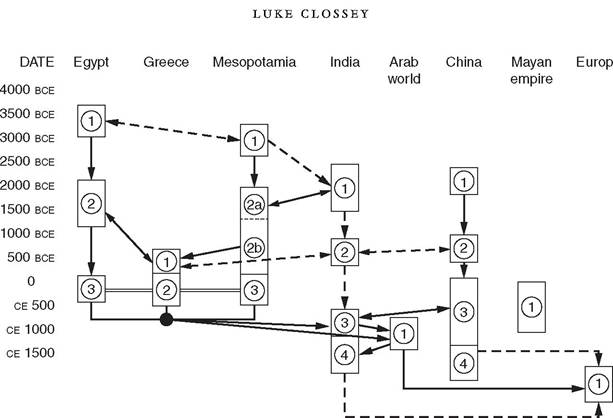
Figure 6.3 Chart of the spread of mathematical ideas (Figure 1.4, pp. 14-15, George GhevergheseJoseph, The Crest of the Peacock: Non-European Roots of Mathematics, 2nd edn. (London: Penguin Books, 2000).
story can be told of science's branches, how modern science moved out of Europe into the Wider World. The classic case is astronomy in China, but scholars are increasingly drawn to how European science uses data from the Wider World as it propagates globally, often in imbalanced power situations associated with colonialism and imperialism.34