Secularization
The most recent of the four moments is secularization, and this is particularly important as it motivates what was described in the opening paragraphs of this chapter as the distinction reigning in the academy between knowledge and belief.
The Latin saeculum originally meant “era” but extended to include “world”, not in terms of global geography but in the sense of the world beyond the monastery walls, as for example “secular clergy”. Formulations vary, but the general sense of the secularization thesis is that as modernity (or wealth or science or rationalism) increases, religiosity declines. Scholars have imagined such a decline in religion would find expression in fewer people identifying as religious, less frequent participation in religious activities such as churchgoing, less religious influence in public or government or academic life, an increased neutrality towards religion in those same spheres, and in religion becoming compartmentalized, declawed, and domesticated. When Christian Scientist parents refuse medical treatment for their children, on the grounds that “material medicine” second-guesses God and thus dilutes the efficacy of prayer, the state intervenes, making clear the place of religion in modern Western society, and showing that it cannot be realized or appealed to exclusively.In the eighteenth, nineteenth, twentieth, and twenty-first centuries scholars have predicted that secularization would happen “very soon now”. It has been “very soon” for a very long time, always the heaven or hell - depending on your perspective - lurking just around the corner. Consistency over so many centuries creates an unavoidable vagueness and uncertainty. As scholars actually look for data, in vain, there is increasingly a consensus that the thesis itself is false. The sociologist Peter Berger has since retracted his 1968 prophecy that “by the twenty-first century, religious believers are likely to be found only in small sects, huddled together to resist a worldwide secular culture”.[190]
What role has the Wider World played in the construction and destruction of the secularization thesis? The thesis was, of course, formed in a European scholarly milieu, based on ideas about contemporary and past Christianity, and only then subsequently expanded to the Wider World.
Indeed, Charles Taylor finds one root of secularism anchored in Christianity itself: “What is peculiar to Latin Christendom is a growing concern for Reform, a drive to make over the whole society of higher standards.”[191] Subtle Euro-centric assumptions remain in some versions of the secularization thesis. For example, the idea that contradictory religions brought together by pluralizing globalization are a recipe for secularism depends on a concept of religion with enough coherence and hard boundaries to cause crashes rather than syncretisms, a concept of religion particularly Western before recent times. Mischievously reapplying a term normally used to describe Germany's atypical-for-Europe history, Hartmut Lehmann writes of secularization itself as a Sonderweg (particular/peculiar path) for Europe, thus forcing the thesis back to its homeland.[192]Sometimes the Wider World is used to confirm the secularization thesis. The expansion of the thesis beyond Europe moved rather smoothly; at first glance the Wider World confirms it (especially when scholars considered the new evidence no more closely than they had their Western data), for the Wider World in our imagination and in reality remains relatively unmodern and relatively religious. For sociologist Talcott Parsons, the Wider World fills in for history: contemporary Australian aboriginals (or Durkheim's presentations of them) play the role of an early stage of his evolutionary scheme, which was a development of Durkheim's own semiexplicit evolutionary scheme.[193] A 2008 study by the Pew Institute does indeed show an inverse correlation between religiosity (measuring belief in the necessity of God for morality, respondents' claimed importance of religion, and daily prayer - admittedly Western criteria) and GDP per capita. (Only a handful of odd places contradict the secularization thesis: Kuwait and the United States, each astonishingly religious given its wealth, and some ex-Communist countries astonishingly irreligious given their poverty.
See Figure 6.2.) Most countries in the Wider World prove the obversion of the thesis by being poor and religious, while Israel, Canada, and Japan all confirm the rich-and-irreligious correlation - and indeed values for Japan more precisely match the Western Europe average scores than do any of the countries' in Western Europe.[194]In other cases, however, the Wider World has not been so predictable. In recent years, years presumed to be more modern, powerful examples of religiosity flare up, contradicting the thesis: Islamic enthusiasm (especially when government limits the “free market” of religious ideas), Evangelicalism in Africa and Latin America, and the religious underpinnings of the terror wars. Indeed, modernization has been seen as a cause of Islamism. Norris and Inglehart use the demography of the Wider World to qualify their
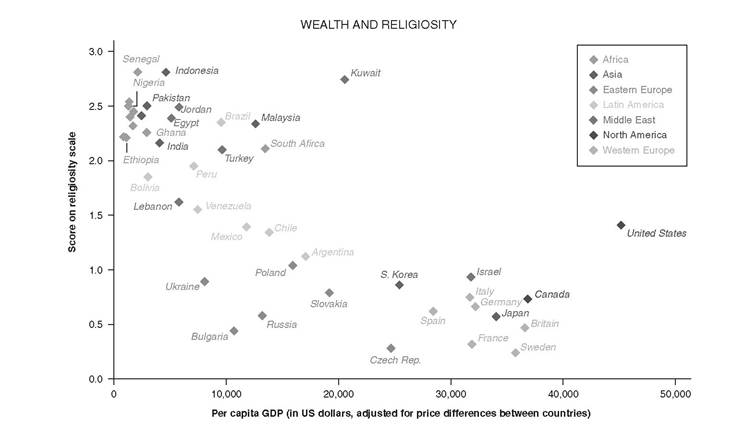
Figure 6.2 Graph of wealth and religiosity (www.pewglobal.org/2007/10/04/world- publics-welcome-global-trade-but-not-immigration).
version of the secularization thesis that links greater security (rather than modernity per se) to greater secularism: that the more religious Wider World has avoided the secular collapse of birth rates means that their populations grow more rapidly, and so the world as a whole is moving towards more religion.[195] The Wider World thus plays a limited role in the fight against the thesis. Perhaps it is more the situation in Europe, where religion survives modernity, that drives the thesis' decline, just as it was once the situation in Europe - modernity seemingly eroding religion - that motivated the thesis in the first place.
More on the topic Secularization:
- Socialist Pilgrimage as a Form of Reenactment
- The Flexibility of Religious Interpretations
- The state of the classroom
- Bibliography
- Christian D. (ed.). The Cambridge World History. Volume 1. Introducing World History, to 10,000 BCE. Cambridge University Press,2015. — 516 p., 2015
- The state of scholarship
- INDEX