Several hundred sites belonging to the period between 7000 and 5000 cal bce have been identified in China's northeast and north-central regions.
1 Archaeologists have associated this wealth of sites with the midHolocene climatic optimum, as the warm and wet conditions of mon- soonal China enabled settlements to flourish.[690] [691] Most sites are situated in mountainous basins or near hills or at the base of mountains.[692] These sites are characterized by structures which could be interpreted as ‘dwellings', storage pits, burials, and sometimes by ditched enclosures.
Pottery vessels and grinding stones are prevalent in this period. Polished stone tools increase in proportion over time, but chipped stones and microliths continue to be found. It has been widely accepted that these settlements and material assemblages represent the initial development of sedentary life in China. Spreading from Daxinganling to the Taihang and Funiu mountains north to south, and from Yitai to the Qinling mountains east to west, these settlements constitute the ‘early Neolithic' in northern China.Alongside the use of other plants and animals, many of those early Neolithic sites are believed to have been associated with the cultivation of two types of millet: broomcorn millet (Panicum miliaceum) and foxtail millet (Setaria italica), referred to as shu and su in Classical Chinese (see Chapter 12). Collection of small grain grasses, including millet, may be traced back to the terminal Pleistocene (between about 15,000 and 11,500 years ago) and may well have been a part of the broad spectrum subsistence during the upper Palaeolithic (which dates from about 40,000 years ago).[693] Turning from the Pleistocene to the early Holocene, it has been suggested on the basis of phytolith and starch residue evidence that broomcorn and foxtail millet were already in use in northern China prior to 7000 bce.[694] Nonetheless, the most abundant macrofossil evidence of broomcorn and foxtail millet is found in association with the early Neolithic sites post-7000 bce.
Drawing on typological lineages of ceramics, archaeologists group the early Neolithic sites into a number of types of material culture.[695] These are: the Xinglongwa-Xinle culture in the Xiliao region, the Cishan-Beifudi culture in Hebei, the Houli culture in Shandong, the Peiligang culture in Henan, and the Baijia-Dadiwan culture in eastern Gansu and western Shaanxi. Recent advances using flotation systems in China (see Figure 12.ι) have revealed dozens of millet assemblages from sites belonging to all five culture groups.[696]
The sites of the Xinglongwa culture are distributed to the southeast of the Daxinganling mountains, in a hilly area that is often referred to in the literature as Liaoxi region, which is mostly in present-day Chifeng in the Inner Mongolia Autonomous Region. Xinglongwa sites are also found in western Liaoning province and northern Hebei. The culture constitutes an early stage in the prehistoric sequence in Chifeng, where there are at least six local subcultures forming a chronological sequence: Xiaohexi (7000-6200 cal bce), Xinglongwa (6200-5400 cal bce), Zhaobaogou (5400-4500 cal bce), Hongshan (4500-3000 cal bce), Xiaoheyan (3000-2400 cal bce), and lower Xiajiadian (2200-1600 cal bce).[697] About a hundred sites of the Xinglongwa culture have been found and dozens of them have been excavated. Well-known sites include Xinglongwa and Xinglongou in Aohan, Baiyinchanghan in Linxi, Nantaizi in Keshiketeng, and Chahai in Fuxin.[698] Among them, Xinglonggou is the most frequently referenced, on account of its rich materials, structured residential patterns, and important early millet finds.
Xinglonggou, China
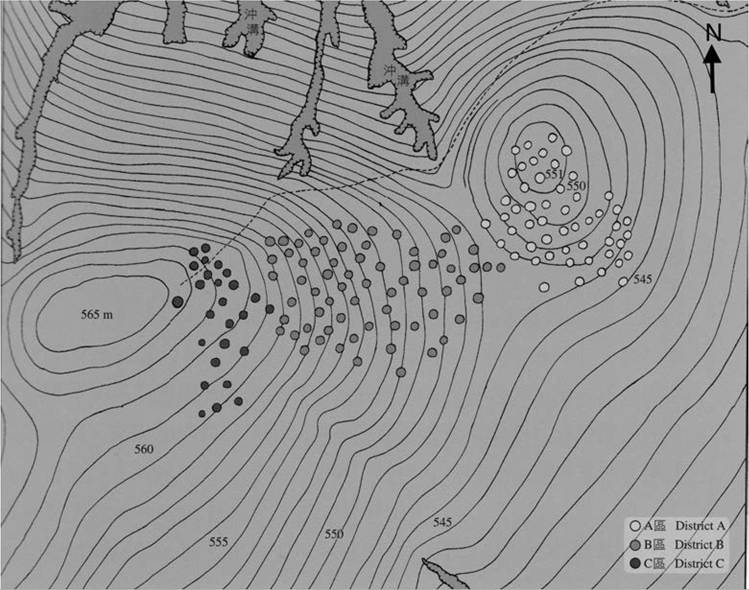
Figure 13.1 Post-excavation plan of Xinglonggou ι. Each dot represents a ‘pit structure'.
Xinglonggou was discovered in 1982.
During the survey of 1998, a joint team from the Institute of Archaeology, Chinese Academy of Social Sciences, and the Aohan Banner Museum, Chifeng, recognized three localities, belonging respectively to the early Neolithic Xinglongwa culture, the middle/late Neolithic Hongshan culture, and the Bronze Age lower Xiajiadian culture.[699] [700] Before the excavation, rows of house plans were discernible on the ground's surface. These house plans were particularly distinct after ploughing. In total, 145 house plans were identified, all aligned in rows running northeast-southwest. In 2001-3, targeted excavations were conducted, uncovering an area of over 5,600 m2 (see Figure 13.1).11Excavations revealed house plans from every period of occupation. They can be divided into three phases and three localities (Xinglonggou I, II, and III
hereafter). Among the three localities, Xinglonggou i is materially the richest. Abundant debris was found on the ‘floors', including tools, ornaments, ceramic vessels, potsherds, animal bones, and occasionally human bones. Many materials may indeed relate to agricultural activities and food processing. For example, grinding debris, such as slabs, hand tools, mortars, and pestles, constitute an important part of household activities. There were also large numbers of microliths, used as blades for notched bone knives and fish spears.
A flotation programme at Xinglonggou i yielded more than 1,500 charred grains of broomcorn millet, together with about 20 grains of foxtail millet.[701] Direct radiocarbon analysis indicates that the broomcorn millet dates to c. 7,700 cal bp.[702] [703] It constitutes one of the earliest records of millet in northern China and the oldest directly dated millet so far. Stable isotopic analysis has revealed that early Neolithic humans living at Xinglonggou i consumed millet as their staple food.14 The following account considers five distinct aspects of Xinglonggou Neolithic lives in association with millet agriculture: landscape, material culture, settlement, production, and consumption. While our ultimate focus is the period of the early Neolithic, we shall introduce this discussion with a consideration of chronological change in the prehistoric ways of life.