Slavery
PETER HUNT
Slavery was a widespread institution in the ancient world (1200 bce - 900 ce). Slaves could be found in simpler societies, but more important and better known was the existence of slavery in most advanced states.
Indeed, it is hard to find any ancient civilizations in which some slavery did not exist. Slave use was sometimes extensive. Classical Athens and Roman Italy were true slave societies. Slaves were as central to the social structure, economies, and cultures of these areas as they were to the New World slave societies. Indeed, slavery in the Roman Empire with its 6 million slaves - on a conservative estimate - may possibly have equaled nineteenth-century New World slavery in scale.The hedge, “may possibly,” in the last sentence illustrates a difference between the study of ancient and modern slavery. Our sources for ancient history in general are spotty and often unrepresentative to begin with; they are even worse when it comes to ancient slavery. Elite men, slaveholders almost without exception, produced the vast majority of ancient texts. Not only do we rarely get the slave's point of view, but only sporadically was the life of such low-status people a concern of our texts. For example, reliable statistics for total slave numbers are almost impossible to find. A final asymmetry is that we tend to know more about those states or empires that imported slaves than we learn about the less organized areas on their peripheries that typically suffered the enslavement of portions of their population. The larger and more centralized societies usually both did the enslaving and produced the written texts, art, or monuments that remain as evidence. All these difficulties are not intractable, or this would be a short chapter, but the insufficiency of our evidence requires emphasis from the beginning and will concern us throughout.
Every year more than a dozen books are published on classical Greek and Roman slavery alone; this chapter, encompassing slavery throughout the world over two millennia, will necessarily be concise and selective in its treatment. To highlight comparative and global perspectives, the chapter is arranged thematically rather than by ancient society. The first section
considers definitions of slavery. In the second section I discuss the spectrum of different types and levels of slave use. Next, we turn to slavery in pre-state societies and the correlation between slavery and cities, trade, and empires. The reciprocal relationship between slavery and states provides the fourth topic. Enslavement and manumission constitute the subject of the last section. Since specific cases are often more vivid and informative than abstractions, I will frequently adduce examples. Although I have tried to draw these cases from a wide variety of places and times, slavery in the best-documented societies, particularly Greece and Rome, is inevitably overrepresented.
What is slavery?
It may seem surprising that one social institution, unconnected with kinship and biology, should appear in so many different societies across the globe and ages. Although slaves did not play the identical role in tribal societies, in cities of the late antique Mediterranean, in China and Japan, and in the Americas, the institution was recognizably the same across a vast span of places and times. This assertion, however, raises the question: what exactly is slavery? Historians have traditionally defined slaves as people treated as property. This definition usually provides a way to distinguish slavery from other systems of domination. In particular, it seems to cover all the people termed slaves without making distinctions based on their material well-being, which would rule out the affluent and seemingly powerful slaves we find in many ancient slave systems. It also passes another crucial test when it comes to ancient slavery.
Although modern slavery is usually contrasted with the wage labor of the industrializing world, ancient slavery was usually an alternative to other classes of dependent laborers who lived and worked subject to significant coercion. For example, serfs were tied to the land, required to labor for their lord in addition to paying other rents, and subject to explicitly unequal systems of justice, which often included physical punishment by their lords. Serfs, however, could not be sold separately from their land and their families; they were oppressed but not treated like property. Serfs were not slaves.Upon close inspection the definition of slaves as property faces difficulties on two fronts. First, people can have property rights in another person without that person being a slave. So, on this score, slavery is not qualitatively different from other relationships that involve property rights in people, for example, a groom's right to his bride in a society with bride price. Second, slaves are never treated consistently as property. For example, most states with slaves set penalties for slaves who commit a crime. Harsher penalties are usually decreed for slaves, as in Qin and Han China.1 The problem is that the law generally treats slaves as people responsible for their crimes rather than as simple property.
To solve these quandaries, Orlando Patterson has devised an influential definition that not only is more precise in delimiting slaves but also tells us several additional things about slavery. Patterson defines slavery as the “permanent, violent domination of natally alienated and generally dishonored persons.”[115] [116] First, slavery is a permanent condition; manumission is never at the slave's discretion and, as an inherited condition, slavery is not even limited by a single person's life span (see Fig. 4.1). Second, violence is at the heart of slavery regardless of whether it is used against a particular slave or not.
This criterion reflects the role that violence plays in maintaining such a harsh system of domination: in a wide range of societies, the whip symbolized the command of slaves. Enslavement is also typically conceived of as an appropriate fate for somebody who would otherwise legitimately have suffered a violent death, an enemy in war or a criminal.These criteria convey the nastiness of slavery but do not yet distinguish slaves from serfs or other downtrodden classes, whose condition is permanent and whom their social superiors treat with violence and contempt. The nub of Patterson's definition lies in his description of slaves as “natally alienated” and, in other places, “socially dead.” These terms indicate that a slave has none of the rights that a person usually possesses by virtue of birth. A slave is not acknowledged to be a member of a family, a clan, a village, or state. In the ancient world, a world without any notion that one possesses rights just by virtue of being human, natal alienation meant that a slave possessed no countervailing rights that might limit the control his master exerted: without these birthrights and relationships, slaves were socially dead. Note that Patterson is talking only about acknowledged, legitimate rights and relationships. Slaves can, in fact, have families. It is just that neither the slave nor the families acquire any official rights by virtue of their relationship. Natal alienation is a large part of the reason that slaves are dishonored people, something seemingly true even of those “elite” slaves who may be better off in material terms than the vast majority of the free population. This definition illuminates one reason why a slave's position is particularly

Figure 4.1 Roman slave collar. The inscriptions on these often included, “Seize me, since I am a runaway,” and promised a reward for the return of the slave. (© Scott Weiner/Retna Ltd./Corbis)
precarious.
Slaves have only one acknowledged tie, that of subordination to their masters.Extent and types of slave use
Historians often distinguish between slave societies and societies with slaves.[117] In a slave society, slaves form a large proportion of the population, sometimes over 30 percent, and play a major role in the economy and especially the central sector of ancient economies, agriculture. Historians often claim that there were only five true slave societies in recorded history - including the ante-bellum South, Brazil, and the Caribbean - but more global perspectives have multiplied the candidates. Of the canonical five, there were two in our period: classical Athens, c. 500-300 bce (and probably similar Greek citystates) and Roman Italy (andprobably Sicily), c. 200 bce -200 ce. In contrast, societies with slaves include any society within which the institution of slavery exists. In the ancient world, this included almost all complex societies. Accordingly, groups such as the Essenes, a Jewish sect, who did not possess slaves, were noted as curious exceptions to the general acceptance of slavery.[118] Indeed, most ancient states possessed more than a mere sprinkling of slaves. We find evidence of large concentrations of slaves in the cases of New Kingdom Egypt, Phoenicia (especially Carthage), Neo-Babylonia, NeoAssyria, China, the Silla Kingdom in Korea, Visigothic Spain, and southern Iraq under the Abbasid dynasty. For example, in Qin and Han China, some elite individuals owned slaves in the thousands and slavery was associated with agriculture in the Han period.[119] In one case, where we do possess decent statistics, we find that slaves made up over 10 percent of the population of some towns in Roman Egypt, not enough to make a slave society - especially since the slaves were domestic rather than agricultural - but hardly a marginal institution.[120] Marxist historians once claimed that ancient Egypt, Babylonia, and China were marked by the slave mode of production - and were thus a fortiori slave societies.
Recent historians reject such formulations and can show that other classes of dependent peasants rather than slaves dominated the countryside. Nevertheless, slavery was important enough to Egypt, Babylonia, Han China as well as India, Judaea, Assyria, and the Islamic world to be a recognized social status with legal regulations.It is sometimes useful to decide whether a society at a particular time was or was not a slave society, but in the rest of this chapter we will bracket that issue of classification and focus on two other topics: What functions did slaves perform in ancient societies with different levels of slave use? What consequences followed as the proportion of slaves and thus the social and cultural importance of slavery increased? Most people associate slavery in the New World with agricultural production, but ancient slavery was a flexible system of labor: slaves performed virtually every sort of service and every category of economically productive work. In addition, slaves could be rented out, which made their use even more adaptable: for example, there seems to have been a market in Athens where one could rent a maid if buying one was too expensive.[121]
As a general tendency, the greater the reliance on slaves the more likely they were to be used in economically productive ways, especially in agriculture, and thus to play a large role in the economy. In contrast, virtually every society with any slaves had domestic slaves. These helped the elite maintain their lifestyle. Slaves performed every service required in a noble's house from cooking to cleaning, from wet-nursing to keeping accounts, from supervising the master's wardrobe to the Romans' nomenclator, whose only job was to remember and announce the names of all the visitors to a Roman grandee's house (see Fig. 4.2). Eunuchs were trusted slaves in the houses of the nobility and royalty in many societies.
Women kept as sex objects constituted a ubiquitous subset of slaves. Their position might vary from second-rank wives to concubines and prostitutes. If these women were treated as wives, who would bear legitimate children, they were in the process of being incorporated into their new society and would soon no longer be slaves. African societies provide many examples of such customs.[122] In addition, both the early and medieval Muslim laws made this incorporation of slave women a legal requirement: when a slave woman gave birth to her master's child, the child was free and the mother would be freed on her master's death - but only if the master acknowledged his paternity.[123] Frequently, however, sexual slavery was just that. Rape of women captured in war was common - a harsh entrance into slavery. In many societies, significant numbers of woman slaves ended up as sex workers. At classical Athens, we learn of a spectrum of such work. In addition to “flute girls,” who livened up parties with music and sometimes with sexual favors, there were the rough equivalents of escorts - sometimes highly paid, kept-women, and prostitutes, working on the streets or in
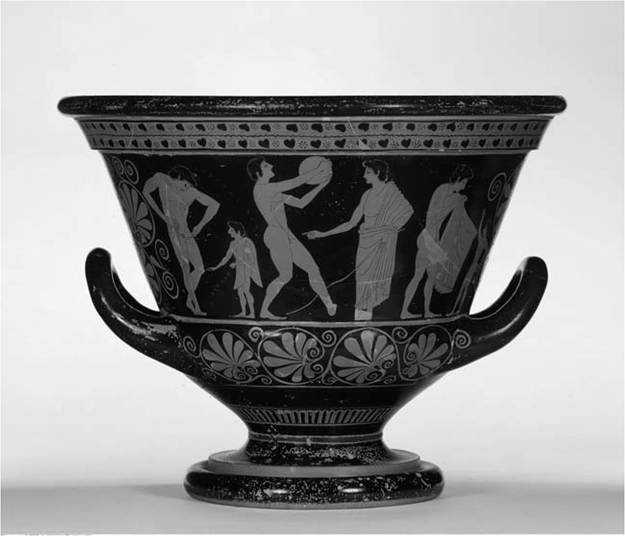
Figure 4.2 Euphronius Krater, gymnasium scene with slaves, depicted much smaller, helping free athletes (bpk / Antikensammlung, Staatliche Museen zu Berlin / Johannes Laurentius)
brothels.[124] [125] [126] These women included ex-slaves and perhaps some free women, but most of them were slaves, especially at the lower levels of the trade. Even slave kept-women lived a precarious life. A law court speech from classical Athens relates how a well-to-do man grew bored of his long-term mistress and planned to sell her to a brothel.11 Although we lack statistics for the numbers of slave prostitutes in any ancient society, at Roman Pompeii, at least, brothels were strikingly numerous for the size of the town.12
Even if sex was not their assigned role, all slave women were vulnerable to coerced sex with their masters - or members of their master's families. The other tasks assigned to slaves often, but not always, reflected the sexual division of labor among the free. Women slaves cooked and cleaned within the houses of their masters. They took care of their master's children and sometimes served as wet-nurses to them. Indeed, they could serve this function beyond their master's house: from Egypt under the Roman Empire we possess a series of detailed contracts for wet-nursing services, including some involving rented slaves as wet-nurses.[127] Most important, slave women made clothing, a crucial necessity and major commodity. In Athens for example, a wealthy woman's main responsibility within the house was to oversee the weaving and spinning of the house's slave women - and parallels from other cultures are abundant (see Fig. 4.3).
As important as the ways that slaves could contribute to the lifestyle of the rich was their function as a display of high status. Notables could give the impression of grandeur by appearing in public with a large escort of slaves, a common practice sometimes criticized in ancient Greece, Rome, and China as a sign of arrogance. Slaves could also serve as vehicles for further displays of wealth and class. For example, some Roman nobles dressed their slaves who appeared in public or who helped entertain guests in fancy, colorful livery.1[128] These functions of slavery fit better into the category of conspicuous consumption than economic profitability. Slaves could also help a noble showcase his religious piety and prowess: among the Maya, nobles and kings kept war captives for sacrifice to their gods - and sometimes cannibalism. In the interim between capture and death, which might last for many years, they were arguably slaves, but hardly productive economically.[129]
Some societies knew only these domestic and display uses of slavery. In developed urban economies, however, slaves produced craft items such as shields, sofas, clothing, pottery, and knives, and they performed services such as haircutting. The exact economic circumstances that led to the use of slaves in such niches are rarely known: the basic reason must lie in the greater availability and lower cost of slaves in comparison to free labor to fill a growing market for finished products and services. Such slavery presupposes a differentiated, market economy and often correlates with trade; for trade
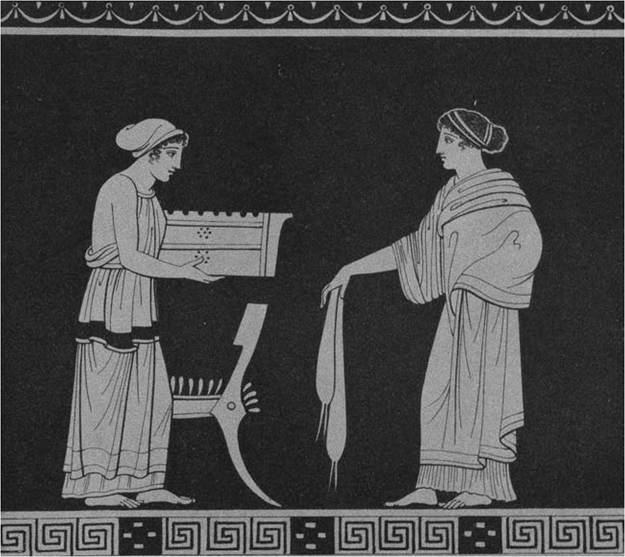
Figure 4.3 A female domestic slave carrying a box of cosmetics, scene of female toilette from the Collection of Greek Vases by Mr. Le Comte de Lamburg (Collection des vases grecs de Mr. Ie comte de Lamberg), 1813-1824, by Alexandre de Laborde (1773-1842), Volume ii, Table 44 (Bibliotheque des Arts Decoratifs, Paris, France / De Agostini Picture Library / G. Dagli Orti / Bridgeman Images)
both increases the market for the finished products and provides a source of slaves. The use of slaves in craft production was common, for example, in Neo-Babylonia, Neo-Assyria, classical Athens and Rome.[130] The employment of slaves in mining could be of even greater economic significance. For example, silver was by far the most important export of classical Athens and the mines employed over 10,000 slaves as is clear from both their physical remains and a series of mine leases preserved on stone. Reportedly, four times that number toiled in the mines of Carthage's Spanish colonies.[131]
For the most part, slave societies used slaves in all the ways that societies with slaves did, but they also used them in large numbers in the dominant agricultural sector of the economy. So, in a slave society such as Rome, there were slaves in craft production, domestic service, and mining, all of these in addition to the masses of slaves on the large farms of elite Romans. A rough-and-ready rule is that variations in the extent of slavery made more difference to the social structure and culture of the society as a whole than in the experience of individual slaves. The life of a mine slave in Carthaginian Spain or at Athens, of a woman house-slave in Han Chang'an or at Rome, would have been similar.
There are exceptions to this rule of thumb, ways that slavery differed depending on its extent and importance. For example, David Turley argues “the social distance in slave societies between slaves and their master was more emphatically underlined than in most societies with slaves.”[132] To take just one example, masters in slave societies often perceived their slaves as threatening and instituted harsh punitive measures to repress them: for example, an infamous Roman law, the Senatus Consultum Silanianum, required that, if a slave killed his master, all the slaves in the household were to be executed. On one occasion the emperor Nero enforced this rule by ordering the execution of several hundred slaves belonging to the urban prefect of Rome, who had been murdered in his house, even though almost all of them were entirely innocent.[133] The ruling classes of Saite Egypt, for example, with its small numbers of slaves would have felt no need for these sorts of measures designed to terrorize a large and threatening slave population.
The relative importance of slavery to a society is usually reflected in its culture: one cannot open any work of Roman literature, philosophy, history, or law, or look at its monuments without realizing that slavery permeated Roman culture. Most directly, the distinction between slave and free is likely to be central to the whole worldview of a slave society; this was perhaps most conspicuous in classical Athens where status distinctions between citizens were deliberately played down whereas the slave/free dichotomy was stressed. This ideology was connected in complex ways with the structure of the Athenian economy and the development of political equality among the citizens. In societies with slaves, slaves were often just one particular grade among many subordinate classes rather than a defining pivot of the whole social structure. For example, in the Spring and Autumn period, Chinese thinkers posited a rigid hierarchy of ten classes without prioritizing any one distinction such as that between slave and free.
A final point about slave societies is obvious: it is much easier to explain why a society possesses a few slaves rather than why it possesses so many slaves that the institution permeates its society. The widespread assumption that outsiders are inferior and do not have rights is enough to explain why moral opposition to slavery was rare. Slaves who performed household or sexual duties were a luxury; others displayed their owner's wealth and status. The desire of ruling classes for luxuries and display is familiar. But for a society to import slaves until they make up a substantial portion of its population requires a rare combination of political and economic causes. In many places, however, the development of cities, trade, empires, and the state contributed to the growth of slavery even when a full-blown slave society did not develop.
Trade, cities, and empires
Although this volume focuses on 1200 bce - 900 ce as a world with states, empires, and networks, significant portions of the human race were at this time still organized in pre-state societies ranging from bands of hunter-gatherers through village societies to tribal societies and chiefdoms. Our evidence, however, for pre-state slavery in the ancient world is for the most part either terrible or nonexistent. For example, slavery among Northwest tribes in North America may have been similar in ancient times to what it was when anthropologists first studied these peoples: slaves provided little economic benefit, but were rather given away or simply killed at potlatch ceremonies.[134] Many languages in Africa have different words for “slave.” Historians have plausibly interpreted this diversity of nomenclature as evidence of the independent development of slavery in many places in Africa in the distant past.[135] One working hypothesis, faute de mieux, would be that slavery among the peoples of the Northwest and Africa was similar a millennium earlier to how it appeared when our evidence begins. But the assumption that the distant past was Unchangingjust because it is unknown is optimistic at best. Somewhat more convincing are statistical surveys of large numbers of societies that show that slavery is rare among hunter-gatherers, is sometimes present in incipient agricultural societies, and then becomes common among societies with more advanced agriculture. Up to this point slavery seems to increase with increasing social and economic complexity.[136] Fishing and especially pastoral societies are an exception to this developmental correlation in that they often have slavery.[137] On balance, pre-state societies probably acquired and used slaves in different ways than did states: in particular, economic motives played less of a role in pre-state slavery. In many such societies slavery mainly involved the abduction of women as sexual partners.[138]
New World slavery was agricultural and can seem atavistic and primitive in comparison with contemporaneous industrialization with its wage laborers and technology. Whether or not this view was correct, slavery in the ancient world had its roots in quite the opposite phenomena: economic and social development, disruption and change contributed to slavery. Indeed, slavery often played the greatest role in the most dynamic societies. The spread and growth of cities resulted from the growth of economic specialization and of exchange. As the epicenters of such developments, cities provided a fertile environment for the employment of slaves in a wide variety of craft production and services for urban markets. In contrast, for much of the time, the agrarian countryside was organized according to long-developed relations of exploitation and dependence - some peasants sometimes remaining independent. These relations differed from place to place and sometimes changed over time but rarely involved chattel slavery. An economic niche for slave labor tended to develop in growing cities.
Urbanism is also associated with trade. Slaves were one of the first items of long-distance trade and continued to be a major component of trade for several reasons. Slaves are valuable. They can be transported by sea or they can be forced to walk whither they are needed - this last a great advantage shared only by livestock. Additionally, slaves were often one of the few things that less technologically advanced people could use to trade with their more developed neighbors. For example, archaeologists have found an extraordinary number of Republican Roman coins in Dacia (modern Romania): about 25,000 coins struck from 130 and 30 bce. Michael Crawford argues persuasively that these coins came from Rome in exchange for Dacian slaves, perhaps to the tune of 30,000 per year.[139] Trade networks also greatly contributed to slavery. A thousand war captives could be reduced immediately to slavery in a neighboring district. This was difficult and dangerous, however, and the risk of flight was great. But if these same thousand captives were transported, sold, and dispersed hundreds or thousands of miles away in small groups or individually, among foreign peoples whose languages, customs, and even environments they do not understand, their subjection became quite practicable. In both Greek and Roman texts, we find the advice not to buy too many slaves from one place.[140] Such ethnic groups could be threatening; in contrast, an isolated and displaced slave was easier to control.
Trade networks - as well as large political entities, which also made longdistance displacement possible - made slavery an advantageous institution for ruling classes and victors in war. The existence of an active market in slaves meant that captives in war did not need to be either killed or carefully guarded and chained. Rather, they could be sold for money or traded for other valuable items. Ruling classes found sale to slave-traders attractive as a fate for political enemies and their families, criminals, debtors, rebels, and, in short, whomever they wanted to get rid of.These people could be dispatched without the possible stigma of killing a community member, without worry about their attempting to return, and with great profit.
Several trade routes characterized by active traffic in slaves became notorious well before the “triangular trade” of the modern Atlantic. Orlando Patterson has analyzed several of these and concluded that the Mediterranean in particular “from the viewpoint of human oppression has been a veritable vortex of horror for all mankind.”[141] The Indian Ocean also nurtured busy trade routes for slaves.[142] These routes involved sea transport. This pattern is overdetermined, since the cheapest and easiest way to transport anything a long distance was by water. Less obvious are slave routes across deserts, such as the Saharan slave trade, well established many centuries before the Islamic conquests.[143] The explanation is best found in a feature that water and desert have in common: neither can be traversed without resources, knowledge, and organization - something a would-be fugitive slave would lack. So it is not just the ease of transport by water, but the way water separates that made sea transport important to the slave trade.
The empires that grew to prominence in our period provided an atmosphere conducive to slavery in several ways. Most directly, imperial wars often gave an extra boost to slavery on the supply side: war captives were enslaved by the armies of Assyria, Babylonia, Greece, China, Rome, and early Islamic dynasties - as well as New Kingdom Egypt before our period and the Incas after. Slaves could be the most valuable and liquid of the perquisites of victory. Two related phenomena are also crucial. First, conquest can both bring great wealth into a society and disrupt the traditional structure of its economy, in particular its agriculture. The case of the Roman Republic's dramatic expansion and development into a slave society makes the effect of this clear. Starting in the third century bce, the Roman Republic fought intense and almost continuous wars and expanded from Italy to control the whole Mediterranean as well as huge inland tracts, including modern Spain, France, and Turkey. The direct enslavement as the result of these wars was huge; a single, short campaign in western Greece reportedly yielded 150,000 slaves.[144] Nevertheless, a study on the prices slaves paid for their freedom suggests that, paradoxically, slave prices were increasing during this period.[145] And why did the Romans need to buy so many slaves from Dacia? The answer must be that conquest brought many slaves to Rome, but even more money. As a result Italy became far more urban and markets for produce grew. The frequent mobilization of large armies disrupted the countryside in Italy as peasants left for years at a time or never came back, a problem various reformers such as Tiberius Gracchus tried to address.[146] New as well as old members of the Roman elite - as well as other Italians - aggressively took advantage of the situation by employing slaves on large farms and selling the produce in the new cities.[147] Roman Italy became a slave society in part as a result of economic and political disruption and opportunism and not simply as a result of mass enslavement in warfare.
A second phenomenon that contributed to slavery was the interaction of strong states with peripheral areas that were not directly conquered, but that lacked the organization to defend themselves from raids and whose internal wars may have been exacerbated by the slave market provided by its centralized and richer neighbors.[148] A recent study reveals that slaves were extremely cheap in classical Athens.[149] These low prices are most plausibly explained by the military advantages Greek city-states enjoyed and the geography of the greater Greek world, which consisted of Greek cities on the coasts of foreign lands throughout the Mediterranean and Black Sea. We hear of deliberate slaving expeditions setting out from these cities and can assume that many times as many raids went unreported in our sources.[150] These coastal cities also provided convenient and tempting slave markets for captives resulting from wars, raids, and civil disturbances among the inland peoples. Active trade by sea meant that a captive sold to a Greek city on the coast of the Black Sea, for example, might soon be for sale in Athens - and cheap. Circumstances, however, can give rise to an almost opposite pattern of slave raiding. For example, during the third through seventh centuries ce, the nomadic Saracens took advantage of their position in the Arabian desert, on the borders of the Persian Empire, the Roman (then Byzantine) Empire, and the Kingdom of Himyar, to prey on their larger and more centralized sedentary neighbors.[151]
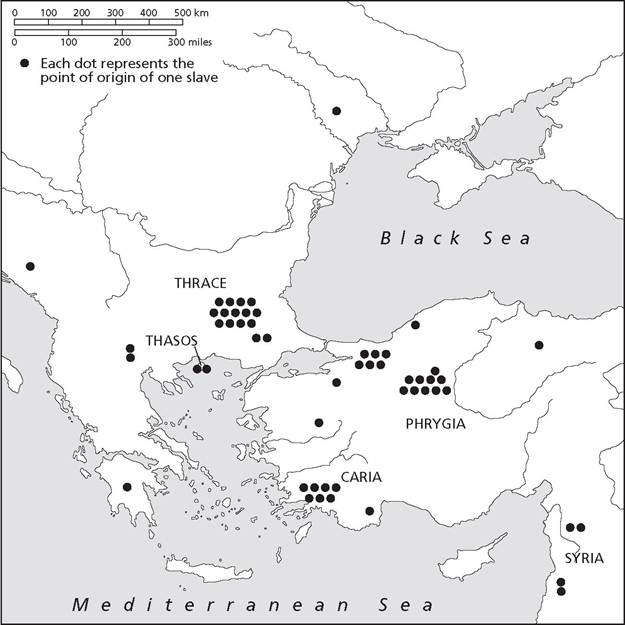
Map 4.i Probable places of origin of Athenian slaves (fifth and fourth centuries bce )
States and slaves
The growth of state power, like the growth of cities, typically went hand in hand with the increasing inequalities both of wealth and power that produced an elite who might desire slaves for their lifestyle, status, or profit. In other ways too, the institutions of slavery and the state often, but not always, enjoyed a symbiotic relationship. A large-scale system of slavery requires the coercive backing provided by a strong state; in various ways, the state could use its power to profit from enslavement or to acquire slaves, both of which could provide an important addition to its power.
The state was a sine qua non for large concentrations of slaves. States promulgate laws; these usually confirmed property rights, and even early law
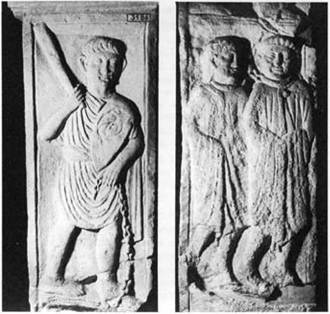
Figure 4.4 Roman soldier with chained prisoners (Landesmuseum Mainz)
codes confirmed the possession of humans: in fact, the earliest-known law code, from Sumer in 2100-2050 bce, refers to legal problems pertinent to fugitive slaves.[152] Behind the law lay the state's superiority in the exercise of violence, which meant that slave owners could live among those they oppressed in relative safety, even when the number of slaves living in a noble's house reached seventy, a hundred, or even more, as it seems to have in Han China, Egypt, Babylonia, Greece, and Rome.
Ancient states directly enslaved people in consequence of two of their powers. First, the conduct of war was one of the first and most important prerogatives of the state. A state sometimes allowed soldiers or officers to appropriate booty, including slaves, but it could reserve such profits of war for itself in whole or part. Captives were sometimes auctioned off with the profits going to the treasury; in other cases, slaves were put to work directly for the state (see Fig. 4.4). A second state power was its ability to punish: in almost all ancient states, slavery was among the punishments that the state could inflict. In Rome criminals could be condemned ad metallum, to work in the mines. In Han China, condemned prisoners could be punished with labor for the rest of their lives - and there seem to have been large numbers of convicts. Their labor was flexible and permanent and thus more valuable than peasant corvee work.39 In some periods of Chinese history, even the families of convicted and executed political criminals could be enslaved. In fact, E. G. Pulleybank argues that it was for this reason that the most common word for slaves came from the word for “child” and that in some periods even private slaves had their head shaved, wore a neck chain, and wore reddish brown clothing just as convicts did.[153] Such penal slaves belonged to the emperor, but they could be assigned to the service of other individuals.
Thus, through its control of war and punishment the state could become a major owner of slaves or profit from selling or otherwise granting control over the slaves in its possession. Sometimes a society's upper classes thoroughly controlled the state, which acted in its interest. So, for example, the Chaldean king, Nabonidus, gave almost 3,000 prisoners of war to serve as slaves for several temples, a donation that was clearly a windfall for the priestly class there.[154] In other cases, the ruler was, to a greater or lesser extent, in competition with the rest of the elite. In such cases, the direct control of slaves, or the profits from their sale, was an important resource for the state in its various power struggles and negotiations with the nobility. A Chinese variant highlights this issue. In 7 ce the emperor Wang Mang tried to ban slavery, but this reform raised too much resistance from his aristocracy and he had to give up the idea.[155] This story implies first of all that in some periods China's aristocracy depended more on slave labor on its estates than is usually assumed. Second, the possession of slaves was a resource that the emperor wanted to see limited. Presumably the state's control of convicts and corvee labor was not in question and thus eliminating the chattel slavery upon which the aristocrats depended would have increased the relative power of the emperor.
In virtue of their social isolation from the rest of society, slaves have sometimes contributed directly to the power of the state or its ruler: the state could use slaves in military, police, and administrative roles. These may seem paradoxical uses of “generally dishonored” people, but are well attested. With the right system of discipline and perhaps the promise of reward, slaves can fight capably for a state against its external enemies, as cases from Greece, Rome, and the Muslim world show.[156] More important was their internal function. Slaves are deracinated and have no ties to elite families within a state. Slave soldiers can thus provide a powerful weapon for monarchs fearful of their own nobles and distrustful of their people. An army recruited from foreign slaves gave monarchs an independent power base. Famous early cases come from the Abbasid dynasty starting in the ninth century.[157] Slave soldiers, recruited from among the Turks and often manumitted upon completion of their training, provided support for rulers plagued by worries about legitimacy and threatened by internal and external enemies. For example, the late-ninth-century Kitab al-buldan of al Ya’qubi relates the settlement of Turkic slave soldiers with land during the reign of the Caliph al Ma’mun, 813-833 ce. He emphasizes that the Turks were settled in separate towns from the local population and forbidden to intermarry; the Caliph bought slave women for them to marry and insisted that the slave soldiers’ descendants should also be endogamous.[158] The biggest long-term threat to their isolation and thus complete dependency on the Caliph lay in their intermarriage after manumission with local peoples, since marriage was almost universally the cement of social alliance.
When it came to assistance with administration, rulers throughout history have often turned to a class of slaves whose familial isolation was biologically ensured: eunuchs. Eunuchs served Roman emperors, and this practice extended into the Byzantine Empire and the Islamic world. The practice finds parallels and antecedents in monarchies all over the Near East and other parts of the world: for example, the Chinese legalist reformer Shang Yang of the fourth century bce was criticized by the historian Sima Qian, c. 145-86 BCE, for getting his first important position due to the influence of a court eunuch.[159] Despite their power, eunuchs were paragons of slavery in that their biological condition prevented them from ever establishing family ties and, however powerful they may have been in relation to other people, their dependence on their master remained absolute.[160]
Slaves served as government administrators in a wide range of contexts. Under the fifth- and fourth-century bce democracy, the Athenians insisted on the rotation of officials appointed by lot for a year only. State slaves, who served as secretaries and assistants to the officials, may have assured whatever continuity and professionalism was necessary to the smooth running of the government; they may have exercised considerable discretion and thus power behind the scenes.[161] In the early Roman Empire, slaves and ex-slaves of the emperor performed bureaucratic functions that required closer supervision and professionalism than a Roman noble could stomach. Several of these offices, filled by ex-slaves, were arguably the most important administrative posts in the realm.[162] Even average members of the thousands of slaves in the familia caesaris, the slaves and ex-slaves of the emperor, could look forward to marriage with freeborn women upon manumission and often even before.[163] To sum up, not only did the state provide a context in which slavery could flourish, but it also benefited greatly from slavery, sometimes to the advantage of the elite and sometimes in competition with it.
Into and out of slavery
The racism directed against black Africans in New World slave systems was a modern, relatively systematic, and extreme example of a much more common attitude toward slaves. This is the notion that the slaves are outsiders - for example, southern “barbarian” slaves in China from Han times till the ninth century ce[164] - and as such have no rights to shield them from the harshest of treatment. A crucial property of slave systems, therefore, is the source of new slaves: whether the slaves are mostly foreigners reduced to slavery, are born into slavery, or are enslaved members of that society. Most historians believe that the last of these three sources, for people to be enslaved within their own society, is relatively rare. It is hard to sever ties with family, clans, and village without physically displacing a person. More important, perhaps, is that ruling classes have usually reduced their own lower classes to some sort of subjection: they have less motivation to destroy family and community ties and disrupt arrangements that already favor them.
There are certainly exceptions to this generalization. In addition to penal slavery, a widespread practice is for parents under the pressure of abject poverty to sell their children into slavery or for abandoned children to be raised as slaves. The former was arguably one of the main sources of slaves during the Han Dynasty in China. William V. Harris argues that the raising of foundlings as slaves, a related practice, was one of the ways that the mature Roman Empire was able to replenish its supply of slaves.[165] The raising of foundlings makes sense in that such children have not yet had birthrights acknowledged, so their natal alienation is something given rather than something that needs to be accomplished at a cost. The sale of young children may fall into a similar category. The “voluntary” sale by destitute parents made (horrible) sense in terms of natal alienation: who had a better right to abnegate children's birth claims than their parents?
Poor people of any age could fall into slavery within their society through debt. Practices in different societies connecting debt with forced labor and slavery are complex, varied, and ubiquitous. In some societies, allowing people to pay off a debt with labor was simply one way that the elite extracted labor from the poor. Even if such debtors never paid off their debt but only the interest, they were not slaves, cut off from their families and place in society. In other cases, a man pledged himself or a family member as security for a debt. If the debt was not paid, then the creditor took possession of the person serving as collateral. At that point, the person could be sold anywhere and had become a slave. The obstacles to enslaving a person within their own society can be seen in the fact that slavery for debt, in contrast to the slavery of outsiders, was banned in many societies - though of course such protective laws were often circumvented.
Despite these categories of enslavement within a community, slaves who have been brought from abroad seem historically more common, especially where slave numbers are large. Their natal alienation was made easy by distance; they were, in fact, outsiders and thus easier to despise and dishonor. Some slave systems sustained themselves by the constant import of more slaves. This is particularly likely when foreign slaves were abundant - in warlike states - and when male slaves were preferentially imported for heavy labor. The latter practice results in an unequal sex ratio and thus reduces the possibility of the slave population reproducing itself. This was certainly the case with modern slavery in the Caribbean and Brazil; judging from the evidence we possess, classical Athenian and probably Roman slavery during the Republic were also dominated by male slaves.[166] In such circumstances we expect that many of the slaves were first-generation slaves imported from their native countries. This expectation is borne out by scattered evidence: for example, it could not be assumed that a slave at Athens could even speak Greek.
The larger the slave population and the more natural the sex ratio, the greater a role reproduction plays in its maintenance. Naturally our sources mention enslavement more than birth into slavery, but birth may be the main source of slaves for the most slaveholding societies.[167] On the one hand, born slaves were slaves from the beginning and they present none of the ideological problems of the transition from freedom to slavery. Aristotle, for example, worried that the nobly born might seem to be natural slaves if they happened to be captured in war - something he ended up denying.[168] On the other hand, born slaves were neither outsiders nor really foreign. Slave masters often insist on the intrinsic foreignness even of born slaves, but this becomes an increasingly ideological exercise; for example, slaves born at Athens would have Greek as their first language and, in much of the ancient world, there was no convenient marker such as skin color to help mark off slaves from the free. Ancient Jewish and Islamic laws display a religious twist to this ideology: Jewish law regarded foreign captives as chattel slaves, but instituted a variety of protections for enslaved Jews; Islamic law forbade the enslavement of Muslims, a law that encouraged slaves to convert, but was often circumvented.[169]
Untold numbers of people suffered enslavement in the ancient world; some gained their freedom. Manumission is sometimes represented as a unique and mitigating aspect of ancient slave systems; it is rather that slavery in the American South, usually the unstated basis of comparison, was an exceptionally closed system. The case of Brazilian slavery, a more open system, also provides a warning against relying too much on manumission as an indicator of a “mild” slave system. Brazil's ex-slaves were prominent in its cities and created a vibrant culture there, but the sugar plantations of Brazil represented the nadir of slave experience with a mortality rate that would quickly have decimated the slave population without constant imports.[170] Ancient slaves often welcomed the opportunity of obtaining freedom. The chance of manumission, always at the master's discretion, also served the interests of masters in that it motivated their slaves to work hard. But not even in the best-attested case, that of Roman slavery, do we have a solid basis for estimating how large a proportion of slaves won their freedom. It was probably small.[171] At Rome manumitted slaves at least became citizens; in many societies, ex-slaves and even their descendants remained inferior or outside of mainstream society; at Athens they became metics, resident foreigners. In most of the ancient world, however, ex-slaves were not distinguished by permanent inheritable markings such as skin color. This meant that, although all the resources of class snobbery might still be arrayed against manumitted slaves and their descendants, their chance of social advancement was greater. Finally, we should not assume that the greater availability of manumission was always a good thing. As long as a slave system maintained itself and the number of slaves did not decline, the more slaves that were manumitted, the more free people needed to be reduced to slavery. This is not an abstract issue: high rates of manumission were in fact usually fostered by the easy and cheap availability of replacement slaves - at great human cost.
Conclusion
The way slaves entered and exited slavery is an important topic for understanding ancient systems of slavery. It is not, however, the only one. Historians investigate many other aspects of ancient slavery that we have not even been able to touch on: the possibility and nature of family or community life for slaves; the extent to which slaves maintained a sense of their birth cultures, assimilated their masters' culture, or did a bit of both; what protections if any did slaves enjoy; and how did slaves resist their oppression given that open revolt was rare and usually hopeless? These questions and others are sometimes hard to answer given our evidence. The answers, if found, often vary from one society to another, from Rome to Egypt, from the Abbasids to the Han - not to mention between modern and ancient slavery. Even more striking, perhaps, are the differences between slaves within the same society: at Rome, for example, between chained agricultural slaves and household accountants, between prostitutes and imperial administrators. Nevertheless, as defined by Patterson, slavery possesses enough unity, globally and across time, so that similar questions at least are appropriate. In our period, in many advanced states similar habits of thought and social and economic developments led to the reliance on slaves, a category of “outsiders within,” almost devoid of rights but extremely flexible when it came to their use.
Further Reading
Comparative or multicultural works
Bradley, Keith, and Paul Cartlege (eds.), Cambridge World History of Slavery, Cambridge University Press, 2011, vol. I.
Cameron, Catherine M., “Captives and Cultural Change: Implications for Archaeology,” Current Anthropology 52 (2011): 169-209.
Dal Lago, Enrico, and Constantina Katsari (eds.), Slave Systems: Ancient and Modern, Cambridge University Press, 2008.
Finkelman, Paul, and Joseph Calder Miller (eds.), Macmillan Encyclopedia of World Slavery, 2 vols., New York: Macmillan Reference, 1998.
Garnsey, Peter, Ideas of Slavery from Aristotle to Augustine, Cambridge University Press, 1996.
Heuman, Gad, and Trevor Burnard (eds.), The Routledge History of Slavery, Oxford: Routledge, 2011.
Patterson, Orlando, Slavery and Social Death, Cambridge, ma: Harvard University Press, 1982.
Rodriguez, Junius (ed.), The Historical Encyclopedia of World Slavery, Santa Barbara, ca: ABC-CLIO, 1997.
Watson, James L. (ed.), Asian and African Systems of Slavery, Berkeley: University of California Press, 1980.
Works on specific societies
Baker, H. D., “Degrees of Freedom: Slavery in Mid-first Millennium BC Babylonia,” World Archaeology 33 (2001): 18-26.
Bradley, Keith, Slavery and Society at Rome, Cambridge University Press, 1994.
Cohen, Edward E., The Athenian Nation, Princeton University Press, 2000.
Crone, Patricia, Slaves on Horses: The Evolution of the Islamic Polity, Cambridge University Press, 1980.
Dandamaev, Muhammad, Slavery in Babylonia: From Nabopolassar to Alexander the Great (626-331 BC), trans. Victoria Powell, DeKalb: Northern Illinois University Press, 1984.
Donald, Leland, Aboriginal Slavery on the Northwest Coast of North America, Berkeley: University of California Press, 1997.
Finley, M. I., “Was Greek Civilisation Based on Slave Labour?” in Brent D. Shaw and Richard P. Saller (eds.), Economy and Society in Ancient Greece, New York: Viking Press, 1982, pp. 97-115.
Fisher, N. R. E., Slavery in Classical Greece, ed. Michael Gunningham, London: Duckworth / Bristol Classical Press, 1993.
Galil, Gershon, The Lower Stratum Families in the Neo-Assyrian Period, ed. Thomas Schneider, Leiden: Brill, 2007.
Gordon, Matthew S., “Preliminary Remarks on Slaves and Slave Laborinthe Third/Ninth Century 'Abbasid Empire,'” in Laura Culbertson (ed.), Slaves and Households in the Near East, Oriental Institute of the University of Chicago, 2011, pp. 71-84.
Harris, William V., “Geography and the Sources of Roman Slaves,” Journal of Roman Studies 89 (1999): 62-75.
Hezser, Catherine, Jewish Slavery in Antiquity, Oxford University Press, 2005.
Hopkins, Keith, Conquerors and Slaves: Sociological Studies in Roman History, Cambridge University Press, 1978, vol. I.
Joshel, Sandra R., Slavery in the Roman World, Cambridge University Press, 2010.
Loprieno, Antonio, “Slaves,” in Sergio Donadoni (ed.), The Egyptians, University of Chicago Press, 1997, pp. 185-219.
Markoe, Glenn E., Phoenicians, Berkeley: University of California Press, 2006.
Pulleybank, E. G., “The Origins and Nature of Chattel Slavery in China,” Journal of the Economic and Social History of the Orient ι (1958): 185-220.
Roth, Ulrike, Thinking Tools: Agricultural Slavery between Evidence and Models, London: Institute of Classical Studies, 2007.
Scheidel, Walter, “Quantifying the Sources of Slaves in the Early Roman Empire,” Journal of Roman Studies 87 (1997): 156-69.
Weaver, P. R. C., Familia Caesaris: A Social Study of the Emperor's Freedmen and Slaves, Cambridge University Press, 1972.