The Clovis archaeological record
The earliest archaeologically distinct Paleoindian culture identified in the Americas is Clovis, named after a unique style of projectile point found at the Blackwater Draw site near the town of Clovis, New Mexico (Map 19.ι).[608] Often found in association with the skeletal remains of mammoths and other megafauna, Clovis points have been found from Canada to Mexico.
Clovis sites date to approximately 13,500 ybp and typically consist of stone tools, debris from stone tool manufacturing activities, and the faunal remains of their prey. Diagnostic Clovis points have unique manufacturing and morphological attributes that distinguish them from previous and contemporaneous Upper Paleolithic technologies of Eurasia and from subsequent projectile point types found in the Americas. Made from cryptocrystalline raw materials (glass-like stone with fine-grained crystalline structures) Clovis points are commonly 10 centimeters in length, bifacially worked (flaked on both surfaces), lanceolate in shape, and have distinct flakes removed from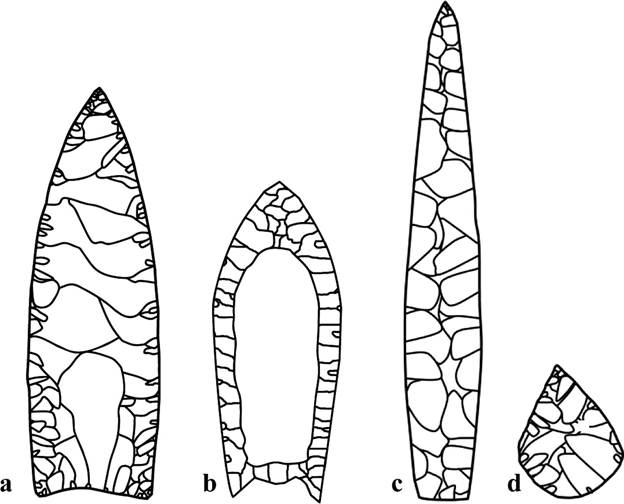
Figure 19.ι A sample of Early Paleoindian projectile point types: (a) Clovis, (b) Folsom, (c) tapered-base point from South America, (d) Chindadn.
their bases referred to as “flutes” (Figure 19.ι). Clovis, and the Folsom culture that followed it, are the only two populations known in human prehistory to have manufactured fluted projectile points. Flutes may serve a functional purpose, as controlling the thickness of point bases facilitating hafting, but must also be considered stylistic attributes unique to Early Paleoindians. Lithic raw materials were selected carefully and considerable flintknapping skill is evident in the manufacture of Clovis points.[609] Hafted to spear shafts and delivered via atlatl, Clovis points were utilized as hunting weapons and secondarily as cutting implements.
A unique bifacial manufacturing technique known as outre passe flaking was used to produce points and other bifaces, a characteristic Clovis shares with the Upper Paleolithic Solutrean culture of Europe. Some archaeologists posit that this similarity reflects an ancestral relationship between Clovis and Solutrean populations, but the shared use of outre passe flaking more likely represents a shared adaptive reliance on bifacial tool production.[610] Regionally distinct variants and gradients of Clovis point morphology are also known. Early Paleoindian projectile points from the Northeast, Southeast, and Great Basin of the United States have distinctive forms that are contemporary with or slightly younger than Clovis. In South America, the earliest projectile points are bifacial and lanceolate but lack flutes and exhibit fish-tail and tapered base morphologies (Figure 19.ι). Such variation in the Early Paleoindian record may reflect regional differentiation among Clovis peoples as they established themselves in new environments and/or gradational changes in point morphology as populations dispersed through time.[611] However, the Clovis point and its associated toolkit undeniably provide the first widespread, technologically consistent, material culture record present in unglaciated regions of the Americas.
With the exception of isolated projectile point finds, which include over 4,000 specimens, the Clovis archaeological record is dominated by open air kill sites and a smaller number of caches.[612] Kill sites (for example, Colby, Dent, Naco, Lehner, and Blackwater Draw, Map 19.ι), containing projectile points and other stone tools likely utilized for butchery tasks found among the skeletal remains of prey animals, are occasionally found in association with adjacent residential campsites (for example, Murray Springs and Gault, Map 19.ι). Clovis kill sites provide the clearest and richest source of evidence documenting human predation of extinct proboscideans (that is, mammoths) known from the global archaeological record.
The assemblages of residential camps typically contain a more diverse array of artifacts including functionally varied stone tools, implements made ofbone/antler/ivory, and the lithic debris resulting from tool manufacture and refurbishing activities. Clovis artifact assemblages typically contain bifaces and finely retouched flake tools functioning as scrapers, gravers, and knives. Non-bifacial tools are made on flakes struck from tabular cores and, particularly in the Southern Plains region of the United States, on large prismatic blades derived from conical blade cores.[613] While consisting of standard prehistoric hunter-gatherer tool types and forms, Clovis lithic technology is often lauded as the quintessential toolkit for a highly mobile foraging population due to the functional flexibility of working edges and the high degree of skill exhibited in their manufacture and design. Non-lithic tools include osseous bone rods that are cylindrical in shape and beveled on one or both ends; the function of these artifacts remains unknown. Discrete aggregations of Clovis artifacts known as caches have also been found in the United States (for example, Wenatchee, Simon, and Anzick, Map 19. ι). Caches often contain extremely large bifaces with shaped Clovis points upward of 20 centimeters long and are generally interpreted as collections of stone tools and tool blanks intentionally cached for later retrieval and use.[614] [615] Cached assemblages may also represent ritual offerings and/or burials as the exaggerated size of some specimens may imply they were manufactured and deposited for non-economic functions. Clovis lithic technology bears some superficial resemblance to the coeval and earlier lithic industries of Western Beringia but presents a distinct suite of manufacturing and morphological attributes only found in the Americas.Known almost exclusively from the stones and bones of their tools and meals, the Clovis archaeological record is consistent with a highly mobile hunter-gatherer population.
Small grinding stones, charred plant materials, and incised stones are rare but have occasionally been found in Clovis deposits. The absence of large grinding stones and features, nearly ubiquitous artifacts in Holocene-aged archaeological sites, implies that certain plant resources such as small nuts and seeds were not frequently utilized by Clovis foragers. Consequently, interpretations of Clovis lifeways are predominately focused on technology and subsistence behaviors that can be empirically addressed. Radiocarbon dates consistently place Clovis sites within a 600-year time span, implying a dispersed and possibly fast-growing population.11 With stone tools frequently made on lithic raw materials deposited hundreds of kilometers from their source locations, Clovis peoples are interpreted to have been highly nomadic populations that established only temporary occupation sites near necessary resources and animal kill sites. Traditionally construed asColonization and occupation of the Americas having a hunting-based subsistence economy that focused on the predation of Pleistocene megafauna, a lifestyle facilitated through high mobility and sophisticated weaponry, Clovis is seen as a unique foraging adaptation to a largely unpopulated Pleistocene landscape. Hunter-gatherers with predominately hunting-based subsistence economies are known from the ethnographic record to move frequently in order to maintain access to sufficient prey populations. Quickly moving, fast growing, and reliant upon prey species with vast distributions across the continent, Clovis exhibits behavioral characteristics consistent with a rapid pan-American colonization event.[616]
By the end of the Pleistocene epoch, approximately 13,000 ybp, the Americas were undergoing rapid climatic, environmental, and biogeographic changes. As the ice melted over thirty genera of large-bodied Pleistocene animals were, or were rapidly becoming, extinct while human populations continued their spread across the continent. For many archaeologists and paleontologists the arrival and dispersal of humans onto the landscape directly contributed to the Pleistocene extinction event.
Following a global pattern of mammalian extinctions preceded by human migration into other continents, Clovis hunting of megafauna may have fueled colonization while driving their preferred prey to extinction.[617] Megafauna are especially susceptible to the negative demographic effects of predation and Clovis points have been shown to effectively penetrate proboscidean hide.1[618] However, the significance of Pleistocene megafauna to the Clovis diet remains contested. The ubiquitous presence of mammoth remains in Clovis faunal assemblages could result from biases in the archaeological record that tend to favor the discovery/study of large-bodied skeletal material over that of smaller animals.[619] It is argued that Clovis megafauna sites are exceptionally visible components of the record but that species such as mammoth and mastodon made little caloric contribution to the everyday diet of Clovis peoples.[620]Others favor an interpretation of Clovis peoples as specialized hunters of Pleistocene prey[621] whose efforts likely contributed to megafauna extinction and established the hunting-based subsistence patterns of subsequent Paleoindians. The subsistence debate largely concerns what is theoretically expected of the faunal record produced under different Paleoindian hunting strategies as opposed to the general composition of the data. It is clear that Clovis populations killed and butchered Pleistocene megafauna and also utilized smaller-bodied prey species. The relative degree to which they preferentially sought and pursued large- versus small-bodied prey is the issue debated. If Clovis foragers only rarely or occasionally targeted now extinct megafauna, and in the absence of any evidence of significant human modification to the environment (for example, the intentional setting of wildfires or other forms of habitat modification) or the introduction of a novel pathogen, their role in the extinction event becomes tenuous.
Favoring interpretations of Clovis subsistence behavior that includes a more diverse mix of plant and small game resources and more regionally differentiated diets, the extinction of Pleistocene fauna is attributed to rapid climate change.[622] A brief period of rapid cooling known as the Younger Dryas coincides with both the onset of extinction and the transition from Clovis to Folsom in the archaeological record. It remains a contentious point of debate whether Early Paleoindians of the Americas contributed to or simply witnessed the demise of the mammoths, mastodon, ground sloths, and other megafauna. After Clovis, Paleoindians focused their hunting efforts on the remaining large-boned species as American fauna evolved into their contemporary range of species diversity and habitats known from the Holocene.Continuously traversing into new landscapes and encountering new subsistence and raw material resources, Clovis peoples may have rapidly hunted and gathered their way from Beringia to Tierra del Fuego, populating the Americas and acquiring regional adaptations along the way. This “Clovis first” model, initially developed in the 1930s and largely accepted by the 1960s, interpreted Clovis populations as terrestrial mammal hunters who traveled through the ice-free corridor and quickly expanded southward in pursuit of prey. While it remains a plausible and supported option today, many archaeologists have begun to question the fundamental components of this scenario. Clovis undoubtedly represents the first continuous occupation of many North American regions but it remains unclear if Clovis represents the development and spread of an in situ cultural development by an existing North American population(s) or if Clovis peoples were truly the first to colonize the continent. Some archaeologists also favor a coastal route through the Americas over the ice free-corridor.[623] Suggesting that colonists could maintain a degree of habitat consistency and reliable resource access by preferentially occupying the coastline, Clovis is then cast as a later inland development of an earlier colonization event by coastally oriented foragers.[624] Rising sea levels at the end of the Pleistocene have submerged any sites that may have been left on or in the immediate vicinity of the coast. Some coastal sites, such as Quebrada Jaguay in Peru (Map 19.1), do indicate the use of marine resources during the Late Pleistocene.
The lack of spatiotemporal trends in the Early Paleoindian record remains problematic and lends credence to the probability that the time range of Clovis will be pushed further back in time with new discoveries and/or that evidence of a pre-Clovis culture will be found. No clearly discernible patterns in the dates of Early Paleoindian sites indicating the entry route and dispersal trajectory are currently evident. Dated cultural deposits from within the ice- free corridor and near-coast localities are exceedingly rare and post-date the earliest Clovis sites. Analyses of Early Paleoindian artifact morphology also produce equivocal results. Notably, the earliest artifact assemblages from Alaska, where colonists would necessarily enter from Beringia, present no clear cultural affinities to Clovis. Isolated fluted points have been found in the region, but the oldest reliably dated artifacts from excavated deposits are of the Nenana complex.[625] Characterized as a predominately flake and blade industry, Nenana complex assemblages contain large bifacial knives, retouched blade tools, endscrapers, pieces esquilles, and diagnostic teardrop to triangular-shaped projectile points (that is, Chindadn points). Nenana may date to as early as 13,400-13,900 ybp but most sites are coeval if not slightly younger than Clovis.
Blade tools are common components of Upper Paleolithic technologies of Siberia and some Clovis assemblages. Broadly similar morphological attributes shared between Nenana and Clovis in the manufacture and style of flake and blade tools can also be construed as reflecting an ancestral cultural relationship to populations in Western Beringia.[626] IfNenana is an extension of Late Pleistocene lithic industries of northeastern Eurasia and the progenitor of Clovis, then a general trend of increasing reliance on bifacial technology occurred as colonists moved south, perhaps culminating in an established tradition of fluting projectile points. Linking similarities in material culture to genetic ancestry is not straightforward and the temporal and demographic relationship between Clovis and Nenana remains unclear. Genetic and/or skeletal analyses can potentially clarify the relationship among Early Pleistocene technologies but too few biological samples have yet been found. An extremely small sample (fewer than ten individuals) of human skeletal material is reliably dated to the Late Pleistocene and/or associated with Early Paleoindian artifacts. The paucity of early human remains is typical of mobile foraging populations and may indicate that Paleoindian funerary practices did not involve burial. The skeletal sample exhibits little morphological similarity among specimens and few resemblances to any single contemporary population.[627] Genetic studies of contemporary native populations from throughout the Americas have also produced disparate results regarding the timing and route of the initial migration but do consistently identify Siberia as the likely source of origin.[628] In addition to these evidentiary gaps in the archaeological record a growing body of sites pre-dating Clovis is reported from both North and South America.