The first migration of humans into the Americas initiated a peopling process that eventually covered over 42 million square kilometers of human occupation spanning high latitude arctic to equatorial environments.
As a large-scale demographic and ecological event, the archaeological record provides the only direct evidence of when and how this process unfolded. As reviewed below, key issues concern the timing of paleoclimatic conditions that impacted possible human entry and migratory routes, the location and age of early archaeological sites, and the lifestyle attributes of the colonizing population as interpreted from artifacts.
Emphasis is placed on reviewing the Clovis archaeological record as the iconic cultural group widely accepted as evidence of a permanent human presence on the continent. What may have preceded Clovis and the general attributes of immediately subsequent populations are also discussed. Current evidence implies early colonizers quickly established a growing and geographically expanding population with unique technological attributes well-suited to exploring and occupying a vast and changing landscape.It was not until the Late Pleistocene that the Americas, the last of the major land masses to experience human colonization, were first occupied by Paleolithic humans. The initial migrants encountered a landscape dominated by continental ice sheets in the north, altered coastlines, and environments supporting a menagerie of now extinct Pleistocene megafauna. Glaciation during the Pleistocene, the geologic epoch spanning approximately 2.5 million to 13,000 years ago, resulted in lowered sea levels and exposed continental shelves as terrestrial ice accumulated in massive sheets and glaciers. The landscape was continuously reconfigured as climate oscillated between glacial and interglacial events; during glacial periods when colder temperatures led to ice accumulation, a strip of land called Beringia was exposed across what is now the Bering Sea that connected Eurasia to North America. Beringia, or the Bering land bridge, provided the hunting and gathering populations of northeastern Eurasia a direct overland route into the Americas at various times throughout the Pleistocene.
The archaeological record suggests that it was not until approximately 14,500 YBP (Years Before Present) however, just prior to the end of the Pleistocene, that a small but viable human population traversed Beringia and established a permanent presence. Entering the Americas through Alaska, these migrants eventually colonized both North and South America, the last large- scale colonization event accomplished by Paleolithic foragers. By the Late Pleistocene only Antarctica and a variety of small islands remained uninhabited by humans. In other parts of the world, hunter-gatherers living in long- occupied landscapes began the process of domesticating plants and animals and aggregating themselves into settled villages. Africa, Europe, Eurasia, and Australia had experienced tens of thousands of years of human occupation before foragers of northern Eurasia set foot in North America and chose to move onward into unfamiliar lands. Subsequent, post-Pleistocene migrations occurred, but this initial colonizing population fundamentally contributed to the cultural, biological, and ecological diversity of the Americas.
Many aspects of the initial colonization event remain speculative, poorly evidenced, and heatedly debated among archaeologists. The Americas' first inhabitants were likely small highly dispersed populations living a nomadic lifestyle. These behavioral characteristics can produce an archaeological record that is both sparse and spatially dispersed compared to the larger settled populations of the more recent past. Early sites are more likely to be deeply buried and subjected to taphonomic processes that further exacerbate their rarity and integrity. Sites and deposits that pre-date 14,000 ybp are subject to heavy scrutiny and few have gained widespread acceptance among archaeologists. Colonization events are complex processes that involve the dispersal and growth of a population that unfolds across space and time; in the Americas this space is both vast and environmentally diverse extending from the arctic to the tropics.
Migration into new lands involves multiple “firsts”: the first people, the first site created, the first dated material, and the first artifact deposited are ideally required in each new region colonists entered to fully understand the spatiotemporal dynamics of the process. The scale of resolution provided by the archaeological record and radiocarbon dating makes true “firsts” extremely difficult to find and identify. It must also be considered that multiple human groups may have ventured into North America during the Pleistocene leaving sites and artifacts but without establishing a permanent presence, creating a record of first explorations but perhaps revealing little about the eventual colonizers.The archaeological record documenting the colonization process contains comparatively few sites and the earliest evidence of human occupation from North, Meso-, and South America differs both temporally and in artifact typology. With small samples, the earliest dates, sites, and recovered artifacts provide no clear spatiotemporal trends indicating the exact timing or dispersal patterns of the initial colonizers. Consequently, understanding of the colonization process remains coarse-grained, because the evidence needed to derive specifics regarding the timing of human arrival and subsequent migration routes and settlement patterns remains scarce. Based on the earliest accepted evidence, as opposed to the “first” occurrence of a behavior, and the inferences made from the stone artifacts and associated materials a general overview of the timing and lifestyle of the initial colonists can be constructed from the archaeological record.
Beginning in the late 1920s American archaeologists excavated a series of sites in the western United States that provided unequivocal evidence of artifacts in association with extinct Pleistocene fauna. Prior to these discoveries it was speculated that non-European human occupation of the Americas was either an extremely recent event or had deep antiquity on the scale of hundreds of thousands of years on par with the prehistory of Europe.
Projectile points and extinct Bison antiquus remains reported at the Folsom site in 1927, followed five years later by the discovery of artifacts associated with mammoth remains at the Dent site (Map 19. i), established the Pleistocene-aged presence of humans in the Americas.1 A series of sites throughout North and South America repeated the pattern of stone tools found among the remains of Pleistocene mammals and with the advent of radiocarbon dating solidified the antiquity of human occupation to the Late Pleistocene. A uniquely American early cultural phenomenon was identified, now referred to as Paleoindian. The Paleoindian time period extends into the Early Holocene when it transitions into the Archaic at different times in different regions. The Archaic is marked by significant changes in projectile point typologies, reduced mobility, and a more diverse use of food resources and associated procurement technologies. Encompassing a suite of cultural traditions defined by the temporal and geographic distribution of projectile point types, the earliest Paleoindian material is associated with human colonization. Paleoindian populations, although coeval with the archaeo- logically defined Neolithic time period on other continents, were mobile hunter-gatherers known for their flintknapping skill and hunting proficiency. [605]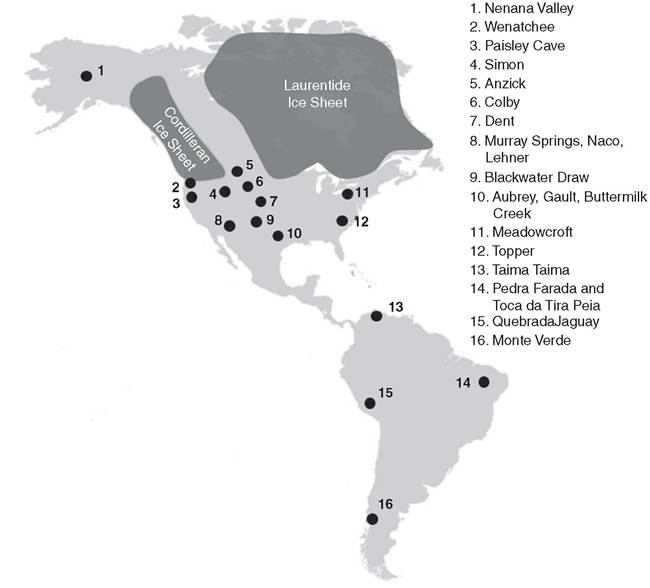
Map 19.1 Location of Late Pleistocene sites mentioned in text from the Americas.
Durable architecture and ceramics are not evident in Paleoindian sites and ground stone, bone needles, human skeletal material, plant-based technologies, and art/decorative objects are rare. Paleoindian material culture was likely designed to be highly portable and certainly contained perishable implements of leather, wood, plant fibers, and other materials that are not preserved.
Entry into the continent via Beringia was possible at various times throughout the Pleistocene and the settlement of the Americas likely represents a larger dispersal and expansion of human populations into northeastern Eurasia that pushed ever eastward until turning south into the Americas.[606] Providing a corridor linking the Old and New Worlds various mammalian species are known to have crossed back and forth, but it was not until after approximately 18,000 ybp during the Last Glacial Maximum (LGM) that a stable human presence was established in Siberia providing a population for eventual dispersal into North America.[607] During the LGM glacial conditions likely prohibited stable populations from occupying the high latitudes adjacent to Beringia and few sites are known from the area.
On the eastern side of Beringia, two large ice masses, the Laurentide and Cordilleran, coalesced during the LGM covering much of present-day Alaska and Canada, effectively blocking access to unglaciated land further south. After the LGM, glacial conditions ameliorated and the ice masses diverged, creating an ice-free corridor located in the Yukon and McKenzie River Valleys of North America (Map 19.ι). At the terminus of Beringia colonists were free to move southward either through the ice-free corridor or along the Pacific coastline. As the ice receded new territories became habitable and Pleistocene coastlines were eventually inundated. Consequently, climatic events imposed geographic barriers to possible human migration routes, the timing of entry, and directly impacted the archaeological visibility of early coastline sites.