The development of gender history
Despite, or perhaps because of, its ubiquity, gender is a relatively new conceptual framework for studying the human past. Until the middle of [324]
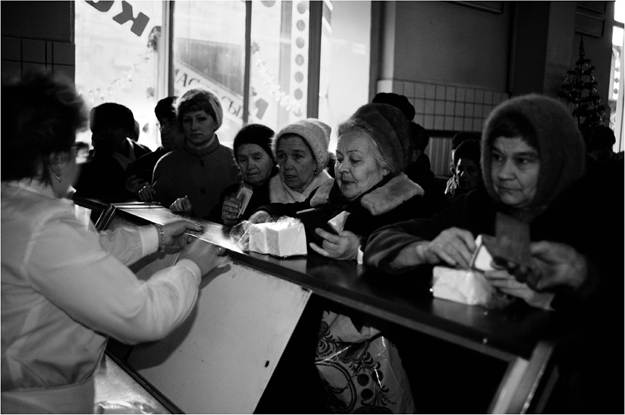
Figure 10.1 Elderly women in Moscow wait in front of a counter on a food line to buy blocks of butter (© Shepard Sherbell/CORBIS SABA).
the twentieth century, most people who obtained a formal education or held positions as official recorders and transmitters of history and tradition were men. Women who were members of the elite did learn to read and write in many cultures, but this was a small group compared to the larger number of men who wrote professionally as scribes, copiers, and record-keepers, or who used writing in their work. For some cultures that have left many written works by men, such as ancient Rome, no complete written works by a female author have survived at all, and very few appear to have been written by female authors in the first place. Educated men also spent much of their time in all-male environments, whether the symposia of ancient Athens, the academies of Song China, the madrases of the early modern Muslim world, or the scientific and literary societies of eighteenth-century cities. Not surprisingly, the men who wrote history within these milieus viewed the male experience as universal; when women appear in their histories, they are exceptions that usually bring disaster. In the nineteenth century, scholars at universities first in Germany and then elsewhere created academic “disciplines" - divisions of learning through which knowledge was categorized and validated. History was one of these, and the scholars who developed it decided that the proper focus of real history was political and military. They also decided that professional history could only be done through years of intensive training accompanied by debate and discussion in university seminars, and that only men had the time or mental capacity to undergo the rigors of real historical research.
The women's movement changed this, as it changed so much else. The women's rights movement of the nineteenth and early twentieth centuries - later termed the “first wave” of feminism - led to a rise in interest in women's history. It also improved opportunities for women in the West to obtain higher education and teach in colleges and universities, giving them an institutional base in departments of history, classics, anthropology, and related fields from which to conduct scholarly studies of the past. Those women wrote histories, some of which focused on women. Similarly, the “second wave” feminist movement of the 1960s and 1970s led advocates of women's rights in the present to look more closely at what they had been taught about the past. Scholars and activists asserted that history as it had been studied and taught was really “men's history,” though it had not been identified as such. This combined with a growing interest in the history of ordinary people rather than simply political or intellectual elites - what was termed the New Social History - and led to an explosive growth in women's history. Historians recognized that there is really no historical change that does not affect the lives of women in some way, though often very differently than it affects the lives of men of the same class or social group. They discovered rich sources that had been lost or neglected, and mined familiar sources in new ways, finding comments on women everywhere.
As historians began to investigate the history of women more extensively, they first fit them into familiar historical categories - nations, historical periods, social classes, religious allegiance - and then realized that this approach, sarcastically labeled “add women and stir,” was unsatisfying. This disruption of well-known categories and paradigms ultimately included the topic that had long been considered the proper focus of all history - man. Viewing the male experience as universal had not only hidden women's history, but it had also prevented analysis of men's experiences as those of men.
Historians familiar with studying women increasingly began to discuss the ways in which systems of sexual differentiation affected both women and men, and by the early 1980s to use the word “gender” to describe these culturally constructed, historically changing, and often unstable systems of difference. Most of the studies with “gender” in the title still focused on women - and women's history continued as its own field - but a few looked equally at both sexes or concentrated on the male experience, calling their work “men's history” or the “new men's studies.”Historians interested in this new perspective asserted that gender was an appropriate category of analysis when looking at all historical developments, not simply those involving women or the family. Every political, intellectual, religious, economic, social, and even military change had an impact on the actions and roles of men and women, and, conversely, a culture's gender structures influenced every other structure or development. Hundreds of courses in women's and gender history were added to the university curriculum, first in the United States and Canada, and then in other parts of the world. (The history done in any country is shaped by regional and world politics, and issues other than gender have often seemed more pressing to historians in Latin America, eastern Europe, and other parts of the world where political and economic struggles have been intense. Universities and researchers in developing countries also have far fewer resources, which has hampered all historical research and limited opportunities for any new direction.)
Along with focusing on gender, some historians turned their attention more fully in the 1980s to the history of sexuality. Just as interest in women's history was inspired by feminist political movements, interest in the history of sexuality was inspired by the gay rights movement, which encouraged both public discussion of sexual matters in general and the study of same-sex relations in the past and present.
Historians and activists studied same-sex relations in many periods, initially focusing primarily on men - whose lives have everywhere left more sources than those of women - but then also on women. Some put emphasis on continuities and similarities in the experiences of individuals and groups across time, and supported efforts to discover physical bases for same-sex attraction in the brain or genetic code. Others emphasized differences across time.The most significant of these differences, asserted many historians of sexuality, was the break between “modern” sexuality and what came before, what is sometimes described as the point at which sexuality itself was born, created, or constructed. As the argument is usually framed, at some point between the seventeenth and the nineteenth centuries people discovered that they had a “sexuality,” a quality defined by sexual object choice. Those who desired those of the same sex were “homosexuals" - a word devised in 1869 by the Hungarianjurist K. M. Benkert - and those who desired those of the opposite sex were “heterosexuals,” a word originally used to describe individuals of different sexes who regularly engaged in non-procreative sex simply for fun, but increasingly used for all those who were sexually attracted to the “opposite” sex. Before this point there were sexual acts, but after this point people came to understand that they had a sexual identity or sexual orientation as a permanent part of the self. This acts versus identities, modern versus premodern binary has been widely challenged as overly dichotomizing and ahistorical, but it has been extremely powerful. The concept of sexual orientation has been even more powerful, of course; it now shapes legal decisions and self-descriptions on Internet dating services as well as history and psychiatry.
Early studies in the history of sexuality focused primarily on same-sex relationships, but in the same way that the development of women's history led scholars to start exploring men's experiences in history as men (rather than simply as “the history of man” without noticing that their subjects were men), gay and lesbian studies has led a few scholars to explore the historical construction of heterosexuality. Recognizing the constructed nature of heterosexuality has been just as difficult for many historians as recognizing that most history was actually “men's history,” however. The cultural analyst Eve Sedgwick wryly notes that “making heterosexuality historically visible is difficult because, under its institutional pseudonyms such as Inheritance, Marriage, Dynasty, Domesticity, and Population, heterosexuality has been permitted to masquerade so fully as History itself.”[325]