The cultural turn
Just at the point that gender history and the history of sexuality were emerging as historical fields, many historians were changing their basic understanding of the methods and function of history.
Historians have long recognized that documents and other types of evidence are produced by particular individuals with particular interests and perspectives that consciously and unconsciously shape their content. Most historians thus attempted to keep the limitations of their sources in mind as they reconstructed events and tried to determine causation, though sometimes these got lost in the narrative. During the 1980s, some historians began to assert that because historical sources always present a partial picture from a particular point of view, one can never fully determine what happened or why; to try to do so is foolish or misguided. What historians should do instead is to analyze the written and visual materials of the past - what is often termed “discourse" - to determine the way various things are “represented” in them and evaluate their possible meanings. Historians should not be preoccupied with searching for “reality,” in this viewpoint, because to do so demonstrates a naive “positivism.” (Both advocates and critics of positivism often quote the words of the nineteenth-century German historian Leopold von Ranke, who regarded the best history as that which retold events “as they actually happened.”)This heightened interest in discourse among historians, usually labeled the “linguistic turn” or the “cultural turn,” drew on the ideas of literary and linguistic theory - often loosely termed “deconstruction” or “poststructuralism” - about the power of language. Language is so powerful, argued some theorists, that it determines, rather than simply describes, our understanding of the world; knowledge is passed down through language, and knowledge is power.
This emphasis on the relationship of knowledge to power, and on the power of language, made post-structuralism attractive to feminist scholars in many disciplines, who themselves already emphasized the ways language and other structures of knowledge excluded women. The insight of the French philosopher Michel Foucault that power comes from everywhere fit with feminist recognition that misogyny and other forces that limited women's lives could be found in many places: in fashion magazines, fairy tales, and jokes told at work as well as overt job discrimination and domestic violence.Historians of gender and sexuality were thus prominent exponents of the cultural turn, and many analyzed representations of women, men, the body, sexual actions, and related topics within different types of discourses. Some historians came to assert that everything regarding gender and sexuality is determined by culture, a position often labeled “social constructionist.” For social constructionists, the idea that everyone had a fixed sexual identity based on something internal was wrong, and those who sought physical bases for sexual orientation were “essentialists.” Gender, too, was a matter of social construction. Because the differences among women (and among men) based on class, race, nationality, ethnicity, religion, and other factors were and are so great, many wondered whether “woman” (or “man”) is a valid category whose meaning is self-evident and unchanging over time, or whether assuming so was, again, naive essentialism. Gender and sexuality, some concluded, are “performative,” that is, roles that can be taken on or changed at will.
The linguistic/cultural turn - which happened in other fields along with history - elicited harsh responses from other historians, however, including many who focused on women and gender. They asserted that it denied women the ability to shape their world - what is usually termed “agency" - in both past and present by positing unchangeable linguistic structures.
They wondered whether the idea that gender and perhaps even “women” were simply historical constructs denied the very real oppression that many women in the past (and present) experienced. Extending this to other groups, they questioned whether one can work to end discrimination against homosexuals, African-Americans, people with disabilities, or any other group, if one denies that the group has an essential identity, something that makes its members clearly homosexual or African-American or disabled. For a period in the 1980s and 1990s this debate was intense, but by the 2000s the division became less sharp, as cultural historians increasingly broadened their focus beyond discourse and representation, and historians who were initially suspicious of the linguistic turn used its insights about the importance of meaning in their work.New developments and new theoretical perspectives are adding additional complexity. The notion of sexual orientation initially created a dichotomized sexual schema of homosexual and heterosexual, but then other categories were added to more fully reflect the wide range of human desires. Sexchange operations have also become more widely available for people whose external genitalia and even chromosomal and hormonal patterns mark them as male or female, but who mentally understand themselves to be the other. Transsexual surgery can make the body fit more closely with the mind, but it has also led to challenging questions about gender and sexual identity: At what point in this process does a “man” become a “woman,” or vice versa? If sexual identity is based on the sex of one's partner, did individuals who underwent sex-change operations also change from being homosexual to heterosexual or vice versa? In the 1990s such questions began to be made even more complex by individuals who described themselves as “transgendered,” that is, as neither male nor female or both male and female. Sexual and gender identities grew into an ever-lengthening list of categories: the longest version I have seen of this in the United States is LGBTTQQI2S - lesbian, gay, bisexual, transexual, transgender, queer, questioning, intersexed, two-spirit. Studies of individuals who challenged sexual and gender categorizations in the past have accompanied the growth of the trans rights movement in the present.
These studies are not simply broadening historical scholarship, but are also proving politically useful, as people within the gay rights and transgender movements in many parts of the world today use them to demonstrate the variety in indigenous understandings of gender and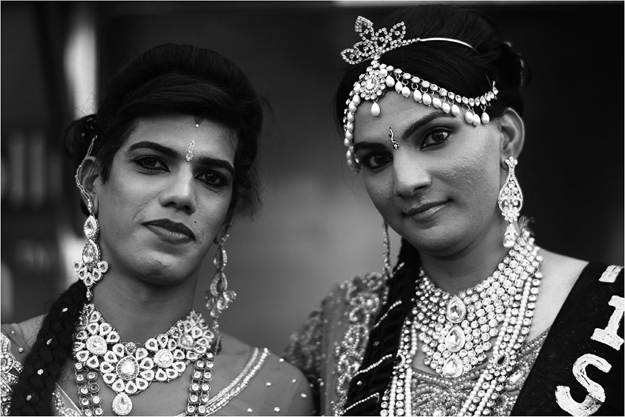
Figure 10.2 Hijras at a Pride March organized by the LGBT community in Mumbai, February 2014, to protest Indian laws that criminalize sexual acts between consenting adults of the same sex (© Subhash Sharma/ZUMA Press/Corbis).
sexuality and to stress that demands for rights for homosexuals or transgender people are not simply a Western import.
Some activists and theorists have wondered, however, whether this growing list of categories has reified boundaries instead of blurring or bending them. This point of view has emerged especially in queer theory, which was developed in the early 1990s, a period of intense AIDS activism, and combined elements of gay and lesbian studies with other concepts originating in literary and feminist analysis. Queer theorists argued that sexual notions were central to all aspects of culture, and called for greater attention to sexuality that was at odds with whatever was defined as “normal.” They asserted that the line between “normal” and “abnormal” was always socially constructed, however, and that, in fact, all gender and sexual categories were artificial and changing. Identity of any sort could easily become false and oppressive, and instead what should be celebrated are hybridity and performance. In the last decade, queer theory has been widely applied, as scholars have “queered" - that is, called into question the categories used to describe and analyze - the nation, race, religion, and other topics along with gender and sexuality. This broadening has led some - including a few of the founders of the field - to wonder whether queer theory loses its punch when everything is queer, but it continues to be an influential theoretical perspective.
Related questions about identity, subjectivity, and the cultural construction of difference have also emerged from postcolonial theory. Postcolonial history and theory were initially associated with South Asian scholars and the book series Subaltern Studies, and focused on people who have been subordinated by virtue of their race, class, culture, or language as part of the process of colonization and imperialism in the modern world. Historians of Europe and the United States are increasingly applying insights from postcolonial theory to their own work as they investigate subaltern groups such as racial and ethnic minorities, and world historians apply them to analyze relationships of power in all chronological periods, not just the era of imperialism.
The notion of hegemony, initially developed by the Italian political theorist Antonio Gramsci, has been an important concept in much postcolonial theory and the history that builds on it. Hegemony differs from domination because it involves convincing dominated groups to acquiesce to the desires and systems of the dominators through cultural as well as military and political means. Generally this was accomplished by granting special powers and privileges to some individuals and groups from among the subordinated population, or by convincing them through education or other forms of socialization that the new system was beneficial or preferable. The notion of hegemony explains why small groups of people have been able to maintain control over much larger populations without constant rebellion and protest, though some scholars have argued that the emphasis on hegemony downplays the ability of subjugated peoples to recognize the power realities in which they are enmeshed and to shape their own history. Many historians have used the concept of hegemony to examine the role of high-status women, who gained power over subordinate men and women through their relationships with high-status men. The sociologist R. W. Connell has also applied the idea of hegemony to studies of masculinity, noting that in every culture one form of masculinity is hegemonic, but men who are excluded from that particular form still benefit from male privilege.[326]
Queer theory and postcolonial theory have both been criticized for falling into the pattern set by traditional history, that is, regarding the male experience as normative and paying insufficient attention to gender differences.
Scholars who have pointed this out have also noted that much feminist scholarship suffered from the opposite problem, taking the experiences of heterosexual white women in Europe and North America as normative and paying too little attention to differences of race, class, nationality, ethnicity, or sexual orientation. They argue that the experiences of women of color must be recognized as distinctive, and that no one axis of difference (men/women, black/white, rich/ poor, gay/straight) should be viewed as sufficient. These criticisms led, in the 1990s, to theoretical perspectives that attempted to recognize multiple lines of difference, such as postcolonial feminism. Such scholarship has begun to influence many areas of gender studies, even those that do not deal explicitly with race or ethnicity. It appears this cross-fertilization will continue, as issues of difference and identity are clearly key topics for historians in the ever more connected twenty-first-century world.
More on the topic The cultural turn:
- Gender history and world history
- The Ideology of Cultural Nostalgia, Enemy of Democracy
- Bibliography
- 154 Urolithiasis (Renal and Urinary Bladder Stone Disease)
- Bibliography
- The history of research into agricultural origins in Japan
- Courtly cultures: western Europe, Byzantium, the Islamic world, India, China, and Japan
- Diseases
- Regional study: exchanges within the Silk Roads world system
- Administration, control, and negotiation in agricultural decision-making