Regional study: exchanges within the Silk Roads world system
XINRU LIU
By 1200 bce, the Eurasian continent was roughly divided into two ecological domains: the agricultural settlements that stretched from China to the Mediterranean, and the nomadic groups who lived mostly on the northern steppe.
The two eventually formed a relationship that included both mutual dependence and frequent conflicts. These north-south interactions often led to east-west migrations, as well as to trade and cultural exchanges, which ultimately resulted in the formation of a major artery of communication that historians now call the Silk Roads.From the mid-first century bce, states and political communities of common culture, which would eventually evolve into empires, appeared in several agricultural zones, including those under the control of the Greeks, the Achaemenid Persians, regional states in South Asia, and the Warring States in central China. Meanwhile, the horse-riding nomadic groups on the steppe started to seek allies and form large confederations to fight for pastoral resources. These nomadic peoples often surprised the sedentary peoples with their new technologies, including horse chariots and horseback riding, when invading sedentary states and empires. Nevertheless, warriors from the sedentary societies soon mastered these innovations and used them to confront their adversaries from the steppe. The two sides were not constantly at war, in large part because they were separated by almost insurmountable mountains and deserts. The Gobi Desert in Mongolia, the Tianshan and Altai mountains that separated the steppe, and the Tarim Basin which contains the Taklamakan Desert, the Kara Kum Desert between the Aral Sea and the Caspian Sea, and the Caucasus mountains between the Caspian Sea and the Mediterranean all buffered the movements of the nomads, but the agricultural regions could not stop all the invasions of horse-riding nomads into the farmlands to their south.
Meanwhile, oasis settlements appeared on the edges of great deserts wherever there was snowmelt from mountains that formed seasonal rivers or fed underground water reservoirs. Since the water supply was precious and unreliable, oases could not become prosperous agricultural settlements until sophisticated hydraulic works such as water lifting and underground channels developed. Constructing the waterworks demanded both hard labor and heavy investment, which were not available locally. The Chinese Han Dynasty (206 bce - 220 ce) brought irrigation systems and a labor force to its western frontier, in order to garrison the Great Wall against invasions of the Xiongnu nomads and to protect its westward trade. Those efforts infused life into the oases surrounding the Taklamakan Desert and also stimulated developments in the oases between the Syr and Amu rivers. The oases around the Taklamakan were separated by large stretches of desert, which deterred the raids of horse nomads. Meanwhile, only camels, a local resource, could traverse efficiently from one oasis to another. The environment of the Aral Sea basin, a land that gained the name of Sogdiana later on, was more conducive given that both horses and camels breed well there. Numerous city-states based on agriculture appeared, but the pastoral economy remained and even became dominant whenever the climate changed to the extent that cultivation was not feasible. The trade routes passing through the oases became the principal routes of the Silk Roads, which could be depicted on a Eurasian map as no more than a few horizontal lines (see Map 17.1). More significantly, they functioned as the heart of a system of communication and transportation linking East Asia to the Mediterranean, and the Eurasian steppe to the Arabian Sea.
The Xiongnu, Han China, and the Yuezhi
In due course the conflicts between the Xiongnu on the Mongolian steppe and the Han Empire of China initiated the first organized trading networks on the Silk Roads.
This started with the rise of the nomadic confederation of the Xiongnu as the supreme power on the Mongolian steppe during the late third century bce. During the same period, the First Emperor of the Qin Dynasty unified China in 221 bce. To fend off the Xiongnu's harassments along the northern border of the empire, the First Emperor of the Qin mobilized a labor force from all over his domain, in order to build the Great Wall, or, more precisely, to have the several long walls already built by the northern states joined together into the Great Wall, which then ran all the way from the east coast of the Yellow Sea to the northern bend of the Yellow River.Downloaded from https:Zwww.cambridge.org/core. Cornell University, on 07 Jan 2017 at 22:30:34, subject to the Cambridge Core term available at https:Zwww.cambridge.org/core/terms. http://dx.doi.org/10.1017/CB09781139059251.019
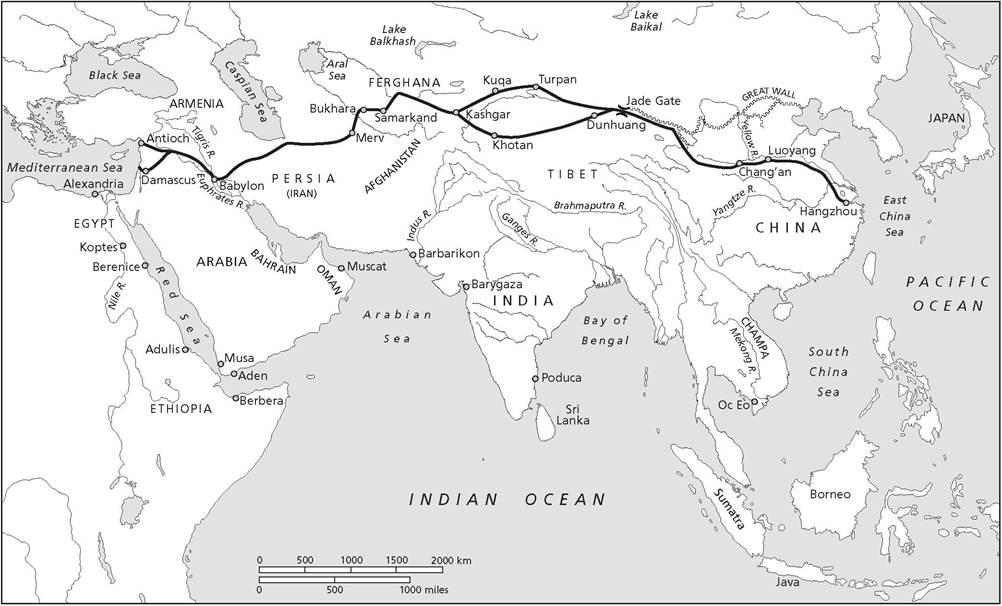
Map 17.i The Silk Roads
Meanwhile, the emperor found an ally on the steppe who was willing to trade horses to China in return for Chinese silk, thereby supplying him with the horses that he needed to defend his realm from the Xiongnu nomads north of China. The Qin Empire was thus able to acquire enough horses to protect this frontier. It was a chief named Luo from the Yuezhi tribe, a group residing in the area west of the Xiongnu, who supplied the horses for silks.[646] However, the Qin Empire fell apart soon after the First Emperor's death in 21o bce, which led to a brief but chaotic period of civil wars during which the northern frontier was neglected in spite of the physically imposing walls that ran along mountain peaks. Even during the first few decades of the Han Dynasty (206 bce - 220 c e), agricultural China could not successfully defend its northern frontier.
Although the Xiongnu continued to make incursions into the frontier regions, the Great Wall stood, thus enabling the Han emperors to adopt a defensive strategy until the empire was strong enough to take the offense.
By and large, the Great Wall functioned less as a defense system for China's agricultural lands than as a fence that marked a border line between the two sides, thereby facilitating a more peaceful trade and exchange of cultures and commodities. When the two sides were not at war, northern herders took their livestock and furs to the periodically opened fairs and markets that operated near the gates along the wall, where the farmers were waiting for them with wheat, millet, and silks. Soon after ascending to the throne in 140 bce, Wudi the “Martial Emperor” (r. 140-87 bce) decided to adopt a more aggressive strategy to deal with the Xiongnu threats. He sent several expeditions to the heart of the steppe to fight the Xiongnu in their own territory. Those military campaigns could not annihilate the Xiongnu force, nor even humiliate them, but they did push the threat away from the foothills of the Great Wall.Emperor Wudi also thought about allying with the Yuezhi to fight the Xiongnu because the Yuezhi had had a long enduring strategic relationship, as recently as during the reign of the First Emperor of the Qin, with agricultural China. To facilitate this, in 139 bce Wudi sent a Chinese envoy, Zhang Qian, to search out the chief of the Yuezhi, who had been forced by aggressive Xiongnu policy to migrate deep into Central Asia. After many difficult experiences including a detention by the Xiongnu for ten years, and deprived of all his companions but a servant known as Gan Fu, a native of the steppe, Zhang Qian finally arrived at the headquarters of the Yuezhi, located
on the bank of the Amu River, which the Greeks had once named the Oxus. However, when the Yuezhi had arrived on the bank of the Amu River, defeated but still richly endowed, they had decided to abandon nomadic life on the steppe and become rulers of a lush agricultural land. They crossed the Amu River into Hellenistic Bactria, where they defeated other recently arrived nomads such as the Sakas/Scythians.
Eventually, through both war and diplomacy, the nomadic tribes formed a new style of regime under the chief of the Kushana, which was most likely a clan of the Yuezhi confederation. This new regime combined the political structure of steppe confederations with the satrapy system of the Persian Empire.After resuming contacts with the Yuezhi, Wudi was more interested in trading exotic goods from the “Western Region” than in making a military ally out of the Yuezhi. However, the steppe routes were simply too hazardous for commercial traffic. Wudi then launched a project to garrison the trading routes going through the oases between the Gobi Desert and the Qilian Mountains. He had the Great Wall extended all the way to the Jade Gate, a name indicating that this was where jade from Taklamakan entered China. He staffed the watchtowers and gates along the wall with soldiers and their families, and equipped the military families with agricultural resources - seeds, draft animals, and tools - in addition to weapons to fend off Xiongnu raids and garrison the Great Wall. Given that this extension of the Great Wall passed through the border land between the farming and nomadic ecological zones, raising crops there was a challenge to the soldiers and their families. The Han government thus supplied them with the tools and the knowledge of irrigation technology. Among thousands of the wooden slips, which were documents of bureaucratic records excavated from several watchtowers on the frontier, there are frequent references to the construction of a kind of irrigation system called “wells and canals” (jingqu).[647] So far no excavations have revealed the structure of the “wells and canals,” but the literary descriptions in the documents clearly demonstrate an irrigation system that brought underground water to the fields via channels, which could be above or below the ground. The hard work of the soldiers and their families could not supply enough food crops for all the frontier forces, but they nevertheless brought agricultural life and technology into this area.
Around 100 bce, Wudi sent orders to expand the military-agricultural colonies outside the Jade Gate, by which he meant the oases on the edges of the Taklamakan Desert.Though the Han suzerainty over the “Western Regions” expanded and contracted during the following three centuries, its agricultural technology and culture remained and thus enabled the oases to grow into viable way stations and depots for the Silk Roads trade.
While the Han Empire was busy maintaining its hegemony over the Western Regions in order to bring more horses, jade, and goods such as corals and glassware from further west into the Chinese court and the homes of its courtiers, the Kushans in Bactria were transforming themselves into rulers of a large commercial and agricultural society. Around the mid-first century ce, they crossed the Hindu-Kush mountains into India, and soon became the supreme power in South and Central Asia, and thereby the most strategic facilitator of the Silk Roads trade from China to the Mediterranean. By the first century ce, the Kushan Empire was attracting not only traders but also religious preachers. Buddhists, Jains, and Hindus from India and Zoroastrians from Iran flooded into Kushan territory to seek patronage. Buddhist monuments were particularly conspicuous in this landscape. Indeed, Buddhism then went through theological and institutional transformation under Kushan hegemony. The new Mahayana doctrine of Buddhism worshipped a divine Buddha and numerous semi-divine bodhisattvas, deviating from the almost atheist teaching of the Buddha during his lifetime in the sixth and fifth centuries bce. Prior to the development of the Mahayana doctrine, Buddhist monks had survived begging for their daily food. After the emergence of the Mahayana doctrine, the monks settled in richly endowed monasteries. As traders and rulers vying to make donations to the Buddha and bodhisattvas, monasteries amassed wealth that funded the numerous stupas and images of Buddhist deities, an artistic legacy that is now known as Gandharan Buddhist art.
The Kushan Empire, embracing a territory across Central Asia and north India, hosted a highly cosmopolitan urban culture. The merchants came from all directions, spoke various languages, and were determined not only to trade but also to make donations to Buddhist, Zoroastrian, and Hindu temples. On the west coast of India, China's silk textiles, fancy and plain, reached seaports at the delta of the Indus and the Gulf of Cambay. There the Roman traders would pick up this cargo and trade their goods for gold and silver coins. They also brought wine, coral, frankincense, and myrrh to these ports. The Kushan Empire thus linked the Silk Roads to the Mediterranean market through the Arabian Sea. In addition, goods passing through Kushan territory were also transported on the westward land routes to the Mediterranean via the Iranian Plateau.
Sogdiana and Ferghana
Between the Han imperial presence in the eastern section of Central Asia and the Kushan dominance in Bactria and India, oasis city-states spread on the land between the Syr and Amu rivers, a region known as Sogdiana. There was also a stretch of fertile agricultural land as well as pastures in the Ferghana Valley, which was ruled by a kingdom called Dayuan. Both horses and camels thrived in the region, and so did the grapes and the wine.
In the second century bce when Han envoy Zhang Qian passed through the Ferghana Valley, he reported seeing about seventy walled cities, both big and small, surrounded by farmlands producing wheat and rice, vineyards harvesting grapes which were fermented into the best wine, and lands growing alfalfa which nurtured the most beautiful and speedy horses.[648] The king of Dayuan commanded a military force of 6,000 soldiers, and was surrounded by a group of aristocrats. They could enthrone or dethrone the king if he was facing difficult political decisions. One of these occasions was a conflict with the Han, which was determined to acquire some of Dayuan' s famous horses. Wudi of the Han sent an envoy to trade for the horses, but the king of Dayuan declined. When the Han troops, headed by General Li Guangli, besieged the capital city, the aristocrats decided it was in the best interest of the country to kill the king, surround the city, and give the horses to the Han general.[649] Though the fame of Dayuan's horses had invited this disastrous invasion from the Han Empire, the distance between Ferghana and China was nevertheless too great to allow the Han Empire to exert any real control. Soon after the Han troops departed, the local aristocrats killed the king enthroned by the Han general and replaced him with their own favorite king. Although disgusted by this betrayal, Wudi could not afford another military expedition and thus had no choice but to keep sending gifts hoping for goodwill and a commercial relationship. This encounter thawed Wudi's ambition to extend China's imperial influence westward beyond the Pamir Plateau. Nevertheless, he still sought its products, not only the “heavenly horses” but also the best fodder, alfalfa, and grapes.
To the west of Dayuan, the city-states in Sogdiana never formed a unified polity but nevertheless nurtured a multicultural environment at the crossroad of the north and south, west and east trade routes. As city-states sprouted in river valleys and oases between deserts, camels became more common than in the Ferghana Valley. Bordered between the truly agricultural ecology in India and the deserts and steppes to the north, Sodgiana was often the target of looting horse nomads who, from time to time, decided to stay put and become farmers and traders. Actually, most residents of the walled cities in Sogdiana behaved much like the Yuezhi warriors did during the Han times, eventually embracing sedentary life. Whatever their ethnic or cultural background, citizens in Sogdiana adopted a somewhat uniform language called Sogdian, a language affiliated with ancient Persian. At the knot of the Silk Roads traffic, they welcomed travelers from all religions. Judging from their own funeral practices, they appear to have been more Zoroastrian than anything else. Though frequently at war with each other, the city-states in Sogdiana nevertheless formed a commonwealth of culture and a uniquely Sogdian identity.
The Sogdians were often farmers in their homeland, but many also took up the profession of trader, traveling to China, India, Persia, the steppe, and even the Mediterranean region. They also were quick to pick up foreign cultures and languages used in the lands they traded with. Indeed, they were among the first group of missionaries who brought Buddhism from India to China in the early centuries of the Common Era. On boulders lining the cliffs along the treacherous roads on the upper Indus, Sogdian traders sketched their names and inscribed their devotion to Buddhism. They also served as agents for nomads who obtained silks from China but did not have the skills necessary to sell them for profit. Donning their colorful, glittering silk robes, Sogdian traders traveled to all corners of the Silk Roads system and established their own networks connecting their diasporas in China, the Taklamakan oases, and in South and West Asia.
Persian silk, a commodity that rivaled Chinese silk in the Eurasian market
Some time around the third century bce, a people known as the Arsacids established what is now known as the Parthian Empire on the Iranian Plateau. Like the Kushans, they were originally from the steppe, but unlike the Kushans, they would eventually begin to manufacture silk cloth and develop a market for it as far east as Central Asia and as far west as the shores of the eastern Mediterranean. Prior to the invasion of Alexander the Macedonian in the late fourth century bce, many of the Arsacids had already become Zoroastrians, but during the occupation of the Greek armies in Asia, it had been to their advantage for the Parthians to accept the Greek gods. However, Greek power did not last forever. Sometime around 64 bce the Parthians defeated a Greek army and forced it out of Iran. Thereafter, many of the Parthians rejected the Greek religion and favored the restoration of Zoroastrianism.
During the first century ce, with Parthian power fUlly established in Iran, they encountered the easterly expansion of the Roman Empire into Syria and Mesopotamia. Although both powers did make military incursions into territories of the other side, they also managed to maintain commercial contacts through intermediaries, mostly Greek-speaking Arabs. Given the hostilities of the two rivals, as well as their desire to trade, a series of independent caravan cities was able to prosper in the deserts in Syria and Jordan. As the fame of Chinese silks started to reach the wealthy Roman towns, the merchants in Parthia were eager to make profit in the trade, and they clearly did not want to see a direct commercial contact between the Han Empire and the Romans. When in 97 ce Gan Ying, an official Chinese envoy sent to establish contact with the Roman Empire, reached a port city called Tiaozhi, probably a Chinese rendering of Antioch, he returned home instead of sailing on to Rome. Sailors there apparently scared him off with stories of the dangers on the sea, but it was more likely Parthians merchants who prevented him from reaching the Roman Empire.
The Parthians claimed that they were reviving ancient Persian tradition and Zoroastrian religion, but they inherited a culture imbued with Hellenistic tradition and also brought in their own steppe culture. The Iranian Plateau was never the most fertile agricultural land. The Persian Empire and the Seleucids had always relied on their Mesopotamia possession for the supply of food grains. But its rich pastoral resources and intimate contacts with the steppes supplied a flourishing woolen textile industry. Artisans in Persia probably soon learned how to produce silk textiles with yarns from China, using technology of woolen textiles. Technically, this meant that Persian artisans invented a way to produce silk textiles in a style characteristically Persian. After the Eastern Roman Empire evolved into the Byzantine Empire and when the silk industry was becoming a government monopoly during the reign of Justinian (483-565 ce), numbers of disgruntled silk weavers escaped the oppression by crossing the border into the Sassanid domain.[650] Thereafter the weaving technique from the Mediterranean textile tradition further enriched Persian silk textiles. Meanwhile, China remained the only country at that time that could produce the silk yarn of long filament, which resulted in strong, fine, and shiny strings for delicate textiles. Silk yarn from China provided materials for Persian artisans making silk textiles even more beautiful than their woolen tapestry.
During the Sassanid period (c. 224 - c. 640 ce), the fame of Persian silk textiles reached as far east as China and as far west as the Mediterranean. Under royal patronage, its weavers developed a repertoire of motifs from legends in the Zoroastrian religious tradition and Persian imperial postures. They emulated the animal and human figures in a majestic Persian royal style, and then surrounded them with decorative patterns borrowed from China, Central Asia, and the Romans. The Simurgh, the mysterious creature with a mammal's head on a bird body in various Zoroastrian stories, was the most popular motif on Persian silk brocade and also other artworks such as silver vases and plates. The pattern of two horses confronting each other and the more sophisticated scene of two horse riders confronting each other were both derived from the scene of Ahura Mazda granting investiture to the founder of the Sassanid Empire Ardashir I (r. 224-241 ce) at Naqshi-I Rustam, Iran. The king and the god face each other on horses, while the god hands a diadem to the king to certify the divinity of the kingship. By the period of the Chinese Tang Dynasty (618-907 ce) Persian silks sold so well in China that some Chinese weaving shops actually specialized in making Persian silk brocade. Persian-style silk brocade also made such a profit all along the Silk Roads system that Central Asian oases also began to use patterns including motifs of Simurghs, lions, rams, and other Persian symbols. Zandan, a weaver settlement within the Bukhara oasis, produced a silk brocade similar to the Persian style which became so popular for centuries that remnants of it have been found all the way from Dunhuang in western China to the churches in Western Europe. Regrettably, no such archival records regarding silk production, nor samples of Persian silks, have survived in Sassanian territory to be examined. Nevertheless, the same patterns of Simurghs and ducks on silk textiles, which are known to be Persian, also appear on the royal robes sculptured on the cliff in Tak-I Bustan in what was Persia. The characteristic Persian motifs on Persian silks, vases, and plates thus set the ascetic standard for artistic products traded along the Silk Roads.
The emergence of a market for silk in the Mediterranean
The Mediterranean became the chief market for Chinese silk and the Silk Roads trade in general after the Roman imperial structure created a strong demand for luxury goods from the east. When Alexander had marched to Central Asia and India in the fourth century bce, his purpose was not to obtain silks from China. At that time, the Greeks were not yet aware of the shiny and glittering textiles; furthermore, the Yuezhi nomads had not yet carried the silk trade to Bactria and Sogdiana where the Greek army was encamped.
After Rome rose as the superpower in the Mediterranean and transformed itself from a republic to an empire, a ruling elite with a taste for luxuries formed. Roman senators, for example, distinguished themselves with robes dyed in purple, an expensive dye extracted from a particular species of shellfish found along a coastal area of the Levant.[651] Elite Roman women, however, developed a fashion of wearing lightweight, semi-translucent silk crepe.[652] Though this type of silk textile uses less material than the heaviest types such as brocade and tapestry, it demands a long filament of yarn from a whole cocoon. During the first two centuries ce, when Roman imperial power reached its apex and created a demand for luxuries, sericulture and filature (a technique that extracts long filaments from cocoons) remained a Chinese specialty. Thus, the Romans had to import this kind of silk textile from China. Meanwhile, as noted above, the Persians were developing their own silk-weaving technology from their own experience in weaving woolen textiles in order to produce wide pieces of brocade and tapestry. In addition, the Persians also learned to unravel plain silk rolls from China for their own purpose. Levant cities such as Tire, Gaza, and Beirut also started silk-weaving industries in order to make heavier types of silk textiles. Both the light type of silk textile and the silk materials for making heavier types of silks relied on the supply from China. The Persians, with their own silk-weaving industry busy, were not the best suppliers of silk materials to the Roman market. Because of this, Roman merchants had to continue their commercial contact with the Kushans who had always been a good source for acquiring Chinese silks.
In addition, a Greek-speaking merchant community set out from the Red Sea to seek silk and other oriental luxuries for rich Romans. Merchants from Hellenistic Egypt had long ventured out of the Red Sea to reach ports along the western coast of India. With the market in the Mediterranean expanding, from the middle or later first century ce, the merchants sailed to India annually, riding the southeast trade monsoon on the Arabian Sea from April to October, and returning on the northwest monsoon that blew from October to April. An anonymous Greek pilot and trader compiled a manual, known as the Voyage Around the Red Sea (Periplus Maris Erythraei), in Greek, which provided information for the voyage as well as the resources that were available for trade in the major ports from the Red Sea to the mouth of the Indus, and all the way down the southeast coast of the Indian peninsula. In Barbaricon on the mouth of the Indus and Barygaza on the Gulf of Cambay, the Greco-Roman traders unloaded their cargo of Mediterranean products such as wine and coral, as well as commodities they purchased along the way, such as frankincense and myrrh from the southern Arabian Peninsula, to purchase silks from China, fragrances from the Himalayas, lapis lazuli from Afghanistan, and local products such as indigo, a blue dye for cotton textiles. The Roman merchants often did not have enough goods to trade for all the things they wanted, so they paid for them with large numbers of gold and silver coins. In their search for tropical spices, the Roman sailors explored many ports along the coast of India. They stopped at a port called Poduca, near the modern city of Pondicherry on the eastern coast of the Indian peninsula, where they encountered many different ships sailing on the Bay of Bengal. Although Roman traders paid local merchants with Roman coins, both gold and silver, the local people apparently buried this treasure, rather than use it in their trade. This suggests that this part of southern India was not extensively involved in the commercial system of the Silk Roads. Meanwhile, on Indian's western coast, important ports such as Barbarikon and Barygaza thrived and east-west commercial exchanges developed rapidly.
Around the same time that Roman ships started to frequent the ports of India, that is, around the late first century bce, the Kushans crossed the Hindu-Kush mountains and assumed the role of the broker in the Silk Roads trade. Cargos arriving at Barbarikon were sent up the river to the residences of kings. In the metropolitan area of the Kushan Empire, that is, the former Hellenistic settlements in Bactria and northwest India, the Greek language not only had survived the frequent changes of regimes since the departure of Alexander but also had sustained Greek culture among their rulers and local communities. As a result, traders dealing with goods from the Silk Roads encountered Roman traders who also spoke Greek. Roman traders also noticed that in Barygaza even Greek coins were still in circulation. Meanwhile the Kushans were casting coins with Greek legends, even though the weight followed the Roman standard. It is also possible that the Kushans simply re-cast the Roman coins with a Kushan king's image on it and a legend that used the Greek alphabet. Thus, the Roman traders were visiting the ports with a familiar commercial environment where the monetary system was recognizable and the coins apparently deemed trustworthy.
Roman traders did not give up on commerce across the land routes of West Asia, even though the empire was frequently at war with the Parthians. They obtained silks, fragrances, and spices through caravan cities such as Petra in the rock valley of Jordan and Palmyra in the Syrian Desert. The caravan cities in this region had a similar history to the oasis cities in Bactria - they had also started out as Greek garrison towns after Alexander's expedition. All of these cities shared Greek architectural features, including the layout of a typical Greek polis. However, since they had no agricultural base such as the Hellenistic cities in Bactria, their survival and prosperity depended totally on trade. Indeed, the trade from the Silk Roads brought great fortune for them. Palmyra, for example, had sufficient wealth to build a marble urban center and a marble necropolis in the desert. Palmyrans not only hosted travelers and collected tariffs from caravans passing through their city but also sent out traders to both the Parthian and the Roman inlands to set up trading depots calledfunduq. Their good fortune nevertheless brought an end to the city. Palmyra expanded from a city-state under Roman suzerainty into a trading empire that started to encroach on Roman territory. Their ambitions were duly met with a crushing suppression that finished off the city in 274. The tragic end of Palmyra, however, merely anticipated the demise of the caravan trade in this region. As the Roman Empire's fortune plummeted in the following decades, the market for their luxuries also dwindled. Caravan cities serving the Roman Empire could not have survived much longer.
Monasteries and travelers
Oasis cities in Central Asia, both those that fringed the Taklamakan Desert and the settlements in Sogdiana, continued to thrive in spite of the demise of the Han, Roman, Parthian, and Kushan empires. Although surrounded by deserts, the underground water and seasonal streams could be tapped for agriculture. Since the beginning of the first century bce, residents there had been developing irrigation systems supported either by Han imperial power, or by the investments made possible by the profits from the trade itself. The oasis settlements thus built a self-sustaining agricultural base that enabled them to survive the demise of their imperial patrons. Nevertheless, their prosperity still depended upon the commercial activities on the Silk Roads. Fortunately for the merchants, from the second century ce, a new form of patronage for the trade arrived with the spread of Buddhism to Central Asia and China. Buddhist ideology and institutions became key players in the market system of the early Silk Roads. Buddhist religious institutions were not the only ones active in oasis settlements along the Silk Roads, since Zoroastrian and later on Manichaean followers could be found on these roads. Nevertheless, Buddhist institutions had the strongest presence there, given that they established monasteries in all the major way stations and had huge statues sculptured on major landmarks.
Buddhism flourished because it had transformed itself from an Indian religion to a universal religious system under the Kushan regime. Mahayana Buddhist teachings created a set of deified Buddhas and many semi-divine bodhisattvas for worshippers who could not grasp the subtleties of the philosophy of the Buddha but were willing to seek the grace of the gods. Thus, it was Gandharan Buddhist art that provided the models for making idols for its worshippers. Mahayana theology also endorsed a commercial ethos that encouraged worshippers to make donations to the Buddha and bodhisattvas, donations that were administered by monasteries. In exchange for these donations, the donors would acquire religious merits that would protect them in the hazardous career of trade and promote their status in their afterlives. Mahayana Buddhist texts such as the Lotus Sutra or the Western Pure Land Sutra promote certain commodities in the Silk Roads trade as sacred goods for worshipping, such as silks and the sapta ratna, or the Seven Treasures, including gold, silver, lapis lazuli, coral, pearls, etc. In this way, Buddhist institutions won the patronage of traders, and in turn the traders benefited from their hospitality.
Before long Buddhist institutions were providing the infrastructure on the trade routes in Central Asia. By the fourth century ce, Buddhist monuments had appeared at all stops of the Silk Roads. Two gigantic statues of the Buddha were carved on the cliffs of the Bamiyan Valley, a lush stretch of land southeast of the formidable Hindu-Kush mountains that marked the Indian gate to the Silk Roads. At the other end of the journey in north China, the huge sitting Buddhas at Yungang, a city located on a foothill of the Great Wall, marked the eastern gate of the Silk Roads. Where there were mountains, Buddhist monks excavated caves in their foothills, and when there were no mountains nearby, they developed oasis settlements or built stupas and monastery enclaves. In the eastern section of the Silk Roads system, Buddhist monks excavated caves on hills near Dunhuang, an oasis inside the Jade Gate, where they hosted travelers and immigrants from Central Asia and India. Outside the Jade Gate, the Shanshan culture developed in the third century and united a number of walled cities on the eastern part of Tarim Basin, thus forming a confederation where numerous Buddhist institutions dotted the landscape. To the north of the Shanshan domain, the Turfan Basin also became a center of Buddhist culture receiving visitors from both the steppe from the northern foothills of the Altai mountain range as well as traders from inside China's Great Wall.
In the western section of the Tarim Basin, the oasis city-state of Khotan developed on the southern edge of the Taklamakan Desert, and connected this area with India through Kashmir and the upper Indus routes. Oasis cities there formed a confederation under Khotan, an oasis famous for its jade ever since the second millennium bce. From the second century ce, local authorities began to issue copper coins with a Chinese legend on one side and Kharoshthi script of the local language on the other. The Khotanese also learned sericulture from China and Buddhism from India. The oases around Khotan built many monasteries that often functioned as local civic centers dealing with daily transactions and disputes. On the northern edge of the Taklamakan Desert and south to the Tianshan range, the town of Kucha exerted cultural influence on the small oases to its east and west. Kucha most likely received its Buddhist culture via the routes of Sogdiana, given that the wall paintings in its cave temples near Kucha were similar in style to those found in Sogdiana. In Sogdiana, the homeland of the Sogdian traders, urban residents were more Zoroastrian than Buddhist. Nevertheless, Buddhist monasteries were built to accommodate travelers of the Buddhist faith.
Sogdian traders and immigrants did carry their Zoroastrian faith on their diasporas along the Silk Roads and inside China. Burials of Sogdian merchants in China, dated to the sixth century, testify that many of them were faithful followers of Zoroastrian teaching. However, they were not interested in converting others to their faith and rather rode on the waves of Buddhist propagation in order to carry out their business with the Chinese and the Indians. In later centuries, some of the Sogdians did become carriers of Manichaeism, a religion founded by Mani (c. 216-277) in Iran. This religion was viewed in the Mediterranean region as a heresy of Christianity, and in Central Asia and China as a mutation of Buddhism. Its followers often adopted Buddhist iconography for worship. Indeed, wall paintings in Manichaean cave temples among the Buddhist caves in the Bezblik grottos near Turfan are so similar to Buddhist ones that only keen observers can distinguish them. At least one true Christian “heretic” sect, the Nestorians, did come to China via the Central Asian Silk Roads not long after the Byzantine authorities denounced and exiled Nestor in the early fifth century, but it did not show its face in China until the early seventh century. Nestorian missionaries had some success in Tang China, but left little trace on the Central Asian trade routes. All these religions from foreign lands brought their culture with them into Tang China, yet none of them could compete with Buddhism and its impact on the minds and pockets of the Chinese people.
Late in the fourth century ce, a boom in Buddhist construction along the Silk Roads took off due to the arrival of a new wave of steppe nomads invading agricultural lands. In China, the Toba clan of the Xianbei tribe unified numerous tribes who poured over the Great Wall and stayed there to establish a Chinese regime, the Northern Wei, by the early fifth century. At the other end of the Silk Roads, the Hephthalites, or Huna as the Indians called them, occupied Sogdiana in the late fourth century and invaded Tukharistan (former Bactria) in the early fifth century, and then skirmished with the Sassanids and made incursions into India, but never established a stable regime in the region. These newcomers from the steppe, like their predecessors such as the Yuezhi or the Scythians, patronized the cultures of the sedentary people. The Buddhist monuments that sprang up under their hegemony were the best testimony to this development. They might be savage during military actions, but religious institutions served as a bridge, connecting them to the sedentary communities. Thus, the patronizing of local religion became an efficient means to exploit the conquered lands and peoples. Buddhist connections in particular could then maintain the flow of trade, even without imperial protection.
The Byzantine Empire and the Tang Empire
From the sixth century to the ninth century, as the Byzantine Empire and then the Tang Empire became the dominant cultural powers of Eurasia, both sought to control the Silk Roads economic and cultural systems. Both empires created their own silk cultures that served their social as well as political hierarchies. In order to get rid of the remnants of the Roman republican tradition, Byzantine emperors tried to build their authority on a unified Christian church with a clear and strict ecclesiastical hierarchy. EmperorJustinian I (r. 527-65) was the most important figure in the establishment of an authoritarian regime. He was famous for compiling the code of Roman law, but he also abolished the classical Greek school of teaching in the empire. He had Hagia Sophia, the largest and most splendid basilica of the time, built to demonstrate his devotion and his patronage of the Christian church. Above one of the vestibules of the basilica, there is a mosaic showing Emperor Justinian holding the basilica and Emperor Constantine holding a model of the city of Constantinople toward the Virgin Mary who is holding the baby Jesus. All four figures wear halos. The Virgin Mary is draped in a dark purple robe from head to toe, and both emperors wear partial purple robes, presumably all made of silk textiles dyed in purple. Justinian thus established the rule that purple silk was the status symbol for both royalty and Christian divinity.
The Tang Empire (618-907) in China unified the states built by nomads in the north, as well as those in the south where northern Chinese immigrants had fled from the nomads in the previous centuries. The Tang Empire thus ruled over a large territory populated by diverse ethnicities. Thereafter, it revived its ambition to expand into the Western Region, which brought in more goods from the Silk Roads and also more kinds of visitors and immigrants. In order to cope with these divisive forces of conquered kings and princes, the Tang emperors established a centralized bureaucratic system that covered the entire country. Officials were now recruited into the bureaucratic hierarchy through nationwide examinations on a variety of subjects. In this system, different colored and differently designed official robes marked the levels in the hierarchy. Empress Wu Zetian (r. 650-705), the only female sovereign in Chinese history, made the decisive step to build the bureaucratic system based on merit but not on blood. Incidentally, purple was the color for the highest level of officials, but it did not reach the status of the royal symbol. Empress Wu favored Buddhism most among the many religions in Tang China, although Buddhism never became the state religion but rather flourished on its own terms. Tang rulers still patronized all religions in their land, foreign or indigenous. They also showed their patronage by granting silk robes to prestigious priests and teachers, and purple robes were considered the most prestigious ones.
Both the Byzantine Empire and the Tang Empire tried to have the purple silk and other silk textiles for official use be produced in state-controlled workshops, and they tried to ban the sales of these silks in the markets. Their efforts to monopolize the silk trade did restrict, to a certain extent, the free transaction of textiles within the Silk Roads economic system. The monopoly, however, could not be sealed tight. Once purple silk became the symbol of high status, people who had means but not the other qualifications to obtain purple silk always tried every means possible to reach it, even risking harsh punishment. Those who appreciated the beauty of silk textiles, more than the status associated with the forbidden types, could resort to silks of other colors and designs. Since the Silk Roads system delivered a great variety of designs and techniques of weaving and dyeing to many lands, many new products appeared in the markets. Indeed, the Persian silk, or silk in Persian style, produced under the Sassanids, became the most popular commodity in the silk market of China, Central Asia, and, via the Byzantine markets, all the way to the markets of Western Europe.
The aspiration of becoming the leader of Christendom prompted Byzantium to distribute purple and other high-end silk textiles to Eastern and Western Europe. After the reign of Justinian I, Byzantine territory shrank continuously, yet the empire still possessed the most prestigious material culture in the entire Christian world. To protect itself from the envy and aggression coming from many directions, the Byzantine emperors used silk textiles, especially the purple ones, as diplomatic weapons. The grandeur of Hagia Sophia and the splendor of its silk decorations convinced representatives from the Slavic countries in Eastern Europe that Constantinople owned a heaven on earth so grand that they should join the Orthodox Church. In Western Europe, Byzantium faced the rivalry of the Papacy in Rome for the leadership of western Christendom. Though the Byzantines lost the competition, their ecclesiastic regalia made in Byzantine workshops, and the liturgy performed in Byzantine basilicas, held the standard for Western Europe for many centuries. Hence, the market for Byzantine silks in Western European churches always kept the purple and embroidered silks flowing westward out of the Byzantine Empire.
The Tang Empire allowed Buddhism to develop its institutions and estates, and it also lavished votive gifts on these institutions, including all kinds of silk textiles and robes for monks and monasteries. Zoroastrian, Manichaean, and Nestorian Christian institutions also flourished in this cosmopolitan environment and received patronage from the imperial authority. Buddhism was nevertheless the religion that transformed the eschatology of the Chinese people. The Chinese, rulers and the ruled, believed that their lives after the current one would depend on the merits they had earned in this and former lives, and that giving to Buddhist monasteries would improve their chance of being reborn into a better existence, and could even protect their lives in this world. The court thus gave many pieces of silk, including the forbidden ones, either newly manufactured or previously worn by living or deceased royal members, to the Buddhist monasteries hoping that these gifts would bring them blessings in their afterlife. The monks, nevertheless, were not allowed to wear these bright-colored silk clothes but had to sell them in order to raise money. By the ninth century, so many types of silk textiles, including those reserved for royalty, were available in the marketplaces that these governmental restrictions became meaningless. When the Tang Empire collapsed at the end of the ninth century, the government monopoly totally diminished. Silk brocade, tapestry, and crepe all became unrestricted and affordable commodities for an urban society with means in China.
Islam transformed the Silk Roads system
Constantinople adhered to its most prestigious product, purple silk, to the end of its regime in the fifteenth century, but its monopoly suffered once the Silk Roads system spread its influence throughout Afro-Eurasia. The Islamic religion, with its commercial ethos and financial structure, together with the Jewish trading communities, ignored the restrictions enforced by the Byzantines and Tang China, and thereby heralded a new age of commerce. After conquering Egypt, the Umayyad Caliphate first imitated Byzantine coins and then invented what became the standard Islamic coinage under Caliph Abdal Malik (r. 685-705).[653] The Islamic doctrine, though, does not endorse money lending, which is essential for gathering capital for trade. The Muslims, however, got around this rule with a traditional financial tool practiced among Arabs, the commenda-type partnership. In this partnership, the capital provider and the agent share both the profit and the risk. For example, Muhammad the Prophet worked as an agent of trade for Khadija, a widow who provided the capital and later became his wife and follower. At least during the first century of Islamic expansion, the Umayyad caliphs seem to have been more interested in exploiting the resources of the conquered lands and peoples and facilitating their own trade than in converting people to their religion.
Nevertheless, such successful conquests brought windfalls of wealth into the caliphate, as well as tensions between the guardians of religious values and the military commanders and soldiers who were overwhelmed by the booty from the battlefields and the luxuries of the conquered rulers in Egypt, Iran, and Central Asia. In their dilemma between following religious discipline and living a frugal life or enjoying their abundant booty from the conquests, the caliphs created the tiraz system that regulated and branded textile production. Tiraz was the Persian word for embroidery, and the tiraz system that they created stated that all the textiles produced in the caliphate should carry a stripe of inscriptions executed with silk thread, giving the place and administration of its manufacture, in addition to the phrase “there is no god than the god alone.” According to the learned Muslim scholars of the Hadith (the sayings of Muhammad the Prophet), a robe made entirely of silk could be too extravagant for a faithful Muslim to get into heaven, but cotton or linen clothes with a band of silk embroidery or tapestry as a decoration were acceptable. Meanwhile, the information on the silk inscriptions served as the brand of the textile and verified its quality and origin. In addition, textiles decorated with a tiraz band were beautiful and affordable, and thus they were traded throughout the Silk Roads system, and were especially welcomed by Western European Christians who had a hard time getting completely purple silk textiles from the Byzantines.
With all its advanced financial tools, Islam changed the face of the Silk Roads after its conquest of Central Asia in the first half of the eighth century. Umayyad generals conquered Tukharistan (formerly known as Bactria) and Sogdiana with both military might and diplomacy. Arab military forces in Central Asia dealt not only with the farmers and traders but also with another wave of nomadic migration by Turkic-speaking tribes. The Turks from the steppe had already settled around Tukharistan and Sogdiana and therefore joined the oasis states to fight the Muslims. In the following centuries, the people in this area - nomads, farmers, and traders - cautiously and tentatively accepted their new rulers and the new religion with their own economic welfare in mind. Eventually, most of them converted to Islam. Thus mosques, Islamic tombs, and caravanserais, all sponsored by Turkish Islamic rulers, began to replace the Buddhist monasteries on the landscape of the Silk Roads. The eastward march of the Arab army finally stopped at the Talas River, which flows between present-day Kyrgyzstan and Kazakhstan. It was there that the Arab army defeated an army of the Tang Empire in 751. Though the Islamic military did not stay to conquer the easternmost section of Central Asia, its residents in the oases and on the steppe converted to Islam in the following centuries. Buddhist cave temples gradually faded into the landscape, but remnants of their culture still linger.
This Arab army in Central Asia took some 20,000 prisoners away from the battle of Talas, including scholars and artisans from many walks of life, both Central Asian and Chinese.[654] They thus arrived at the center of the Islamic empire in the decade just after the “Abbasid Revolution” had taken over the caliphate from the Umayyad line and built a new capital at Baghdad. These talented prisoners thus participated in the construction of the new caliphate. Under the Abbasid Caliphate, the smartest traders and some of the best brains in Central Asia then embraced Islam and therefore contributed to religious, intellectual, and commercial developments in the Islamic world. In particular, in the late eighth century, the Barmak family, one great patron lineage of Buddhism from the city of Balkh (Greek Bactra), moved to Baghdad to serve the caliphate as viziers, or chief ministers, for half a century. They were most likely responsible for the introduction of paper-making and the establishment of a bureaucratic system for the Islamic empire. The Barmakids also took an interest in collecting books written in Greek, Persian, and Sanskrit languages and had these scholarly and literary works translated into Arabic. This Central Asian family finally lost its elevated position in Baghdad politics and met a tragic end. However, there is no doubt that for a long time they contributed to the economic and intellectual prosperity under Caliph Harun al-Rashid (r. 786-809), who was deemed to be the greatest of the caliphs in the stories of the One Thousand and One Nights. Baghdad intellectual life attracted another Central Asian, Muhammad Ibn Musa al-Khwarismi (fl. c. 825), whose career left a considerable legacy to the world. His name shows that he was from Khwarizm, one of the city-states in Sogdiana. He then translated the Indian decimal system (which included a zero) into the “Arabic numerals” as we now know them today. In a way, he thus laid the foundation of modern mathematics, as shown by our term “algorism,” which is derived from his name al-Khwarismi.
The Silk Roads was a network of trade routes that crisscrossed the Eurasian continent, but the concept of the Silk Roads also encompasses a much larger historical process than trade. It became a world system where farmers and herders fought with each other and also learned from each other; and where sincere and less sincere followers of Buddhism, Christianity, Zoroastrianism, Manichaeism, and Islam from a great many lands met to trade and talk with each other. The various participants in the system formed not only a commercial network but also a cultural domain where the ascetic values of commodities evolved, spread, mutated, and sometimes dissolved to make way for new types of “cultural” goods. Even highly devoted people changed their religious faiths when the situation in their world changed. Eventually the Silk Roads system dwindled and all but disappeared after the land routes no longer could compete with the volume of commerce during the subsequent “Age of Maritime Trade.”
XINRU LIU
Further Reading
Primary sources in English translation
Burrow, Thomas, A Translation of the Kharoshthi Documents from Chinese Turkestan, London: The Royal Asiatic Society, 1940.
The Geography of Strabo, trans. Horace LeonardJones, Cambridge, ma: Harvard University Press, 1928.
Jenner, W. J. F. (ed. and trans.), Memories of Loyang: Yang Hsuan-chih and the Lost Capital (493-534), Gloucestershire: Clarendon Press, 1981.
The Periplus Maris Erythraei, trans. Lionel Casson, Princeton University Press, 1989.
Pliny, Natural History, trans. H. Rackham, Cambridge, ma: Harvard University Press, 1942, vols. ii and vi.
Ibn al-Zubayr, Kitab al-Dhakha'ir waTTuhaf trans. Bernard Lewis, Oxford University Press, 1987.
Mas'udi (896-956 ce), The Meadows of Gold, the Abbasids, ed. and trans. Paul Lunde and Caroline Stone, New York: Kegan Paul, 1989.
The Questions of King Milinda (Menander), trans. Rhys David, Oxford University Press, 1890.
The Saddharma-Pundarika, trans. H. Kern, Oxford University Press, 1884.
Sima, Qian, Records of the Grand Historian of China, trans. Burton Watson, West Sussex: Columbia University Press, 1961.
The Smaller Sukhavati-vyuha, trans. J. Takakusu, Oxford University Press, 1894, vol. xlix.
Sulayman al-Tajir, and Abd Zayd Hasan ibn Yazid STrad, An Account of China and India in Arabic Classical Accounts of India and China, trans. S. Maqbul Ahmad, Shimla: Indian Institute of Advanced Study, 1989.
Secondary works
Barfield, Thomas, The Perilous Frontier: Nomadic Empires and China, 221 bc to ad 1757, Hoboken, nj: Blackwell Publishers, 1989.
Barthold, W., Turkestan down to the Mongol Invasion, Cambridge University Press, 2007.
Benjamin, Craig G. R., The Yuezhi: Origin, Migration and the Conquest of Northern Bactria, Turnhout: Brepols Publishers, 2007.
Bowen, Richard LeBaron, and Frank P. Albright, Archaeological Discoveries in South Arabia, Baltimore, md: Johns Hopkins University Press, 1958.
Cribb, Joe, and Georgina Hermann (eds.), After Alexander, Central Asia before Islam, Oxford University Press, 2007.
de la Vaissiere, Etienne, Sogdian Traders: A History, trans. James Ward, Leiden: Brill, 2005. Foss, Clive, Arab-Byzantine Coins, Washington, dc: Dumbarton Oaks Research Library and Collection, 2008.
Gordon, Stewart (ed.), Robes and Honor: the Medieval World of Investiture, New York: Palgrave, 2001.
Hawkes, Jason, and Akira Shimada (eds.), Buddhist Stupas in South Asia, Oxford University Press, 2009.
Hodgson, Marshall G. S., The Venture of Islam, UniversityofChicagoPress, 1974, vols. I and ii.
Juliano, Annette L., and Judith A. Lerner (eds.), Monks and Merchants: Silk Road Treasures from Northwest China, New York: Harry N. Abrams, 2001.
Khazanov, Anatoly, and Andre Wink (eds.), Nomads in the Sedentary World, London: Curzon Press, 2001.
Liu, Xinru, Ancient India and Ancient China: Trade and Religious Exchanges ad 1-600, Delhi: Oxford University Press, 1988.
Silk and Religion: An Exploration of Material Life and the Thought of People, ad 600-1200, Oxford University Press, 1996.
Marshak, Boris, Legends, Tales, and Fables in the Art of Sogdiana, New York: Bibliotheca Persica Press, 2002.
Marshall, John, Taxila, Cambridge University Press, 1951.
Ray, Himanshu, Monastery and Guild: Commerce under the Satavahanas, Delhi: Oxford University Press, 1986.
Rostovtzeff, Michael, Caravan Cities, trans. D. Talbot Rice and T. Talbot Rice, Oxford: Clarendon Press, 1932.
Sen, Tansen, Buddhism, Diplomacy, and Trade: the Realignment of Sino-Indian Relations, 600-1400, Honolulu: University of Hawai'i Press, 2003.
Young, Gary K., Rome's Eastern Trade, International Commerce and Imperial Policy 31 bc - ad 30), London: Routledge, 2001.