The earliest farmers of central Europe are among the most studied prehistoric societies in the world, yet they still confront archaeologists with many questions and challenges.
For nearly forty years, we have investigated farming communities from the sixth and fifth millennia bce in a part of northern Poland known as Kuyavia (in Polish, Kujawy) that lies along the Vistula River (in Polish, Wisla) south of the modern cities of Toruii and Bydgoszcz.
Around a town called Brzesc Kujawski, the earliest farmers left a remarkable record of their presence, including traces of houses, burials, and pits containing pottery, stone tools, animal bones, and charred seeds, while the impact that they had on the local environment is revealed by the study of sediments and pollen cores.The landscape of Kuyavia is defined by its glacial heritage. It is a flat plain covered by morainic clay and glacial outwash lying between two east-west glacial meltwater valleys. Languid slow-moving streams run in troughs left by meltwater running under ice sheets that covered the area until 20,000 years ago. Retreating glaciers left behind blocks of ice that became embedded in post-Glacial sediments. When the chunks of stagnant ice melted, they left small basins that became lakes and ponds. Many basins have filled with peat and other biogenic sediments, so the modern cultivated landscape of Kuyavia masks the environmental variation present when the first farmers arrived.
Millennia of erosion and ploughing have left the traces of Neolithic settlement in Kuyavia lying just below the modern surface. The plough zone is scraped off to reveal the lower portions of prehistoric features, including pits, post holes, bedding trenches of houses, and graves. We know that the surface on which the prehistoric occupants of these sites trod was probably a few dozen centimetres higher, but what remains permits us to reconstruct the outlines of houses and find the graves of their occupants. The lower parts of pits contain enough rubbish in the form of pottery, stone tools and chipping
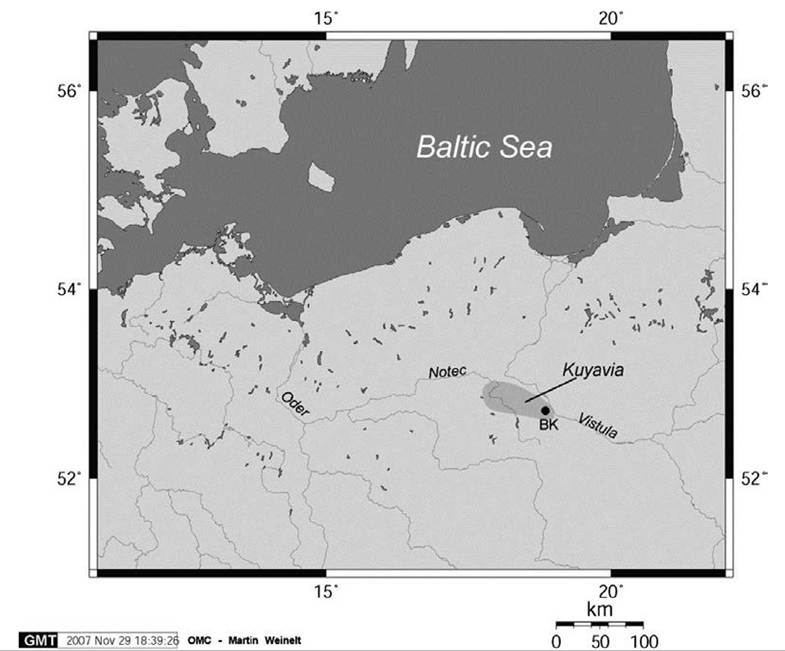
Map 23.i North-central Europe showing location of Kuyavia and Brzesc Kujawski (BK).
waste, animal bones, and seeds to permit the reconstruction of the material world of the Neolithic farmers and to study their economy.
We were not the first to excavate at Brzesc Kujawski. In the spring of 1933, a young researcher at the Archaeological Museum in Warsaw, Konrad Jazdzewski, gazed out the window of an attic room in an agricultural school just outside Brzesc Kujawski. He had come to rescue a late Neolithic grave found in the school's field. Across a road and a lake lay a low ridge of gravel and clay. ‘Something must be there,' he thought, and a few days later, his initial inspection of the site revealed pottery and ground stone tools. The museum director allowed Jazdzewski to remain longer, and by summer his excavations began to yield spectacular results.
Jazdzewski discovered traces of Neolithic longhouses and burials at Brzesc Kujawski.[MCCCXIV] Unlike the rectangular longhouses first found at Koln-Lindenthal
Pioneer farmers at Brzesc Kujawski, Poland in Germany in the early 1930s, the houses at Brzesc Kujawski had bedding trenches that ran around their perimeter in a long trapezoidal outline. Posts set into these trenches formed the walls. Many house outlines overlapped, indicating that structures were replaced multiple times. Among the houses were graves holding crouched skeletons with copper ornaments. Jazdzewski called the people who built these houses and were buried among them the ‘BrzeSc Kujawski Group', but before radiocarbon dating, it was unclear how they fitted in with other early farming societies in central Europe.
World War II interrupted Jazdzewski's research at Brzesc Kujawski. In 1976, the authors arrived under the auspices of the Museum of Archaeology and Ethnography in E6dz, Poland, to pick up where Jazdzewski left off.[1315] Archaeological methods had improved since World War II, and our aim was to excavate carefully to obtain charcoal for radiocarbon dating and to recover animal bones and charred seeds to study the subsistence economy. During the 1950s and 1960s, analysis of Jazdzewski's finds had shown that the Brzesc Kujawski Group were not the only Neolithic inhabitants of the site. An earlier farming society, known as the Linear Pottery culture (also called the Linearbandkeramik or LBK), had also lived there. Thus the story of early Neolithic farming settlement in Kuyavia involves not one, but two, societies, the first during the second half of the sixth millennium bce, the second in the middle of the fifth millennium bce.