The future of migration
Migration remains a mix of old and new. With the expansion of higher education, one of the current migratory trends is that in which students leave home and even their country to attend university and prepare for their role in a high-tech world.
Yet this same process includes much that is habitual. That is, young adults leave home, travel a distance, cross social boundaries, and learn new languages and customs (now those of the academic world); some of them will return home after the experience, while others will migrate further. The ancient human pattern of cross-community migration has now been put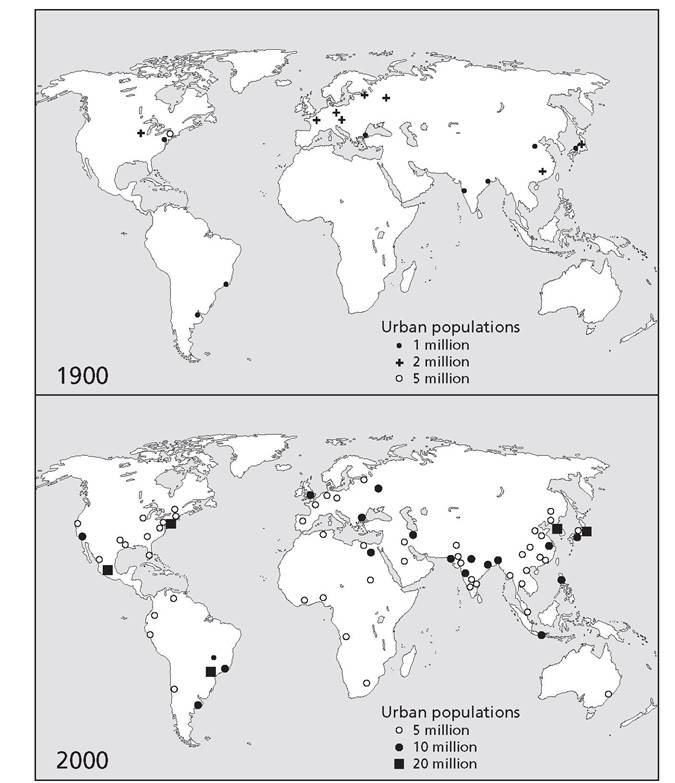
Map i2.io Twentieth-century urbanization.
in the service of contemporary globalization, demonstrating the role of underlying human habits in even the most dramatic of changes.
The continuities in migration remain impressive. Land and sea both remain central to human movement. It is true that travel is increasingly by air for long distances and by automobile, bus, and train for shorter distances. But if human travel by water has declined, a steadily growing proportion of commodities moves by water whenever possible. In a similar continuity, it seems that national units and national identities will continue and perhaps strengthen, even as migration expands. By the same token, the informal social organization of diasporas seems likely to continue, to expand, and to remain influential in human affairs. Meanwhile, urban, suburban, and rural areas will surely change as agriculture continues to mechanize and urban areas become increasingly dominant.
Where will future migrants settle? Our biggest cities grow at water's edge, even as the waters rise in response to climate change. People continue to leave rural areas for small and large urban areas.
Perhaps future migration will be mostly from city to city. Will we move mostly to the tropics? What changes can we expect in languages - will people learn more or fewer languages? The dramatic spread of the English language in the last halfcentury has made some suggest that it will become a dominant or even unique language. The number of native speakers of English, some 350 million, is 5 percent of the human population (a somewhat larger number speak English as a second language); another 5 percent are native speakers of Spanish. Yet while the smallest languages are disappearing, others are growing. Most of the great cities are multilingual. So we will have a multilingual rather than an English-only future and the experience of learning new languages and cultures through migration will still continue for a long time.The development of our globally multicultural society will bring new commonality but also new differentiation. Past migration has dependably brought connection in history, but the connections have included cultural differentiation and inequality as well as sharing of resources. Hopefully, our future will include not only more migration but also more careful study of the past of migration - at local and global levels - in order better to observe the current changes in migration.