Capitalism since 1700
A series of great transformations intertwined with one another as the eighteenth century progressed. Capitalism, an economic system of new complexity, extended links in all directions, moving and transforming commodities and marketing them for profit.
Globe-encompassing culture congealed as people continued to exchange foodstuffs, clothing, music, and sport. The categories of diaspora, race, and nation became increasingly explicit, bringing as much division as unity. War, made more destructive with capitalistic investment and racial passion, ended lives and expanded hierarchies. Population grew at gradual but accelerating rates, especially in cities. Languages shifted and spread, especially as linked to empires. Migration played a central role in linking these transformations; at the same time, the global interactions transformed the practices of migration. The remainder of this narrative is an effort at once to entangle and untangle this list of factors, and to show the central and sometimes causal role of migration in the social change of the past two centuries, when the absolute and perhaps relative numbers of migrants reached a new peak.The emergence of capitalism became evident wherever commerce was intensive. Factory production and wage labor expanded in parts of Western Europe and North America. Mechanized plantations operated by slave labor along the West Atlantic. Shipping and marketing firms expanded their activities to all the large ports of the world. Combinations of wage labor and forced labor carried out tasks on the ships linking the ports, and among the port workers and workers who transported goods on land: the Dutch East India Company expanded such a combination beginning in 1602. Mines expanded along with demand for extracting iron, gold, silver, lead, copper, diamonds, and other minerals. Bankers and insurance firms, usually held by wealthy families, provided finance and collected profits.
Competition brought conflict: the European continent was engulfed with warfare for over twenty years from 1792 - even more massive wars were to come.Despite the divisions of war and race, the world had expanded its unities by the early nineteenth century. Remarkably, death rates were in decline in many parts of the world so that populations began to increase steadily. Centuries of global cultural exchange - of foods, clothing, customs, and diseases - crossed all the lines of race, religion, social class, language. The sum of these provided a basis for death rates to decline. In fact, increases in European, Asian, and American populations had already begun, the latter especially because of immigration. African populations remained in stagnation in this era, as a result of war and enslavement. In addition the Pacific Basin, which had been at the fringe of global interaction in previous centuries, was now incorporated with a vengeance into the imperial and capitalist order, with resulting high rates of mortality and migration throughout the region.
A sudden shift in about 1850 brought a wave of long-distance migration that lasted to 1940 (see Map 12.9). As Europeans gained the upper hand in the world economy, breakthroughs in factory production brought steam engines, railroads, textiles, plus mining and shipping of coal. The principal character of long-distance migration shifted from the forced migration of captives to voluntary migration (though many such migrants were semivoluntary contract laborers). Sometimes it took a crisis to launch the flow of migrants, as with Ireland's 1845-9 potato famine. The outstanding change, however, was the development of new technology, especially steamships that traveled dependably and cheaply, but also telegraphs to convey information on conditions worldwide. The rise of industrial production expanded demand for minerals and agricultural produce.
Where ten million had crossed the Atlantic as slaves from 1550 to 1850, nearly fifty million Europeans crossed the Atlantic from 1840 to 1940, and another eighty million migrants moved from India and China.
Two regions of sparse population - North America and Southeast Asia - each absorbed over thirty million immigrants. In addition, huge numbers of migrants traveled by land: North and Central Asia absorbed over twenty million immigrants in areas ruled by China and Russia. This great wave of migration transformed diasporas and formed nations. Diasporas, previously initiated by empires as much as by commerce, became more closely tied to capitalism. Diasporas sustained tradition and language among migrant communities; they also sought to influence affairs in their homeland. In Brazil and the United States, various diaspora communities joined each other to create nations by declaring independence; their westward-moving settlers became new diasporas that expanded the nation. Later diasporas coming to the United States and Brazil from Europe became part of each nation. The notion of nationhood was not necessarily inclusive, however: African diasporas of Brazil and the United States only became full citizens with the end of slavery; ultimately, many retained their African-diaspora identity too. The Chinese migrants north into Manchuria expanded the nation; the Chinese migrants to Southeast Asia remained a diaspora.The nineteenth-century expansion of empires established imperial control from a few capitals over the great majority of the world's population. These empires accompanied - regardless of whether they caused - a huge expansion of intercontinental migration. In preceding centuries, as empires helped to mix populations to a new level, racial identities and antagonisms arose. Racial distinctions served to divide communities by color, physical type, even by dress and religious practice - and increasingly to place them in hierarchies. These factors of race, affirmed significantly in the eighteenth century, came to be reaffirmed even more forcefully in the expanding nations and empires of the late nineteenth century. Racial distinctions were to expand to a disastrous twentieth-century peak before declining.
The African continent, which had been within the global system of interaction but beyond imperial control, succumbed to European conquest in the late nineteenth century and underwent most of a century of racially defined imperial rule. Much of Northeast Asia soon came under Japanese imperial rule. Empires, always eclectic collections of governing practices, now became reliant at once on racial divisions and on growing ties to industry.305
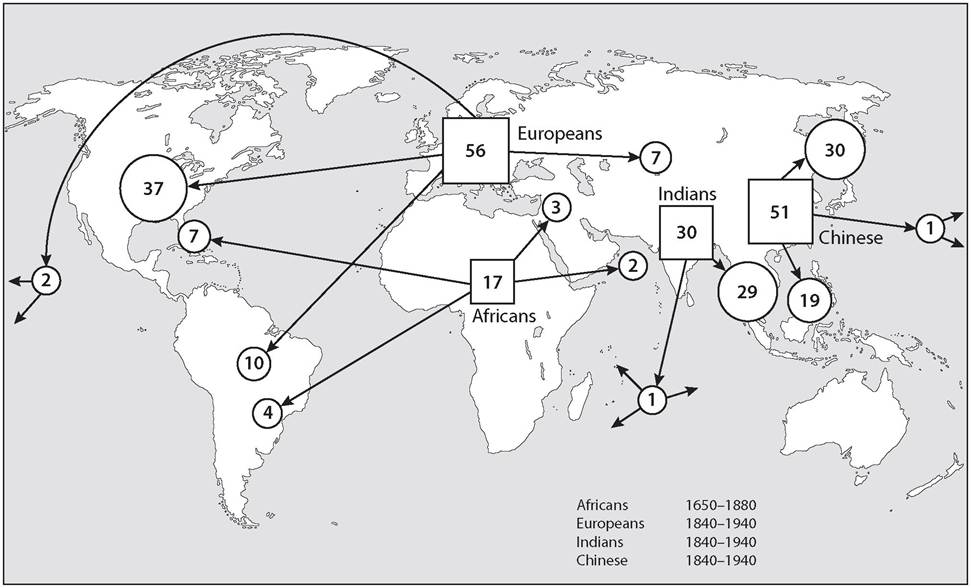
Map i2.9 Global migration after 1850. The numbers in the squares represent numbers of emigrants, in millions; the numbers in circles represent numbers of immigrants, in millions.
As expanding industry led to an arms race among imperial powers, the competition became ferocious. Wars among empires broke out sporadically: the United States seized the Spanish Empire in 1898; Japan successfully challenged both the Chinese and Russian Empires in 1905. The Great War raged from 1914 to 1918: by the end of it the empires of Germany, Austria, the Ottomans, and Russia had collapsed. The remaining empires, badly shaken, sought to consolidate their holdings, yet continued to use racial discrimination as a major tool for sustaining empire.
Imperial tensions soon arose again, and Nazi Germany especially used race as its principal political tool in the peak of racial discrimination, defining Jews and others as races to be eliminated. At the conclusion of the Second World War - the most widespread and destructive of wars - the expanded empires of Germany and Japan were dismantled, but so as well was the general idea of empire, especially because of its association with racial hierarchy. Within another thirty years empires had been abandoned - in response to independence movements - by Britain, France, the Netherlands, Belgium, the United States, and eventually Portugal. This appeared, at least for the time, to be a permanent decolonization.
The pause in war after 1945 brought the formation of the United Nations and the bare bones of a formal global community. Nevertheless, the threat of a great war continued for almost fifty years of Cold War, and decolonization brought continuing streams of casualties and refugees. A great postwar economic boom gradually fueled a new wave of migration. Increased economic productivity, while its benefits were distributed very unevenly, nevertheless allowed for an acceleration in population that eventually reached every area of the world; the expanding populations responded by crowding increasingly into cities. For the first time in millennia, peasants were no longer the majority of the human population (see Map 12.10).
Languages had shifted and moved for all of history, but expanded connections of language and diaspora developed in this era. Empires had imposed their language of government on small numbers of colonial officials, but migrants later moved along the paths created by imperial languages: people at far ends of an empire used imperial ties and imperial language to migrate in new directions. In this way Portuguese, Spanish, French, Russian, and especially English became worldwide languages.
New and expanded diasporas emerged in the wave of migration after 1950: Caribbean migrants settled in Europe and North America, Turks moved to Germany, Mexicans moved to the United States. With more advanced communications, people of the diaspora were better able to maintain contact with home, even after generations. Chinese, Irish, Filipino, and Palestinian diasporas each participated actively in affairs of their ancestral home; diaspora Jews participated in the affairs of a newly created homeland.
Urbanization took a new turn in the late twentieth century. For much of the period after 1850, migration was mainly from crowded regions to sparsely populated regions. From the second half of the twentieth century, however, the dominant pattern turned out to be the opposite - the movement of people from rural areas or small towns to centers of population expanded as never before.
Urbanization in European and North American lands had seized the lead during the nineteenth century and reached, by the 1960s, rates near to 75 percent. For other parts of the world, urbanization picked up to a rapid rate that brought region after region to urban proportions even exceeding 75 percent. A dozen urban areas grew to include twenty million inhabitants or more, some on every continent. The urban settlers, in addition, came primarily from the immediate hinterland of the cities rather than from great distances. As a result, human society reached a tipping point at the beginning of the twenty-first century, in which a majority of the human population came to live in urban rather than rural areas.Global popular culture developed in remarkable new directions as a result of multiple types of connections. While electronic communications were most obviously important, the expanded migration and multicultural atmosphere in many parts of the world encouraged the sharing of many aspects of popular culture: music, cuisine, dress, film, images. Remarkably, the African diaspora and the people of Africa - large groups that had suffered severe discrimination - played a disproportionate role in creating and spreading the new popular culture. In the twenty-first century, wherever one lived, it was no longer surprising to see a migrant from anywhere on the planet.