Connections, 800-1800 ce
Within just over the past millennium, four patterns of migration developed further importance: pastoral, maritime, forced migration, and urbanization. Each of these patterns depended on the basic rules of human migration - reliance especially on young adults as migrants, reaching across communities to learn by exchanging elements of language and culture, and reliance on improvised migratory networks to facilitate movement.
Attention has commonly focused on the most spectacular breakthrough in communication - the voyages of Columbus, da Gama, and Magellan (the latter in 1519-22) (see Map 12.7). For overall interpretation, however, it is just as well to focus on the full thousand years of expanding movement and interconnection - the full range of changes that resonated with Magellan's circumnavigation. The four types of migration commonly interacted with each other as they influenced most corners of the world. By the end of this period, the expanded patterns of migration had brought three types of changes in identities: racial categorization and the formation of diasporas and nations as newly significant types of communities.Pastoral migrations
Pastoral migrants had moved across Eurasia and Africa since the hunting and herding of large animals began, but an extraordinary period of such migrations continued from the eighth through the sixteenth centuries (see Map 12.7). In that era, numerous pastoral groups moved their animals across lands surrounding the great arid belt from Atlantic Africa to Manchuria: they grazed and marketed goats, sheep, cattle, camels, and horses. With the rise of Islam, armies from the Arabian Peninsula seized control of Mesopotamia, the Levant, Iran, and North Africa, and set up a capital for the Umayyad Caliphate in Damascus. Of those conquered, many gradually converted to Arab language and culture. Later, Arab pastoralists moved
297
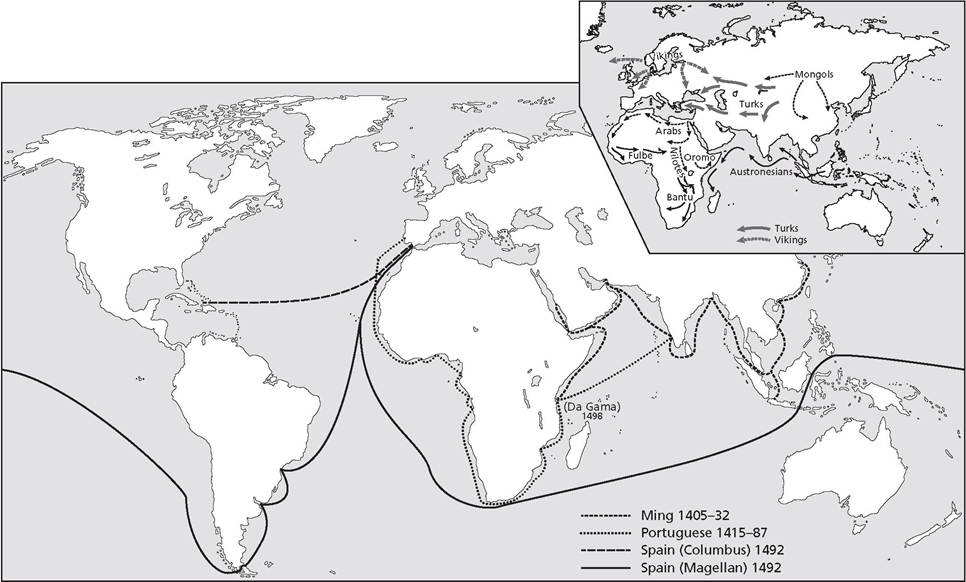
Map 12.7 Maritime and pastoral migration, 800-1500 ce.
from Egypt west to the Maghrib in the tenth and eleventh centuries, and south to the Nilotic Sudan in the fourteenth and fifteenth centuries.
From the eighth century, Turkish pastoralists spread west across the steppes to the Black Sea, into Iran and Anatolia, and into South Asia. To the east, peoples of the eastern steppes known as Khitan, Liao, and Jurchen moved southward both as families and as armies, gaining recurring influence in northern China up to the twelfth century. In the far west, Berber-speaking peoples known as Sanhaja expanded from the Sahara Desert in the eleventh century, establishing the Almoravid state with its capital at Marrakech and extending their conquest throughout North Africa and Iberia. South of the Sahara, cattle-keeping Fulbe families moved eastward from Senegal as far as Lake Chad, and cattle-keeping Nilotic speakers moved upriver from the middle Nile to Lake Victoria and beyond, establishing kingdoms including Rwanda.The most extraordinary pastoral expansion was that of the Mongols, who, under Chinggis Khan, launched conquests in the early thirteenth century that extended the logistics of communication and control all across Eurasia. Mongol and other pastoral rulers moved to capital cities from which they dominated commerce, but new migratory movements arose to shift the balance of power. In sum, pastoral migration remained especially prominent in the Eastern Hemisphere from the eighth to the sixteenth century. The very nature of empire in this era depended significantly on pastoralist armies and social institutions, as seen through the Umayyads, the Almoravids, the Mongols, the Golden Horde, and the Manchu. Even after pastoralists lost the upper hand in interaction with settled polities, pastoralist alliances and armies remained important in global politics until the nineteenth century.
Maritime migrations
The world's best navigators, during the first millennium ce, were the Polynesian and Micronesian sailors of the Pacific, whose complex array of techniques enabled them to complete pinpoint navigation so that they reached tiny islands in immense seas. Their vessels and populations were small, but they linked the Pacific Islands to maritime Southeast Asia.
Related groups founded the state of Sri Vijaya, based in Sumatra, which linked commerce of China and India from the seventh through the thirteenth century. Along with other mariners in the Indian Ocean - speaking Greek, Austronesian, Arabic, and Gujarati languages - they learned the monsoon system and expanded the range and volume of their shipping. In another dense area of maritime contact, Chinese, Korean, and Japanese mariners traded and warred with each other. Their ships, built for the rough seas of the north Pacific, were able to make long voyages to Southeast Asia and into the Indian Ocean. The exchange among these competitors brought such technological advances as rudders, the compass, watertight compartments, and innovative configurations of sails and masts. The Mongols, in their conquest of China, learned from this naval tradition and led major expeditions against the Song, Japan, and Java.Mariners from the Baltic Sea and North Sea suddenly expanded their range in roughly 800 ce, relying on light but seaworthy vessels for 300 years of prominence. To the west, these Viking warriors raided across open seas to the British Isles, along the north coast of Europe, across the Atlantic, and into the Mediterranean where they encountered dense waterborne traffic relying especially on galleys and their oarsmen. To the east, they raided along rivers to Slavic-speaking areas, leaving major imprints in Constantinople, on the Caspian shores of Persia, and among the Turkish-speaking rulers of the middle Volga. For other regions - the Americas and Africa - while the vessels rarely carried more than fifty oarsmen, mariners nevertheless traveled the coasts, the lakes, and great river systems. As a result, it can be said that, even before the voyages of Columbus, people all around the world were in maritime contact with one another.
It was European voyagers who achieved decisive advances in technology and social organization of long-distance seafaring. An earlier Chinese lead in long-distance voyaging was not sustained, so it was Portuguese, Spanish, Italian, and Dutch mariners who did the extraordinary work of mapping the coasts and charting the winds and currents of the open seas.
The volume of trade and migration increased steadily across the Atlantic, the Indian Ocean, and the Western Pacific. By the late eighteenth century the volume of oceanic commerce and migration had increased several times over; with the mastery of longitude, the world became almost completely mapped.Forced migrations
Forced migration also expanded during this millennium, especially as large states became established, and especially in the zone from the Mediterranean to the Indus, the historic center of slave societies. North of this zone, merchants dispatched captives from Slavic, Turkic, and Caucasian societies; from south of this zone, captives came from societies of the Nile Valley and West Africa. Still others came from South India and Southeast Asia. Enslavement became central to war and politics, as Slavic, Turkish, East African, and Caucasian slave soldiers became central to the military forces of the great powers.
Overlaying this terrestrial wave of enslavement was a steadily expanding maritime slave trade, especially across the Atlantic but also in the Indian Ocean (see Map 12.8). As the capitalistic economy developed, this trade in slaves focused on production of sugar and other commodities for sale. Over ten million enslaved Africans made the voyage to the Americas in the years up to 1850, far more than the number of European migrants to that time. (Other waves of slave trade - from the Eurasian steppeland, across the Sahara, and across the Indian Ocean - were also large but have yet to be estimated with precision.) Finally, expanded slave economies developed within Africa and Asia, reaching their peak in the late nineteenth century, after which slavery declined rapidly in the face of a worldwide anti-slavery movement. Yet racial categorization, reinforced by the centuries of enslavement, remained after slavery as an extreme form of social discrimination.
Urbanization
Urbanization, a fourth dimension of migration, developed gradually in this period.
The leading cities included such imperial capitals as Constantinople, Baghdad, and later Beijing, and such commercial centers as Alexandria, Guangzhou, and the Silk Road center of Sarai on the lower Volga (though it prospered only in the thirteenth and fourteenth centuries). Cities maintained their size only through in-migration, as their death rates were high. After 1500 three great capital cities - London, Edo (later to be renamed Tokyo), and Constantinople (though now under Ottoman rule) - led in population for three centuries. As the global economy expanded, port cities grew in size and significance, including Lisbon, Nagasaki, Amsterdam, Batavia, Genoa, and Havana.Diaspora, nation, and race
The various streams of migration, structured increasingly by empire, changed the character and complexity of identity, both for individuals and groups. Individuals could be defined specifically by gender, age, birthplace, color, marital status, language, religion, occupation, and slave/free/elite status - or more vaguely with group labels of race or ethnicity. During this millennium of expanded migration, the localized notion of ethnic group gave rise to expanded types of identity: the diaspora, the nation, and racial groupings. In diasporas, migrants and their descendants maintained a common identity and culture linking them to their homeland. (The term “diaspora” has only recently come to be used as a general term for a dispersed community held together by informal structures, but it is now
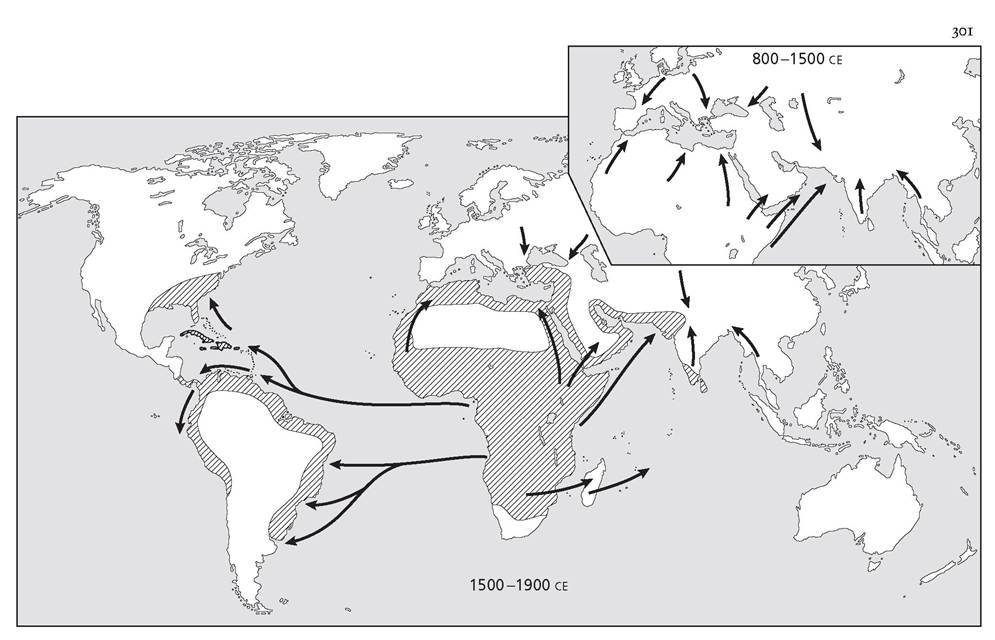
Map 12.8 Forced migration, 800-1900 ce. The arrows represent primary streams of forced migration, and the shaded areas regions in which forced migration had the most impact.
recognized to reflect an important pattern in the modern world.) In nations, inhabitants of a region, including both migrants and locals, formed a common identity for political purposes. In racial categorization, one group labeled another in order to make a statement of social hierarchy.
Maritime migrations from the fifteenth century had built up diasporas around the Atlantic and Indian Ocean basins - people from many parts of Africa plus English, Irish, Scottish, Portuguese, Castilian, Dutch, Jews, German speakers, Arabs, Persians, Gujaratis, and Armenians. A Russian diaspora spread east across Siberia and a Chinese diaspora spread west and south, both within empires. Especially in the Americas, diasporas facilitated the development of nationhood: diaspora-based populations sought to redefine their identity in an imperial world. Thus, diasporas broke from their homelands and imperial centers to become nations in the cases of the United States and Haiti. Latin American nations defined themselves in wars of independence against Spain, ultimately recognizing national citizenship for members of European and African diasporas and for people of Amerindian descent. For Russia and China, the continental diasporas helped define and extend the nation. In Europe, national identities arose in France, briefly in Poland, and more fully in Germany. Racial categorizations, meanwhile, served to perpetuate hierarchies within empires and nations. In response the African diaspora, defined in racial terms, developed an increasingly influential common consciousness. The global reach of empires on land and sea brought about the interconnection, investment, and seizure of resources - primitive accumulation, in the words of Karl Marx, but also cooperation - that made possible dramatic global economic and demographic growth in the nineteenth century.