The village of paddy owners
The village where the people who built the paddies at Nakanishi-Akitsu lived has not yet been discovered. In the second excavation a ditch 1.1 m wide and 30 cm deep, dating from the early to the early middle Yayoi period, was found, however, to the north of the remains of the paddy, close to the Murono-Miyayama mounded tomb, where the elevation is a little higher.[823] Only a 1.6-metre-long section was excavated, but it produced numerous finds compared with the surrounding area.
The pottery dating to the Yamato i -2 and ιι-1 phases corresponded with the period of use of the paddy field. Fine sands and coarse sands with clay had accumulated above the ditch, and a layer dating to the Yamato ιιι phase was identified above the sand layer. This indicated that the layer of sand deposited by the flood between the early and early middle Yayoi extended to the area near the Murono-Miyayama tomb. This is the only ditch from the early Yayoi period in the vicinity. Although theKEN ICHI OKADA
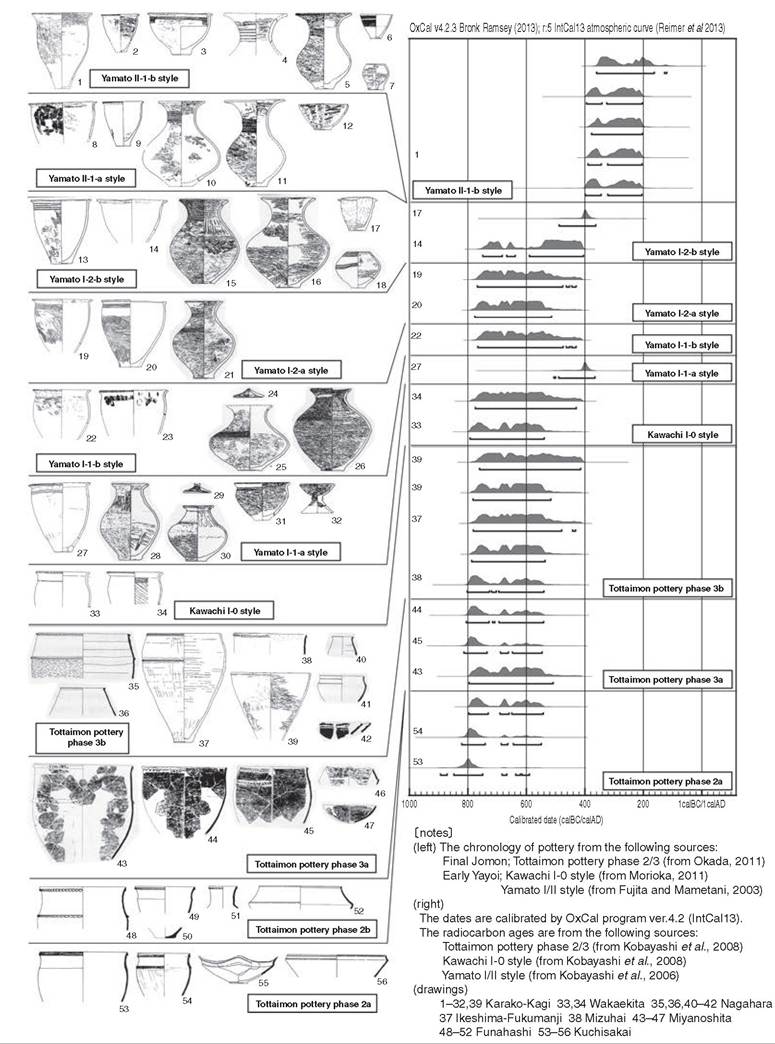
Figure 15.6 FinalJomon and early Yayoi pottery chronology and calibrated radiocarbon dates.
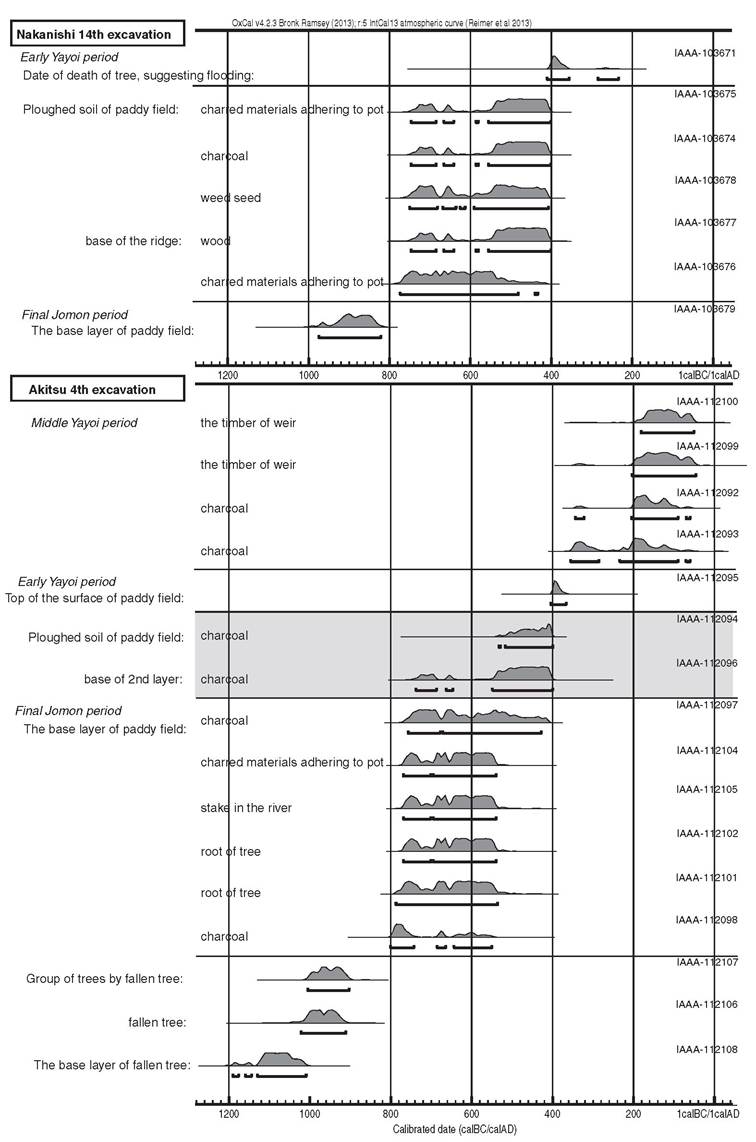
Figure 15.7 Calibrated radiocarbon dates from the paddy fields at Nakanishi-Akitsu.
nature of the ditch remains uncertain, I consider that it formed part of a moat enclosing the settlement of the people who built the paddies.
Traces of the village of the people who built the paddies at Haginomoto were discovered some 400 m north of the Haginomoto site, at Kawanishi- Nenarigaki.[824] This settlement was used for a relatively short period from the Yamato i-ι-b to 1-2-a phases, and was enclosed by a moat (Figure 15.2). The settlement extended across an area measuring 140 m north to south.
Two buildings with their posts set in pits were identified within the enclosure, and there are also many other pits within the settlement area whose function has yet to be confirmed. The moat at Kawanishi-Nenarigaki was 1.0-2.5 m wide and 50-80 cm deep, and can be distinguished from other ditches running across the site. Many archaeological remains were found in all the ditches and the moat. Although the ditch at Nakanishi is shallower than the ditch in the second excavation area, the fact that it was over a metre wide and contained many artefacts supports the interpretation that it functioned as a moat enclosing a settlement area.Another early Yayoi ditch-enclosed settlement was discovered at Shijo- Shinano, 3.5 km north of Haginomoto.[825] The settlement area was about 150 m long and 100 m wide, and was occupied from the Yamato i-1-b phase and abandoned in the Yamato ii phase. It seems that moat-enclosed settlements were relatively common at this time, and indeed I suggest that they were built every 3 to 4 km, the distance between the sites of Shijo-Shinano, Haginomoto, and Nakanishi. The distance between the paddy remains at Haginomoto and the moat at Kawanishi-Nenarigaki is 400 m, and the distance between the paddy at Nakanishi and the second excavation area is 500 m, about the same as at Haginomoto, further supporting the idea of the presence of a village in this location. It takes under ten minutes to walk this distance, probably less time than was required to walk from one side of the paddy to the other.