Stratigraphy and date
The extensive paddies at Nakanishi-Akitsu all date to the early Yayoi period (2,600-2,400 cal bp). Stratigraphy and the dating of associated artefacts provide the basis for the chronology of the paddies.10 Although the quantity of remains from the paddy soils was relatively low, the specific types of ceramics recovered indicate that the site dates from the late final Jomon (tottaimon-style pottery decorated with incised bands) to the late part of the early Yayoi (Yamato i-2-b phase) (see Figure 15.6).11 A thick deposit comprising sand and gravel indicative of inundation by flood extended over a wide area, sealing the paddies found in the fifteenth season in the southern part of the site, and reaching to the fifth and sixth excavation areas at Akitsu to the north.
Slightly later pottery (Yamato ιι-1-a style from the end of the early Yayoi to the start of the middle Yayoi) was found above this flood deposit. The fourth excavation area at Akitsu produced pottery of the Yamato i -2-b and ιι-ι-a phases, with sherds of the later Yamato ii and Yamato iii phases above that.[816]The chronology of the process of paddy development can be seen in the following sequence, extending back to the final Jomon. During the fourteenth and sixteenth seasons at Nakanishi, cultivated soils from the paddies were discovered that formed a palaeosol. The artefacts recovered from this soil were mainly tottaimon pottery from the second half of the final Jomon period.[817] From the silt or fine sand layers below this was unearthed pottery from the early-middle part of the final Jomon, with pottery from the middle- late Late Jomon from the sand and gravel layer under the silt or fine sand layer. The chronological order of the artefacts and stratigraphy therefore accorded with each other (Figure 15.5).[818] [819] This indicates high levels of erosion and sedimentation activity from the later late Jomon to the middle final Jomon, becoming lower towards the end of the final Jomon, the soils formed at this time becoming the palaeosol. Paddies were constructed after the formation of this palaeosol.
The same palaeosol was found immediately below the cultivated paddy soil in the fourth, fifth, and sixth excavation areas at Akitsu, but contained only a few artefacts. A large quantity of final Jomon tottaimon pottery was found in the palaeosol that extended along the watercourse, covered by a layer of gravel.15 This tottaimon pottery was identified as belonging to tottaimon phases 2a to 3b, and in the absence of any Yayoi pottery, this layer is considered to have formed before the end of the final Jomon.Therefore, unlike the results from the fourteenth and sixteenth seasons at Nakanishi outlined above, the findings from the fourth, fifth, and sixth seasons at Akitsu indicate that the thick gravel layer was formed through the erosion and sedimentation of the watercourse from the late final Jomon, and that it became the base of the soil. Paddies were constructed here after
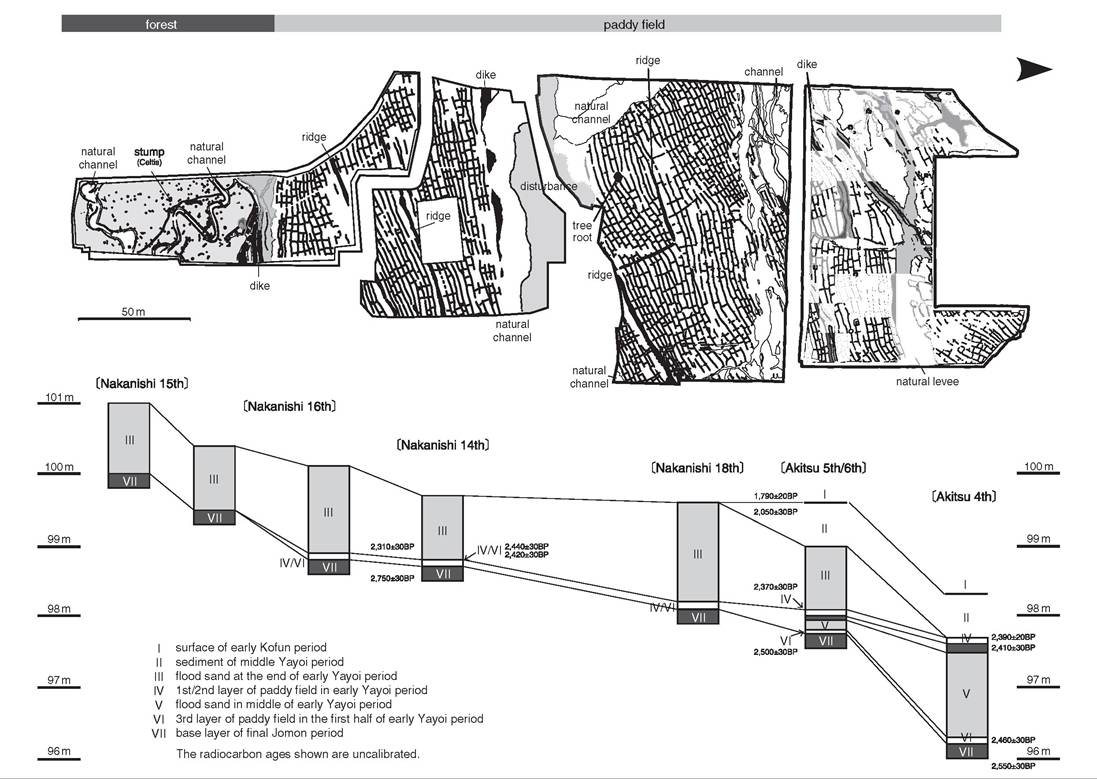
Figure 15.5 Plan and section of early Yayoi paddies at Nakanishi-Akitsu
this soil had formed. It is therefore inferred that the earliest paddies were not built until after the Yamato ι-ι-a phase of the early Yayoi period.[820]
In summary, the early Yayoi paddies at Nakanishi-Akitsu were used from the Yamato i-1-a to Yamato ι-1-b phases. This is supported by radiocarbon dating of wood, seeds, and carbonized remains attached to pottery sherds,1[821] and is similar in date to the Yamato i phase pottery from Karako-Kagi (Figures 15.6 and 15.7).[822]