Early Yayoi paddies at the Nakanishi-Akitsu site complex
The Nakanishi site is located 1.4 km southeast of Tamade (Figure 15.4, left). The site is on a gently sloping alluvial fan which extends to the north, and to the south lie the Kose hills.
The southwestern edge of the site, and the highest point on the ridge, is occupied by the fifth-century keyhole-shaped mounded tomb of Murono-Miyayama, burial place of the powerful Katsuragi clan. To the west the Katsuragi River flows down to the plain, while the Manganji River rises to the south, carving a gentle valley to the northeast as it flows towards the Soga River.Excavations at Nakanishi-Akitsu began in 2009 and are continuing (Figure 15.4). Twenty seasons of excavations have taken place to date at Nakanishi, with early Yayoi paddies investigated between the fourteenth and twentieth excavation areas, in conjunction with the construction of the Keinawa expressway. The tree-covered southernmost area of the site was investigated during the fifteenth season.[810] To the north of this, two phases of paddy construction, separated by a layer of sand as at Tamade, were revealed during the fourteenth, sixteenth, eighteenth, and twentieth seasons. The structure of the paddies was as seen at Tamade: a series of small units divided by larger and smaller ridges.[811]
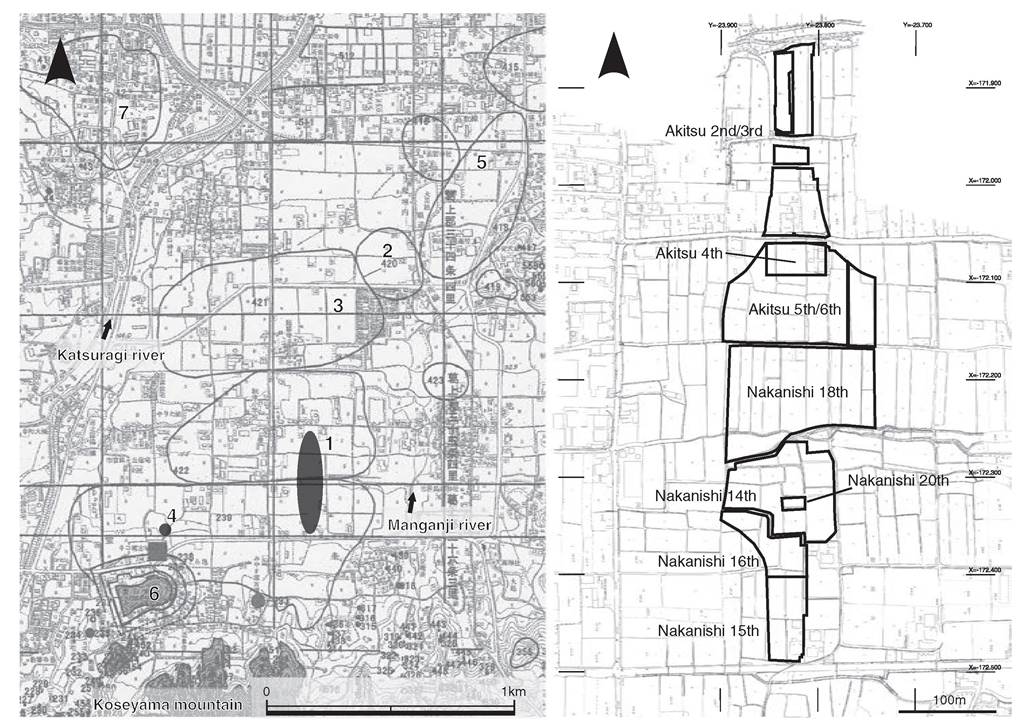
Figure 15.4 Location of the Nakanishi-Akitsu site complex: 1: Tamade; 2: Saragi; 3: Imade; 4: Nakanishi-Akitsu recent excavations (expanded plan on right); 5: Nakanishi, second excavation; 6: Murono-miyagama tomb; 7: Kamutsuba.
Immediately to the north of the eighteenth excavation area, three layers of early Yayoi paddies extend into Akitsu areas 5 and 6.[812] The northernmost part of the site, investigated in the fourth and fifth seasons, produced evidence for a large watercourse in the northeastern sector, but no clear traces of paddy, indicating that this was the northern limit of the paddy area.[813] [814] [815] The area of paddy therefore extended some 340 m north to south on either side of the valley, covering a total area exceeding 25,000 m2. It is possible that the area of early Yayoi paddy extended over 100 m to the west, following the topography, and to the Manganji River in the east. If future research indeed proves this to be the case, then the total area of paddy at Nakanishi-Akitsu was between 50,000 and 100,000 m2.