Africa: states, empires, and connections
STANLEY BURSTEIN
Ancient Africa occupies a peculiar place in the scholarship on world history. After detailed accounts of human evolution in Sub-Saharan Africa and the spread of Homo sapiens sapiens from Africa throughout Eurasia and the Americas, treatment of the history of the continent beyond a few privileged places - Egypt, Nubia, and Aksum - virtually ceases until roughly the late first millennium ce or sometimes even later.
The author1 of a widely read history of the world offered the following rationale for this situation: “the early history of even such huge areas as black Africa or pre-Columbian America are only lightly sketched in these pages, because nothing that happened there between very remote times and the coming of Europeans shaped the world.”Like most half-truths, this one misleads as much as it illuminates. SubSaharan Africa was isolated from Eurasia, but much less completely than is often believed.[849] [850] For much of the Holocene, in fact, archaeological evidence points to significant interaction between the continent and neighboring regions of Eurasia. Examples are easy to find. The branch of proto-Afro- Asiatic that gave rise to the Semitic languages spread to southwest Asia, as did the domesticated donkey. Even more remarkable, several domesticated subSaharan grains, including sorghum, somehow had reached South Asia by c. 2000 BCE.
Nor did such exchanges go in one direction. Indian humped cattle may have reached Africa as early as the beginning of the second millennium bce, while west Asian plant and animal domesticates such as wheat and barley spread to Egypt and Nubia. Sheep and goats also spread throughout the Nile Valley and North Africa and even crossed the Sahara, becoming a staple of West African and, later, African agriculture in general.
Almost certainly, cultural interaction between Africa and western Asia was not limited to the exchange of these few plant and animal domesticates. Unfortunately, evidence has allowed only a number of parallels between the cultures of early dynastic Egypt and those of the prehistoric Sahara and Nubia to be identified.[851]Be that as it may, relations between Sub-Saharan Africa and North Africa and western Asia changed dramatically during the third millennium bce. The cause was the end of the Holocene wet phase about 3000 bce. By 2000 bce aridity comparable to that prevalent in the region today had dried up water sources throughout the Sahara, emptying it of people except for the inhabitants of the few remaining oases and inhibiting contact between North Africa and Sub-Saharan Africa for over 2,000 years.
Isolation, however, did not mean stagnation. North and south of the Sahara economic and social development proceeded apace. By the time contact was gradually reestablished in the late first millennium bce and the first millennium ce, socio-cultural evolution had generated conditions in both regions that were strikingly similar. Over much of the continent, mixed economies that combined farming with pastoralism and were supported by iron-based technologies were the norm. Cities, which were established in North Africa during the first half of the first millennium bce, had also begun to appear south of the Sahara in the first millennium bce and became increasingly significant in the first millennium ce. Similarly, large states, which dominate the history of North Africa in antiquity, had also begun to play a similar role in the history of the Sahel and West Africa by the end of the first millennium ce (see Map 23.1). This is a remarkable story, but telling it is difficult not only because of its vast scale and complexity but also because of the nature of the available sources and the peculiarities of ancient Africa's historiography.
Sources and historiography
Raymond Mauny, the great French historian of Medieval Africa, entitled his history of ancient Africa Les siecles obscurs de l'Afrique,[852] The Dark Centuries of
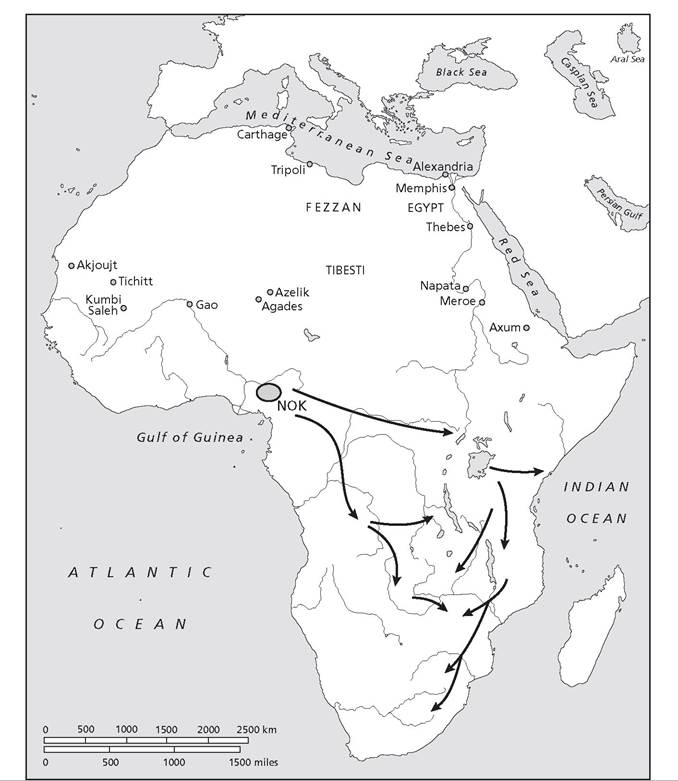
Map 23.i Africa in antiquity.
(Arrows refer to Bantu migrations.)Africa, dark, of course, not because nothing important happened but because of the lack of written sources. Although written sources for ancient African history exist in a variety of languages, including Egyptian, Latin, Greek, Hebrew, Phoenician, Berber, Meroitic, Ge'ez, and Arabic, until the late first millennium ce their coverage is limited to North Africa, the Nile Valley, and the Red Sea and its hinterlands. Equally important, outside the Nile Valley and the Red Sea basin, virtually all written sources reflect the point of view of outsiders instead of native Africans.
The deficiencies of the ancient written sources are aggravated by the lack of a historiography dealing with Africa as a whole. Instead, each region has its own historiography with its own distinctive issues and methodologies. Northeast Africa, which has separate scholarly traditions for ancient Egypt, Nubia, and Aksum, is the most extreme example but not the only one. The situation is similar throughout North Africa, where up to the 1960s scholarship emphasized the Mediterranean aspects of the region's history, reflecting the tendency of French and Italian intellectuals to view their countries as taking up Rome's imperial mission in Africa. And everywhere, so long as the European empires lasted, racism encouraged the notion that native African peoples were incapable of original creation. Meanwhile, the new African historiography that emerged in the second half of the twentieth century concentrated on reconstructing the history of Sub-Saharan Africa while downplaying the possible significance of contacts with North and Northeast Africa before the late first millennium ce when they are documented in Arabic sources.[853]
As a result, historians' traditional preference for written sources combined with the already mentioned external biases tended to distort the history of ancient Africa in two ways: confusion of the date of the first mention in written sources of developments in the African interior with the date of their origin and too great a readiness to invoke foreign influence, be it Egyptian, Carthaginian, Greek, Roman, or Arab, as their explanation.
While archaeology[854] and linguistics[855] have the potential to compensate for these deficiencies, their potential is only beginning to be realized. What follows, therefore, must be considered provisional, an interim report on the work in progress that is the history of ancient Africa.North Africa in the first millennium bce
Egypt and Nubia
The twelfth century bce was marked by a true “crisis of the old order” in western Asia and North Africa. Two great empires, those of the Hittites and the Egyptian New Kingdom, which had provided order in this vast region for almost three centuries, came under attack. The Hittites disappeared first, leaving in their wake a collection of petty kingdoms and city-states. Egypt, whose empire included Palestine and extended a thousand miles up to the Nile to the fourth cataract and west from Egypt almost to the Syrtes, the coastal region of the modern Gulf of Sidra, survived three attacks early in the century, one launched from the east by the Sea Peoples and two from the west by the Libyans allied with various sea raiders.
The Egyptian victories bought its empire another century of existence, but by the end of the New Kingdom in 1069 bce it also had disappeared. Unlike the Hittites, the blow was self-inflicted, the result of a civil war caused by the attempt of Panehsy, the governor of Nubia, to seize control of Upper Egypt. Although Panehsy was driven out of Egypt, Egypt lost its vast Nubian empire and with it access to the products of the African interior and the gold that had made Egypt's wealth legendary in the late second millennium bce.
Egypt emerged from the struggle with Panehsy impoverished, divided, and under foreign rule for the first time in over half a millennium. The Pharaohs of the late New Kingdom had encouraged the settlement of Libyans in Egypt and the recruitment of Libyans into the Egyptian army. By the tenth century bce, Libyans probably made up a majority of the Egyptian army and occupied high positions in the government.
One of them, Shoshenq, seized the throne in 945 bce, founding the twenty-second dynasty and opening a period of over 200 years of Libyan rule in Egypt.[856]Although recognized as Pharaohs, the Libyans retained much of their own culture as evidenced by their non-Egyptian names, tribal titles, preference for oracular ratification of decisions, and, most important, the practice of granting offices, which then became hereditary, to kinsmen. Increasing political fragmentation was the inevitable result, until by the late eighth century bce Egypt was divided into at least ten separate political units, four of which were ruled by “kings.” A divided and weakened Egypt created opportunities throughout North Africa. The Nubians were the first to take advantage of them.[857]
The government of Egypt's Nubian empire during the New Kingdom was complex, but critical to its success were local leaders in the central Sudan who had been co-opted into the system. The end of Egyptian rule freed them, and although the details are lost, American excavation of the royal cemetery at el-Kurru near the fourth cataract of the Nile documented the transformation of a regional chieftain into a king ruling in Egyptian style the entire Upper Nile Valley. The process began in the early ninth century bce with burials in Nubian-style tumulus tombs and ended in the late eighth century bce with Egyptian-style burials in pyramids.
Their kingdom was vast and complex, extending from the first cataract to somewhere south of the fifth cataract of the Nile. Most of its population were farmers, who lived in villages by the Nile, while tribes of transhumant pastoralists, who recognized the suzerainty of the kings of Kush, inhabited the eastern desert between the river and the Red Sea. Agricultural produce, supplemented by various products from the African interior including ivory, ebony, animals and their hides, and slaves together with gold from the eastern desert, underpinned the kingdom's economy.
Administration focused on a series of towns built around Egyptian-style temples between the third and fifth cataracts of the Nile, of which the most important was Napata, traditionally believed to be the southern home of the Theban god Amun and the site of the king's coronation. At the top of the system was the king, who was chosen from a group of potential heirs whose mothers belonged to a privileged class of court women who held the title of king's sister.The Egyptianization of the Kushite monarchy reflected the establishment of close relations between the kings of Kush and the priesthood of Amun at Thebes, who relied on the Kushites for support against the Libyan kings in Lower Egypt. By the late eighth century bce, alliance had led to conquest, with the Nubian king Shabako being crowned at Memphis as the first king of the twenty-fifth dynasty, which ruled Egypt for half a century.
The twenty-fifth dynasty marked a period of political and cultural revival in Egypt after the weakness of the period of Libyan rule. In Egypt, local dynasts were subordinated to royal authority and the military was strengthened. Temple construction and royal art revived. So did funerary and
Africa: states, empires, and connections theological literature, all of which were characterized by emulation of archaic Egyptian styles and high-quality workmanship.
The union of Egypt and Nubia virtually re-created the great empire of the New Kingdom. When, however, the kings of the twenty-fifth dynasty followed the example of their New Kingdom predecessors and tried to reassert Egyptian influence in Syria-Palestine, they collided with the Assyrians, who were expanding into the same area, with disastrous results. After three decades of on-again-off-again warfare against the kingdom of Israel and other Egyptian proxies in the region, the Assyrians invaded Egypt in force, first in 671 bce and again in 667 bce. Memphis and Thebes were sacked, the Kushite royal family was captured, and the king, Tarharqo, fled into Nubia, where he died in 664 bce. A decade later his successor Tamwetamani was decisively defeated by Psamtek I, Assyria's client king of Egypt and the founder of the twenty-sixth dynasty; the union of Nubia and Egypt was at an end.
Despite its brevity - it lasted a little over a decade - the period of Assyrian rule brought critical changes to Northeast Africa. For Egypt it led to over a century of independence and prosperity under the rule of the twenty-sixth dynasty. Kush, on the other hand, lost its outlet to the Mediterranean. As a result, despite continuing to claim to be kings of Upper and Lower Egypt, Kushite kings henceforth ruled an inner African kingdom. Equally important, they faced a hostile Egypt - the twenty-sixth dynasty kings tried to eliminate all trace of their Nubian predecessors in Egypt - that reacted aggressively to any hint of Kushite moves to expand its influence toward the Egyptian border. Sometimes these tensions broke out into open warfare, as happened in 593 bce when an Egyptian raid spread destruction throughout Nubia as far as the Kushite capital of Napata, destruction that is evidenced by the discovery of cachettes at Napata and near Kerma at the third cataract containing the fragments of royal statues smashed during the raid.[858] [859]
Tension between the two kingdoms ended only with the Persian conquest of Egypt in 525 bce. Their respective fates, however, differed. For Egypt, Persian conquest meant reduction to the status of a province - a satrapy - governed by a Persian satrap. For Kush the result was more complex.11 Kush also felt the impact of Persian conquest, but, unlike Egypt, it didn't become a satrapy ruled by a Persian satrap. Instead, Kush continued to be ruled by its
own kings, but it was obligated to send to Persia as tribute characteristic products of its territory - gold, slaves, ebony, and animal products, which are depicted on the podium of the royal apadana at the Persian capital at Persepolis - and to provide troops for Persian armies if requested. Kush continued in this status until the end of the fifth century bce when Persia lost control of Egypt, a situation that became permanent when Alexander the Great conquered the Persian Empire in the late 330s and early 320s bce.
The significance of Alexander's conquest of the Persian Empire differed for Egypt and Kush. Egypt became again a major imperial power with an overseas empire that included much of the coastal regions of the Aegean and eastern Mediterranean basins. It did so, however, under the rule of the Macedonian dynasty of the Ptolemies and with a new ruling class composed of Greek immigrants. As in the case of Egypt, the fall of Persia confirmed the independence of Kush. Also like Egypt, the character of the ruling class changed. The Egyptianized elite that had dominated Kush since the foundation of the Kushite monarchy in the ninth century bce was replaced by a new class with strong ties to the region around the new capital city of Meroe, south of the fifth cataract of the Nile. The change was not limited to government personnel, but it was reflected culturally by the replacement of Egyptian as the language of culture with Meroitic written in a new quasi- alphabetic script as the language of government, the new prominence of local Nubian gods such as the royal war god Apedemak in the Kushite pantheon, and the reappearance of the ancient funerary practice of burying members of the royal court with the king after his death (see Fig. 23.1).[860]
North Africa
Unfortunately, the situation in the rest of North Africa after the collapse of Egyptian influence in the region in the twelfth century bce is less clear. As usual, the problem is the sources. While the evidence indicates that North Africa from the western border of Egypt to the Atlantic was inhabited by a variety of peoples speaking languages belonging to the Berber family of the Afro-Asiatic language family, native sources are virtually non-existent. Instead, scholars depend on external sources, Egyptian and, after the fifth century bce, Greek and Roman, the focus of which is more ethnographic than historical.
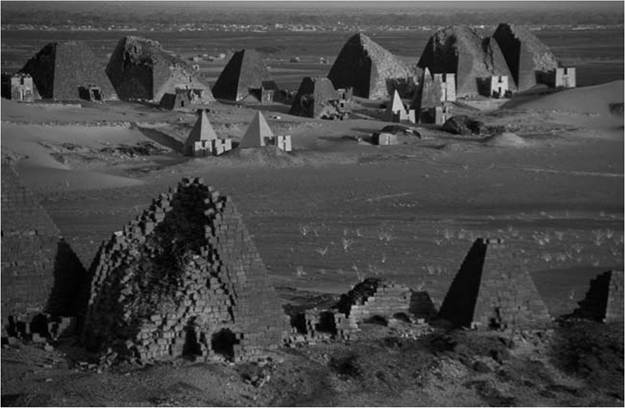
Figure 23.1 Funeral pyramids and temples from Kingdom of Kush (800 bc - 350 ad), necropolis on Island of Meroe (UNESCO World Heritage List, 2011), Sudan, Meroitic civilization (De Agostini Picture Library / C. Sappa / Bridgeman Images)
These sources do, however, allow a reconstruction of socio-political organization in North Africa at the beginning of the first millennium bce.[861]
According to the fifth-century bce Greek historian Herodotus[862] the native peoples of North Africa were divided into two groups: pastoralists who inhabited the area between Egypt and the Syrtes, and agriculturalists living beyond the Syrtes, and Egyptian references to large herds of cattle in Libya confirm the existence of large-scale pastoralism in the regions bordering Egypt. While most of the region's inhabitants probably lived in villages, mention of towns in Egyptian texts and depictions of walled settlements in the area as early as c. 3000 bce point to the existence of at least limited urbanism in North Africa by the end of the second millennium bce. Centralized political institutions, however, were lacking in the region. The sources instead describe North Africa as divided between a small number of large tribes such as the Libu and the Meswhesh in the second millennium bce and the Musulami in the first millennium bce. These tribes were not unified entities but segmental, alliances of regional tribes and sub-tribes united around charismatic leaders the sources call kings and their families. Although inherently unstable, the military potential of these tribal alliances, which was provided by elite chariotry in the late second millennium bce and cavalry in the first millennium bce, was considerable, as evidenced by their attacks on Egypt in the early twelfth millennium bce and their formidable resistance to Carthaginian and Roman expansion in the first millennium bce.
Greeks and Phoenicians in North Africa
While geography is not destiny, it does tend to focus activity more in some directions than others. For ancient Egypt that meant south toward Nubia, northeast toward Syria-Palestine, and east toward the Red Sea. The Persian and Macedonian conquests confirmed these trends. For North Africa the primary orientations were south toward the Sahara and ultimately the Sahel and north toward the Mediterranean, particularly the Mediterranean islands and the Iberian Peninsula. The failure of Persia to extend its power significantly west of Egypt combined with the settlement in North Africa of two peoples - Greeks and Phoenicians - who had begun expanding westward through the Mediterranean basin in the late ninth century bce and strengthened the primarily north-south orientation of North African activity in the first millennium bce.
Greek settlement in North Africa began c. 630 bce with the foundation of the city of Cyrene on the Gebel Akhdar east of the Syrtes in modern Libya by settlers from the central Aegean island of Thera.[863] Cyrene flourished almost immediately, becoming a major exporter of grain and a now extinct North African plant called Silphium, which was believed to have significant medicinal value, to the Aegean. As a result, Cyrene grew rapidly, founding four additional cities including Barca, modern Benghazi, in the region. Cyrcnc's relations with its Libyan neighbors quickly deteriorated also as a result of the city's rapid growth.
Initially Cyrene had been founded with the assistance of the Libyans, and intermarriage between Greeks and Libyans is attested throughout the city's history. Cyrene's rapid growth and agricultural expansion, however, created
Africa: states, empires, and connections increased demands for additional land and labor to work it, thereby putting pressure on pastoralist populations living in the city's hinterland. This finally resulted in an unsuccessful attempt by the Libyans, in alliance with Egypt, c. 570 bce to drive the Greeks out of Libya. The failure of the Libyan revolt enabled Cyrene and its subsidiary cities to continue to expand their agricultural territories into the interior and to bring under their rule the Libyan inhabitants of their hinterlands. Not surprisingly, hostilities between Cyrene and Libyans living further in the pre-desert zone, who remained free but threatened by the expansion of the city's agricultural territory, also continued intermittently until the early centuries ce.
Despite continued tension between Cyrene and her Libyan neighbors, the city also became a key link between the Mediterranean and the African interior by becoming the principal gateway for Greeks desiring to consult the famous oracle of the Egypto-Libyan god Ammon in the Oasis of Siwah, 200 miles south of the Mediterranean. By so doing, however, it also connected the Mediterranean basin to the caravan route that ran westward through a series of oases from the western desert of Egypt to the Niger River, thereby beginning the process of reconnecting North Africa to SubSaharan Africa.[864] Although archaeological evidence for the use of this route in the early first millennium bce is still lacking, the clear description of it in the work of the Greek historian Herodotus confirms that it was already known in the fifth century bce.
The Phoenician impact on the peoples of North Africa began earlier than the Greekbut was slower in developing.[865] The reason is clear. For almost two centuries from their foundation in the early eighth century bce, the first Phoenician settlements in the region - Utica and Carthage in Tunisia, Gades (Cadiz) in the southwest of the Iberian Peninsula, and Lixus on the Atlantic coast of Morocco - functioned primarily as links in the sea route that connected their mother city, Tyre, with the metal trade of the far western Mediterranean. Only with the Babylonian capture of Tyre in 574 bce did the situation change with dramatic results.
Carthage quickly replaced Tyre as suzerain of the Phoenician settlements in North Africa.[866] By the fifth century bce, Carthaginian influence extended
from Tunisia to the Atlantic in North Africa and across the Mediterranean to western Sicily and Sardinia. At home Carthage ceased paying tribute to its Libyan neighbors and expanded its territory south and west of Cape Bon, rapidly creating an empire that included all the Phoenician settlements between the Syrtes and the Atlantic.
The creation of the Carthaginian Empire spread Phoenician language, culture, and institutions throughout North Africa and transformed the social and cultural life of the region's Libyan populations. The results were most obvious in the cities of the Carthaginian Empire. These were ruled by an elite consisting of a mixture of Phoenicians and acculturated Libyans called Libyphoenicians by Greek and Roman writers, whose estates were worked by tributary Libyans. The military needs of the Carthaginian Empire also facilitated the emergence of the first Libyan kingdoms in North Africa.
Lacking sufficient manpower to meet its military needs, Carthage largely relied on mercenary and allied troops, infantry and especially cavalry. These troops were recruited from tribal alliances in Numidia, modern Algeria, and Mauretania, modern Morocco, and the chiefly families of the dominant tribes in these alliances, Mauri in Mauretania and the Massyli in Numidia, became the royal families of the new kingdoms. By the time these kingdoms appear in the sources in the late third century bce, they were thoroughly Punicized, with administrations organized on the Carthaginian model and centered in Libyphoenician cities such as Volubilis in Mauretania and Cirta in Numidia.[867]
So long as Carthage dominated the western Mediterranean basin, Numidia and Mauretania remained dependent allied kingdoms. That situation changed, however, in the third century bce. Three devastating wars with Rome spread over more than a century, from 264 bce to 146 bce, and ended with the total destruction of Carthage and the liberation of the two North African kingdoms. Under the rule of Massinissa, Numidia became a Roman ally and an important Mediterranean power. Like other Hellenistic kings, Massinissa became a patron of culture, inviting Greek artists and intellectuals to his capital at Cirta, which he adorned with Greek-style buildings, and educating his sons in Greece. Hellenization continued under his son and successor Micipsa, who was reputed to be a student of Greek philosophy. Massinissa and his successors were buried in monumental tombs that combined Phoenician and Greek architectural forms, vivid evidence of the cultural forces in play in North Africa in the late first millennium bce (see Fig. 23.2).
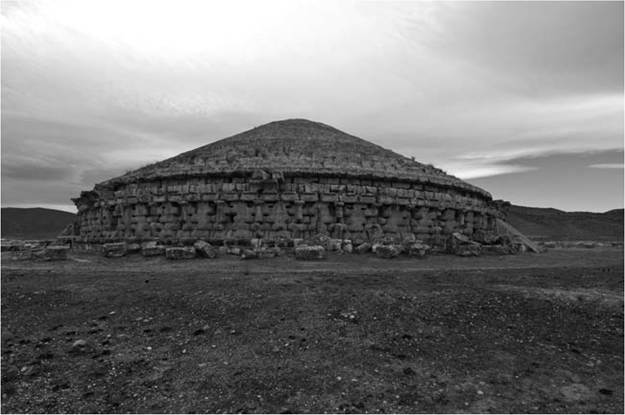
Figure 23.2 A Numidian Royal Tomb: The Medraqen (Numidia). Possibly the tomb of King Massinissa, c. mid-second century bce (imageBROKER / Alamy)
Outside the elite circles of the royal court, however, Numidia remained true to its Punic and Libyan roots. Punic remained the language of government and religion even at the royal capital of Cirta, while a script was developed to write Libyan that was widely used in the rural hinterland of the kingdom and still survives in the form of the Tafinagh script used by the Tuaregs. Although comparable evidence is lacking, the indications are that developments in the kingdom of Mauretania after the collapse of Carthage were similar.
Numidia and Mauretania prospered as Roman allies, but their kings ruled as Roman clients, and maintaining the balance between their desire for independence and the demands of their Roman masters proved increasingly difficult. The experience of Numidia was typical. On the death of Micipsa in 118 ce, the kingdom was divided between the king's two sons and a nephew named Jugurtha. Civil war, the extermination of the legitimate royal line, a devastating war with Rome, and ultimately annexation by Rome in 46 bce followed. The same pattern was repeated elsewhere in North Africa, with Cyrene and the other Greek cities of Libya being annexed in the 70s bce and the kingdom of Mauretania in 40 ce. Even Egypt, which had enjoyed 300 years of independence under the Macedonian dynasty of the Ptolemies, was occupied by Rome in 30 bce following the suicide of its last ruler, Cleopatra VII. However the details differed, the result was the same everywhere in the region: the imposition of direct Roman rule so that, by the mid- first century ce, all of North Africa, from the Sinai Peninsula to the Atlantic Ocean, formed the southern periphery of a vast Mediterranean empire whose center was the city of Rome.
North Africa under the Romans: first century bce to the third century ce
Although it was not until c. 40 ce that the Romans annexed the kingdom of Mauretania and imposed direct rule throughout North Africa, the character of Roman policy in the region was determined by events half a century earlier in the 20s bce.[868] During the decade following the conquest of Egypt in 30 bc e, the Romans made a concerted attempt to extend their rule south into the desert on a broad front. Campaigns were mounted against the kingdom of Saba in Yemen, Kush, and the kingdom of the Garamantes in the Fezzan. Victories were claimed and even a triumph celebrated over the Garamantes, but the final result was failure on all fronts. Defeated by the logistical problems of campaigning in the desert, the Romans pulled back to the southern border of Egypt and the pre-desert in North Africa, never to attempt to extend their power south into the Sahara and Nubia again.
Securing control of North Africa was not easy. The first century of Roman rule in the region was marked by rebellions that were made harder to suppress by the rebels' ability to use the desert beyond the frontier as a sanctuary from which to launch raids into Roman territory and to draw on the desert tribes to bolster their forces. The most serious such movement was that of the former Roman auxiliary trooper Tacfarinas in Numidia, who frustrated all attempts to defeat him during a seven-year period from 17 ce to 24 ce. A similar uprising in the 40s C e followed the annexation of the kingdom of Mauretania, and as late as 70 ce the Garamantes raided as far as the Mediterranean coast from their home in the Fezzan. By the early second century ce, however, resistance had largely ceased, and a single legion of 5,000 men supported by an unknown number of locally recruited auxiliary
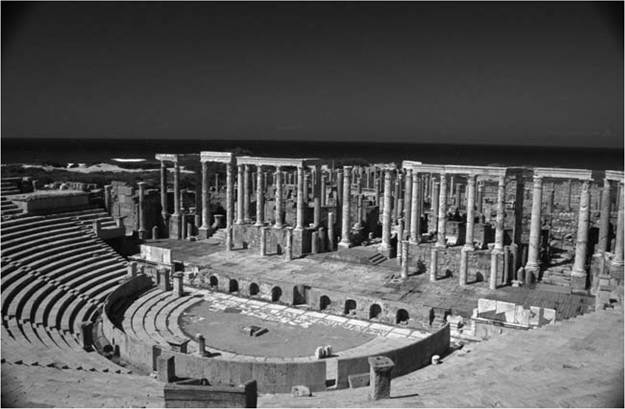
Figure 23.3 The Theatre (Leptis Magna, Libya / ©Julian Chichester / Bridgeman Images)
troops sufficed to maintain security throughout the vast area from the western border of Egypt to the Atlantic.
The integration of North Africa into the Roman Empire coincided with a massive increase in demand for the products of the region to meet the needs of Rome with its huge population, perhaps a million strong, and the western Mediterranean provinces. Included among those products were building stone, semi-precious stones, and wild animals for the increasingly popular games, but the greatest demand was for agricultural goods: olive oil, wine, and especially grain for which North Africa became one of Rome's two principal sources of supply (the other was Egypt). To meet the increasing demand, the area under cultivation and the irrigation systems needed to support it expanded into the interior toward the pre-desert. The resulting prosperity is reflected archaeologically in the remains of numerous estates in the interior and of cities near the Mediterranean such as Leptis Magna and Sabratha in Libya, Timgad in Algeria, and Volubilis in Morocco with their spectacular public buildings and monuments (see Fig. 23.3).
The prosperity of Roman North Africa was real but unevenly distributed. The principal beneficiaries were the inhabitants of Carthage and other Roman colonies founded in the late first century bce and the first century ce and the upper classes of the pre-Roman cities and towns of the region. The former were mainly Italian in origin, predominantly Roman veterans, while their Punic and Libyan names suggest that the latter were drawn from Romanized members of the tribal elites of the region, descendants of the Libyphoenician upper class that ruled these cities during the pre-Roman period. A similar naming pattern on inscriptions in the interior indicates that the owners of the new estates were drawn from the same groups. Nor was the influence of this African elite limited to North Africa, as evidenced by the growing number of Roman Senators from the region, one of whom, Septimius Severus, even became emperor, founding a dynasty that ruled Rome for almost half a century from 193 C e until 235 C e.
Sub-Saharan Africa: c. 1200 bce - c. 600 ce
Since the late nineteenth century, historians have associated the first millennium bce and the early first millennium ce with a development of fundamental importance for the history of Sub-Saharan Africa: the Bantu Expansion, that is, the spread of the Bantu languages, a subfamily of the Niger-Congo language family, over most of central and southern Africa, an area larger than Europe. Early African historians[869] viewed the Bantu expansion, however, not merely as a linguistic phenomenon. Technologically, it supposedly marked the introduction into central and southern Africa of a package of important technologies that included mixed agriculture, pottery, and especially iron metallurgy. Culturally, foraging peoples such as the pygmies and the Khoisan were believed to have been replaced over much of this huge region by sedentary agriculturalists.
Dating these developments was difficult, but several lines of evidence seemed to point to the late first millennium bce - early first millennium ce. So, the limited linguistic divergence of the approximately 600 Bantu languages suggested that the Bantu expansion took place quickly and relatively recently, probably within the last few thousand years, while the identification of the border area of Nigeria and Cameroon as the home of Proto-Bantu suggested that its direction was east toward the Great Lakes and, ultimately, the Indian Ocean, and south along the west and east coasts of Africa. As to its cause, most scholars viewed the expansion as resulting from overpopulation, spurred possibly by the introduction of important new crops from Southeast Asia, including bananas and yams, and facilitated by the superiority conferred by the diffusion of iron technology from either North Africa or the Nile Valley. Both these phenomena again seemed to confirm the late first millennium bce - early first millennium ce date for the expansion suggested by the linguistic evidence.
This view of the Bantu Expansion lasted until the 1990s, when a combination of factors - more intensive linguistic analysis of the Bantu language family, increased archaeological activity, and a growing number of radiocarbon dates for key sites - resulted in its collapse and replacement by a more nuanced and complex reconstruction.[870] So, linguistic analysis suggested that the break-up of Proto-Bantu and, therefore, the expansion may have begun as early as the beginning of the third millennium bce. In addition, while ProtoBantu vocabulary indicated that the Proto-Bantu were forest dwellers who cultivated root crops, the terminology for grain crops in Bantu languages spoken in the Great Lakes region and east and southern Africa indicated that such crops were acquired from Cushitic speakers encountered during the expansion. Equally important, radiocarbon dates of ironworking sites indicated that iron was being smelted and worked in the Great Lakes region in the early first millennium bce and gradually diffused westward in succeeding centuries. Such dates, which were earlier than the first appearance of iron- working in North Africa and the Nile Valley, strongly suggested that iron- working in Sub-Saharan Africa resulted from independent invention in SubSaharan Africa and not diffusion from a source in the Nile Valley or the Mediterranean region as had been believed.[871] At the same time these dates were too late for iron metallurgy to have been a cause of the Bantu Expansion, although, of course, iron tools may have been a factor during its later phases. Taken together, these facts suggested that the expansion should be viewed as a gradual process, lasting over many centuries, instead of a large-scale migration of iron-using farmers that occurred in a relatively brief period of time, as had been believed for most of the twentieth century.
Equally important, according to this reconstruction, the area of Bantu speech would have grown as much by absorbing foraging and farming peoples as by migration.
As is so often the case, the truth probably lies somewhere between the extremes represented by these two views of the Bantu Expansion. What is clear, however, is that the spread of iron-using sedentary societies based on mixed agriculture transformed life over much of central and southern Africa. Population increased, society became more complex, and trade expanded to meet growing demand for iron and other products. In places located where products from different ecological zones could be exchanged and transported by water, towns with economies based on trade and manufacturing appeared.
As a result, while independent villages remained the norm in central and southern Africa until well into the second millennium ce, larger forms of socio-economic organization appeared in West Africa.[872] Evidence of the existence of early complex society in the region was first recognized with the discovery of the Nok culture in modern Nigeria.[873] For decades the only evidence for the Nok culture consisted of remarkable terracotta figures discovered by modern tin miners that probably were intended for dedication in shrines. Radiocarbon dates from the settlement site of Samun Dukiya and the industrial site of Taruga, however, revealed that the Nok culture actually extended over a vast area of 75,000 km2 and was created by iron-using farmers over a period of 700 years from c. 500 bce to c. 200 ce (see Fig. 23.4).
The emergence of complex society is clearer, however, further north in southern Mauretania, where extensive remains of stone-built villages associated with the Tichitt Tradition reveal the existence of a proto-urban culture based on mixed agriculture as early as the late second millennium bce. Although the Tichitt Tradition extended throughout much of the first millennium bce, the increasing emphases on defensive walls and the selection of defensible sites for villages in its final phases indicate that it came under serious attack, probably from Libyan-speaking raiders based in the Sahara.
By c. 300 bce the Tichitt Tradition had ended in its home territory. A closely related culture survived in the inland delta of the Niger River in Mali, where it seems to have formed part of the matrix for the emergence of the first true West African cities. The earliest attested example is the early
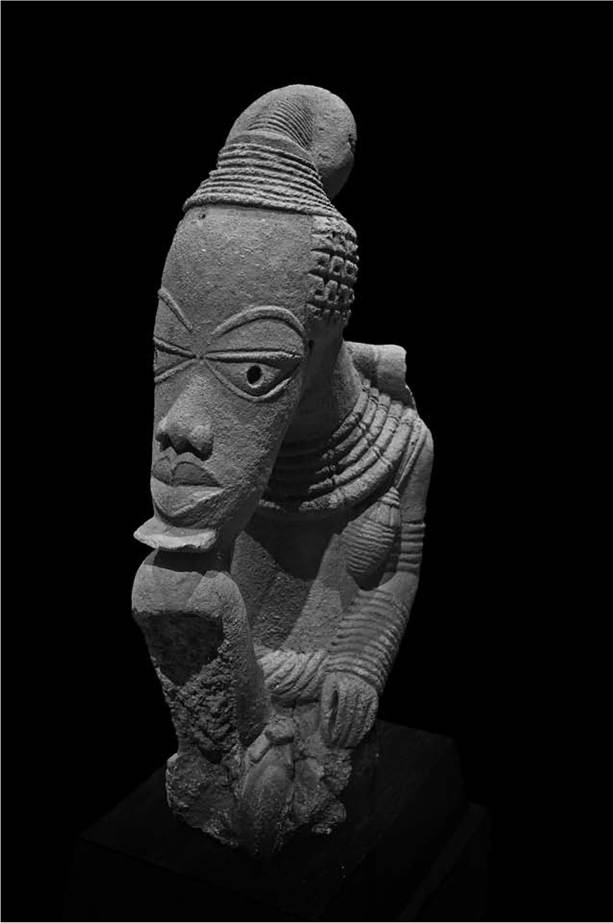
Figure 23.4 Character with chin resting on knee, Nok sculpture, terracotta before sixth century bce, Nigeria (Peter Horree / Alamy)
first-millennium bce site of Dia, but the process is best documented at the later site of Jenne-Jeno.[874] Founded as a village c. 200 bce in an exceptionally fertile area watered by the Niger River, Jenne grew steadily until by the late first millennium ce it was a walled city approximately 33 hectares in extent surrounded by a cluster of villages, each of which seems to have specialized in a particular craft such as iron working. The secret ofJenne's prosperity was its location, which allowed easy access to the salt and mineral resources of the Sahara to the north and to the animal and plant products and eventually the gold of the forest zone to the south, and made it the center of a regional trade network covering much of the Niger basin and its hinterlands. Unfortunately, archaeology has not yet provided evidence for the social structure and governmental organization of Jenne. The existence of numerous other large mounds in the Inland Delta region, however, indicates that Jenne was only one of several such urban centers in the region. It was control of urban centers such as Jenne and the trade networks dependent on them that would become the foundation of the prosperity of the great empires of the Medieval Sudan such as Ghana and Mali.
Reconnection of Sub-Saharan Africa to Eurasia
Roughly contemporary with the developments just described, the isolation of Sub-Saharan Africa from Eurasia that had begun in the third millennium bce was gradually overcome. Not surprisingly in view of the difficulty of the trans-Saharan route, the first attempts to make contact with Sub-Saharan Africa were made by sea. In the mid-fifth century bce, the Carthaginians mounted a large colonizing expedition led by a high magistrate named Hanno south from the old Phoenician colony of Lixus along the Atlantic coast of Africa. What purports to be a Greek translation of Hanno's report survives. Although the text is clearly corrupt and identification of the geographical references in it is controversial, most scholars believe that the expedition reached at least as far south as the Senegal River and possibly as far as Mount Cameroon.[875] How many of the colonies Hanno claims to have founded survived is not known, but references by fifth- and fourth-century
Africa: states, empires, and connections bce Greek sources suggest that Carthage's goal was access to gold sources near the Atlantic coast. The trade mentioned by the Greek sources, however, depended on continued support from Carthage, which ceased as a result of the Punic Wars, so that by the mid-first century bce all Carthaginian activity south of Lixus and the island of Mogador had ceased, and Rome made no attempt to revive it.
While the west coast of Africa faced only the open sea, the east coast opened onto the Indian Ocean with its millennia-old seaborne trading networks. Occasional contact was inevitable, and, indeed, archaeological evidence for the cultivation of bananas, a fruit native to Southeast Asia, in West Africa as early as c. 500 bce suggests that Austronesian speakers were already visiting the region by that time.[876] Full integration of the East African coast into the Indian Ocean network, however, had to wait for the great expansion of trade between the Mediterranean and South Asia that began in the first century bce. Already by the mid-first century ce, Arab traders were trading manufactured metal goods of all kinds, wine, and grain for ivory, rhinoceros horn, and high-quality tortoise shell. Arab traders were probably also responsible for the other items from the Near East and the Indian Ocean region such as glass beads, cowry shells, and bitumen that have been discovered on archaeological sites as far west as the Senegal basin. The center of this trade was the treaty port of Rhapta, which was governed by Arab merchants under the suzerainty of the kingdom of Himyar in Yemen. Although the site of Rhapta is still unknown, circumstantial evidence suggests that it was located in the Rufiji Delta in Tanzania.[877]
Integration of East Africa into the Indian Ocean trading network had more dramatic results further north in the Red Sea basin.[878] For millennia the Nile Valley had been the primary route by which goods from Northeast Africa reached Egypt and the Mediterranean. The great increase in the number of ships traversing the Red Sea and Indian Ocean offered an alternate and easier
route for these goods, and geography dictated that it would not be the largely landlocked kingdom of Kush but that of Aksum in the highlands of modern Ethiopia that benefited (see Fig. 23.5).
Unlike Kush, Aksum was of relatively recent origin.[879] Although archaeological evidence suggests that its roots lie in the early first millennium bce, when South Arabian colonists founded a series of small kingdoms in the territory of modern Eritrea and Tigray in Ethiopia, the kingdom of Aksum began its rise to prominence in the late first century bce, when the ruler of one of these kingdoms, that of the Habasha (= Abyssinians), made the city of Aksum his capital. Located on the Ethiopian plateau with ready access to the upper Nile Valley and its hinterlands on the west and to the Red Sea on the east, Aksum was ideally situated to profit from the new conditions in the Red Sea created by the expansion of the Indian Ocean trade. The kings of Aksum took advantage of this opportunity, establishing, in agreement with Rome, Adulis (= Massawa) as a treaty port and encouraging the development of a trade diaspora in their kingdom.
As a result of these developments, Adulis[880] became by the mid-first century ce the principal center not only for the export of goods from the coastal regions of the Red Sea and its hinterlands but even for ivory collected in Sennar in Kushite territory. During the second and third century ce, Aksumite kings continued these policies, extending their rule over most of the hinterlands of the southern Red Sea basin and building and maintaining a caravan route to Egypt that bypassed the Nile corridor entirely, thereby confirming Aksum's rule as the principal supplier of Northeast African goods to the Mediterranean basin.
It took time for the effects of these developments on Kush to become evident. Indeed, the late first century bce and the early first century bce was in many ways the climax of Kushite history. Peaceful relations between Rome and Kush resulted in unprecedented prosperity. By the end of the second century and early third C e, however, conditions had changed dramatically. The emergence of Aksum as Rome's primary source of African goods gradually reduced diplomatic contact between Kush and Roman Egypt, as Roman policy toward the Upper Nile Valley increasingly focused on the defense of the southern frontier of Egypt. The resulting impoverishment of the Kushite monarchy weakened its control over its peripheral territories,
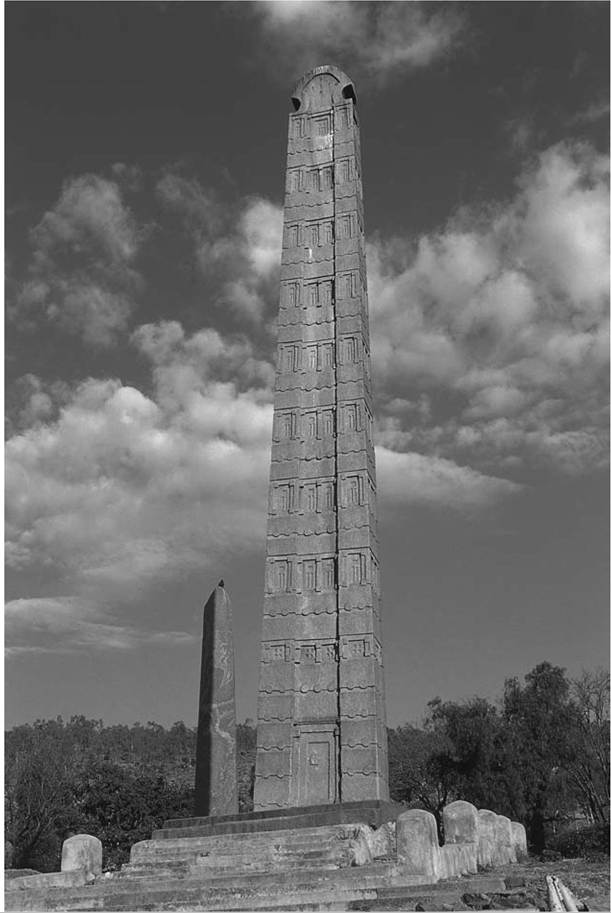
Figure 23.5 Ethiopia, Aksum, great stele and obelisk, c. third-fourth century ce (De Agostini Picture Library / W. Buss / Bridgeman Images)
exposing the kingdom to attack and ultimately conquest by neighboring peoples and states, especially Aksum. As usual, the sources to trace the process in detail are lacking. When the evidence allows us to observe conditions in the region in late antiquity, however, the kingdom of Kush had disappeared, giving way to a series of warring successor states. The Nile corridor had ceased to be the principal artery for the transmission of African goods to Egypt, and Aksum had become Rome's principal ally in Africa and the main intermediary between India and the Mediterranean basin in the Indian Ocean trade.
In contrast to the situation in East Africa, the date of the opening of transSaharan connections is controversial. The problem is twofold. Regular transSaharan trade is first attested in Medieval Arabic sources, and the contents of the trade - Sub-Saharan gold and slaves exchanged for Saharan salt and copper - leave no archaeological traces, with the result that scholars have tended to date the beginning of trans-Saharan trade to the eighth century ce at the earliest. Circumstantial evidence - rock engravings of horses and chariots aligned north and south in the western Sahara,[881] the presence of one-humped camels in North Africa by the first century bce,[882] and the unexpected minting of gold coins by the mint at Carthage in the fourth century ce[883] - suggest, however, that, in fact, trans-Saharan trade began during the early centuries ce. (For a picture of these rock engravings, see Chapter 24 by Ralph Austen on trans-Saharan trade in this volume.) These hints have been strengthened by spectacular discoveries made during the past two decades by Italian and British archaeologists in the territory of the kingdom of the Garamantes in the Fezzan (see Fig. 23.6).
References to the Garamantes are numerous in Greek and Roman texts from the fifth century bce to late antiquity. These suggest that as early as the fifth century bce the Garamantes may already have developed a state and were raiding Sub-Saharan African populations, and that by the first century c e their kings' authority extended deep into the Sahara, perhaps as far as Tibetsi or even Lake Chad. Moreover, excavations[884] at the Garamantian heartland of
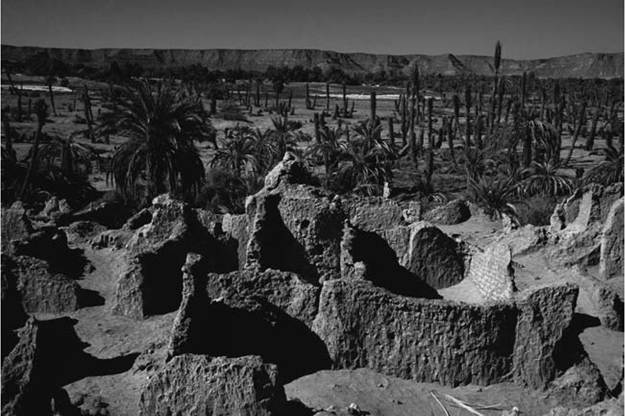
Figure 23.6 Archaeological site of Garama, Libya, c. first half of the first millennium ce (bildagentur-online.com/th-foto / Alamy)
the Wadi al-Ajal and their capital of Garama have revealed that during the first three centuries ce the Garamantian kingdom occupied a territory of c. 250,000 km2, used the Libyan script, maintained a massive irrigation-based agricultural system, and imported large amounts of luxury goods from Roman North Africa. The size and wealth of the Garamantian kingdom - wealth that certainly exceeded what could be produced by the trade in semiprecious stones mentioned by Roman writers - combined with the location of Garamantian fortifications and watch towers along later caravan routes toward the Niger bend and the Sahel37 strongly suggest that the trans-Saharan trade already existed during the early centuries ce, albeit probably on a smaller scale than the later Medieval trade. Confirmation of this hypothesis finally has been provided by the discovery at the site of Kissi in Burkina Faso of a wide variety of imported goods, including metal products from Roman
J. Mattingly, Sue McLaren, Elizabeth Savage, Yahya al-Fasatwi, and Khaled Gadgood (eds.), The Libyan Desert: NaturalResources and Cultural Heritage (London: The Society for Libyan Studies, 2006), pp. 189-204.
37 Mario Liverani, “Looking for the Southern Frontier of the Garamantes,” Sahara 12 (2000): 31-44.
North Africa, cowry shells from the Red Sea or Indian Ocean, and glass from the Near East.[885]
The birth of Afro-Eurasia: c. 400 ce - c. 900 ce
By the fourth century c e, the framework for the full reintegration of SubSaharan Africa into Eurasia as a whole was in place. How that reintegration took place, however, was determined by the resolution of the crisis of late antiquity, a crisis that had both cultural and political dimensions.
Throughout the region, millennia-old traditions of worship and funerary practice gradually disappeared as Christianity, now transformed from an underground cult to the official religion of the Roman Empire, spread. By the mid-sixth century ce, Christianity was dominant from Aksum to the Atlantic. The spread of Christianity, however, did not bring unity but the reverse as old tensions between city and rural populations were overlaid by conflicts over correct doctrine and practice. So in Egypt, Monophysites, who drew their support primarily from the native Coptic population, were in conflict with the predominantly Orthodox Greek population of Alexandria, while further west in North Africa similar struggles were played out between urban-based, Latin-speaking Catholic Christians and Donatists, whose strength was in the largely Libyan countryside.
While religious tensions were felt from Egypt to the Atlantic, their effects were most severe in North Africa, where they hindered the development of a unified defense against the political upheavals that struck the region. As a result, during the two centuries between the end of the dynasty of the Severi in 235 ce and the Vandal invasion in 429 ce, the links that bound the region to the Roman Empire gradually dissolved as the imperial government focused its efforts on defending itself against attacks from the Germans and Sassanid Persia. Mauri nomads took advantage of Roman weakness, raiding deep into Roman territory and crippling agriculture and towns in the frontier zones. As a result, with the Vandal capture of Carthage in 439 ce, a decade after their invasion in 429 ce, Roman rule in North Africa ended, leaving the region divided between the Vandal kingdom in Numidia and several small kingdoms dominated by partially Romanized Libyans in Mauretania.
Instead of bringing security, however, the establishment of the Vandal kingdom opened a period of instability in North Africa that lasted for over two centuries. The Vandal kingdom itself was the first victim, falling to a Roman invasion launched by the EmperorJustinian I in 533 ce. Ravaged by plague and exhausted by conflicts with Slavic and Avar invaders in the Balkans and repeated wars with Sassanid Persia in the Near East, however, Rome proved no more able than the Vandals to contain the raids of the Mauri nomads and to restore security and prosperity to North Africa.
More seriously, the empire also was unable to meet the unexpected challenge of the Arab invasions. During the decade between 632 ce and 642 ce, Arab armies, inspired by the new religion of Islam, overran Sassanid Persia, Syria-Palestine, and Egypt. North Africa, however, proved harder to conquer. Although a major defeat was inflicted on Byzantine forces near Carthage in 647 ce, it took another half-century before the remaining Byzantines and their Libyan allies, whom the Arabs called “Barbar” or “Barbarians,” that is, “Berbers,” were finally overcome in 698 ce by the Arabs and their own Berber client troops. A little over a decade later, they crossed into Spain and overthrew the kingdom of the Visigoths. By the time the Arab and Berber advance was stopped in 732 c e at the Battle of Poitiers, the governor of Ifriqiya - Africa - ruled from his capital at Qayrawan just south of Carthage all of North Africa and the Iberian Peninsula, the largest North African political unit since the formation of the Carthaginian Empire a millennium earlier. This hard-won political unity lasted, however, less than half a century. A great Berber revolt in the mid-eighth century ce provoked by the enslavement of Berbers, despite their conversion to Islam, shattered it, and unity was not restored until the rise of the Fatimid dynasty in the tenth century ce. The political fragmentation of North Africa was paralleled by growing cultural unification as Berbers increasingly adopted the new Arabicbased religion of Islam, while Latin-based Christianity gradually declined until it disappeared sometime in the twelfth century ce.
The impact of the Arab expansion further south in Africa, however, was uneven, but everywhere one thing was evident: the desire for slaves needed for labor and particularly for soldiers to supplement the limited number of available Arab troops. So, already in the seventh century, slaves were being exported from the east African coast - what in antiquity was called Azania and in the Middle Ages Zanj - to Mesopotamia.[886] Further north the political order that had prevailed in late antiquity changed dramatically.
Isolated from its Roman ally, the kingdom of Aksum, which at the peak of its power in the early sixth century ce controlled an empire that extended from Sennar in the west to Yemen in the east, collapsed. Although the kingdom itself survived as a Christian state, it did so by relocating into the interior of Ethiopia, abandoning its old capital of Aksum and establishing a new capital at Jarma at a still unidentified site. At about the same time, however, an Arab attempt to conquer the Christian successor states of Kush was defeated at Dongola in 652 ce, resulting in the negotiation of a unique agreement, the baqt, in which the independence of the Nubian Christian kingdom of Makuria was recognized and grain subsidies guaranteed in return for an annual tribute of slaves and the guarantee of privileged treatment for Muslim merchants operating in its territory.[887] Further west, Arab forces were more successful, conquering the old territory of the Garamantes in the Fezzan and thereby gaining access to the trade routes that led south to Tibetsi and Lake Chad and west toward the inland delta of the Niger.
In West Africa, however, the results were dramatically different. Arab sources record a raid that reached the Sahel and brought back to North Africa large amounts of gold and slaves in 733/ 4 ce, but the sources then are silent for two centuries. When they resume in the tenth century ce, they reveal a complex situation in the Sahel. References to Muslim kingdoms trading slaves attest to the spread of Islam south of the Sahara, but they were the result of conversion of rulers and not conquest. Most remarkable, however, is the dominant position in the region of an empire that Arab geographers called Ghana after the title of its king and its inhabitants Wagadu.[888]
The date of the origin of Ghana is unknown, although Arabic references to it as a powerful kingdom c. 800 ce suggest a date earlier in the first millennium ce. More important, by the tenth century ce Ghana ruled a core territory located between the Niger and Senegal rivers, while its authority extended beyond its core to cover numerous vassal states. Ghana's wealth came from its control of the Sub-Saharan end of the caravan trade that brought slaves and gold from the mines at Bambuk and Bure in Mali and Guinea to North Africa in exchange for Saharan salt and copper. According to the Arab geographers, Ghana were a sacral monarchy. The relations of the kings of Ghana and their subjects was hedged around with elaborate ceremonial, and after death they were buried together with members of their court in lavishly furnished tombs. The empire also possessed massive military forces consisting of infantry, archers, and cavalry.
Most striking, however, is the nature of Ghana's relations with North African Muslims. According to the Arab sources, Kumbi, the capital of Ghana, was a double city, one section of which was inhabited by Muslim merchants and scholars, while the other was the fortified residence of the pagan king. This situation can only mean that Muslims resided and traded in the territory of Ghana on terms granted them by the kings of Ghana. Unfortunately, whether or not the agreement resulted from a failure to conquer Ghana, as did the similar situation created by the baqt in the Upper Nile Valley, is unknown.
More important than the details of the origin of the agreement, however, are its implications. Unlike the situation in Egypt and North Africa, Islam in the Sahel did not spread by conquest but by the conversion of rulers, which forced Muslim clerics and their converts to accommodate the religions of their non-Muslim subjects. The result was the development of a form of Islam marked by the survival of pre-Islamic religious and social practices that puzzled and sometimes shocked visitors from the greater Islamic world, such as the fourteenth-century ce traveler Ibn Battuta.
Conclusion
The two millennia between 1200 bce and 900 ce were marked by fundamental changes in all aspects of African life. At the beginning of the period, the Sahara divided North Africa from Sub-Saharan Africa, cities and large states were unknown outside the Nile Valley, and the use of metals was limited. By c. 900 ce trade across the Sahara had become common, urbanbased states were the norm north of the Sahara and spreading south of the desert, while the use of iron was routine throughout most of the continent. The continent's cultural orientation, however, had changed fundamentally. Thanks to the spread of Islam, much of Africa including North Africa, the Sahel, and the coast of East Africa had become an integral part of a civilization that extended from Afghanistan in the east to the Atlantic Ocean in the west.
Further Reading
Adams, William Y., Nubia: Corridor to Africa, Princeton University Press, 1977.
Aubet, Maria Eugenia, The Phoenicians and the West: Politics, Colonies, and Trade, 2nd edn., Cambridge University Press, 2001.
Boardman, John, The Greeks Overseas: Their Early Colonies and Trade, 4th edn., London: Thames and Hudson, 1999.
Brett, Michael, and Elizabeth Fentress, The Berbers, Oxford: Blackwell Publishing, 1996.
Burstein, Stanley M., Graeco-Africana: Studies in the History of Greek Relations with Egypt and Nubia, New Rochelle, ny: Caratzas, 1995.
Burstein, Stanley M. (ed.), Ancient African Civilizations: Kush and Axum, 2nd edn., Princeton: Markus Wiener Publishers, 2009.
Cherry, David, Frontier and Society in Roman North Africa, Oxford University Press, 1998.
Connah, Graham, African Civilizations: An Archaeological Perspective, 2nd edn., Cambridge University Press, 2001.
Desanges, Jehan, Recherches sur TActivite des Mediterraneens aux Confins de TAfrique, Paris: Diflusion de Boccard, 1978.
Ehret, Christopher, An African Classical Age: Eastern and Southern Africa in World History, 1000 BC to ad 400, Charlottesville: University of Virginia Press, 1998.
The Civilizations of Africa: A History to 1800, Charlottesville: University of Virginia Press, 2002.
Fage, J. D. (ed.), The Cambridge History of Africa, Cambridge University Press, 1978, vol. ii. Lancel, Serge, Carthage: A History, trans. Antonia Nevill, Oxford: Blackwell Publishing, 1992.
Leahy, Anthony (ed.), Libya and Egypt c. 1300-750 bce, London: SOAS Centre of Near and Middle Eastern Studies, 1990.
Levtzion, Nehemia, Ancient Ghana and Mali, London: Methuen & Co. Ltd., 1973.
Mattingly, David, Imperialism, Power, and Identity: Experiencing the Roman Empire, Princeton University Press, 2011.
McIntosh, Roderick J., Ancient Middle Niger: Urbanism and Self-Organizing Landscape, Cambridge University Press, 2005.
Mitchell, Peter, African Connections: Archaeological Perspectives on Africa and the Wider World, Walnut Creek, ca: AltaMira Press, 2005.
Mokhtar, Gamal (ed.), General History of Africa, vol. ii: Ancient Civilizations of Africa, Berkeley: University of California Press, 1981.
Morkot, Robert, G., The Black Pharaohs: Egypt's Nubian Rulers, London: The Rubicon Press, 2000.
Munro-Hay, Stuart, Aksum: An African Civilization of Late Antiquity, Edinburgh University Press, 1991.
Phillipson, David W., African Archaeology, 2nd edn., Cambridge University Press, 2003. Foundations of an African Civilisation: Aksum & the Northern Horn: 1000 bc-ad 1300, Woodbridge: James Currey, 2012.
Raven, Susan, Rome in Africa, 3rd edn., London: Routledge, 1993.
Roller, Duane W., Through the Pillars of Herakles: Greco-Roman Exploration of the Atlantic, New York: Routledge, 2006.
Shinnie, Peter, Meroe: A Civilization of the Sudan, London: Thames and Hudson, 1967.
Stahl, Ann Brower (ed.), African Archaeology, Oxford: Blackwell Publishing, 2005.
Torok, Laszlo, The Kingdom of Kush: Handbook of the Napatan-Meroitic Civilization, Handbook of Oriental Studies, vol. 31, Leiden: Brill, 1997.
Welsby, DerekA., The Kingdom of Kush: The Napatan and Meroitic Empires, London: British Museum Press, 1996.
The Medieval Kingdoms of Nubia: Pagans, Christians and Muslims along the Middle Nile, London: British Museum Press, 2002.