History of research
The study of plant and animal remains in China is as old as archaeology itself. Both were analysed in 1928 during the excavation of Zhoukoudian Cave where skeletal remains of Homo erectus, known as ‘Peking Man', were recovered.[632] They were also both studied during the 1931 excavation of Anyang, believed to be one of the Shang dynasty capitals.
The subsequent development of archaeology in China in many ways mirrors the changing social and political discourse of the twentieth century. Archaeological results are often used to justify social and political theories, whether nationalism or communism. Various authors have noted a close relation between Chinese archaeological practice and the building of national identity in the first half of the twentieth century and then subsequently the Marxist framework of history in the second half.[633]Between 1949 and 1979 the People's Republic was organized under a centralized socialist power system. As in the Soviet Union, archaeological thinking was framed within a theory of linear social evolution. Publications on ancient agricultural systems in this period tended to focus upon relations of production and class struggle. A notable example is Guo Moruo's (1972) hypothesis on three stages of the development of Chinese societies: primary, slavery, and federalist society, relating to the archaeological records of Neolithic, Early Bronze Age, and Late Bronze Age.
In 1979, a more relaxed political atmosphere following the end of the Cultural Revolution and the implementation of economic reforms stimulated developments in all aspects of Chinese archaeology. More broadly, economic reform also opened China's doors to the world. Scholarly exchange between China and Western countries was actively encouraged, and Western archaeological methods and theories introduced.
The number of articles dealing with prehistoric agriculture multiplied. In the 1980s, two periodicals were launched for publications of articles related to agriculture, Nongye Kaogu (Agricultural Archaeology) and Gujin Nongye (Ancient and Modern Agriculture).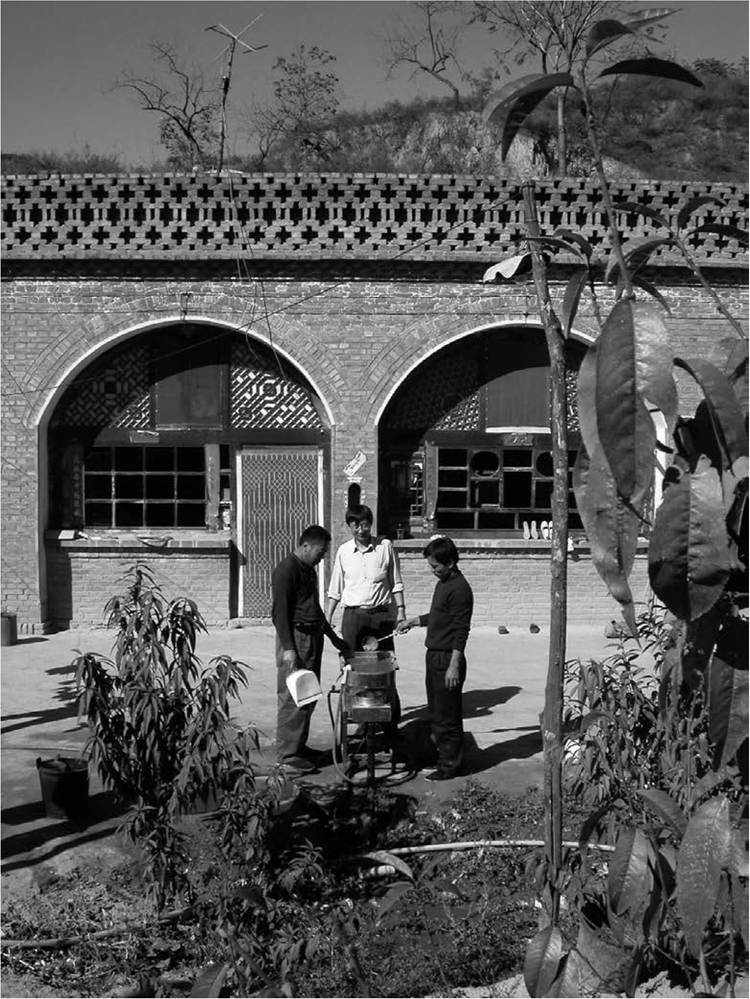
Figure 12.1 Flotation to retrieve carbonized plant remains at Liulin, Shanxi province; Zhijun Zhao in the middle
Prior to the late 1990s, archaeobotanical data were sporadically collected without systematic use of flotation strategies (washing soil from excavations to retrieve organic remains: Figure 12.1). The documentation of archaeological plant remains was focused upon taxonomic identification. Chinese archaeobotany (the study of plant remains from archaeological excavations) was initiated at the turn of the 1990s, primarily inspired by international encounters. In 1986, following his visit to the University of Cambridge, Huang Qixu published an article in Nongye Kaogu introducing the flotation system that had been developed in the late 1960s and 1970s by Eric Higgs's group working on the early history of agriculture.[634] A subsequent account was published in the same journal by Xiong Haitang describing his observations during the visit to Nagoya University in Japan. This method was then applied in Liluo in 1992, an excavation led by the Chinese Academy of Social Sciences. Meanwhile, flotation machines modified from that originally designed by Patty Jo Watson in America (the SMAP type) were brought to East Asia by Toronto archaeobotanist Gary Crawford, first to Japan and Korea and subsequently to China. The last two decades have witnessed the widespread application of systematic flotation and the rapid development of archaeobotanical studies. Beijing archaeobotanist Zhijun Zhao (Figure 12.1) has played a pivotal role in encouraging the application of flotation in China. Zhao in 2011 reported on flotation-based archaeobotany at more than 80 archaeological sites across China: about 7,000 soil samples had been processed, and a significant quantity of charred plant remains recovered.[635] This rapid growth in archaeobotanical evidence has been accompanied by qualitative improvements in the analysis and interpretation of such evidence.