Material assemblage
In some respects the early Neolithic communities of China occupying similar topographical locations formed a network, their interconnections demonstrated both by the rare but diagnostic materials like jade that passed between them and by their sharing of a common typology in objects such as pottery vessels and stone tools, as indeed their shared cultural name, the Xinglongwa culture, indicates.
Their ceramic vessels are simple in form and dominated by the bucket-shaped pot.1[708] They are sand tempered, brownish in colour, and made with the coiling method. Typical decorations on pots consist of belts of net-patterns, zigzag patterns, mat impressions, ‘V' shape patterns, and point impression zones from top to bottom. The tool assemblage consists of both refined bone tools and stone tools.20 The former include awls, needles, spoons, and notched knives and notched fish spears embedded with micro- lithic blades. Stone tools include chipped stone hoes, spades, and knives. There are also a large number of microliths, as blades for notched bone knives and fishing spears. Grinding stones, such as slabs, handstones, mortars, and pestles, constitute an important part of the tool assemblage.Various studies have explored the functions of the grinding tools and grinding activities at these sites. A physical anthropological study of human
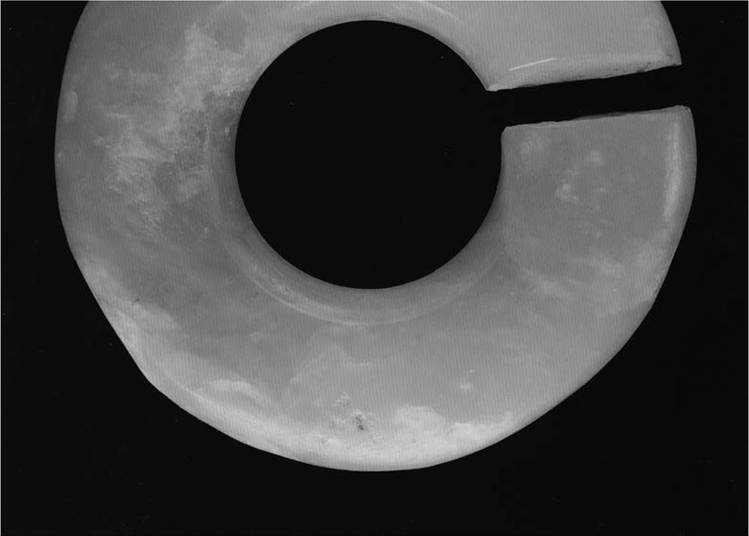
Figure 13.4 Early Neolithicjade slit ring from Xinglonggou I.
skeletons from Xinglongwa culture sites suggests that young females had deformed knees, probably resulting from prolonged kneeling while using grinding stones.[709] Residue analyses of grinding stones from Baiyinchanghan and Xinglonggou have revealed that these tools were indeed used for processing plants, including yams, acorn, and many types of grass.[710]
Xinglonggou has also provided one of the oldest records of jade objects in China (Figure 13.4).
There are many types, including slit rings (the most abundant type), scoop-shaped objects, arcs, tubes, axes, adzes, and chisels. The material, colour, and social significance of the Xinglonggou jade have been discussed by numerous authors.[711] All Xinglonggoujades were made of nephrite, chalcedony, and other soft rock materials.[712] To make such jade objects, various procedures needed to be performed, including percussion, pecking, grinding, sawing, drilling, scraping, and mirror polishing. Traces leftXinglonggou, China
on different types of jades indicate that the shape and size of the object affected the choice of technique. Sometimes more than one technique was employed on the same part of the object: the slits of the slit rings, for example, show differences in the processes by which they were cut, with evidence of both string-sawing and blade-sawing.[713]
In terms of mineral choice for making the ornaments, there appears to have been a colour preference for yellow-green nephrite. More than fifty nephrite jade objects have been recovered from Xinglongwa cultural sites, including many from Xinglonggou, and they are all yellow-green. The choice of this colour is interesting in its distinctness in relation to the colours of local minerals. The latter consist of chalcedony, marble, pyrophyllite, talc, and jasper, materials that were mostly red, black, or white. To date, no nephrite has been found in the Liaoxi region, the nearest nephrite mine being in Xiuyan in Liaoning province, a few hundred miles from Xinglonggou, and its material is yellow-green. It has therefore been suggested that the jades of the Xinglongwa culture were the result of long-distance exchange networks.[714] The original colour of the raw material of Xiuyan nephrite, however, would have been hard to recognize, as the cortex is covered with various false colours hiding the jade's true colour from the collector: it would only have been exposed when the rock was broken up.
Although the preference for green-yellow stone can be traced back to the Palaeolithic in East Asia, scholars have called for caution in automatically assuming that high value was attributed to jade of this colour at Xinglonggou and other Xinglongwa sites. It has been argued that gradations of value were not pronounced during the Xinglongwa period and that the evidence is not strong that the jades themselves were graded in value, whereas in later periods some of the types that exist in Xinglongwa contexts certainly developed into symbolically charged objects.[715]