Pastoral nomads
TIMOTHY MAY
The ancient Central Eurasian steppes stretched from Manchuria in the east to the Alfold Plain in Hungary and Romania in the west. While often conceived of as a flat expanse of plains, the steppes varied considerably.
Although much of it comprised grasslands, the ancient and medieval steppes were broken and subdivided by rivers, hills, mountains, and even deserts across the Eurasian world, thus dividing it into regions with the northern area bounded by the taiga forests of Siberia as well as wetlands.While nomadism varied considerably across the world, steppe pastoral nomads subsisted largely on the dairy products of their animals, such as cheese, yogurt, and cheese curds, supplemented with meat from their animals as well as from hunting. The slaughter of their herds and flocks of horses, sheep, goats, cows or yaks, and camels was carefully controlled, as the animals also served as the nomad's wealth. Many observers remarked on the nomads' love of kumiss, or fermented mare's milk, which the nomads drank in abundance in the summer after the foaling season. In addition to serving as food sources, animal by-products such as wool, hair, and leather provided the nomads materials for most, but not all, of their needs. Trading with sedentary societies was necessary as pastoral nomadism was not completely self- sufficient.1 Often a symbiotic commercial relationship developed with sedentary neighbors. In exchange for animal products and animals (horses in particular), the nomads received silk, grains, weapons, tools, and other luxury items. If trading was not permitted, warfare also served as a means of securing goods. [292]
The nomads did not wander aimlessly in search of grass and water. To prevent overgrazing, families often lived by themselves or in small clusters with their flocks and herds and rotated their pastures seasonally.
Living in round shelters known most commonly as yurts, which were constructed from wooden lattice walls and covered by layers of felt, nomads could easily disassemble their yurts and load them on camels or wagons. The entire camp could pack and move relatively quickly and on short notice. Tribal migration also occurred when vast numbers of camps moved, often because they had been displaced by a more powerful neighbor.But what is a tribe? Following the example of Rudi Lindner, a tribe is a sociopolitical group based on, but not limited to, familial ties of a real or Active ancestor. The identity is taken from the dominant group where the kinship (if it existed) actually mattered. Membership of the tribe varied through time and as members came and went, both willingly and unwillingly. Nonetheless, as long as the dominant element maintained its hegemony over the subgroups, the identity of the tribe remained that of the ruling element.[293] This is not to say that the ruling elite had complete dominance. Tribal leaders consulted and listened to the concerns of the subgroup leaders. While leaders did not always heed their advice, failing to do so repeatedly undermined the relationship, thus making the subgroups more susceptible to rebellion, or in need of protection from another tribal confederation or perhaps even that of a nearby sedentary power. The position of leader tended to be a quasi-elected one, as the leader needed to demonstrate not only his competence in warfare but also his capability for fulfilling social obligations toward his followers and subjects. Failure to do so usually meant he would be replaced, forcibly if necessary.
The Scythian Era
Covering the Pontic and Caspian steppes, Scythia stretched roughly from the Dniester River to the Amu Darya River (the ancient Oxus River) and perhaps even to the Altai Mountains (see Map 9.1 for a general map of Central Eurasia), although for Herodotus, our primary source on the Scythians, it comprised an area that extended from the Danube to the Don River.[294] As the
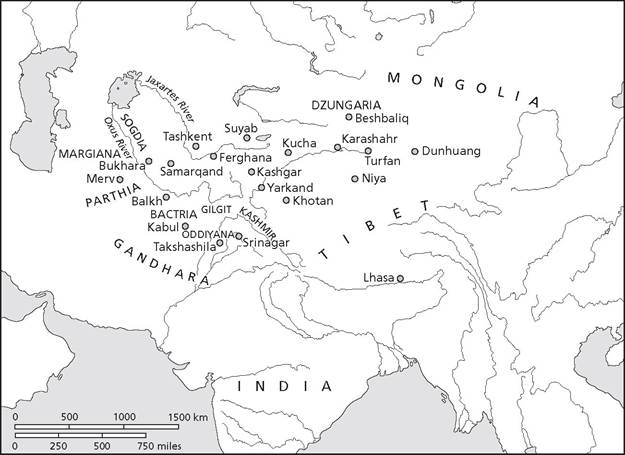
Map 9.1 Central Eurasia
Scythians did not leave any written sources for much of their history, we are reliant on the accounts from sedentary cultures as well as abundant archaeological evidence from thousands of excavated tombs.[295] The archaeological data reveal a culture that filled the above boundaries, but it is not certain if it was a single Scythian entity or several groups who shared a common culture that archaeologists have described as Scythian.[296] Furthermore, it is difficult to pinpoint the ethnic identity although most believe them to have been Iranian who also mingled with proto-Turkic groups that had migrated westward.[297]
The name Scythia is derived from the Greek sources, known as the Saka and Sai respectively in the Persian and Chinese sources.
In most instances these terms seem to refer to pastoral nomads who shared a similar culture which consisted of the use of composite bows, the akinakes - a straight short sword - artistic motifs of stags and other animals in combat, as well as the widespread use of bronze cauldrons and iron metallurgy. They also shared a pastoral nomadic lifestyle with the development of more complex riding harnesses and the creation of deer stones.[298] Nonetheless, it is not conclusive if the Scythians were an empire or a tribal confederation with the name Scythian being derived from the dominant tribe. From the perspective of most sedentary societies, however, it was difficult to determine the substantial differences between most pastoral nomads, although Herodotus certainly tried. Herodotus identified several groups within Scythia, with the true Scythians being the so-called Royal Scythians.[299] Although the primary identity of the Scythians was that of swift-moving horse archers and pastoral nomads, the Scythians also ruled a number of sedentary cultures, particularly around the northern rim of the Black Sea, who identified themselves as part of a larger Scythian milieu and not just as tribute-paying subjects.[300]Yet, the Scythians differed from later pastoral nomads as well. While later nomads would dwell in yurts, the nomadic Scythians dwelt in what might be considered four-wheeled covered wagons.[301] [302] The wagon homes did not preclude the Scythians from more permanent settlements in winter.11 In addition, and perhaps because of their sedentary subjects, the Scythians established hill fortresses (termed gorodische by archaeologists), particularly in present-day Ukraine.[303] They were sizable structures for the Bronze Age, with one at Bcl'sk near Poltava protected by ramparts extending 34 kilometers and enclosing 4,000 hectares. Furthermore, the gorodische served as manufacturing centers for artisans as well as courts for Scythian rulers and trade centers, with Greek merchants coming from colonies on the Pontic coast.[304]
In the 700s, the rise of the Scythians forced the Cimmerians from the Pontic steppes and into the Middle East.
The Scythians invaded the Middle East in pursuit of the Cimmerians, which brought the Scythians into a war between the Assyrians and Medes. IfHerodotus is correct, the Scythian army remained in the region for twenty-eight years before returning to the steppes. In their wake, the Scythians left a collapsed Assyrian Empire as well as an exhausted Median state. Trade contacts and even warfare may have even extended to Egypt based on archaeological evidence of Scythian arrowheads found there.14Significant socio-political changes occurred after their return to the steppes. In the period between 600 and 400 bce, the Scythians were largely a tribal society ruled by a king from the Royal Scythians with their primary camp located near the lower Dnieper River.[305] The monarch received tribute of wealth, goods, and servants from the subject tribes but also distributed wealth to his supporters, particularly his comitatus or war band.
While the Scythians occasionally raided into the Middle East and other sedentary areas, they were not immune from invasion either. In 530 the founder of the Persian Empire, Cyrus the Great (r. 559-530 bce), attacked the Massagaetae living in Mawarannahr or Transoxiana, in an effort to bring them under his domain, but their queen refused his marriage overtures, defeated his armies, and killed him.16 King Darius I (r. 522-486 bce) of Persia also attempted to subdue the Scythians. His invasion of Scythia in 513 went through Thrace, targeting the Scythians in the Pontic steppes. Much to his frustration, his invasion failed as the Scythians retreated into the steppes, occasionally sending troops to harass the Persians. Darius famously complained that they would not stand and fight.17 Eventually, Darius became convinced of the futility of conquering the Scythians and retreated. The Scythians continued to stalk detachments of the Persians, but Darius extracted the majority of his army from the steppes.
During the fourth century, the political environment of Scythia changed significantly. The Scythians asserted their control over the forest groups to the north of the steppe, accessing the fur trade. Political centralization increased so that the Scythian tribes became firmly united under one king, Atheas, as opposed to earlier arrangements of a titular king who worked in conjunction with the leading figures from the other tribes. The increase in wealth from the fur tribute from the forest tribes and the Greek demand for wheat facilitated the greater centralization. As a result, agriculture became an important part of the Scythian economy in the late fifth century.18 The increase in wealth, which included Greek payments for wheat in gold and silver, often worked as art, increased the sedentarization of the nomads, particularly the aristocracy who served as mediators. To facilitate trade, King Atheas minted coins and established a true city at Kamenskoe Gorodische.
In addition, King Atheas sought to expand his power and influence into the Greek world. With his borders reaching the Danube, he invaded Thrace on several occasions. Atheas' empire-building ceased, however, when he encountered another rising empire. In 339 bce, King Philip of Macedon defeated the 90-year-old King Atheas. Although the Scythians lost some of their Danubian territory, they still controlled much of the steppes in the vicinity. As a testament to Atheas' state-building skills, the rest of the Scythian kingdom remained stable after his death.
The region between the Don and Danube rivers became known as Scythia Minor or Lesser Scythia, although Scythian dominance ebbed after invasions by Celts, Getae, and Sarmatians in the second century.[306] By this period the Scythians in the region ceased to exist as an identifiable group, but Scythian primacy remained in Greater Scythia, although much reduced, stretching from the Bug River to the Dnieper River and centered on the Crimean peninsula.[307] The grain trade with the Mediterranean world remained a vital part of the economy, thus retaining the kingdom's agricultural base.
While the Scythians were no longer at their height, they possessed military power under King Scilurus in the second century, as demonstrated by his conquest of the Pontic Greek colonies such as Cherson in an effort to remove middle men in the trade. In addition to minting his own coins, Scilurus also built a fleet to challenge Greek control of the Black Sea.[308]1 In the face of this threat, the Chersonese and other Greek colonies appealed for aid from Mithradates VI Eupator, the King of Pontus, located on the southeastern shores of the Black Sea. After three expeditions, the Scythians finally relinquished their control of most of Chersonese territory. Cherson remained under Scythian threat until 63 bce, when a Roman army under Platinus Silvanus defeated the Scythians.[309] Further Roman actions reduced the Scythians to a minor threat. Only with the arrival of the Goths in the third century c e did the Scythians cease to exist as an identifiable polity and people, as they mixed into the Gothic population.
Sarmatians
The Sarmatians or Sauromatae appear in the sources in the 500-300s bce.At least from the time of Herodotus, the Sarmatians coexisted with the Scythians, but nomadized to the east of Herodotus' Scythia. Although it is not clear if they were a subset of Scythians, the Sarmatians were an Iranian pastoral nomadic group and spoke an Iranian dialect similar to Scythian.[310] The Sarmatians interacted with the Scythians frequently as the Sarmatians nomadized between the Don and Volga rivers, although by the sixth century some had crossed the Don River and found pastures near the Sea of Azov and may have been subject to Scythian dominion. These interactions tended to be amiable encounters, as evidenced by the Sauromatae joining the Scythians against Darius.[311]
While the Sarmatians were similar to the Scythians, they had access to less wealth, as seen in the Sarmatian kurgans (burial mounds).[312] The range of Sarmatian culture can be easily traced through their kurgans. By the second century ce, cultural artifacts show more homogeneity than in the Scythian period. Social differentiation did occur with a defined aristocracy and the comitatus apparatus, but a well-developed or defined state does not appear.
The initial Sarmatians appear to have been primarily nomadic, but with increased contact and domination over Scythian areas they acquired sedentary populations, and some Sarmatians may have settled down as well. It should be noted, though, that the Sarmatians received less, or were more resistant to, outside cultural influences compared to the Scythians and were more isolated than them at least in the fifth and fourth centuries bce.
As noted previously, there is less gender hierarchy among nomads. The early Sarmatians were even more egalitarian, with some evidence of a matriarchal framework for at least some Sarmatian groups. Among all Sarmatians, women served not only in political and governance roles but also in the military. Indeed, the Massagetae may have been Sarmatian and not Scythian in identity, as they were ruled by a queen. Herodotus attempts to explain the unique situation of the Sarmatians by noting that they originated as the children of Scythian men who lived with the Amazons somewhere in Central Asia.[313]
By the fourth century, subgroups within the Sarmatians also became identifiable, such as the Alans, Aorsi, Iazyges, and Roxolani. Owing to population increases, pasture limitations, and pressure from eastern nomadic groups, the Sarmatians begin a mass migration across the Don River into the Pontic steppes in the 200s, severely disrupting the Scythians, which contributed to their failures against Mithradates. From the Pontic steppes, the Roxolani raided into Crimea and threatened Roman Danubian provinces. Another faction migrated south to the steppes north of the Caucasus Mountains.[314] Some of the Sarmatian movements were due to internecine conflict rather than external threats. For instance, in the foothills of the Caucasus Mountains the Aorsi and Siracae fought each other as well as joined opposing sides during the Roman-Pontic War, with the Aorsi siding with Rome. Both were weakened, which allowed the Alans to dominate the Caucasus steppes in 50-60 ce.[315]
Although the Sarmatians' demise as a major power came by the fourth century ce, their influence did not vanish. The arrival of the Goths in the third century signaled their death knell. While the Sarmatians were incorporated into the larger Goth body, they retained some distinct identity. With the appearance of the Huns in the Pontic steppes in 375 ce, the remaining Sarmatians were absorbed.[316] Only the Alans successfully maintained a separate identity by which they became known rather than as Sarmatians. While they often fought allied with and against the Huns, they remained somewhat apart, possibly because they could retreat to the fastness of the Caucasus Mountains. The influence of the Alans remains apparent today, as Ossetians and Kabardians claim them as their ancestors.
Although ethnically, culturally, and linguistically related to the Scythians, Sarmatians differed from the Scythians in military apparatus. The Scythians were primarily horse archers using tri-lobed arrows, often dipped in venom or hemlock so that even light wounds would be deadly. For close combat they used spears and their famous akinakes swords, but as they were lightly armored, they typically eschewed close combat and preferred to use archery in combat. The Sarmatians also used light horse archers, but were known to use infantry too. More importantly, even the most undiscerning sedentary opponent could identify the Sarmatians by their use of cataphractarii or heavy cavalry. Armed with a lance and dressed from head to toe in armor consisting of metal plates sewn to leather or cloth, the Sarmatians were described as being dressed in dragon scales.[317] Armor found in kurgans indicates that only the wealthiest Sarmatians wore metal armor. Less prosperous warriors wore similar armor, but with either bone or leather scales. Owing to their armor, the horses of the Sarmatians also differed from those of the Scythians. By the late Sarmatian period, the horses tended to be larger and increasingly grain fed, possibly reflecting a less pastoral and perhaps semi-agricultural society or control of sedentary populations who provided grain.[318] Indeed, the Sarmatians influenced the Goths' use of heavy cavalry, which served as the predecessors of heavy cavalry in Europe.
The Xiongnu and Hunnic period
Although Scythian and Sarmatian culture stretched across much of Central Eurasia, in the eastern steppes there arose a distinctly non-Indo-European culture. Several groups dwelled in the Mongolian steppes with very little sustained contact with Chinese civilization until the fifth century bce.[319] There is no indication that any group achieved significant superiority over the others until the fourth century when several pastoral nomadic groups emerged in eastern Central Eurasia. Located in the Ordos Loop of the Huanghe River, the Xiongnu eventually dominated much of the steppe south of the Gobi Desert. The Chinese referred to the nomads in eastern Mongolia as the Donghu or Eastern Barbarians. Both the Xiongnu and the Donghu were Altaic groups - forerunners of the Turks and Mongols.[320] The two other groups, the Yuezhi and the Wusun, who probably both spoke Indo-European languages, lived to the west in the modern Chinese Gansu province and the Gobi Desert beyond (see Map 9.2).
As the Xiongnu had more interaction with the Chinese states to the south and even joined them in their wars, scholars have a better understanding of their history than that of the Yuezhi or Donghu.[321] The leader of the Xiongnu ruled the tribal confederation through a royal clan and held the title of shanyu (supreme ruler), although leading figures from other clans had the potential to assume the leadership position. By the time the Xiongnu enter the Chinese sources, they were pastoral nomads in the strictest sense but also maintained ties with sedentary cultures, such as Chinese states, as well as with other nomadic groups. Some agriculture also existed among the Xiongnu, although it is not clear if it was conducted by the Xiongnu themselves or by sedentary subjects.
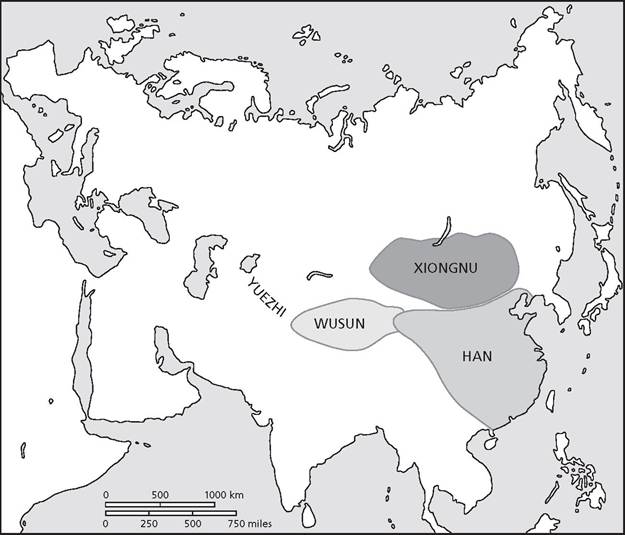
Map 9.2 Xiongnu homeland
Despite the formidable capabilities of the Xiongnu military, in 214 bce the armies of Shi Huangdi of the Qin Dynasty (221-206 bce ) defeated them and drove them north of the Huanghe River, shattering Xiongnu supremacy in the southern steppes.[322] Although the practice of building defensive walls existed during the Zhou era (1046-256 bce), Shi Huangdi promoted the fortification of the Ordos Loop not only as a defensive measure against the return of the Xiongnu but also to claim territory, demarcating a clear sedentary zone.[323] Complete Xiongnu collapse, however, was staved off by Shi Huangdi's death in 210 and the subsequent demise of the Qin Dynasty.
After the Xiongnu returned to the Ordos Loop, they reached their peak under Maodun. During the period of weakness between 214 and 210, Maodun's father and the shanyu of the Xiongnu sent his son as a hostage to the Yuezhi, intending to make another son his successor. Maodun stayed with the Yuezhi for four years before escaping back to the Ordos during the chaos of a Xiongnu attack on the Yuezhi.[324] His humiliation as a hostage motivated Maodun never to allow a similar situation to arise. He swiftly rose to power by developing a highly disciplined bodyguard, which he used to usurp the throne by assassinating his father.[325] With a young and inexperienced ruler leading the Xiongnu, the Donghu sought to take advantage of the situation but met defeat when they encroached on Xiongnu pastures in the Gobi Desert region - a traditional dividing line between the steppes.
With the threat of the Donghu nullified, Maodun took his revenge on the Yuezhi and drove them from former Xiongnu territories west of the Ordos.[326] With the southern steppes under Xiongnu control, Maodun then expanded north to dominate all of present-day Mongolia and extended his influence into southern Siberia. His expansion north of the Gobi allowed Maodun to access both the gold mines of the Altai and the Siberian fur trade (see Map 9.3).
All of this was possible for three reasons. The first was that Maodun created a highly disciplined army that gave him a considerable advantage over all of his opponents. Secondly, it took several years for China to stabilize after the Qin collapse in 210 bce. Finally, with his enemies subdued and his southern border secure due to the absence of a powerful Chinese state, Maodun used his wealth to stabilize his control of the nomads. Once he had conquered all of the nomads, however, he could no longer exploit them in order to sate the demands of his followers. In need of additional wealth, he turned his gaze to China. The Xiongnu had no desire to rule China, but raided it in order to extract wealth as well as to offer a release for his followers who, if left to their own devices, might attempt to break away from Maodun' s control.
In 206 bce, however, the Han Dynasty (206 bce - 220 c e) stabilized China. In his initial years, Emperor Gaozu could do little but attempt to fend off Xiongnu raids. By 201, with his control over China secure, Emperor Gaozu responded to the raids by invading the steppes. As would be a trend for most of Chinese history, advancing into the steppes against the nomads ended in disaster. The Xiongnu simply retreated, luring the Han deeper into the steppes and extending their lines of communications and supplies. A third of the Han army died from exposure alone. The Xiongnu constantly harassed
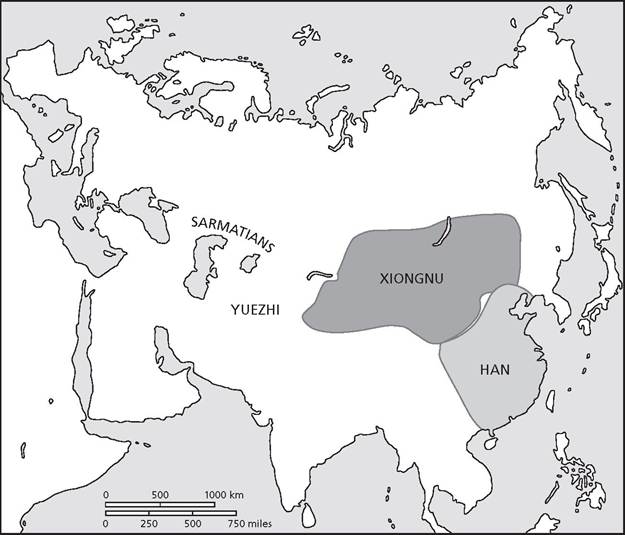
Map 9.3 Xiongnu at their height
the Han but never engaged in a full battle until the Han reached their breaking point. Gaozu eventually found his camp besieged. He could neither go forward nor retreat without risking destruction. Thus in 198, Gaozu began negotiations with what became known as the Heqin treaties.[327] The result of these treaties was that the Han agreed to send regular gifts of wine, silk, grain, and other goods to the Xiongnu. In addition, a royal princess was sent as the shanyu’s bride. The Han also recognized that the territory north of the Han northern defenses was that of the Xiongnu, and the Han would not encroach on it. In return, Xiongnu would not attack. This peace treaty lasted sixty years.
Although the Heqin treaties appeared as a protection racket, it was much more complex. From the shanyu’s perspective, it provided a largesse to assist his followers, which provided him leverage over otherwise independent-minded tribal chieftains and prevented their raids on China and internal feuds. The Han also benefited as it promoted trade. Although it is uncertain if this trade with the central government was greater in value than the goods sent to the Xiongnu, the border trading posts prospered. In the long term, the Han believed they would achieve the upper hand, as the lack of raiding would sap the Xiongnu's martial abilities. Another tactic was the use of a royal princess. Marriage to a royal princess gave immense prestige to the Xiongnu nobility. As the princess also arrived with a retinue, the Han also saw this diplomatic tool as a way to sinicize the Xiongnu by introducing Han culture and practices to them and thus “civilize” the Xiongnu. While it may have been somewhat successful in terms of the Xiongnu becoming more adept at diplomacy with the Han, it is difficult to determine whether it was the influence of the princesses and their entourages or simply more contact with the Han government that did it. In either case, rampant sinicization did not occur on the levels that the Han envisioned. Nonetheless, these trade arrangements were cheaper than war, particularly the logistics involved in invading the steppe.[328]
With the Han neutralized, Maodun then turned his attention to the Yuezhi and launched a series of campaigns, led by his son Jizhu, in 175. The Xiongnu victories in 162, after Maodun's death, over the Yuezhi split them into two groups and gained the Shanyu Jizhu modern Gansu as well as most of the oasis cities of Xinjiang.[329] The Large Yuezhi fled to the Ili Valley where they were absorbed by the Wusun, Xiongnu allies, who nomadized in the Ili Valley or fled to join kinsmen in the south. The Small Yuezhi fled into Mawarannahr or Transoxiana where they eventually became known as the Tokharians, an ethnonym derived from one the Yuezhi clans, who later formed the Kushan Empire.[330] With these conquests, the Xiongnu Empire now added non-Altaic nomads and large numbers of sedentary populations. For the most part, as long as they paid tribute, provided troops, and recognized the shanyu as their ruler, they were left to their own devices.
In addition to the merchants and agriculturalists in Xinjiang, the Xiongnu also ruled over agriculturalists in Mongolia. It is not clear exactly who these people were, but they grew millet, barley, and wheat as well as constructed workshops. Maodun clearly developed a strategy for these agriculturalists, as the ones in the Orkhon Valley were located near his winter camp. In addition, other settlements existed, such as the one near Ivolga (modern Ulan Ude), in which some houses had heating ducts under the floors. Although the Xiongnu settlements were not on the same scale as those of the Scythians, it appears that the Xiongnu understood that sedentary cultures had their benefits and could make them less dependent on the Han. This is further evinced by the fact that the Xiongnu collected tribute and traded not only with the Han but also with sedentary cultures in Siberia, the Ferghana Valley, and Xinjiang, thus providing them with a wide variety of goods and even foods such as grapes. This allowed them to also serve as the major intermediaries and protection for trade between the Han and other regions.
Xiongnu military supremacy allowed them to maintain hegemony over such a far-flung empire rather than a well-structured bureaucracy. The Xiongnu fought largely as horse archers, but wore armor. The Xiongnu were actually more technologically advanced than their nomadic rivals or even the Han cavalry in that they used stirrups, which provided the Xiongnu with two major advantages. The first was that it is much easier to mount a horse with stirrups than without. The second is that it made archery more accurate. The traditional method of riding in Mongolia has been by almost standing in the saddle and using the legs as shock absorbers. In doing so and by timing the shot when the horse's hooves are off the ground, the archer was able to shoot much more accurately and with a more powerful bow than one who just sat on a horse, as the archer uses more muscle groups while standing. In addition, Xiongnu used not only bone and bronze weapons and tools but also iron materials, which gave them an edge over many other nomads and Siberian groups while keeping them on par with the Han.
With their control of trade and military supremacy, the Xiongnu constituted a threat that the Han Empire could not abide. During the reign of the Han Emperor Wudi, the Heqin tribute system deteriorated. For the Han, the demands became too onerous not only in terms of material goods but, more importantly, in terms of shame for the state. Wudi planned military offensives against the Xiongnu but realized that the Han army alone could not defeat the Xiongnu. Thus in 138, he sent an envoy named Zhang Qian west in an attempt to forge an alliance with the Yuezhi, now resettled along the northern banks of the Amu Darya, which failed. He also sought to improve the stock of the Han cavalry by acquiring the legendary blood-sweating heavenly horses.[331] This desire for horses also reflects the problems the Han faced with the Heqin treaties. As China lacks the mineral selenium in its soil, a necessary mineral for the proper raising of horses, the Han were dependent on outside sources for large numbers of horses. The Xiongnu and other nearby nomads traditionally supplied them through trade. However, with the Heqin treaties and Xiongnu dominance, they could dictate the terms of trade and the quality of the horses that went to China. Without good mounts, the Han army had little chance of success against the nomads.
While Zhang Qian was away, Wudi ultimately decided to launch an offensive, against the advice of his advisors. The cost was great as they planned for a one-hundred-day campaign. Previous campaigns failed as the Han tried to crush the Xiongnu in one blow. By switching to a gradual plan, the Han found success.[332] The Han forced the Xiongnu north of the Gobi in 127 through a sustained effort and then occupied the Gobi. With more walls and irrigation works, the Han occupation of the Ordos found success with the Huanghe as a definable border. Taking advantage of their victories, the Han also established a presence north of the Huanghe River and gained control of the Gansu corridor when the local Xiongnu submitted after repeated attacks by Han armies. As with the Ordos Loop, the Han secured the region with settlers and military colonists reaching Dunhuang by 104 bce. Yet, despite two Han victories north of the Gobi in 119 bce, Wudi could not crush them. With these events, southern Mongolia (south of the Gobi) became a neutral zone of sorts occupied by pastoral nomads who turned to the Han for aid against Xiongnu aggression. This threat declined as the defeats fractured the Xiongnu into western and eastern divisions, but it remained a threat. Indeed, Han control of their far western territories was dependent on the cooperation of other nomads. With Wusun aid, the Han could control modern Xinjiang, as they did in 71 bce, but when the Wusunjoined the Xiongnu after 23 ce, the Han lost control.
Nonetheless, Xiongnu declined in the face of Han expansion, as these losses stripped the Xiongnu of not only territory but also tribute, from both the Han and nomadic groups and the oasis towns that were formerly Xiongnu subjects. Furthermore, the Xiongnu saw fractures within their own ranks. By 54 ce clear divisions arose among the Xiongnu based on proximity to Han influence. The southern Xiongnu turned to Han patronage against their northern brethren and submitted to the Han emperor.
Thomas Barfield describes this as the Inner Frontier Strategy in which one steppe group moves closer to China and looks for protection and in return sends hostages and tribute (horses).[333] The Inner Frontier Strategy was employed most frequently, and was necessary, when a state of civil war occurred in the steppes. Chinese empires utilized it as an effective way of controlling the steppes as well as creating a buffer zone that allowed them to play one nomad against the other. The nomads, however, were not passive actors in this strategy, no matter how the Chinese viewed their own machinations. For the nomads, the Inner Frontier Strategy provided them with time, protection, and resources to regroup against their rivals. This benefited the southern Xiongnu in additional ways as well as the southern Shanyu Huhanye, who became one of the most powerful individuals in the Han Empire - just below the emperor.
The northern Xiongnu, led by Shanyu Zhizhi, tried to also find similar accommodation with the Han, but the Han declined their offer of submission. With the southern Xiongnu in their sphere of influence, the Han rightly saw no benefit and only added expenses. In 45 ce the northern Xiongnu killed a Chinese envoy, which led to war. With their southern Xiongnu allies, the Han successfully advanced north, defeating the northern shanyu. He fled west and invaded Sogdia. Sogdia then appealed to the Han for assistance, to which the Han complied and sent troops who defeated and killed Zhizhi.
The southern Xiongnu now controlled Mongolia. The shanyu's wife, Wang Zhaojun, a Han princess, assisted relations with the Han by establishing tribute missions and preventing war. Furthermore, with turmoil in the Han Empire, the Shanyu Huhanye successfully restored the Xiongnu Empire to its former height.[334] After his death famine and civil war returned, causing the Xiongnu to fragment. Although the Xiongnu continued to exist, they lacked the power to control the entire steppe.[335]
The Huns
Before long another confederation arose from the former vassals of the Xiongnu, which resulted in the westward exodus of the Xiongnu. As they moved across the steppe, their identity changed. Scholars do not know exactly what occurred, but the Xiongnu merged with other disparate pastoral nomads and formed a new confederation known as the Huns, although this may have been what the Xiongnu called themselves.[336] The Huns were an amalgamation of Altaic (both proto-Turkic and proto-Mongolian) and Indo-European nomads. The cultural affinity with the Xiongnu is clear, as archaeological evidence shows a connection with Xiongnu culture found in Mongolia and Inner Mongolia. The Huns reached the Aral Sea by 160 c e but remained on the steppe between the Ural River and the Ili Valley for over a century. Not until the fourth century did the Huns begin a massive migration that propelled them into Central and South Asia, the Middle East, and Europe.
By 50 ce, the Yuezhi in Central Asia had transformed Sogdia and Bactria first by destroying the Greco-Bactrian kingdoms when they fled from the Xiongnu and the Wusun and then establishing the Tokharian Empire, and finally transforming into the Kushan Empire that eventually included parts of Uzbekistan, Afghanistan, Pakistan, and much of northern India. The empire collapsed by the end of the third century, leaving the region without a powerful central authority. To the west the Sassanian Empire arose and nibbled at the fringes of the former Kushan Empire. A larger and more devastating threat, however, emerged in 350 when one branch of the Huns, known as the Chionites in Latin sources, invaded and conquered Sogdia and raided the Sassanian borders. By 400 ce, Bactria and part of northern India fell to them as well. Here the Huns stabilized and became known to us as the Kidarites or Kidara, named after their leader Kidar.[337]
This dynasty was short-lived, as it fell to a new wave of pastoral nomads known as the Heftal, and in some sources as the Hephthalites or White Huns.[338] The origins of their name, particularly the color aspect, remain a mystery. Controlling Sogdia, Bactria, as well as much of modern Xinjiang, the elites gradually became semi-nomadic, holding court at fixed locations, and moving to the hills and mountains to escape the heat, while the majority of the Hephthalites remained nomadic. From their position in Central Asia, the Hephthalites raided Gupta India as well as Sassanid territory. Although conflicts on the Sassanid border were frequent, the Sassanids saw value in hiring them as mercenaries as well as giving them refuge during power struggles. Ultimately, however, the Sassanids defeated the Hephthalites in the 560s by allying with another steppe power - the Turks.52
While the Huns were active in Central Asia, another branch crossed the Volga River in 360 and then proceeded to conquer and incorporate the Alans and the rest of the Sarmatian groups. Their migrations caused the Goths in the Pontic steppes to migrate toward the Roman Empire. Hunnic attacks became more frequent, and by 375, augmented by the Alans and other Iranian nomads, the Huns dominated both the Pontic and Caspian steppes.
From the Pontic steppes, the Huns menaced three empires. By marching through the Caucasus Mountains, the Huns attacked the Sassanians. Their ties to the Chionites are confirmed by the fact that the attacks appear to reveal some coordination between the two groups. The Eastern Roman Empire determined that they made useful mercenaries, particularly to counter the Sassanid horse archers. Yet this employment opportunity did not exempt the East Roman Empire from attacks either.[339] Under King Rua, the Huns raided the Balkans and even attacked Constantinople. Under this onslaught, the Eastern Roman Empire provided the Huns with a subsidy (or tribute) of 700 lb of gold and opened frontier markets for them. While this staved off most of the attacks, the Huns extended their rule to the Baltic Sea and moved into the Alfold Plain of modern Hungary in 433.
Rua's death in 433-432 did not significantly change the status quo. The Byzantines still paid an annual tribute of approximately 700 lb of gold and permitted border markets in order to forestall raids. Owing to this largess, Rua's nephews and successors, Bleda and Attila, successfully maintained control of the Hunnic Empire. The two consolidated their power and invaded the Byzantine Empire only when its attentions were directed elsewhere.
With the success also came rivalry. Attila established himself as the undisputed ruler of the Huns in 445 through fratricide. Despite this, Attila's reign was not secure. Sources indicate that he remained very concerned about the fugitives to whom the Byzantines gave amnesty and that he needed an immense amount of tribute and plunder to keep his subordinates in line.[340] If the Byzantines did not sate his demands, Attila invaded. After an invasion of the Balkans in 447, Emperor Theodosius II agreed to pay 2,100 lb of gold as well as 6,000 lb of gold in overdue payments. While it was an enormous sum, payments such as this were a small portion (2%) of the Byzantine budget.
While the Huns continued to extort wealth from the Byzantines, Attila found less success in the Western Roman Empire because of its increasingly decentralized authority. In 451, Attila led a vast army of Huns and allied groups into Gaul against the Visigoths. At Troyes, Attila found not just the Visigoths but also the Roman army led by Aetius, who had spent considerable time among the Huns. Aetius defeated Attila and forced him to withdraw. The Huns continued to seek conquest and plunder in the Western Roman Empire and invaded Italy in 452. After sacking northern Italy, Attila descended upon Rome. Although legend states that Pope Leo the Great persuaded Attila not to sack Rome, in reality Attila had received word of plague in the vicinity, and in addition the Byzantines threatened Attila's lines of communication. Furthermore, Attila's campaigns were not about conquest, but plunder and convincing the Romans (both east and west) that only regular tribute prevented such raids.
The invasion of Italy was Attila's last great invasion, however, as he died of a hemorrhage on his wedding night in 453. Although the Huns maintained their empire for a few more years, it slowly unraveled without Attila's leadership. The empire depended on Attila's charisma and determination. He had not created any significant structures to hold the empire together after his death. His sons attempted to continue the empire, but without the continual flow of tribute and plunder they found it difficult to hold the confederation together, and the Byzantines decisively defeated them in 466. After this most Huns migrated back to the Pontic steppes where they gradually became absorbed by other groups, although a few bands remained along the Danube in present-day Hungary.
Post Xiongnu world in the east
In the wake of the Xiongnu collapse, the Xianbei confederation filled the power vacuum in the eastern steppes. The Xianbei had been part of the Donghu confederation, joining the Xiongnu after Maodun's victory over the Donghu. During periods of Xiongnu weakness, the Han allied with Xianbei leaders to harass the Xiongnu and also traded with them as part of the practice of using “barbarians to kill other barbarians.”[341]
Although the Manchurian Xianbei replaced the Xiongnu as the major power in northern Mongolia after 89 ce, they were incapable of retaining the same level of central control that the Xiongnu did. The Xiongnu still existed in the southern steppes, occasionally joining the Xianbei in raids. The Han Empire's own policy of using barbarians against barbarians actually accelerated the decentralization of the steppes, creating instability on their own border. With the destruction of a strong Xiongnu state, the Xianbei no longer had a target for their raids. Thus, the Xianbei turned their attention to the south and raided China.
Under the leadership of their khaghan, Tan Shihuai, the Xianbei carried out annual attacks on China and created a khaghanate that stretched from Manchuria to Zungharia. The use of the term khaghan (a ruler of imperial rank) first appears with the Xianbei.[342] The lack of centralized rule, however, meant that the empire was strictly a construct of his charisma and military success. With his death in 180, the Xianbei Empire fragmented into a number of petty polities throughout the eastern steppes, many of which became involved in the civil wars of the later Han period where the Xianbei served as valued mercenaries.
Although the Xianbei remained nomads on the steppe, a number of Chinese dynasties emerged from Xianbei warlords along the border. Manchurian groups could be nomadic, but they also contained many semi- nomadic elements and often their tribes contained sedentary forest populations. Because of their more intimate familiarity with sedentary populations, the Xianbei successfully ruled sedentary regions even as their nomadic armies allowed them to conquer territory in China. One such example was that of Murong Hui (283-333) who first did this in Manchuria. His realm exported grain to China and also produced silk for commerce.57 His successor, Murong Huang, expanded into China, conquering the Chao kingdom, which had Xiongnu roots, and established the Yen Dynasty. The Yen remained a viable state until 370, when the rulers became too rapacious and caused an economic collapse. Other nomadic groups, such as the Toba or Tabghach, followed a similar route, establishing the Wei Dynasty (386-534), and attempted to straddle a dual kingdom of pastoralists and sedentary agriculturalists.
As the Xianbei and Toba became more focused in Manchuria and northern China, the Ruruan emerged in Mongolia. Their background remains murky, as scholars are unsure if they were of Turkic, Mongolian, or Tungusic origin, although it appears that they were at one point part of the Donghu confederation. Nonetheless, the Ruruan remained a potent force on the steppe and became the Wei Dynasty's most feared opponent. By 394, under the leadership of Shelun Khaghan, the Ruruan coalesced into a formidable power and ruled over a vast territory. Some of his success was due to Wei policy of manipulating nomads near their borders, which left those pastoral nomads weak; the Ruruan, being farther away from Wei influence, dominated these groups as some nomads sought to escape Toba suzerainty. Furthermore, the Ruruan dominated much of Inner Asia in the same manner as the Xianbei and Xiongnu before them, with their dominion reaching into modern Xinjiang, Siberia, and to the borders of Korea.
By the 490s, the Toba's military capabilities had declined, partly because of the increasing sinicization among the elites, which allowed the Ruruan to continue as a power as they recovered from every setback. The sinicization of the Toba-Wei Dynasty caused a rift between the government and the nomads, who felt increasingly disenfranchised. In spite of their fractured society, the Wei still retained enough prestige, as the last Ruruan khaghan, Anagui (r. 520-552), sought an alliance with the Wei. The alliance was shortlived as the Wei collapsed, forming Eastern Wei and Western Wei dynasties, which allowed the Ruruan to assert their authority over the nomadic dependencies of the Wei. The Eastern Wei continued the alliance and paid tribute to Anagui. In fear of the shift in power, the Western Wei secured an alliance with Bumin, the leader of the Turks, a vassal of the Ruruan. The Turks remained loyal to the Ruruan, however, by crushing an invasion from the west against the Ruruan by nomads in 551. It appears that the Turks may have played a significant role in the victory, as the Turks began to assert themselves more and Bumin demanded a royal bride from the Ruruan. When Anagui refused, Bumin successfully requested a princess from the Wei. Then in 552, the Turks defeated the Ruruan, causing Anagui to commit suicide. Over the next few years, the Turks secured their position in Mongolia. Although many of the Ruruan eventually accepted Turk rule, a significant number fled westward and had a notable impact on events in Western Eurasia.
Rise of the Turks
Although Bumin Khaghan led the Turks to success against the Ruruan, his life ended in the midst of destroying the Ruruan. Mughan Khaghan (552-575), Bumin's younger son, came to the throne. Basing their power in the Orkhon River valley of Mongolia, the Turks were heterogeneous ethnically and linguistically, although language became a key identity marker for the Turks. Under Mughan's leadership, the Turks conquered many of the states that bordered China as well as expanding into Siberia, Manchuria, and Central Asia, which brought the Kirgiz, Khitans, and Hepthalites respectively under their control. Mughan's uncle, Ishtemi, carried out the conquest of the western steppes, propelling the remnants of the Ruruan and other nomads to form the Avar confederation in Western Eurasia. The Kok Turk (Blue Turk or Heavenly Turk) Khaghanate now stretched from Manchuria to the Black Sea and perhaps further west, making it the largest steppe empire in history at this point in 568.[343]
To ease the governance of the empire, it divided into two wings roughly around the Altai Mountains and Lake Balkhash.[344] They dominated much of the Silk Roads trade, and the revenue from it helped maintain the empire. Although the Turks had allied with the Sassanids against the Hephthalites, the Sassanids rebuked their trade overtures. The Byzantines, however, were interested in new trade routes through the steppes as the Sassanids blocked most trade coming from the southern Silk Roads. Furthermore, the Byzantines sought potential allies against the Sassanids as well as the Avars.[345] In the east, the Turks had very close and, at times, dominating relations with various Chinese dynasties between the Han and Sui periods, during the reigns of Mughan and his successor and young brother Taspar. This changed some during the Sui period (581-617) when the Sui effectively challenged Turk military supremacy in northwestern China.
Although Ishtemi ruled the western portion of the Turk Khaghanate as the Yabghu Khaghan or junior khan, it was not independent as the eastern half of the empire remained the political center. This model of dual-governance influenced numerous steppe states throughout history, including the Karakhanids and the Mongol Empire. The risk, which affected virtually all steppe empires, was that it could lead to independent appanages, which is what occurred with Ishtemi's successor and son, Tardu (567-603), who also then attempted to usurp the eastern halfs traditional supremacy.61 The eastern portion of the empire never recovered from Tardu's actions and remained in a truncated form until 630 when it fragmented for good.
The western portion of the empire continued on after Tardu's death. Tun Yabghu Khaghan (618-630) and Heraclius of the Byzantine Empire pragmatically renewed their alliance against the Sassanids. Tun Yabghu also established a capital at Talas in Central Asia and maintained cordial relations with the Tang Empire in China. Although his reign was a high point, many nomadic leaders viewed his rule as favoring his sedentary subjects and not the nomads. Several revolts erupted and led to his assassination in 630. His successors could not reestablish control and the Turkic empire collapsed into a number of tribal confederations.[346]
In the east, the Turkic decline was brief. Under the leadership of Kutlugh Khan (682-691), the Turks returned to dominance as the Second Turkic Khaghanate. Dissatisfied with living under Tang dominance, he and his sons spent most of their time establishing their dominance over other Turkic tribes in Mongolia as well as non-Turkic tribes in Siberia and Manchuria. The establishment of the khaghanate was completed under Kutlugh Khaghan's successor, Qapaghan Khaghan (691-716), who stabilized the empire after its rapid growth.
Unlike the previous empires, this khaghanate left extensive records from the Turkic perspective on monuments throughout Mongolia, written in a runic script. While the various Khaghans provided much-needed leadership, a large amount of their success also came from the brilliance of Tonyukuk, a Chinese-educated Turk who first entered the service of Kutlugh Khaghan. He advocated the return to the steppe, arguing that the previous Turkic states had declined because they sinicized, and urged the Turks to maintain their culture and identity at all costs.
He recommended the Turks remain independent of the Chinese - both geographically and culturally. Tonyukuk objected to the building of a capital city as this provided a target for the Tang. He also argued that Buddhism and Daoism undermined their martial skills.[347] Tonyukuk did not advise isolation, but maintained they should follow the tradition of extracting benefits from China through trade, and raid if necessary. Tonyukuk believed that they could then hold the confederation together through the distribution of luxury goods to leaders. This had been standard practice on the steppes, but leaders too often had been seduced by the wealth of China and placed themselves in a more subservient role.
Many of Tonyukuk's warnings were directed to Bilge Khaghan (716-734), who found the symbols and luxury of Chinese imperial legitimacy attractive. Ultimately, Tonyukuk's wisdom prevailed, as he argued that the Turks' strength was their mobility. Bilge Khaghan learned this fact quickly as he quelled numerous rebellions among his nomadic vassals. Aided by his uncle, Kul Tegin, Bilge Khaghan emerged as perhaps the most successful khaghan, expanding the empire to the Syr Darya and almost to Tibet. Unfortunately, the empire unraveled not long after the death of Kul Tegin in 731. With
Bilge's death in 734, his sons failed to hold the state together, and they were overwhelmed by truculent vassal tribes in alliance with the Tang.[348]
Ramifications of the Turks
After the demise of the Hunnic Empire, the Byzantines were able to expand their influence in the steppes. The Danube was once again their frontier, often protected by nomads hired as mercenaries. At the same time, the Byzantines viewed the nomads as neighbors and sometimes refugees, yet still realizing that they could be a threat.[349] During the reign of Emperor Justin II (r. 565-578), the Byzantines also established trade ties through the Crimean with local powers such as the Turkic Onoghurs, who controlled the Ural trade routes in the wake of Hunnic collapse.
The rise of the Turks upset this balance. As the Kok Turks expanded into the Caspian steppes, others were forced westwards into the Pontic steppes, among them Oghur Turks, a group different from the Oghuz Turks who settled in the Caspian steppes.[350] The two most well known among these groups in Western Eurasia were the Kutrighur and Utrighur. Although identical in terms of culture, language, and Turkic identity, the Kutrighur and Utrighur engaged in frequent warfare. While both moved to the Pontic steppes, due to the strife over pastures and other issues, the Kutrighur relocated to the Danube area. Generally speaking, neither groups caused the Byzantines too much concern. However, after the Kutrighurs pillaged the Balkan provinces on several occasions, Emperor Justinian (527-565) formed an alliance with the Utrighurs. Afterwards, the Kutrighurs sought the favor of the Byzantines. This arrangement allowed the Byzantines to manipulate Kutrighurs and Utrighurs to their profit.[351] This system worked well until 557 when the Avars arrived and incorporated the Kutrighurs and Utrighurs into their polity.
The Avars
After the rise of the Turks in Mongolia, many Ruruan groups fled westward to stay ahead of the Oghuz Turk expansion, but also defeated other groups to augment their numbers. The Avars, as they became known, never accumulated enough power to successfully challenge the Kok Turks. As the Avars entered the Pontic and Danubian steppes, nomads who did not find refuge in the Byzantine Empire came under their dominion. By this point, the Avars could no longer be considered the Ruruan but a confederation comprised of numerous Turkic and other Altaic groups along with Iranian and Germanic steppe groups.
In 558, they sent an embassy to the Byzantines and caused quite a stir with the way they plaited their long hair on both sides of their head, which fashionable Byzantines adopted.[352] [353] Additionally, the Avars brought new military technology into the region - the stirrup and the saber. From the Byzantines, the Avars demanded the usual types of gifts as well as fertile land. Although a treaty was made, the Avars received only gifts and not land. The Byzantines desired them as an ally to control the steppes yet also threaten the Sassanid Empire through the Caucasus passes.
Relations with the Byzantines soured as the Avars formed new alliances and operated in conjunction with the Lombards in Central Europe in 568. Eventually, even the Lombards feared the Avars and migrated to northern Italy. One factor in the decline of cordial relations between the Avars and the Byzantines was the appearance of the Turks in Western Eurasia. In 568, the Turkic yabghu Tardu (referred to as Tourxanthos in the Greek sources) contacted Emperor Justin II and referred to the Avars as runaway slaves, thus delegitimizing Avar claims to the title of khaghan.[354]°
With the arrival of the Turks, the Avars pressed into Central Europe and settled in the Alfold Plain. Under the leadership of Bayan, the Avars reached their apogee and began raiding the Byzantines' Balkan possessions.[355] The Byzantines resorted to Barfield's Outer Frontier Strategy: paying them 80,000 gold pieces and to be allies, although the Byzantines viewed the Avars as subordinate due to their status as fugitives from the Turks and the gold was simply a gift, not tribute.[356] The Avars proved to be unreliable allies as they allowed their Slavic subjects to raid and settle in Byzantine lands.[357]
The Avars remained a significant power until 623 when their influence began to decline. By the 620s, more Avars became sedentary. This weakened them militarily as they lost control of Central Europe when the Wends revolted. Yet even after this setback, their decline was not immediately apparent until after 626 when their Constantinople in league with the Sassanids failed. The military loss was sufficiently grave that the Avars lost not only substantial military resources but also prestige. Their downward spiral continued as they lost their dominance over the Slavs in the Balkans. Emperor Heraclius (610-641) then launched an offensive in the Balkans, aligning the Byzantine Empire with the Turks against the Avars. After this, the Avars remained a threat, but not on such a grand scale. They raided to the east and west, but in the end their power was forever shattered when Charlemagne's forces defeated them in an eight-year war (788-796), forcing them to submit to Frankish authority.
Khazars
The Khazars began as the western-most province of the Kok Turks and dominated the Caucasus steppes while also becoming the most powerful Jewish state until the rise of Israel in the twentieth century. Situated between the Black and Caspian seas, Khazaria served as the primary intermediary between the Turks and the Byzantines. As part of the western Turk empire, they began raiding south of Derbend in 627, just after the Byzantines had fended off the Avars. By 628, the Khazars brought much of Transcaucasia under their sway. With the resources procured from Transcaucasia combined with their northern pastures and increasing control of the Pontic steppes along with their trade with the Byzantines, the reason that the Khazars weathered disorder and even emerged as a powerful kingdom as the rest of the Turkic empire collapsed is clear.
The rise of Islam, however, paused Khazar expansion. The Arab irruption into the Middle East threw the region into confusion. The Sassanid Empire collapsed before them, and the Byzantine Empire, exhausted by virtually a century of war with the Sassanids, lost Syria and Egypt. Soon the Khazars were neighbors with the dynamic Islamic Umayyad Empire. Hostilities quickly rose between the two states with attacks launched by both sides. Neither side gained much initially, although Khazar troops reached Mosul after destroying an entire Umayyad army in 730. An Arab army, however, under the future Caliph Marwan II (744-750), led a massive army into the heart of Khazaria, bypassing their fortifications, and sacked the Khazar capital of Itil. They pursued the khaghan up the Volga and forced him to convert to Islam. Umayyad domination was elusive, however, as they could not control the steppe with tenuous lines of communication. Almost immediately, the khaghan recanted his conversion.[358]
By the time the Umayyad Empire collapsed during the Abbasid Revolution in 750, the Khazars had not only reestablished their strength but extended their power from Khorezm on the Aral Sea, dominating the Pontic steppe. Their southern border with the Abbasid Caliphate (750-1258) was secured when the second Caliph, al-Mansur, arranged a marriage alliance between one of his governors and a Khazar princess.
With no major threats and secure trade routes, Khazaria flourished. The Khazars encouraged sedentary Slavic settlers to establish towns and farms so they could benefit from them as well while maintaining their military supremacy, which allowed them to control and extract tribute from the Bulghars and the Rus' to the North. Gradually, however, their commercial activities became more important, particularly in dealing with the Byzantines. They gained Crimea from the Byzantines by denying them wheat and other goods.
While the Byzantines lost Crimea, they attempted to influence the Khazars through the spread of Christianity in Khazaria. The Khazar elite, however, went in a different direction and converted to Judaism in 837-838.[359] For decades they had extensive contact with Jewish merchants. Some had converted not long after Marwan's invasion in the eight century, perhaps as a rejection of Islam. The Khaghan, however, did not convert until 861, and Judaism became largely a religion of the elite. Some commoners might have converted, but they became largely Christian or Muslim or retained their shamanic beliefs.
The conversion was largely due to the influence of Bulan, a military commander or bek. His success in introducing the new religion gave his position a new significance resulting in the rise of a dual kingship in the ninth century. The khaghan became more symbolic, while the descendants of Bulan carried out the day-to-day business as the khaghan bek or isha, who commanded the army and had the real power. While the Khaghan had a sacred status, he could be replaced if necessary.76
While the conversion may have stymied Byzantine and Islamic influence in the court, like the Uighur conversion to Manichaeism, it created a gap between the elite and the common Khazars. This disaffection affected the Khazars detrimentally in all areas. Their military ceased to be dominated by Khazar nomads and was increasingly dominated by other Turks or Muslim mercenaries, although it remained the only standing army in the region. Turkic vassals, known as Pechenegs, also increased their autonomy as the Khazars weakened.
In the early tenth century, there was little reason to think the Khazars would disappear as a power, with a professional military and government which used Turkic runes. Indeed, the state operated more efficiently than ever. However, it also lost the ability to police the steppe. As the nomads were no longer tied to the rulers, they no longer assisted the khaghan willingly. This was not simply due to the nomads' resentment of the conversion, but the fact that the khaghan and elite paid more attention to commerce than tradition. At the same time, the Pechenegs in the Pontic steppes and the Magyars in the Danubian Alfold Plain emerged as threats that raided Khazar territories. The Pechenegs were so disruptive that the Byzantine Emperor Porphyrogenitus (r. 913-959) viewed them as the dominant force. Eventually the Khazars lost the Pontic steppes and were confined to the territory between the Black and Caspian seas. In their own territory the Alans began to assert themselves; possibly because they converted to Christianity they did not want to be ruled by Jews. In essence the Khazars were losing territory and saw their trade routes cut and a loss of income. Bulghar benefited from this. It also converted to Islam and ceased to be a vassal of Khazar, diverting its trade to the Middle East through Central Asia. The Rus' also became a threat, sailing down the rivers and raiding. As a result of the loss of the Volga trade and also ongoing chaos in the form of Rus' and Pecheneg attacks, the Khazars never recovered.
Uighurs
The Uighurs Khaghanate rose in Mongolia in 744 out of the ashes of the Second Turkic Khaghanate. The dominant member of the Tokuz Oghuz (nine tribes) confederation, the Uighurs followed the now predictable pattern of stabilizing Mongolia and then expanding so that their influence reached into Tarim Basin and Ferghana Valley by 800. Contrary to the views of Tonyukuk, the Uighurs were more open to outside influence, both pastoral and sedentary. The runic writing system used by the Turks did not carry over, and the Uighurs adopted a writing style from Central Asia derived from Syriac, introduced to them by Sogdian Manichaean missionaries.
Further straying from the wisdom of Tonyukuk, the Uighurs also built cities. The most important city was their capital known as Ordu Balik, later known as Karabalasghun, located near the Selenga River in the Orkhon Valley of Mongolia. Control of the Orkhon valley became very important to legitimizing any confederation, and the practice dated back to the Xiongnu period.[360] Although Ordu Balik started simply as the royal camp, which is the meaning of the name, the camp became a permanent site with a sedentary population inhabiting it all year round and as a commercial center on the Silk Roads.
The Uighurs preferred to trade with the Tang for luxury goods rather than raid. They had accepted Tang “suzerainty,” but in the late 700s it was primarily a facade. In the 750s, the Tang suffered a number of defeats and faced a growing number of rebellions, forcing the weakened Tang government to rely upon Uighur military support. The Uighurs took advantage of Chinese weakness in the 750s to renegotiate tribute agreements. The Tang had to comply or risk losing Uighur support. As a result, the Uighurs crushed several rebellions including that of An Lushan.
The Uighurs also enter history as the only state to adopt Manichaeism as a religion. Their encounter with Manichaeism occurred with their occupation of Loyang during the An Lushan rebellion. In 762, Yidijian Khan converted to Manichaeism and brought a number of Sogdian Manichaeans back to Ordu Balik.[361] Over time, a large number of Uighurs converted as well. No one really knows why Yidijian converted to a religion that promoted vegetarianism, among many things, that went contrary to nomadic practices. Perhaps he had a moment like that of Asoka and regretted the destruction his armies caused. A more cynical and pragmatic Yidijian may have seen it as a way to counter possible Chinese acculturation that came with Buddhism and Taoism, as the Khazars did in the face of Muslim and Christian missionaries. Whatever the reason, the religion did not establish deep roots among the Uighurs, as the religion's ban on dairy products did not really allow for the average nomad to develop a deep attachment.
Manichaeism may have hastened the fall of the Uighurs. Scholars and observers from the Uighur era thought it made them too “soft,” in the same manner that Tonyukuk worried about Daoism and Buddhism. In addition, not all of the Uighur confederation accepted the religion. It appears to have been the cause of Yidijian's assassination, which led to a purge of his family in 779 by his successor Alp Kutlugh. This purge did not eliminate Manichaeism, as it remained influential among the Uighurs in 813.[362] In reality, Manichaeism was a symptom of larger problems. While it is true that the Uighurs lost their vitality, Manichaeism was not the only cause. As with the building of a capital city, the adoption of Manichaeism and the extravagance of the court separated the rulers from the ruled, as with the Khazars. In order to maintain this lifestyle, even before the conversion, the Uighurs focused more on commerce rather than maintaining their military strength. Furthermore, the cities served, as Tonyukuk warned Bilge Khan, as an easy target for rebels and invaders. The Kirghiz rebelled in 821 and eventually destroyed the Uighurs in 840. Famine and a series of bad weather events between the two incidents left the Uighurs too weak to oppose the Kirghiz rebellion. The Kirghiz forced the Uighurs out of Mongolia, but the Uighurs found refuge in their former domains in the Tarim Basin, where they established a new kingdom that lasted well into the fourteenth century as part of the Mongol Empire.
Central Eurasia on the eve of the millennium
As the second millennium began, the Central Eurasian steppes were quite different. Although much of the social culture of the pastoral nomads remained similar, the material culture differed as did the identity of the nomads. Whereas Indo-Europeans once held sway over the steppes to the Altai Mountains, now Altaic groups of Turkic identity dominated smaller Indo-European populations. The stirrup and trousers were now standard features for all societies in Eurasia, yet the deadly horse archer remained largely a steppe phenomenon, but one that spread in the eleventh century as Turks entered the Middle East in large numbers.
In addition, the Central Eurasian steppes lacked a single dominant entity. The Mongolian steppes in the east were partially dominated by the Liao Empire of Manchurian origin, while the Pontic and Caspian steppes were ruled by confederations of Turkic groups such as the Pechenegs and Kipchaks, with the Kipchaks eventually becoming the preeminent pastoral nomadic group in the twelfth century. With the collapse of the Khazar Empire, however, the nomads lacked a central authority and ceased to be a major power, although they remained formidable. Nonetheless, the steppes remained crucial in world history for trade routes that crisscrossed it and nomads serving not only as customers but also as guards and suppliers of caravan animals. The importance of the pastoral nomad did not end, though, but reached its peak with the rise of the Mongol Empire in the thirteenth century.
Further Reading
Primary sources
Herodotus, The Histories, trans. Robin Waterfield, Oxford University Press, 1998.
Honey, David B. (ed. and trans.), The Rise of the Medieval Hsiung-nu: The Biography of Liu- Yuan, Bloomington, in : Research Institute for Inner Asian Studies, 1990.
Sima Qian, Records of the Grand Historian: Han Dynasty II, trans. Burton Watson, New York: Columbia University Press, 1993.
Records of the Grand Historian: Qin Dynasty, trans. Burton Watson, New York: Columbia University Press, 1993.
Secondary sources
Babcock, Michael A., The Night Attila Died: Solving the Murder of Attila the Hun, New York: Berkley Books, 2005.
Barfield, Thomas J., The Perilous Frontier: Nomadic Empires and China, 221 BC to AD 1757, Cambridge, ma: Blackwell Publishers, 1992.
Benjamin, Craig C. R., The Yuezhi: Origin, Migration and the Conquest of Northern Bactria, Turnhout, Belgium: Brepols, 2007.
Brook, Kevin Alan, The Jews of Khazaria, Lanham, md : Rowman and Littlefield Publishers, 2006.
Christian, David, A History of Russia, Central Asia and Mongolia, Malden, ma : Blackwell Publishing, 1998.
Curta, Florin, “The Earliest Avar-age Stirrups, or the ‘Stirrup Controversy,'” in Florin Curta (ed.), The Other Europe in the Middle Ages: Avars, Bulgars, Khazars and Cumans, Leiden: Brill, 2008, pp. 297-326.
Di Cosmo, Nicola, Ancient China and Its Enemies: The Rise of Nomadic Power in East Asian History, Cambridge University Press, 2004.
Gardiner-Garden, John R., Apollodoros of Artemia and the Central Asian Skythians, Bloomington, in: Research Institute for Inner Asian Studies, 1987.
Golden, Peter B., An Introduetian to the History of the Turkic Peoples: Ethnogenesis and StateFormation in Medieval and Early Modern Eurasia and the Middle East, Wiesbaden: Otto Harrassowitz, 1992.
“The Peoples of the South Russian Steppes,” in Denis Sinor (ed.), The Cambridge History of Early Inner Asia, Cambridge University Press, 1990, pp. 256-84.
Heather, Peter, Empires and Barbarians: The Fall of Rome and the Birth of Europe, Oxford University Press, 2010.
The Fall of the Roman Empire: A New History of Rome and the Barbarians, Oxford University Press, 2005.
TIMOTHY MAY
Heinrich-Tamaska, Orsolya, “Avar-age Metalworking Technologies in the Carpathian Basin (Sixth to Eighth Century),” in Florin Curta (ed.), The Other Europe in the Middle Ages: Avars, Bulgars, Khazars and Cumans, Leiden: Brill, 2008, pp. 237-62.
Ivantchik, Askold I., “The Funeral of Scythian Kings: The Historical Reality and the Description of Herodotus (4.71-72),” in Larissa Bonfante (ed.), The Barbarians of Ancient Europe: Realities and Interactions, Cambridge University Press, 2011, pp. 71-106.
James, Edward, Europe's Barbarians, ad 200-600, Harlow, UK: Pearson, 2009.
Kelly, Christopher, The End of Empire: Attila the Hun and the Fall of Rome, New York: W. W. Norton, 2009.
Khazanov, Anatoly M., Nomads and the Outside World, trans. Julia Crookenden. Madison: University of Wisconsin Press, 1983.
Lenski, Noel, “Captivity and Romano-Barbarian interchange,” in Ralph W. Mathisen and Danuta Shanzer (eds.), Romans, Barbarians, and the Transformation of the Roman World, Burlington, vt: Ashgate, 2011, pp. 185-98.
Mackerras, Colin, “The Uighurs,” in Denis Sinor (ed.), The Cambridge History of Early Inner Asia, Cambridge University Press, 1990, pp. 317-42.
Melyukova, A. I., “The Scythians and Sarmatians,” in Denis Sinor (ed.), The Cambridge History of Early Inner Asia, Cambridge University Press, 1990, pp. 97-117.
Moses, Larry W., “Relations with the Inner Asian Barbarian,” in John Curtis Perry and Bardwell L. Smith (eds.), Essays on T'ang Society, Leiden: Brill, 1975, pp. 61-89.
Nechaeva, Ekaterina, “The ‘Runaway' Avars and Late Antique Diplomacy,” in Ralph W. Mathisen and Danuta Shanzer (eds.), Romans, Barbarians, and the Transformation of the Roman World, Burlington, vt : Ashgate, 2011, pp. 175-81.
Robertson-Brown, Amelia, “Banditry or Catastrophe?: History, Archaeology, and Barbarian Raids on Roman Greece,” in Ralph W. Mathisen and Danuta Shanzer (eds.), Romans, Barbarians, and the Transformation of the Roman World, Burlington, vt: Ashgate, 2011, pp. 79-96.
Rolle, Renate, “The Scythians: Between Mobility, Tomb Architecture, and Early Urban Structures,” in Larissa Bonfante (ed.), The Barbarians of Ancient Europe: Realities and Interactions, Cambridge University Press, 2011, pp. 107-32.
Sinor, Denis (ed.), The Cambridge History of Early Inner Asia, Cambridge University Press, 1990.
“The Establishment and Dissolution of the Turk Empire,” in Denis Sinor (ed.), The Cambridge History of Early Inner Asia, Cambridge University Press, 1990, pp. 285-316.
“The Hun Period,” in Denis Sinor (ed.), The Cambridge History of Early Inner Asia, Cambridge University Press, 1990, pp. 177-206.
Sneath, David, The Headless State: Aristocratic Orders, Kinship Society, and Misrepresentation of Nomadic Inner Asia, New York: Columbia University Press, 2007.
Somogyi, Peter, “New Remarks on the Flow of Byzantine Coins in Avaria and Walachia during the Second Half of the Seventh Century,” in Florin Curta (ed.), The Other Europe in the Middle Ages: Avars, Bulgars, Khazars and Cumans, Leiden: Brill, 2008, pp. 83-150.
Stadler, Peter, “Avar Chronology Revisited, and the Question of Ethnicity in the Avar Qaganate,” in Florin Curta (ed.), The Other Europe in the Middle Ages: Avars, Bulgars, Khazars and Cumans, Leiden: Brill, 2008, pp. 47-83.
Szadeczky-Kardoss, Samuel, “The Avars,” in Denis Sinor (ed.), The Cambridge History of Early Inner Asia, Cambridge University Press, 1990, pp. 206-29.
Thompson, E. A., The Huns, Malden, ma: Blackwell Publishing, 1999.
Vida, Tivadar, “Conflict and Coexistence: The Local Population of the Carpathian Basin under Avar Rule (Sixth to Seventh Century),” in Florin Curta (ed.), The Other Europe in the Middle Ages: Avars, Bulgars, Khazars and Cumans, Leiden: Brill, 2008, pp. 13-46.
Yu, Ying-Shih, “The Hsiung-nu,” in Denis Sinor (ed.), The Cambridge History of Early Inner Asia, Cambridge University Press, 1990, pp. 115-81.