Regional study: Baktria - the crossroads of ancient Eurasia
JEFFREY LERNER
The country that the Greeks called Baktria (Bactria) (see Map ιι.ι) with its double-named capital of Baktra-Zariaspa (modern Balkh) was located on the plain that comprises northern Afghanistan from the Hindu-Kush mountains in the south to the Amudaria (Greek, Oxos) River in the north and west, and the Badakhshan mountains in the east.
Archaeologists have divided the country into two regions: an eastern one from the Kunduz River to the Badakhshan mountains and a central one centered on the oases of Baktra and Tashkurgan. Along with the Amudaria, the main rivers of the region - Kokcha, Kunduz, Tashkurgan, Balkh, Sar-i Pul, and Shirin Tagao - served as the chief conduits of trade and commerce with the Indian subcontinent in the south, Central Asia in the north and east, and the Middle East and Mediterranean in the west as well as allowing for agricultural deltaic oasis settlements to flourish.Stone, Bronze, and Iron ages
Evidence of the earliest inhabitants of northern Afghanistan is dated to the Paleolithic period. Throughout the Stone Age, habitation was restricted to caves at sites like Kara Kamar, Hazar Sum, and Aq Kupruk where the bones of wild animals such as of gazelle, goat, and sheep were found along with tens of thousands of stone tools fashioned into hand axes, scrapers, burins, cores, and points from quartz, limestone, and other materials. By the Mesolithic period at Tashkurgan, Dara-i-Kur, and elsewhere, wheat and sheep indigenous to the region had been domesticated, as had barley and goats that had originated in western Asia. The Neolithic period, as in Egypt, India, and Mesopotamia, was one of food surpluses, which led to specialization and the rise of complex societies and eventually civilization itself. Thus, ceramics were manufactured as were tools such as hoes, celts, and polishers of
Downloaded from https:Zwww.cambridge.org/core.
Cornell University, on 07 Jan 2017 at 22:22:54, subject to the Cambridge Core term available at https:/www.cambridge.org/core/terms. http://dx.doi.org/10.1017/CBO9781139059251.013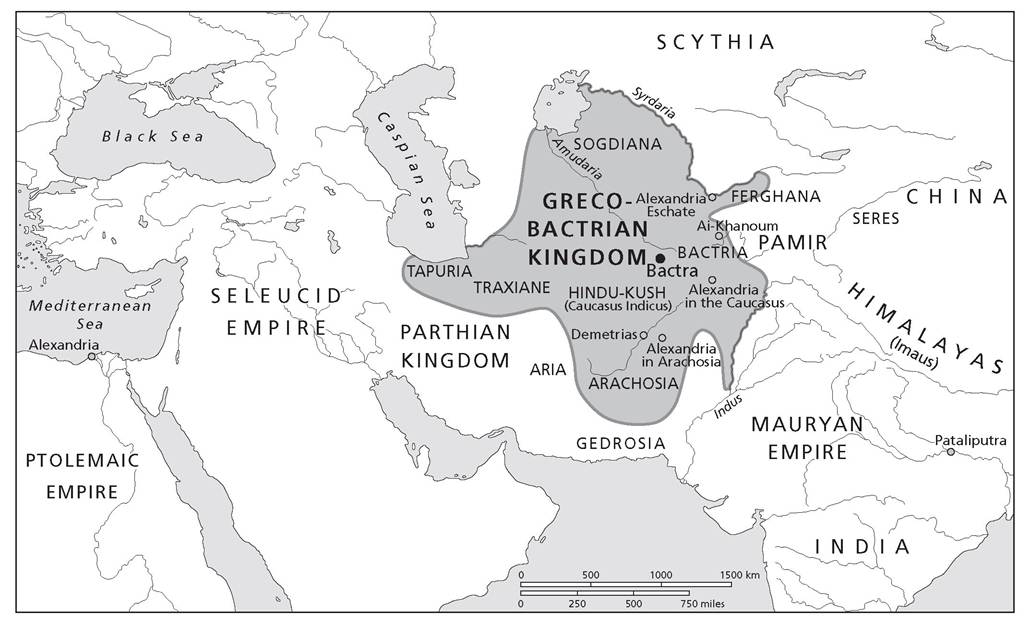
Map ii.i Bactria (Baktria)
limestone, while steatite bowls found throughout the Iranian Plateau testify to the establishment of long-distance trade networks.1
During the Bronze Age (c. 3000-1000 bce), hundreds of desert oasis settlements arose on both sides of the Amudaria. As is the case with earlier periods, much about Baktria's history at this time remains unknown due to the absence of any written record, but what little can be gleaned indicates that it formed part of the Oxos Civilization, or more commonly, the Baktria- Margiana Archaeological Complex (BMAC),[431] [432] which originated in the delta of the Murgab River of modern Turkmenistan in the oasis of Margiana (modern Merv) north of the Kopet Dag range. BMAC encompassed much of Afghanistan and Baluchistan between 2200 and 2000 bce.[433] The inhabitants were sedentary farmers who irrigated their expansive fields to grow wheat and barley, and lived in large oasis towns, such as Sapalli and Dashli in Baktria, with massive towered defensive walls, palaces, temples with fire altars, and private dwellings. BMAC encompasses a range of diverse artifacts of high level, including female statuettes, ceramics, jewelry, seals, silver and gold vessels, ceremonial shaft-hole axes, and bronze tools replete with iconographical features including boars, dragons, and numerous other real and mythical beasts. Throughout this period and in the succeeding Early Iron Age, the economy was based on a symbiosis between pastoralists and agriculturalists, which enabled the sites of Shortugai and later Bala Hissar of Kunduz in northeastern Afghanistan to serve as Indus Civilization centers of trade.
The walled city-fortress of Sapalli may have housed as many as 300 residents. Horse riding and spoked wheels also developed at this time, as did long-distance trade with western Asia, the Indus valley, and the Andronovo culture and its variants to the north, facilitated by the domestication of the camel and animal-drawn carts. In the Early Bronze Age, steppe groups of Indo-Iranian speakers began migrating in a series of waves southward into Baktria and the Iranian Plateau, bringing with them their culture, as the presence of their pottery testifies in the settlements and cemeteries of the Late Bronze and Early Iron Age, ultimately assimilating with the indigenous population. The result was that Central Asia, and in particular Baktria, became the center of a nascent “world system” linking Inner and Outer Eurasia with the Near East, India, and China.[434]Achaemenid Baktria, sixth to fourth century bce
The first written references to Baktria occur after its inclusion in the Achaemenid kingdom.[435] In Darius I's (r. 522-486 bce) inscriptional lists of satrapies, Persian administrative provinces ruled by a governor, or satrap, Baktria (Baktrish) appears as the twelfth conjoined with that of another country, Sogdia (Sugda). Sogdia (modern Uzbekistan and Tadjikistan) was situated between two of Central Asia's largest rivers, the Amudaria in the south and the Syrdaria (Greek, Iaxartes) in the north. Its heartland comprised two river valleys: the Zarafshan (Greek, Polytimetos) containing the city of Samarkand (Greek Marakanda), as signified by the ruins of the site of Afrasiab located east of the present-day city, and the Kashka, south of Samarkand and home to numerous settlements including the site of Erkurgan. The satrapy also included the country of Margiana (Margu) in Turkmenistan, an oasis in the Murghab River delta.
Baktria is mentioned as a fully constituted state by the Greekwriter Ktesias (c. 400 bce), a contemporary of the Achaemenids, fragments of whose work was preserved by Diodorus of Sicily in Book 2, wherein he recounts in his Assyrian history the many achievements of Queen Semiramis (Sammuramat, ninth-eighth century bce): how she aided the Assyrians in capturing the citadel of the Baktrian king Oxyartes, gave birth to Ninyas, son of king Ninos (Shamsi-Adab V [824-811 bce], biblical Nimrod), collected a force in Baktria, and launched an unsuccessful assault against the Indian king Strabrobates.
Elsewhere in Polynaios' Strategika (8.26), she is said to have extended the Assyrian kingdom northward to include the Sogdians and the Sakai. Although it is possible to see in these tales the existence by the seventh century bce of a Baktrian state, no cuneiform evidence survives to lend any support to this notion or even that the Assyrians ever conducted military operations in Baktria, Sogdiana, or India, let alone against the nomadic Sakae in Central Asia. On the other hand, it cannot be ruled out that relations vis-a-vis trade and commerce were established between Baktria and Assyria in the pre-Achaemenid era.Although it remains doubtful whether Baktria is mentioned in the Rig Veda, the Avesta, a work containing Zoroastrian scriptures and the Gathas, or teachings of the prophet Zarathustra (Zoroaster), holds more promise. Zarathustra may have lived as early as the beginning of the first millennium bce. Even if the religion did not originate in Baktria, then very soon after its creation tradition holds that he made his home there and died in 522 bce at or near the city of Balkh. The Avesta was written during the reign of Cyrus (559-530 bce) who promoted the religion throughout the Achaemenid empire. By the late sixth century, it was adopted as the official state religion. Essentially, the religion is dualistic, holding that the endless battle for control of the universe is waged between Ahura-Mazda (Good) and Ahriman (Evil). By following the precepts set forth in the Avesta, people can choose to aid Ahura- Mazda in his battle. Less certain is the contention held by some that Vishtaspa and Hutaosa, whose names are Avestan, were converts to the religion, thereby making their son and future Achaemenid king, Darius I, a Zoroastrian by birth.[436]
The Persian conquest of Baktria and the nearby countries of Central and South Asia were accomplished by Cyrus II (r. 549-530 bce) in 545-539 bce. The events of Cyrus' campaign remain shrouded in uncertainty.
Ktesias reports that hostilities between Cyrus and the Baktrians ended when the Baktrians submitted upon learning that the Median king Astyages had adopted Cyrus as his son. Baktrian troops are also mentioned by Herodotus (7.64) and by Aeschylus in The Persians as having taken part in Xerxes' failed invasion of Greece (480-479 bce) under the command of Hystaspes (Vishtaspa), son of Darius I and satrap of Baktria.The practice of installing a relative of the king as the satrap of Baktria was indicative of Persian hegemony over the region, one that, like the Medes before them, emphasized personal relations between the crown and the local aristocracy rather than the imposition of a formal administrative system. During this period, the amount of land along rivers and canals that was irrigated for cultivation, a practice that began in the Bronze Age, continued to increase, bringing prosperity to the sedentary population. This is reflected in the 360 talents of silver paid annually by the satrapy (Herodotus 3.89) as well as in the growth of settlements in eastern Baktria at Bala Hissar in Kunduz and nearby at Qunsa, Ai Khanoum, and Archi and in the central part of the country at Baktra, Dilberjin, and Altyn Dilyar. In Sogdia the most famous of settlements included Cyreschata (Cyropolis), probably near the modern city of Khojent along the Syrdaria (Iaxartes) marking the northernmost outpost of the kingdom, and Samarkand, where the administrative government of the country was located.[437] It was to this part of the kingdom that exiles of whole towns from other parts of the Achaemenid realm were sent, the most famous of which included an Egyptian village (Herodotus 4.204) and the Milesian Branchidai clan whom Xerxes had transplanted in 479 bce (Herodotus 6.10-20), all of whose descendants Alexander massacred (Strabo 11.11.4, 14.i.5; Curtius 7.5.28-35). Evidence of trade is reflected by the circulation of Greek coins from Asia Minor and the subsequent local production of imitative Greek coins, especially the silver tetradrachmas of Athens, while the famed carpet found in a tomb at the nomadic tomb of Pazyryk in Siberia (probably dating from the fourth or third century bce) passed through this region on its long sojourn northward.[438] The Persians were perhaps responsible for introducing the Aramaic script as the region's first form of writing that was subsequently used as the basis of written Parthian, Sogdian, Khorezmian, and even Kharosthi in northwest India and other parts of Central Asia until the fourth century ce.
The achievement of the Achaemenid rulers due in large part to their Assyrian and Babylonian predecessors, was to administer their expansive kingdom with the flexibility of enabling peace and prosperity to flourish for some two centuries.[439]Hellenistic Baktria, fourth to mid-second
century bce
During Alexander the Great's campaign in Persia, a relative of the Persian king, Darius III Commodanus (r. 336-330 bce), and satrap of Baktria-Sogdia, Bessos, commanded the Baktrian cavalry at the Battle of Gaugamela (331 bce). After the Persian defeat, Bessos had Darius murdered and fled to Baktria with his followers where he assumed the royal title and name of Artaxerxes IV as well as command over the army. In pursuit of the usurper, Alexander crossed the Hindu-Kush and quickly subdued Baktria. With the Macedonians in control of Baktria, Alexander went into Sogdia in pursuit of Bessos. It was here that Alexander encountered a resistance composed of shifting alliances between regional Baktrian and Sogdian rulers and nomadic Saka tribesmen. Bessos was subsequently arrested in Sogdia by his supporters and surrendered to Alexander who sentenced him to death and proclaimed himself as Darius' true successor (Arrian 3.8.3ff.; Curtius 4.6.2ff.). Throughout his Central Asian campaign (329-327 bce), Alexander used Baktria as the base of his operations before departing to India. Sogdia in particular proved difficult to subdue. While Alexander was preoccupied with founding a series of towns and fortresses on the Syrdaria, including Alexandria Eschate, and was battling Saka tribes on the other side of the river in Ferghana, Bessos' successor Spitamenes with a force of other Sakai massacred a Macedonian force outside Marakanda on the Polytimetos River. Alexander spent almost the next two years reducing Sogdia and Margiana, throughout which he founded cities and fortresses, settling in them veterans from his army, and enlisted conscripts and took hostages to serve in the army. Spitamenes was subsequently killed by his allies the Massegetai, who sued for peace. His daughter, Apame, later married Seleukos I Nikator (r. with title of king, 305-281 bce) in Susa (324 bce), a Macedonian general and founder of the Seleukid kingdom, and mother of Antiochos I (r. 281-261 bce, as co-ruler from 292). The last major event of the campaign involved an act of diplomacy when Alexander married Rhoxane (Roshanak), the daughter of the Baktrian nobleman Oxyartes, in 327 bce (Arrian 4.18.ff.; Curtius 8.4.ff.).[440] [441]
When Alexander departed for India, he left behind more than 13,000 veterans installed in various settlements throughout Baktria and Central Asia. Although numerous sites have been excavated, there has yet to be found even one with an inscription bearing its ancient name, including those believed to have been founded by Alexander, so their identities remain largely conjectural.11 By the time of Alexander's death in 323 bce, the local peoples, whom he had appointed as administrators, were replaced by Greeks and Macedonians. The intervening years between Alexander's departure (327 bce ) and the reconquest of the region by Seleukos I (c. 306 bce) is unknown, save the few names of its satraps, Amyntas, Philippos, Stasanor, and eventually its last, Diodotos I. Twice the veterans assigned to remain in the country rebelled, longing to return home, and they were joined by the local population desirous of independence.[442] [443]
Under the Seleucids (c. 306-248/7 bce), Macedonian authority was once again reasserted in Central Asia. Seleukos I renamed Margiana Seleuceia, which upon his death was refounded as Antiocheia after Antiochos I and its walls enlarged to some 250 kilometers. Seleukos entered into diplomatic relations with the Mauryan Dynasty (c. 324-180 bce) of India in c. 305 bce when he signed over to Chandragupta (Greek, Sandrakottas, r. c. 324-301 bce) all claims to any land south of the Hindu-Kush in exchange for a treaty of peace allowing Seleukos to retain his possessions of Margiana, Baktria, and Sogdia north of the Hindu-Kush as well as 500 war elephants. The two likewise exchanged ambassadors, with Megasthenes serving as the Seleucid representative. Seleucid authority over the region created a semblance of cultural homogeneity by making Greek koine the kingdom's lingua franca, introducing a formal currency, and establishing long-distance trade networks stretching from the Mediterranean to Central and South Asia as well as encouraging an influx of colonists who settled throughout Asia.13
During the reign of Antiochos II (261-246 bce), the Seleucid kingdom weakened, allowing the satrap of Parthia, Andragoras, to assert his independence. Shortly afterward, in c. 248/7 bce, he was overthrown by Arsakes I, the leader of the nomadic Parni, at about the same time that the satrap of Baktria, Diodotos I, likewise formed his own kingdom. It was perhaps in this period that Margiana fell under Arsakid control. Not until some four decades later, in 208 bce, did Antiochos III (222-187 bce) attempt to reassert Seleucid control over both countries. Although he enjoyed success in Parthia, Baktria proved more formidable. By the time of his arrival, the kingdom of Baktria had passed to Euthydemos I (c. 220-190 bce) who had overthrown Diodotos II, the founder's son (Justin 41.4.9). For two years (208-206 bce), Euthydemos withstood a siege at his capital of Baktra, until finally Antiochos agreed to a peace. Euthydemos retained his kingdom and formed an alliance with the Seleucid, the negotiations of which were conducted by Demetrios I, Euthydemos' son. When all was settled, Antiochos departed for Syria by way of India and the Persian Gulf, while Euthydemos remained in sole possession of his kingdom of Baktria and Sogdia (Polybios 11.39.1-10).
The history of ancient Baktria is marked by an almost complete dearth of written testimony. Aside from coins the next largest source of information we possess about Hellenistic Baktria comes by way of archaeological finds, much of which was accumulated between the 1950s and 1970s with very little afterward due to the tragic wars that continue to plague Afghanistan. The best-known settlement of Hellenistic Baktria is the city of Ai Khanoum, which probably won formal recognition as either a polis or a politeuma during the co-regency of Seleukos I and Antiochos I (292-282/1 bce). Its founder was a certain Kineas who no doubt served as the royal epistates. During the Greek- Baktrian period, the city grew in stature and importance. Located at the confluence of the Kokcha and Piandj, it was built on a hill and thus divided into two sections, an acropolis and at its base the city proper, which was protected by an imposing wall more than 30 feet high and up to 26 feet thick interspersed with towers. The main gate opened onto an avenue that ran the length of the city, along which one gained access to a theater with seating for 5,000, an arsenal, a gymnasium dedicated to Herakles, a temenos dedicated to Kineas, and a propylaeum that led to a royal palace with a treasury, library, private apartments, and storerooms.[444] Judging by the finds from the site's excavations, the merchants of Ai Khanoum, undoubtedly like those in other cities of Greek Baktria, were involved with long-distance trade networks centered principally with Parthian and Seleucid Iran and India, while contact with China and the Mediterranean and Black seas was less regular.
The death of King Ashoka (c. 272/268-232 bce), grandson of Chandragupta, signaled the decline of the Maurya realm. By 180 bce the Mauryas had been replaced by another Indian dynasty, the Sungas, while political chaos reigned throughout much of northern India up to the Hindu-Kush. What little understanding we have of this period derives chiefly from the coins minted by the successors of Euthydemos I north and south of the Hindu-Kush. Although their chronology and precise genealogical relations remain tentative, the major figures of this period are reduced to a small number of sovereigns - Demetrios I, Euthydemos II, Antimachos I, Agathokles, Pantaleon, Apollodotos I, Antimachos II, Demetrios II, and Menander - who were responsible for setting in motion the events of the ensuing two centuries.
According to Strabo (15.1.27), Demetrios I invaded the lands south of the Hindu-Kush and portions of the Indian subcontinent, perhaps as far as Pataliputra (Patna, India). More than thirty kings, who ruled various principalities between southern Afghanistan and northwest India and created an array of dynastic entities, owed their position to the Euthydemids. Collectively, they are referred to as the Indo-Greeks, while those whose reigns are primarily associated with areas north of the Hindu-Kush are termed the Greek Baktrians, or Graeco-Baktrians. The Indo-Greek kingdoms are most often associated with Alexandria in the Paropamisadai (modern Begram), Taxila in the western Punjab, and Pushkalavati (modern Charsada, Pakistan). When Demetrios I returned to Baktria he was overthrown by a new claimant to the throne, Eukratides I. He quickly dispatched other members of the Euthydemid house in Baktria and established his own dynasty that would last only through the lifetime of his sons: Eukratides II, Platon, and Heliokles I. With his affairs in order, Eukratides I attempted to enlarge his kingdom by reestablishing Baktrian authority over the Indian lands held by the Indo-Greeks to the south. It seems that what success he enjoyed was short-lived, as he found himself pitted against the Indo-Greek king Menander, who was able to offer formidable opposition. In any event, Eukratides I soon decided to return home, but along the way he was murdered by one of his sons. For his part, Menander appears to have enjoyed a long reign. He seems to have ruled from Sagala (modern Sialkot, Pakistan) in the northern Punjab. Menander's kingdom extended from Barygaza in the west to Magadah in the Ganges valley. He is one of only a handful of kings to be mentioned by both classical authors (e.g., Strabo ιι.ι.ι) and Indian authors, notably by the anonymous writer of the Buddhist work, Milindapanha (The Questions of King Menander), which portrays him as a convert and patron of the religion. The last Indo-Greek sovereigns are believed to have been Strato III, whose coins place him in the eastern Punjab in c. 20 ce, and a certain Theodamas of Gandhara (modern Pakistan), known only from a signet ring bearing his name and royal title written in the Indian script of Kharoshthi dated to the first century ce. Both are regarded as casualties of the invading nomadic Indo-Scythians.[445]
The Indo-Greeks never achieved a unified kingdom as they constantly warred with Greek Baktrians, feuded with each other, or battled competing nomadic groups, notably the Indo-Scythians, the Indo-Parthians, and the Yuezhi. The last known descendants of the Indo-Greeks, the so-called Greek-Indians of the western Deccan, were perhaps merchants and appear in a series of Prakrit and Sanskrit inscriptions as Buddhist donors of various rock-cut Buddhist cave temples in the mid-third century ce.[446] The IndoGreek heritage was culturally significant. As early as the mid-third century bce, Ashoka inscribed his Buddhist bilingual inscriptions in Kandahar in Greek and Aramaic; the latter was retained as an administrative language that had been used by the Achaemenids. The skill of the Greek translators reveals their intimate understanding of both Buddhism and Greek philosophy even at this early period. The Greek language, long after the IndoGreeks themselves had constituted a potent political power, was adopted by their successors, like the Parthians, Scythians, and Kushans, as indicated by their coins and inscriptions. Even after the Greek language had become extinct in the second century ce, the Greek script was adopted by the Kushans for writing in their language of Baktrian and remained in use until the Arabic conquests in the ninth century ce. For their part, the Indo-Greeks by the second century bce were using the language of their subjects, as their bilingual coins of Greek and Prakrit written in either the Brahmi or the Kharoshthi script testify.[447] Besides Buddhism, the IndoGreeks, like Heliodoros, the ambassador of Antialkidas, converted to Hinduism. In the first century ce, Hellenistic artists from Baktria and India as well as from the Mediterranean world had fused the conventions of classical art with the Indian artistic traditions of Buddhism to fashion the Gandhara style, such as those depicting images of the standing Buddha. Corinthian columns along with the architectural use of the capital formed part of the decorative repertoire of Baktrian and Gandharan art. The identities of Buddhist, Greek, and Indian deities became fused, as with Herakles and Vajrapani. By the fifth century ce, Hellenistic arts had become so firmly part of Buddhist iconography that it spread well beyond Baktria to Central Asia and even China.[448]
Nomadic hegemony of Baktria, mid-second century bce to first century ce
The history of this period is generally viewed as an interlude marking the transition from the end of Greek rule to the beginning of the Kushan Empire. Much of our knowledge derives from the narrative of Zhang Qian, the ambassador from Han China in the mid-second century bce, which comprises chapter 123 of the Shiji, The Records of the Grand Historian, composed in 109-91 bce. He reports that the tribal confederacy of the Xiongnu (perhaps subsequently known as the Huns of Europe and the Hunas of India)[449] defeated the Yuezhi in the Xinjiang and Gansu provinces, forcing them to move first westward to the Ili River valley along the southern shore of Issyk Kul, then again southwestward through the Ferghana valley (modern Uzbekistan, Kyrgyzstan, and Tadjikistan). From there they conquered Daxia (Baktria) in the south, but settled north of the Gui (the Chinese name for the Amudaria or Oxos River) in Sogdia where their king would eventually establish his capital in the town of Jianshi. During their migration from the Issyk Kul region to Daxia, the Yuezhi displaced a group of Saka tribes (Sai-wang) whom the Yuezhi subsequently followed southward when they, too, were forced to quit the region. Togetherboth groups are identified with the nomads who invaded Greek Baktria in the mid-second century bce. It is a more difficult task to equate these tribes with those mentioned by the classical authors Apollodoros - Asioi, Pasianoi, Tocharoi, and Sakarauloi (Strabo 11.82) - and Trogus - Saraucae and Asiani (Justin, Prologi 41 and 42) - as being responsible for the conquest of Baktria. The problem of identifying the Yuezhi is that it intersects history and language, since they may have spoken the centum Indo-European language variant of Tokharian. Long after their empire disappeared, however, the name survived in the form of Tokharistan, which comprised eastern Baktria and Badakhshan. Sogdia in this period was divided into two spheres, with the Yuezhi occupying the southern portion of the country up to the Hissar range, while the northern section fell under the sway of the nomadic state of Kangju centered on the middle course of the Syrdaria, consisting of a loose federation of small principalities (Hanshu, 96A.3894).[450]
The difficulty of reconstructing the history of this period is due to a dearth of literary sources, while the interpretation of this period's material culture has given way to more questions than answers. Thus, there has yet to be found any Baktrian city, including Ai Khanoum, that had suffered a nomadic onslaught.[451] It is possible that the Sakas entered Baktria in the extreme eastern and western sections of the country but did not conquer it, as that task was left to the Yuezhi. Two Arsakid kings, Phraates II in c. 128 bce and then Artabanos II in c. 123 bce, died fighting the Sakai when they invaded western Baktria and eastern Iran. Another Arsakid king, Mithridates II (c. 12387 bce), affected a peace with the Sakai and, in return for acknowledging his authority, they were permitted to remain in the eastern Iranian district of Seistan. Subsequently, an amalgam of Sakai and Parthians ruled various regions from Seistan across southern Afghanistan to northwest India at the expense of the smaller and less powerful Indo-Greek domains. The Sakai who passed through eastern Baktria had, in the first half of the first century bce under Maues, established a kingdom in northwestern India.[452]
The events that led to the downfall of Greek Baktria indicate that politically there may have been dramatic changes, but those changes are not reflected in the material culture. Zhang Qian's description of Daxia under the hegemony of the Yuezhi indicates that the country thrived economically. He marveled that merchants returned from India laden with goods from as far away as his native China. He regarded the inhabitants of the Daxia to be poor in the use of arms and afraid of battle, but clever at commerce. The Baktrian site of Tillya-tepe dating from the first century ce - based on a coin of the Roman emperor Tiberius found in one of the graves - serves as a kind of time capsule of the ancient world at the dawn of the Silk Roads. More than 20,000 objects were recovered from six graves of a nomadic family. They demonstrate that the tastes of nomadic peoples and their sense of refinement were far more cultivated than previously thought. The inventory of artifacts displays a wide-ranging admixture of styles, including Chinese, Greek, Indian, Iranian, Roman, and Siberian.[453] Politically, the once mighty Greek Baktrian sovereigns were replaced by small, local principalities in places such as Ai Khanoum. Rather than destroying the cities that they had subjugated, the Yuezhi exacted tribute from them, much as the Scythians had done for centuries to the Greek poleis of the Black Sea. If the treasury at Ai Khanoum is any indication, the tribute that these principalities paid was in the form of silver derived from Indo-Greek and Indian punch-marked coins. This resulted in a peaceful coexistence between conquered and ruled. Even the last Greek king of Baktria, Heliokles I (r. c. 125-90 bce), seems to have enjoyed a long reign,[454] although he presided over a greatly diminished kingdom perhaps from his capital of Baktra. This milieu changed only when the trading network south of the Hindu-Kush collapsed because of the depletion in the supply of the silver. Without it no Baktrian city was able to pay the Yuezhi tribute and thus was unable to trade with them. The result was chaos among the five ruling clans of the Yuezhi who must have competed among themselves for a swiftly disappearing share of silver. It may well have been this event that propelled the Yuezhi to cross the Oxos into Baktria in search of new sources of revenue in the mid-first century bce.[455]
Kushan Baktria, first to fourth century ce
It is generally agreed that the Kushans were one of the five tribes of the Yuezhi, among whom some probably spoke Tokharian, mentioned by the Chinese sources.[456] According to the Hou Hanshu (Annals of the Later Han Dynasty), based on the report submitted by the Chinese general Ban Yong in c. 125 c e, after the Yuezhi had settled down north of the Amudaria and had made Jianshi their capital, Daxia (Baktria) was divided into five hsi hou or yabghu (tribal princedoms), perhaps corresponding to the five tribes that constituted the confederacy. After a lapse of more than a century, a certain Qiujiuque (Kujula Kadphises), from the yabghu of Guishuang, became king of the Yuezhi and established the kingdom of Guishuang (Kushan) in the mid- first century ce. He invaded Anxi (Indo-Parthia), captured Gaofu (Kabul), and conquered Puda (Paktiya) and Jibin (Gandhara). He was more than 80 years old when he died and was succeeded by his son Yangaozhen (Vima Takto), who subjugated Tianzhu (India) and appointed a general(s) to administer it. To the north of the Kushan kingdom was another called Kangju, situated on both sides of the Syrdaria. Zhang Qian in c. 128 bce called it a nation of nomads who recognized the authority of the Yuezhi to the south and the Xiongnu to the east. By the second century ce, it had incorporated a significant portion of northern Sogdia, Dayuan (Ferghana), and Yancai between the northern shore of the Aral Sea and the Caspian Sea, thereby controlling an important segment of the northern route of the Silk Roads. It is difficult to know to what degree the Kushans abandoned their pastoral heritage in favor of a more sedentary lifestyle, like the Achaemenids and many others before them. The archaeological record indicates that under Yuezhi hegemony and their Kushan successors, the amount of land brought under irrigation for cities and farms substantially increased, suggesting that the populations of Baktria and Sogdia not only grew but flourished and prospered, while graves attributed to the Yuezhi and early Kushans contain a richer panoply of goods than in previous periods.[457]
Thanks to the Rabatak inscription,[458] the genealogy of the Kushan kings is known from Kujula Kadphises to Kanishka I. Thus, toward the end of the first century ce, the reign of Vima Takto's son and successor, Vima Kadphises, marks the period of the “Great Kushans,” beginning with his reign in the first century ce to those ofhis successors Vasishka I, Huvishka, and Vasudeva I in the third century C e. He minted the first gold coins (dinar) of the kingdom and initiated a heavier bronze coinage (tetradrachma). The Kushans gained control of the southern branch of the Silk Roads at the Indian port of Barygaza (modern Broach), thereby establishing direct mercantile relations with Roman Egypt and indirectly with the Mediterranean world at the expense of the Iranian kingdom of Parthia. He, in turn, was succeeded by the most famous and yet enigmatic of the Kushan rulers, Kanishka I, who is known primarily from legends, coins, and inscriptions. Although he is credited with founding various Buddhist monuments, such as stupas that housed reliquaries, he may not have been a convert, since he is associated with a number of religions that are primarily Iranian in nature, and to a lesser extent Greek and Indian. Judging by his coin legends and inscriptions, he introduced Baktrian as the official language written in a modified Greek script at the expense of the former universal languages of Aramaic and Greek. For example, the stem of the Greek Ρ (rho) was elongated to form P (sho), creating the sound “sh.” Kanishka also inaugurated a new era beginning with the first year of his reign and thus presumably ending the era initiated by the IndoScythian king Azes I in 58 bce. He presided over his kingdom from the capitals of Purushapura (modern Peshawar) near the Khyber Pass, Mathura in northern India on the banks of the Yamuna River, and the Baktrian summer capital at Kapisa (perhaps Alexandria ad Caucasum, now Begram) in the heart of the Kushan kingdom. Like other Kushan kings, Kanishka adopted the title of devaputra (son of the god(s)), perhaps modeled on the imperial Roman title of divi filius or the Chinese regal notion of tianzi (son of heaven). This may explain why a Chinese traveler in the third century could remark that the world is divided into three spheres, each ruled by a “son of heaven”: China, the Kushan, and Rome.[459]
Kanishka's reign also marks the largest extent of the Kushan kingdom, from bordering the state of Kangju in the north on the banks of the Aral Sea southward encompassing significant portions of contemporary Turkmenistan, Kyrgyzstan, Uzbekistan, Tadjikistan, Afghanistan, Pakistan, and northern India up to the city of Varanasi (Benares) on the Ganges River and in the east at Sanchi in Madhya Pradesh. If the resemblance between the frieze of putti in the Gandharan style frescoes at Miran and the frieze on the Kanishka casket from Peshawar are contemporary, then both works were produced during his lifetime. Kanishka might well have been responsible for expanding Kushana authority not only at Miran but also at the oasis cities of Kashgar, Yarkand, and Khotan in the Tarim Basin. He may well have enabled Buddhist pilgrims to travel in safety for a considerable length on the road to China, bringing with them Gandhara art and the Kharoshthi script. The name of the last of the Great Kushans, Vasudeva I, exhibits that not only was he a worshipper of the Hindu god Vishnu, but also the ethnic identity of the dynasty itself was increasingly becoming Indian. His reign of some thirty years was the last in the line of Kushan rulers to enjoy peace and prosperity, as his successors would give way to new powers that arose from within and without the kingdom. The period of the reigns of the “great” kings was followed by those of lesser kings, the last of whom held onto power in small principalities in northwest India.
Under the Kushans, Baktria became the international hub of the “Silk Roads” where people throughout Eurasia traveled bringing goods and ideas on their way to China, India, Parthia, or Rome. Such was the undertaking of a certain Macedonian merchant named Maes Titianos in the first or second century ce, whose information about the lands from Central Asia to China was noted by the geographer Claudius Ptolemy (1.11.7), which he had obtained from his predecessor the geographer Marinos of Tyre. This is the period when in Central Asia, and particularly in Baktria, such disparate religious and philosophical traditions as Buddhism, Christianity, Confucianism, Daoism, Hellenism, Hinduism, Manichaeism, and Zoroastrianism, to name but a few, encountered one another. By the second century ce, diplomatic relations between the Kushans and Rome appear to have become more frequent. Augustus had received an embassy from “India” during his reign, followed by others in the reigns of Trajan, Hadrian, and Antoninus Pius. As early as the reign of Kujula Kadphises in the first century ce, some of his copper coins represent the king on a curule chair similar to the one that appears on Claudius' coins, while the obverse of others bears a portrait strikingly similar to those on the silver denarii of Augustus and Tiberius. Vima Kadphises' gold coins approximate the same weight standard that was employed in producing Roman aurei. In the first and second century c e, the Kushan extension into Central Asia resulted in joint Chinese and Kushan military operations against nomads who mounted raids against merchants on the myriad trade routes and oasis settlements between both countries as well as the exchange of diplomatic gifts between the Kushans and the Han. Kushan gold coins, though initially intended for trade with the Mediterranean world and India, had the unintended consequences of becoming the accepted, universal currency of the Silk Roads.[460] Although military confrontation between the two powers occasionally erupted, it appears not to have been serious, as early in the second century Kanishka was able to found a kingdom at Kashgar in Xinjiang that incorporated the former Chinese dependencies of Khotan and Yarkand. This marked the formal introduction of the Brahmi script into Central Asia. Kushan Buddhist missionaries were likewise active at the Chinese capitals of Loyang and Nanjing.[461]
Kushan coins also reflect this eclectic mix with a pantheon that consists of Iranian steppe, Hellenistic, and Hindu deities alongside those associated with Buddhism, Jainism, and Zoroastrianism.[462] One of the chief beneficiaries of the Silk Roads was Buddhism, whose monks from Parthia and Margiana, Baktria and India followed in the footsteps of merchants as they traveled from India through Central Asia to China by the second century ce. According to the Sarvastivada tradition of Mahayana Buddhism, Kanishka I convened the fourth great Buddhist Council, probably in the Gandharan region of Kashmir, to establish treatises on Buddhist canonical texts.[463] Other Buddhist literary achievements ascribed to Kanishka's reign include works such as Ashvaghosha's, Buddhacarita, or life of the Buddha; tradition has Ashvaghosha acting as Kanishka's personal spiritual advisor in all matters related to Buddhism. By the fifth and sixth centuries, Buddhism had become the established religion throughout Central Asia.[464]
In addition to trade, Kushan prosperity rested on the tradition of supervising workers from village and city to build and maintain large- and smallscale irrigation complexes, particularly those along the Zerafshan, Syrdaria, and Amudaria rivers. New technologies in agriculture, such as the widespread adoption of iron, led to increased productivity, as did a greater diversity of crops, such as cereals, fruits, cotton, and poppy, while wine was now produced as far north as Khorezm and Margiana in the west in sufficient quantities for export, while Ferghana became renowned for its horse-breeding activities.
The term “Kushan art” really represents distinct artistic regions under Kushan domination that over time came to reflect common themes, ideas, and representations rather than a uniform style. Two of the most famous schools were Gandhara in the Pakistani Punjab and Mathura in northwest India. In the Kushan period Buddha at this time was portrayed in human form, whereas previously he had been abstracted as footsteps or a lotus. The Gandhara school was influenced by Hellenistic art, and its artists are noted for their depictions of the Buddha's image, which appears Apollo-like, and episodes connected with his life rendered in a mixture of stucco and grayish schist stone. Further south at the Buddhist center of Hadda in Gandhara, numerous objects associated with Buddhism, such as statues, paintings, stupas, and assorted other monuments, exhibit a brand of Gandhara art that combined Baktrian, Hellenistic, and South Asian styles. The Mathura school concentrated on scenes depicting everyday life and drew from local folk deities. The artists thus created idealized images of the female and male form as well as representations of the Hindu and Buddhist pantheon. Mathura sculpture is readily identifiable by the use of mottled red sandstone. Further north in Baktria, Kushan urban architecture at sites like Baktra, Dilberjin, and Dalverzin-tepe replaced the older Greek plan: cities became rectangular and were built emphasizing new defensive techniques, such that city walls became taller and wider with towers and walkways. The Corinthian capital was transformed into a garden in which lion griffins or zebu bulls roamed or served as the setting of a meditating Buddha. Greek temples gave way to Kushan dynastic cults, while in large urban areas such as Surkh Kotal and Termez, Buddhist monasteries, stupas, and viharas arose as Buddhism began spreading beyond Baktria proper to where missionaries adapted the religion to meet the spiritual needs of its Central Asian converts. The Kushan palace at the summer capital of Begram yielded two rooms filled with an array of items from countries that participated in the trade and commerce of the Silk Roads: Chinese lacquer boxes, bronze Hellenistic statuettes, Roman glass, Indian ivory carvings.[465]
Baktria from the Sasanians to the Hepthalites,
c. 250 ce to 550 CE
The downfall of the Kushan kingdom was the result of the eastern expansion of the Sasanian empire (224-650 ce) of Iran by its founder, Ardashir I (c. 224-240 ce). By c. 230 ce he had conquered Parthia and seized Margiana, Baktria, and Sogdiana from the Kushans in an attempt to re-establish a second Achaemenid kingdom. Under his son, Shapur I (242-272 ce), the western portion of the Kushan kingdom was further reduced when Gandhara fell under his authority. Judging by their coins minted at Balkh and at another possibly in the Kabul valley, a Sasanian governate consisting of fewer than a dozen individuals was installed bearing the title of Kushanshah, “King of the Kushans,” until c. 350 ce.[466] That year marks the beginning of an obscure period in the history of Baktria as a new series of eastern tribes of mixed Iranian and Hunnish (Chinese, Xiongnu) descent overran the Kushano- Sasanian kingdom at the same time as the Huns in the west were invading Europe.[467]
The first to do so were the Chionites who subdued Transoxiana and Baktria and eventually became allies of the Sasanian king Shapur II (309-379 ce).[468] According to the Greekhistorian Ammianus Marcellinus (16.9-19.2), by 358 ce they aided their Persian ally against the Roman emperor Constantius II (317-361 ce) during the siege of Amida whereat the son of the Chionite king Grumbates was killed. The Kidarites, from Kidara the dynasty's founder, ruled an empire that stretched from a portion of Sogdiana, through Tokharistan to Gandhara, beginning at some point between 380 and 430 ce. They, in turn, were followed by the Hephthalites, or White Huns (Procopius, Persian Wars 1.3.1-7), who emerge as the dominant power in the mid-fifth century ce following their successive victories over the Sasanian emperor Peroz (457-484 ce). Their successes allowed them to rule over Central Asia, Korasan, and Afghanistan. Since they adopted Baktrian as their administrative language, nothing is known of their own language. The Hepthalites retained the heavily influenced Sasanian culture of Baktria and allowed Buddhism to be freely practiced in the areas that they conquered. Yet the six and seventh centuries mark the decline of Buddhism not only in Baktria but also in the countries to north and south of it as the religion gave ground to a revitalized Hinduism from India and an expanding Islam from Iran.
Hepthalite power abruptly ended with their defeat by the combined forces of the Sasanian king Kosrow I Anoshirvan (531-579) and an offshoot of the Turkish confederacy newly arrived from their homeland in Mongolia under the leadership of their Khan Sinjibu or Silzaboulos between 558 and 561 ce.[469] The Hepthalite kingdom was evenly divided along the Oxos: the lands to the north went to the Turks, those to the south belonged to the Sasanians, although small Hepthalite principalities remained in the regions of Kabul, Herat, and elsewhere in Afghanistan. The last in the line of Hepthalite rulers appears in Arabic writings as the Tarkhan Nizak dynasty, the most famous of whom led the forces that opposed the Arab invasions of c. 650-710 ce. The dynasty, however, survived for several more decades until the middle of the century.[470] This period of new waves of nomads entering Baktria on their way southward to Iran and India is marked by the decline of large urban areas, most notably in terms of population and political significance. Cities no longer served as the seats of central authority that presided over large regions; for now this function fell to villages and large estates.[471]
While Baktria experienced the political and social upheavals wrought by incessant nomadic migrations and the increasingly diminished power of Sasanian Iran, to the north the mercantile city-states of Sogdiana flourished from the seventh to the eleventh century c e. Buddhism in Sogdiana had all but disappeared by c. 600 ce and for a time was replaced by a profusion of indigenous cults, Nestorian Christianity, Manichaeism, and a local strain of Zoroastrianism, until they too vanished due to an energized Islam that had fused with Persian culture. The city-states of Bukhara and Samarkand became the leading centers of a trade with China that was founded not on the essentials of everyday life but on life's luxuries - rare and expensive textiles such as silk, pearls, jade, horses, exotic animals and birds, plants, even musicians and dancers, as well as gems, spices, ivory, and the always precious metals of gold and silver. To the west on the river delta of the Amudaria along the southern coast of the Aral Sea, Khwarizm (Chorasmia) had long been the beneficiary of trade with eastern Europe via the Caspian Sea and the Volga River. It remains questionable whether Khwarizm formed part of the Kushan empire and to what degree if any the country formed part of the Sasanian kingdom. Near the beginning of the fourth century, the indigenous Afrighid dynasty seized the Khwarizm throne, perhaps becoming a Hepthalite dependency in the sixth and seventh centuries ce, while in 711-712 ce Qutaiba bin Muslim took advantage of the civil war that had arisen in the country and conquered it, by which time Khwarizm had become an Islamic state.[472]
Baktria under Arab rule to c. the ninth century ce
The death of Muhammad (c. 570-632 ce) was followed by the rule of the four caliphs who were charged with the secular and spiritual power of the growing nascent Islamic state. During this period much of the Middle East was subdued by the Muslim armies. In 651 ce the last Sasanian king was killed at Merv (formerly, Margiana), which became their base in the region, as it had been for the Sasanians before them. The conquerors colonized the oasis with Arab settlers in 671, thereby transforming Merv and Khorasan into a bastion of Islamic civilization.[473]
From here the Arabs launched further campaigns, including the conquests of Baktria by 652 ce and by 715 ce Transoxiana, or as it was now called, Mawara'n-nahr - “the land beyond the river,” Amudaria. The assassination of the Muslim army commander Qutayba bin Muslim ushered in a period of internal strife and political weakness that ensued for the next three decades. Tensions finally climaxed in 751 ce at the Battle of Talas (modern Dzhambul) between the army of the Chinese Tang dynasty and that of the Arab Abbasid dynasty as to which civilization, Chinese or Muslim, would determine the fate of Central Asia.[474] Although the battle itself was fought to a standoff, the Chinese retreated, leaving the region under Muslim rule and with it all of the benefits of belonging to the Islamic world. It was conflicts such as these mixed with episodes of religious zealotry that so annihilated the pre-Islamic culture of the region that by the tenth and eleventh centuries almost nothing survived.
Politically, the Abbasid Caliphate (750-1517 ce), just as others before it in Central Asia, would devolve into numerous provincial dominions ruled by a host of different pretenders, including former Abbasid governors, indigenous dynasties, and clans from myriad tribal families fresh off the steppe. Not until the tenth century was the Samanid dynasty (819-1004 ce), so named after its Persian ancestor Saman-khudat from Balkh, able to establish a strong centralized government based on the Abbasid model at Bukhara that promoted peace and prosperity throughout the region and rivaled only Baghdad in the pursuit of cultural and intellectual achievements.[475] Bukhara became one of the world's leading cities, situated as it was along the Silk Roads and serving as an important center of trade and commerce, culture, religion, and learning. Not since the days of the Kushans had there been a government strong enough to curtail civil strife, while at the same time keeping the wealth it collected within the region itself rather than allowing it to be carted away to adorn far-off lands.[476]
Conclusion
As a matter of geographical happenstance, Baktria has always stood at the crossroads of history. It is the place where civilizations begin and civilizations end, forming as it were one of the important meeting points of the Afro- Eurasian landmass where the peoples of Inner and Central Asia, China, the Indian subcontinent, the Near East, and the Mediterranean world encountered one another, sometimes peacefully and sometimes not. Whether through the trade and commerce brought by the Silk Roads, or as the nexus of cultural and religious exchange or even as the natural entry point through which conquerors and would-be conquerors passed, those who settled in Baktria created a society that by its very nature was trans- civilizational. It was a society that was as much multicultural as the environment it sought to tame. This is at the heart of the dynamic of Baktrian society, for the encounters among disparate peoples enabled an intercultural borrowing to exist that resulted in a rich and varied form of society. The history of Baktria, then, is the history of civilization itself.
Further Reading
Anthony, David W., The Horse, the Wheel, and Language: How Bronze-Age Ridersfrom the Eurasian Steppes Shaped the Modern World, Oxford University Press, 2007.
Barthold, W., Turkestan down to the Mongol Invasion, ed. C. E. Bosworth, London: Lowe and Brydone, 1968.
Beckwith, Christopher I., Empires of the Silk Road: A History of Central Eurasiafrom the Bronze Age to the Present, Princeton University Press, 2009.
Benjamin, Craig, The Yuezhi: Origin, Migration and the Conquest of Northern Bactria, Silk Road Studies 14, Turnhout: Brepols, 2007.
Bernard, Paul, “The Greek Colony at Al Khanum and Hellinism in Central Asia; Al Khanum catalog,” in Pierre Cambon and Fredrik T. Hiebert (eds.), Afghanistan: Hidden Treasures from the National Museum, Kabul, Washington, dc: National Geographic Society, 2008, pp. 81-130.
Boyce, Mary, A History of Zoroastrianism, Leiden: Brill, 1982, vol. ii.
Briant, Pierre, From Cyrus to Alexander: A History of the Persian Empire, trans. P. T. Daniels, Winona Lake, in: Eisenbrauns, 2002.
Burstein, Stanley M., "NewLightonthe Fate of Greek in Ancient Central and South Asia,” Ancient West and East 9 (2010): 181-92.
Cribb, Joe, "The Greek Kingdom of Bactria, its Coinage and its Collapse,” in Osmund Bopearachchi, Marie-Franςois Boussac, and Christian Landes (eds.), Afghanistan, ancien carrefour entre l'Est et l'Ouest: Actes du colloque international au Mus'ee arch'eologique Henri-Prades-Lattes du 5 au 7 mai 2003, Turnhout: Brepols, 2005, pp. 207-25.
Cribb, Joe, and Elizabeth Errington (eds.), The Crossroads of Asia: Transformation in Image and Symbol, Cambridge: Ancient India and Iran Trust, 1992.
Cribb, Joe, and Georgina Herrmann (eds.), After Alexander: Central Asia before Islam, Oxford University Press, 2007.
Dani, A. H., B. A. Litvinsky, and M. H. Zamir Safi, "The Kushano-Sasanian Kingdom,” in B. A. Litvinsky, Zhang guang-da, and R. Shabani Samghabadi (eds.), History of Civilizations of Central Asia, Paris: UNESCO, 1996, vol. ιιι, pp. 103-18.
de la Vaissiere, Etienne, Sogdian Traders: A History, Leiden: Brill, 2005.
Fussman, Gerard, "Southern Bactria and Northern India before Islam: A Review of Archaeological Reports,” Journal of the American Oriental Society, 116 (1996): 243-59.
Hill, John E., Through the Jade Gate to Rome: A Study of the Silk Routes during the Later Han Dynasty 1st to 2nd centuries ce An Annotated Translation of the Chronicle on the “Western Regions” in the Hou Hanshu, Charleston, sc: BookSurge Publishing, 2009.
Koshelenko, G. A., "Vosstanie grekov v Baktrii i Sogdiane 323 g. do n.e. i nekotorye aspekty grecheskoi politicheskoi mysli IV v. do n.e.,” Vestnik drevnei istorii 119 (1972): 59-78.
Kuhrt, Amelie, and Susan Sherwin-White, From Samarkand to Sardis: A New Approach to the Seleucid Empire, Berkeley: University of California Press, 1993.
Lerner, J. D., "The Greek-Indians of Western India: A Study of the Yavana and Yonaka Buddhist Cave Temple Inscriptions,” The International Journal of Buddhist Studies i (1999): 83-109.
"Revising the Chronologies of the Hellenistic Colonies of Samarkand-Marakanda (Afrasiab II-III) and Al Khanoum (Northeastern Afghanistan),” Anabasis: Studia Classica et Orientalia 1 (2010): 58-79.
Liu, Xinru, Ancient India and Ancient China: Trade and Religious Exchanges, ad 1-600, Delhi: Oxford University Press, 1990.
JEFFREY LERNER
“A Silk Road Legacy: The Spread of Buddhism and Islam,” Journal of World History 22 (2011): 55-81.
Narain, A. K., The Indo-Greeks, Oxford University Press, 1957.
Raschke, Manfred G., “New Studies in Roman Commerce with the East,” in Hildegard Temporini and Wolfgang Haase (eds.), Aufstieg und Niedergang der romischen Welt: Geschichte und Kultur Roms im Spiegel der neueren Forschung, Berlin: Walter de Gruyter, 1978, pp. 604-1378.
Rudenko, Sergei I., Frozen Tombs of Siberia: The Pazyryk Burials of Iron Age Horsemen, Berkeley: University of California Press, 1970.
Sarianidi, Viktor I., "Issledovanie pamiatnikov Dashlinskogo oazisa,” in E. I. Kruglikova (ed.), Drevniaia Baktriia, vol. I, Moscow: Nauka Publishing, 1976, pp. 21-86.
Sims-Williams, Nicholas, "The Bactrianinscription of Rabatak: a new reading,” Bulletin of the Asia Institute 18 (2004): 53-68.
Staviskij, Boris J., La Bactriane sous les Kushans: Problemes d'histoire et de culture, trans. Paul Bernard, M. Burda, Frantz Grenet, and P. Leriche, Paris: Librairie d'Amerique et d'Orient, 1986.
Vogelsang, W. J., The Rise and Organization of the Achaemenid Empire: The Eastern Iranian Evidence, Leiden: Brill, 1992.
Wiesehofer, Josef, Ancient Persia from yya bc to 650 ad, trans. A. Azodi, London: I. B. Tauris, 1996.