The Mediterranean
CRAIG BENJAMIN AND MERRY E. WI E S N E R - H A N K S
During the last two millennia before the Common Era, new agrarian states and eventually large and complex agrarian empires appeared in the lands bordering the Mediterranean Sea.
The name Mediterranean is derived from Latin and means “in the middle of the earth,” a reference to the fact either that it is almost entirely surrounded by land or that it was deemed to be at the center of the known world by ancient West Afro-Eurasian societies. The Mediterranean Sea is connected by the Hellespont to the Black Sea in the east and by the Strait of Gibraltar to the Atlantic Ocean in the west. The coastline of the Mediterranean is almost 29,000 miles long, and it is upon this extensive littoral that a range of human communities eventually found themselves incorporated into expansive agrarian states and empires.Eastern Mediterranean, c. 1800 - c. 800 bce
The cultural influence of the Assyrians and Egyptians upon smaller groups, particularly the Hebrews, Phoenicians, Minoans, and Mycenaeans, who occupied the coasts and islands of the Eastern Mediterranean, was substantial. The early Hebrews were pastoral nomadic people who spoke a Semitic language and occupied the dry lands between Egypt, the Mediterranean, and Mesopotamia during the second millennium bce. They created a new form of religious belief, a monotheism centered on the worship of an all-powerful god they called Yahweh. Most of our evidence for Hebrew history comes from a series of books gathered together to form the Hebrew Bible (which Christians later adopted and termed the “Old Testament” to parallel specific Christian writings termed the “New Testament”). Reverence for these written texts became a hallmark of Judaism - the religion of the Hebrews. The Bible relates that some Hebrews migrated to Egypt, but in the fourteenth or thirteenth century bce their descendants left Egypt under the leadership of a charismatic visionary named Moses and migrated north to Palestine, on the southeastern shores of the Mediterranean.
This group of Hebrews, now known as the Israelites, organized themselves into a loose confederation of a dozen tribes, which evolved politically into a monarchy that prospered under kings such as David (1000-970 bce) and Solomon (970-930 bce).During the reigns of these kings, the Hebrews constructed an elaborate law code based on a series of rules of behavior, the Ten Commandments, which they understood to have been given by Yahweh to Moses while he was leading the Hebrews out of Egypt. These required certain kinds of religious observances and forbade the Hebrews to steal, kill, lie, or commit adultery. The complex system of rules of conduct built on these provides an intriguing glimpse into many aspects of life, including the status and rights of women in this particular Eastern Mediterranean culture during the first millennium bce. Some Hebrew laws pertaining to the seduction of virgins by men, or the right of men to sell their daughters into slavery, or the fact that divorce was easy for a man to institute but impossible for a woman, suggest harsh societal attitudes toward women. Others, however, seem to provide legal support for women and even imply similar status for both genders. For example, adultery was punishable by death for both men and women. There is no doubt that Hebrew society was patriarchal, with men in charge in public and within the household, but spouses were also expected to support one another. Celibacy was frowned upon - almost all major Jewish thinkers and priests were married - and the bearing of children was in some ways a religious function.
After the reign of Solomon, renewed tribal tensions resulted in the division of the Israelite state into two kingdoms, Israel in the north and Judah in the south. As the Assyrian state expanded into the region, the kingdom of Israel was conquered in 722 bce, and tens of thousand of Israelites were deported and resettled throughout the Assyrian realm, the beginning of the Jewish Diaspora (Greek for “scattering”).
In 586 bce, the New Babylonian Empire of Nebuchadnezzar conquered the southern state of Judah, and thousands more Hebrews were sent into exile. The region and its scattered people thereafter remained under the hegemony of a series of foreign invaders for the rest of the era, notably Persians, Macedonians, and Romans. Although the Hebrews appear to have played a minor political role in the history of ancient Afro- Eurasia, their influence on religious thinking has been profound.To the north of the kingdoms of Judah and Israel, another Semiticspeaking group migrated out of the deserts of Arabia to the shores of the Mediterranean around3000 bce, where they eventually established a series of city-states. Although they referred to themselves as Canaanites, these people are known to world history as the Phoenicians. Like the Hebrews, their political history is relatively insignificant, but their long-term cultural and commercial importance is anything but. Phoenician cities like Tyre, Sidon, and Beirut flourished because of the Phoenicians' expertise at seagoing trade. Phoenician merchants imported basic food and resources, but became renowned for their high-value export goods, particularly their superbly dyed textiles. The most prized of these were textiles dyed purple and red with the mucus of the murex sea snail; this may have been the origin of the word “Phoenician,” which seems to have come from the Greek word for “purple.”
For four centuries between about 1200 and 800 bce, the Phoenicians dominated Mediterranean trade, establishing commercial colonies in numerous locations on the coasts and islands of the middle sea (see Map 12.1). Phoenician fleets, in search of rare and valuable resources like tin and copper (which were used to make bronze), ivory, and precious stones, sailed as far afield as the Atlantic coasts of France, Spain, and Africa, and even the British Isles. In so doing they quickened the pace of commercial activity in the lands centered upon the Mediterranean and facilitated high levels of cultural exchange between the great civilizations and smaller states of the region.
Two other aspects of Phoenician history demonstrate the extraordinary impact that even small players can have upon the stage of world history. They adopted a phonetic alphabet most likely invented in the Sinai Peninsula to write their language, which simplified learning to read and write because the number of characters was much smaller than in writing systems in which characters stood for words or ideas. This proved so flexible that it was later adapted by the Greeks, who in turn passed it on to the Romans, until eventually alphabet writing spread throughout much of the world. And one of their commercial colonies, Carthage, located on the North African coast near modern-day Tripoli, went on to become the capital of a major state that eventually challenged the Romans for control of the entire Mediterranean basin.The Phoenicians also foreshadow a significant historical development that emerged during the chronological period covered by this volume, but that continued to influence historical processes into the modern era, namely the extraordinary dynamism of smaller commercial states. The Phoenicians established a series of purely commercial city-states that were similar in nature to the ancient Greek poleis, the great trading cities of the Indian Ocean, and even the Italian city-states of the early modern era. Because they were focused primarily on trade, commercial city-states were much more innovative than were the great tributary empires. They also tended to
Downloaded from https:Zwww.cambridge.org/core. Cornell University, on 07 Jan 2017 at 22:23:45, subject to the Cambridge Core term available at https:/www.cambridge.org/core/terms. http://dx.doi.org/10.1017/CBO9781139059251.014
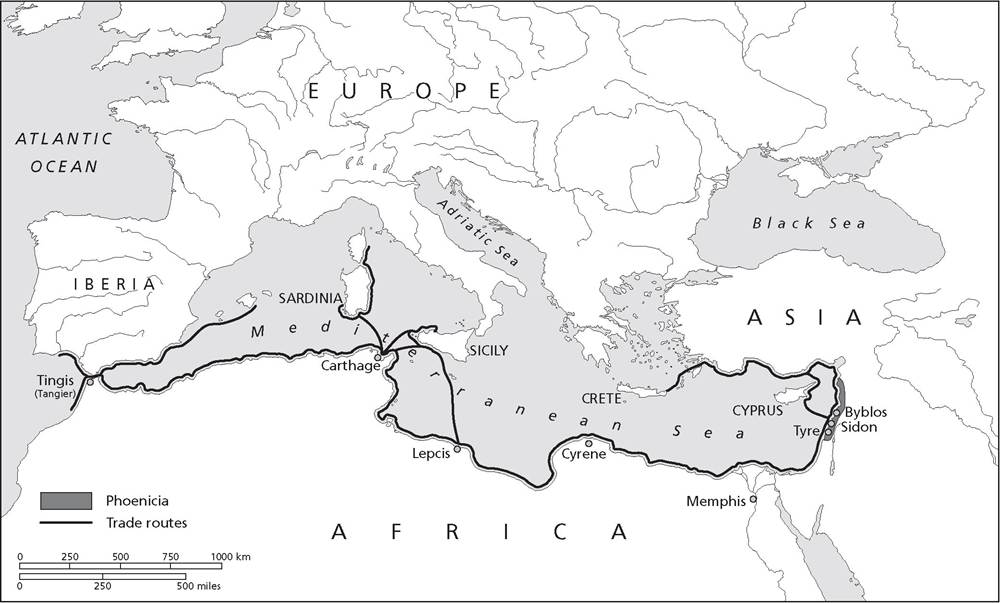
Map i2.i Trade routes of the Phoenicians
engage more actively with trans-regional webs of exchange, because of their own limited internal resources and highly urbanized commercial populations.
Eventually, these often geographically tiny states became politically and militarily powerful enough to challenge and sometimes defeat the vast but sluggish tributary empires.The Minoans and the Mycenaeans,
C. 2700 - C. 1000 BCE
At the same time that the Hebrews were active in Mesopotamia and Egypt and that the Phoenicians were constructing their commercial city-states along the coast of modern-day Lebanon, a complex society emerged on the island of Crete, in the Eastern Mediterranean. Like the Phoenicians, the Minoans (2700-1450 bce, named after their legendary founder King Minos) were active maritime traders, and because of its central location Crete became a major commercial center in regional trade networks. The Minoans copied Phoenician shipbuilding techniques and designs and sent their fleets all over the Eastern Mediterranean, exchanging Cretan olive oil, wine, and wool for Egyptian grain, Phoenician textiles, and regional manufactured goods. The Minoans used the wealth generated by successful trade (as opposed to imperial expansion) to create a sophisticated society, and their wealth attracted raiders.
Among the raiders were people who came from the mainland of the Greek peninsula where a different type of society had developed. Migrants who spoke an early form of Greek settled across the Balkans and Greece after about 2200 bce and built farming communities dominated by defensible great stone fortresses. By about 1650 bce one group of these immigrants had raised palaces and established cities at Thebes, Athens, Mycenae, and elsewhere. These palace-centers ruled by local kings formed a loose hegemony under the authority of the king of Mycenae, and the archaeologists who first discovered traces of this culture called it Mycenaean. The Mycenaeans copied writing and building techniques from the Minoans. The script of the Minoans (known as Linear A) has never been deciphered, but Mycenaean Linear B clay tablets have been deciphered in the thousands, providing invaluable sources for historians about affairs in the region between roughly 1500 and 1100 BCE.
The Minoan and Mycenaean cultures introduced more complex social structures to the islands and coasts of the Mediterranean basin. On Crete, archaeological evidence of Minoan social hierarchy is ambiguous. Legend speaks of a founding King Minos, and the English archaeologist Arthur Evans called the large structure with hundreds of interconnected rooms that he unearthed at Knossos a palace. Later scholars have questioned whether there was ever a single male king of the Minoans, however, although fresco evidence seems to suggest that certain groups or even individuals might have occupied positions of leadership for specific tasks within society. Minoan society was also long thought to have been relatively peaceful, but new excavations are revealing more and more walls around cities, which has called the peaceful nature of Minoan society into question.
There is less uncertainty about Mycenaean social structures, which were clearly organized into a hierarchical system, with a king on top and a series of clearly defined socio-political groups below. In the Mycenaean city-state of Pylos, for example, the king possessed large estates and may have been seen as semi-divine, appointed individuals to powerful administrative positions, and was also supported by delegates and officials known as the hequetai (followers). Below the noble and administrative classes were workers employed in agriculture (work groups at Pylos seem to have consisted of eighteen men and eight boys); textile production (most likely carried out by slave workers attached to the palace); and metal production (Pylos may have employed up to 400 metalsmiths). Trade in textiles, metals, and other goods was a vital component of Mycenaean society, yet in all of the tablets thus far discovered, there is no mention of a merchant class, suggesting that the elites used their monopoly control of this lucrative activity to further strengthen their power and status.
Minoans appear to have worshipped goddesses far more than gods, and women played the lead role as officials at religious ceremonies. The principal deity was a beautiful Mother Goddess, who was usually dressed in luxurious clothing that sometimes included a strapless fitted bodice (the first fitted garment known to history). In the same way that Indus fertility divinities might have been the prototypes for subsequent Hindu goddesses, it is quite possible that the Minoan Mother Goddess was the inspiration for later goddesses of classical Greek religion, including Athena, Demeter, and Aphrodite. Whether the honoring of female divinities translated into more egalitarian gender roles for real people is unclear, but surviving Minoan art, including frescoes and figurines, shows women as well as men leading religious activities, watching entertainment, and engaging in athletic competitions, such as leaping over bulls. Their elaborately patterned dresses and their beautifully curled and arranged long dark hair suggests that the female spectators had the time, resources, and social freedom to follow high fashion.
Mycenaean society appears to have been more patriarchal than Minoan. Although elite women were given the responsibility of tending to the estates while the men were away at war, both upper- and lower-class females are often depicted performing a range of domestic tasks, including laundry, reaping and grinding grain, and bathing and anointing male warriors. War was common, and military values appear to have shaped Mycenaean society. Graves contain spears, javelins, swords, helmets, and the first examples of metal armor known in the world.
Contacts between the Minoans and Mycenaeans were originally peaceful, and Minoan culture and trade goods flooded the Greek mainland. But most scholars think that around 1450 bce, possibly in the wake of an earthquake that left Crete vulnerable, the Mycenaeans attacked Crete, destroying many towns and occupying Knossos. For about the next fifty years, the Mycenaeans ruled much of the island. The palaces at Knossos and other cities of the Aegean became grander as wealth gained through trade and tribute flowed into the treasuries of various Mycenaean kings. Prosperity, however, did not bring peace, and between 1300 and 1000 bce various kingdoms in and beyond Greece ravaged one another in a savage series of wars that destroyed both the Minoans and the Mycenaeans.
The fall of the Minoans and Mycenaeans was part of what some scholars see as a general collapse of Bronze Age societies in the Eastern Mediterranean. This collapse appears to have had a number of causes: internal economic and social problems, including perhaps slave revolts; invasions and migrations by outsiders, who destroyed cities and disrupted trade and production; changes in warfare and weaponry, particularly the adoption of iron weapons, which made foot soldiers the most important factor in battles and reduced the power of kings and wealthy nobles fighting from chariots; and natural disasters such as volcanic eruptions, earthquakes, and droughts, which reduced the amount of food and contributed to famine. The new cultures that emerged in the region were fundamentally different from their predecessors because of these events.
In Greece, these factors ushered in a period of poverty and disruption that historians have traditionally called the “Dark Age” of Greece (c. 1100-800 bce). Cities were destroyed, population declined, villages were abandoned, and trade decreased. Pottery became simpler, and jewelry and other grave goods became less ornate. Even writing, which was not widespread in any case, was a casualty of the chaos. In this era, Greek-speaking peoples dispersed beyond mainland Greece, arriving at a time when traditional states and empires had collapsed. By the conclusion of the Dark Age, the Greeks had spread their culture throughout the Aegean basin, and like many other cultures around the Mediterranean and Southwest Asia, they had adopted iron.
Classical Greece, c. 800 - c. 350 bce
The Mycenaean practice of building strongly fortified citadels at the heart of their agrarian societies influenced their regional successors, and as political order returned to the Eastern Mediterranean after centuries of unrest, new fortified settlements were constructed that evolved into fully fledged citystates. By 800 bce, the polis (city-state) had become the heart of an emergent Greek culture in which commercial activity and political structures revived. The poleis became thriving urban centers administered by a range of different types of government, including monarchy, aristocracy, and oligarchy. Many also came under the control of ambitious individuals who came to power by using their wealth or by negotiating to win a political following that toppled the existing legal government; the Greeks called them “tyrants,” but they were not always oppressive rulers, and they sometimes used their power to benefit average citizens. The Greeks never constructed a unified state but rather coexisted in a series of small, competing states that were as often at war with each other as they were with external states like the Persians. Ultimately this disunity resulted in the virtual self-destruction of Greek culture in a bitterly contested civil war.
Many different poleis developed in Greece, but Sparta, situated in a fertile region of southern Greece called the Peloponnesus, became the leading military power. To expand their polis, the Spartans conquered Messenia in the southwestern Peloponnesus and turned the Messenians into Helots, unfree residents forced to work state lands. The Helots soon rose in a revolt that took the Spartans thirty years to crush. The continuous threat of further revolts by the enslaved Helots (who outnumbered the Spartans by ten to one) led Sparta to devote most of its energy to training an elite military force that facilitated not only the continuing enslavement of the Helots but also Spartan domination of much of the Peloponnesus.
Even family life was sacrificed to the polis. After long, hard military training that began at age seven, citizens became lifelong soldiers, the best in Greece. In battle Spartans were supposed to stand and die rather than retreat. Because men often did not see their wives or other women for long periods, not only in times of war but also in peace, their most meaningful relations were same-sex ones. The Spartan military leaders may have viewed
such relationships as militarily advantageous because they believed that men would fight even more fiercely for lovers and comrades. An anecdote frequently repeated about one Spartan mother sums up Spartan military values. As her son was setting off to battle, the mother handed him his shield and advised him to come back either victorious, carrying the shield, or dead and being carried on it. Spartan men were expected to train vigorously, do with little, and like it, qualities reflected even today in the word spartan. Spartans expected women in citizen families to be good wives and strict mothers of future soldiers. With men in military service much of their lives, women in citizen families ran the estates and owned land in their own right, and they were not physically restricted or secluded. Many Greeks admired the powerful, disciplined Spartan military machine, but others, particularly the Athenians, saw Sparta as an uncivilized totalitarian state.
Athens was located to the north of Sparta, on the fertile plains of Attica, which gave it access to both farmland and the sea through the nearby port of Piraeus. Athens also had access to some of the richest silver mines in the world. As Athens prospered through agriculture and maritime trade, the major beneficiaries seemed to have been the noble landowning class that controlled government and discouraged agricultural and commercial innovation. Small farmers and landless peasants were often reduced to the status of debt slaves, while commoners within the city resented aristocratic privilege. A series of leaders tried to mediate the increasingly tense relationship between social groups, including Solon, who in 594 bce passed a series of reforms to try to appease all groups. Eventually debt slavery was canceled, and more and more commoners gained a voice in government. By the early fifth century bce, all male citizens over the age of 18 could vote in the citizens' assembly, the most democratic form of government thus far seen in world history, although citizen women, slaves, and resident aliens had no vote. Under the leadership of the elected general Pericles (461-429 bce), Athens became one of the most vibrant commercial and cultural centers in western Afro-Eurasia. (For a detailed discussion of Athens in the fifth century bce, see Chapter 13 by William Morison in this volume.)
All the Greek poleis experienced rapid population growth between the eighth and fifth centuries (see Map 12.2). In hopes of reducing potential political unrest (and because the Greek peninsula is rugged, with limited agricultural land), many of them settled excess populations by founding colonies along the Mediterranean and Black Sea coasts, beginning in about 750 bce and continuing for the next 250 years. These colonies built upon the trade networks established by the Phoenicians and Minoans and further
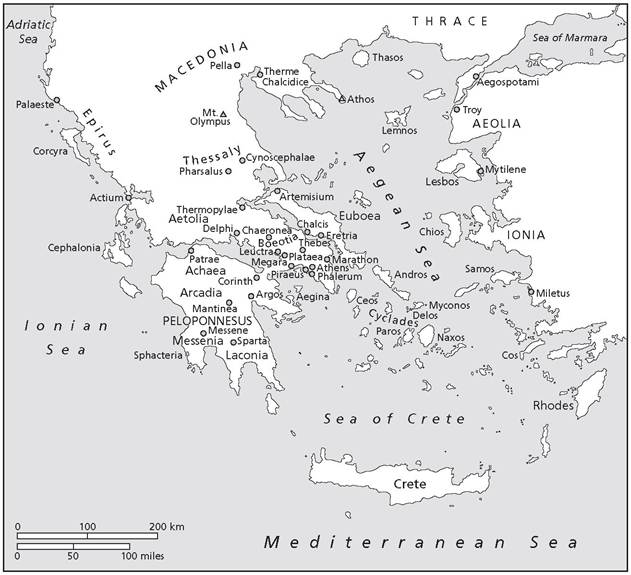
Map i2.2 Classical Greece
unified the entire region. Transplanted Greek colonists also enhanced cultural and intellectual life, and Greek scholars in the Ionian colonies in particular (along the Aegean coast of modern-day Turkey) began systematically to investigate both the natural and the metaphysical world.
These same Ionian colonies brought the Greeks into direct conflict with the rising power of western Eurasia, the Achaemenid Persians, who had created a large empire that was expanding westward. The sophisticated Greek colonies along the Ionian coast resented Persian hegemony, and in 500 BCE they rebelled. The Persians responded by crushing the rebellion, then launching an attack on the Greek peninsula. Despite having vastly superior forces, a Persian army sent by Darius in 490 bce was defeated on the plains of Marathon. Ten years later, Darius' successor Xerxes invaded Greece with probably the largest military force ever assembled to this point in world history, but the Spartans famously forestalled the Persians at Thermopylae, and the Athenians destroyed the Persian fleet at Salamis. The Athenians grew so powerful and aggressive that they alarmed Sparta, however. This led to the outbreak of the bitterly divisive Peloponnesian War (431-404 bce) between Athens and her allies, and Sparta and her allies, which brought in its wake disease, widespread civil wars, destruction, famine, and huge loss of life. Following nearly three decades of conflict, intrigue, and plague, the Spartans emerged as nominal “winners,” but conflicts among the city-states of Greece continued.
The Hellenistic era, 350-30 bce
The Greek city-states wore themselves out fighting one another, and Philip II, the ruler of Macedonia, a kingdom to the north of Greece, gradually conquered one after another and took over their lands. He then turned against the Persian Empire but was killed by an assassin. His son Alexander continued the fight. A brilliant military leader, Alexander conquered the entire Persian Empire from Libya in the west to Bactria in the east. He also founded new cities in which Greek and local populations mixed, although he died while planning his next campaign. Alexander left behind an empire that quickly broke into smaller kingdoms, but more importantly, his death ushered in an era, the Hellenistic, in which Greek culture, the Greek language, and Greek thought spread as far as India, blending with local traditions. The end of the Hellenistic period is generally set at 30 bce, the Roman conquest of the Hellenistic kingdom of Egypt, but many aspects of Hellenistic culture continued to flourish under Roman governance.
Alexander's most important legacy was the spread of Greek ideas and traditions across a wide area, a process scholars later called Hellenization. To maintain contact with the Greek world as he moved farther eastward, he founded new cities and military colonies and settled Greek and Macedonian troops and veterans in them. This practice continued after his death, with more than 250 new cities founded in North Africa, West and Central Asia, and southeastern Europe. These cities and colonies became powerful instruments in the spread of Hellenism and in the blending of Greek and other cultures. Wherever it was established, the Hellenistic city resembled a modern city. It was a cultural center with theaters, temples, and libraries - a seat of learning and a place for amusement. The Hellenistic city was also an economic center - a marketplace and a scene of trade and manufacturing.
The ruling dynasties of the Hellenistic world were Macedonian in origin, and Greeks and Macedonians initially filled all-important political, military, and diplomatic positions. The prevailing institutions and laws were Greek, and Greek became the common spoken language of the entire Eastern Mediterranean. Instead of the different dialects spoken in Greece itself, a new Greek dialect called the koine, which means common, became the spoken language of traders, the royal court, the bureaucracy, and the army across the Hellenistic world. Everyone, Greek or easterner, who wanted to find an official position or compete in business had to learn it. Those who did gained an avenue of social mobility, and as early as the third century bce local people in some Greek cities began to rise in power and prominence. Cities granted citizenship to Hellenized natives, although there were fewer political benefits of citizenship than there had been in the classical period because real power was held by monarchs, not citizens. Cultural influences in the other direction occurred less frequently because they brought fewer advantages. Few Greeks learned a non-Greek language unless they were required to because of their official position. Greeks did begin to worship local deities, but often these were somewhat Hellenized and their qualities blended with those of an existing Greek god or goddess.
In the booming city of Alexandria, the Macedonian rulers known as the Ptolemies generally promoted Greek culture over that of the local Egyptians. This favoritism eventually led to civil unrest, but it also led the Ptolemies to support anything that enhanced Greeklearning or traditions. Ptolemaic kings established what became the largest library in the ancient world, where scholars copied works loaned from many places onto papyrus scrolls, translating them into Greek if they were in other languages. They also studied the newest discoveries in science and mathematics. Alexandria was home to the largest Jewish community in the ancient world, and here Jewish scholars translated the Hebrew Bible into Greek for the first time. The kings of Bactria and Parthia spread Greek culture far to the east, and their kingdoms became outposts of Hellenism, from which the rulers of China and India learned of sophisticated societies other than their own. (For a detailed discussion of Bactria, see Chapter ιι by Jeffrey Lerner in this volume.)
When Alexander conquered the Persian Empire, he found the royal treasury filled with vast sums of gold, silver, and other treasure. The victors used this wealth to finance the building of roads, the development of harbors, and especially, as noted earlier, the founding of new cities. These cities opened whole new markets to merchants who eagerly took advantage of the unforeseen opportunities. Whenever possible, merchants sent their goods by water, but overland trade also became more prominent in the Hellenistic era. Trade networks extended into China, from which the most prominent good was silk, which later gave the major east-west network its name: the Great Silk Roads. (For a detailed discussion of Silk Roads commerce, see Chapter 17 by Xinru Liu in this volume.) This period also saw the development of standardized business customs, so that merchants of different nationalities, aided especially by the koine, communicated in a way understandable to them all. Trade was further facilitated by the coining of money, which provided merchants with a standard way to value goods as well as a convenient method of payment.
Slaves were a staple of Hellenistic trade, traveling in all directions on both land and sea routes. Ancient authors cautioned against having too many slaves from one area together, as this might encourage them to revolt. War provided prisoners for the slave market; to a lesser extent, so did kidnapping and capture by pirates, although the origins of most slaves is unknown. Both old Greek states and new Hellenistic kingdoms were ready slave markets, and throughout the Mediterranean world slaves were almost always in demand, working in the shops, fields, farms, and mines, and in the homes of wealthier people.
Despite the increase in trade, the Hellenistic period did not see widespread improvements in the way most people lived and worked. Cities flourished, but many people who lived in rural areas were actually worse off than they had been before, because of higher levels of rents and taxes. Technology was applied to military needs, but not to the production of food or other goods. Manual labor, not machinery, continued to turn out the agricultural produce, raw materials, and manufactured goods the Hellenistic world used.
The mixing of peoples in the Hellenistic era influenced religion, philosophy, and science. The Hellenistic kings built temples to the old Olympian gods and promoted rituals and ceremonies like those in earlier Greek cities, but new deities also gained prominence. More people turned to mystery religions that blended Greek and non-Greek elements, and taught that by the rites of initiation, in which the secrets of the religion were shared, devotees became united with a deity who had also died and risen from the dead. Others turned to practical philosophies that provided advice on how to live a good life.
The Roman Republic and Empire
c. 600 BCE - c. 600 CE
While the Greeks were establishing poleis and setting up colonies in the Aegean, a group of aristocrats in Rome, then a small city in central Italy, revolted against their king and established a republic ruled by an aristocratic assembly, the Senate. At that moment, late in the sixth century bce, Rome was no more distinguished than a score of other cities scattered about the Italian peninsula. The ancestors of the Romans had established their villages around a group of seven hills above the plains of Latium, on the banks of the Tiber River. The residents farmed and traded; they were using bronze tools by 1800 bce and iron by 900 bce. To the south of Rome, Greek colonies flourished along the coast of the mainland and the island of Sicily. To the north of Rome were the Etruscans (eighth-fifth centuries bce), who controlled much of northern and central Italy from their fortified cities in Tuscany. In stories told later about the founding of Rome, Etruscan kings came to rule the city, but they were overthrown in a series of events that involved female virtue and male honor. In this founding myth, of which there are several versions, the son of King Tarquin, the Etruscan king who ruled Rome, raped Lucretia, a virtuous Roman wife, in her own home. She demanded that her husband and father seek vengeance, and then committed suicide in front of them. Her father and husband and the other Roman nobles swore on the bloody knife to avenge Lucretia's death by throwing out the Etruscan kings, and they did. Whether any of this story was true can never be known, but Romans generally accepted it as history, and dated the expulsion of the Etruscan kings to 509 bce. They thus saw this year as marking the end of the monarchical period and the dawn of the republic, which had come about because of a wronged woman and her demands.
Most historians today view the idea that Etruscan kings ruled the city of Rome as legendary, but they stress the influence of the Etruscans on Rome. The Etruscans transformed Rome into a real city with walls, temples, paved roads, a drainage system, and other urban structures. The Romans adopted the Etruscan alphabet, which the Etruscans themselves had adopted from the Greeks.
Though it may not have happened precisely in 509 or thrown out foreign rulers, the revolt by aristocrats was an actual event, and a new form of government was established. Executive power was in the hands of two officials, known as consuls, whose decisions were ratified by the Senate, the real source of power in Rome. Senators and consuls were members of the aristocratic patrician class, whose privileged legal status was determined by their birth as members of certain families. Patrician men dominated the affairs of state, provided military leadership in time of war, and monopolized knowledge of law and legal procedure. The common people of Rome, the plebeians, were free citizens with a voice in politics, but they had few of the patricians' political and social advantages. While some plebeian merchants rivaled the patricians in wealth, most plebeians were poor artisans, small farmers, and landless urban dwellers.
Inequality between plebeians and patricians led to a long social conflict, in which the plebeians sought to increase their power by taking advantage of the fact that Rome's survival depended on its army, which needed plebeians to fill the ranks of the infantry. According to tradition, in 494 bce the plebeians literally walked out of Rome and refused to serve in the army. Their general strike worked, and the patricians made important concessions. The plebeians gained the right to elect their own officials (tribunes) who were able to veto (“I forbid”) unfair consul decisions. Eventually the plebeian assembly (the Concillium Plebis) was granted the right to pass laws binding on all Romans. By these various political compromises, the power base was expanded. The patrician elites still managed to maintain their privileged position in society through their ownership of agricultural land, continuous self-enrichment through corrupt practices in the provinces, and their ability to “buy” the votes of plebeian elected officials.
In its foreign affairs, the Roman Republic responded to a series of external threats in a hard-nosed and practical manner that led, rapidly and perhaps unexpectedly, to Roman domination of the entire Italian peninsula. Historians are divided on the question of whether Rome ever intended, at least in its early history, to create a large tributary empire, or whether expansion was rather a result of sensible responses to security threats. Rome was humiliated in 309 bce by a party of marauding Gauls, who occupied the city and were persuaded to leave only when they were paid a substantial ransom. Thereafter Rome rebuilt its military into a formidable, professional force, and as Etruscan power waned in the north, the Romans fought successful defensive wars against other Latin states and Greek colonies. The Romans did not impose harsh sanctions on defeated peoples, however, allowing conquered states to retain the right of self-government so long as they provided levies of troops and supported Roman foreign policy. This enlightened form of hegemony paid enormous dividends when the Republic faced its sternest challenge in a major struggle with Carthage.
By the year 270 bce, Rome's one remaining rival in the Central Mediterranean was the Phoenician colony of Carthage, which was probably wealthier than the Republic at that stage and certainly possessed a superior navy. The Mediterranean was simply too small to accommodate two expansive powers, each of which sought increased resources through tribute and booty. In a series of three Punic Wars (264-146 bce), the Romans eventually crushed the Carthaginians, although it was a hard-won victory. The Romans next turned east, defeating the Hellenistic kingdoms or turning them into client states. Declaring the Mediterranean mare nostrum, “our sea,” the Romans began to create a political and administrative machinery to hold the Mediterranean together under a mutually shared cultural and political system of provinces ruled by governors sent from Rome. Following a subsequent series of smaller campaigns, by 133 bce Rome was supreme in the Mediterranean. Roman language, law, and culture, fertilized by Greek influences, would in time permeate this entire region.
With the conquest of the Mediterranean world (see Map 12.3), Rome became a great city. The spoils of war went to build theaters, stadia, and other places of amusement, and Romans and Italian townspeople began to spend more of their time in leisure pursuits. This new urban culture reflected Hellenistic influences. Romans developed a liking for Greek literature, and it became common for an educated Roman to speak both Latin and Greek. Furthermore, the Roman conquest of the Hellenistic east resulted in wholesale confiscation of Greek paintings and sculpture to grace Roman temples, public buildings, and private homes.
New customs did not change the core Roman social structures. The male head of the household was called the paterfamilias, who had great power over his children. Initially, this seems to have included power over life and death, but by the second century bce that had been limited by law and custom. Fathers continued to have the power to decide how family resources should be spent, however, and sons did not inherit until after their fathers had died. Most citizens did marry, with patrician women marrying in their mid-teens and non-elite women in their late teens. Grooms were generally somewhat older than their brides. Marital agreements, especially among the well-to-do, were stipulated with contracts between the families involved. If their owner allowed it, slaves could enter a marriage-like relationship called contubernium, which benefited their owner, as any children produced from it would be his. Women could inherit and own property, though they generally received a smaller portion of any family inheritance than their brothers. The Romans praised women, like Lucretia of old, who were virtuous and loyal to their husbands and devoted to their children. The wife often supervised domestic arrangements, while her husband conducted his business and political affairs in public. The primary interest of elite Roman males was not in their families but in the affairs of state, and this occupied much of their time. The first- century ce Greek historian Plutarch captured this idealized attitude of the Roman patrician male when he wrote, “it is a noble thing and the mark of an
Downloaded from https:Zwww.cambridge.org/core. Cornell University, on 07 Jan 2017 at 22:23:45, subject to the Cambridge Core term available at https:/www.cambridge.org/core/terms. http://dx.doi.org/10.1017/CBO9781139059251.014
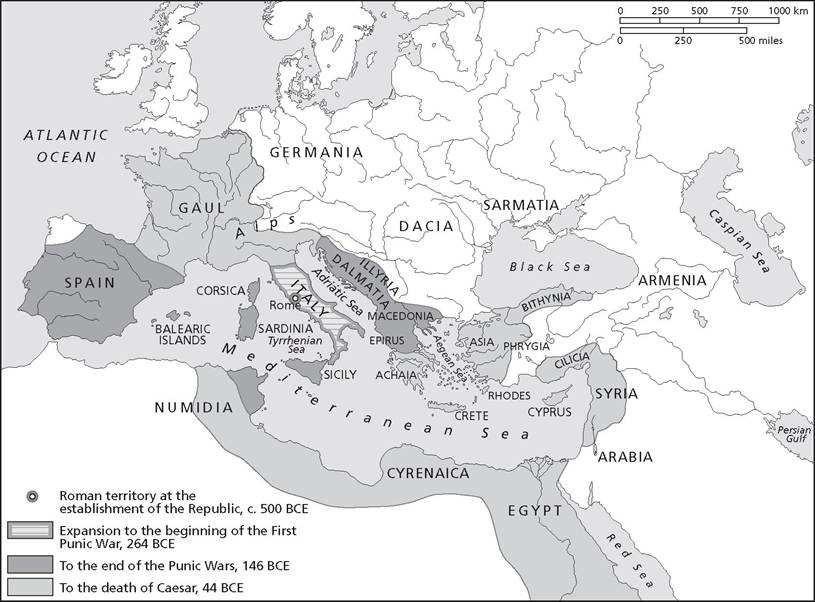
Map 12.3 Roman Republic
exalted (Roman man's) spirit to exclaim, ‘I love my children, but I love my country more.'”
To administer their new expansive, post-Punic Wars state, the Romans adopted a provincial system, with a governor selected from the senatorial class installed in each province. Many governors, however, as representatives of a class deeply imbued with the philosophy of growth through tribute taking, took this as an opportunity for personal profit, and corruption became widespread. When soldiers returned home from war, they found their farms practically in ruins. Many were forced to sell their land to ready buyers who had grown rich from the wars. These wealthy men created huge estates called latifundia, where they grew profitable crops like olive oil and wine, rather than necessary staples like grain. Now landless, veterans moved to the cities, especially Rome, but could not find work. These developments not only created unrest in the city but also threatened Rome's army by reducing its ranks. The Romans had always believed that only landowners should serve in the army, for only they had something to fight for. Landless men, even if they were Romans and lived in Rome, were forbidden to serve. The landless veterans were willing to follow any leader who promised help. The leaders who first answered their call were the Gracchi brothers, who proposed dividing public land among the poor and distributing grain cheaply. They were murdered by wealthy senators, launching a long era of political violence that would ultimately destroy the republic.
In this atmosphere of seething discontent, a series of powerful men began to compete for the loyalty of the military and for control of the state. Throughout the first century bce, Rome was preoccupied by a series of civil wars between the personal armies of men like Marius, Sulla, Pompey, and Julius Caesar, all of whom also engaged in military campaigns further expanding Roman territory. Julius Caesar, an able general, brilliant politician with unbridled ambition, and superb orator, emerged victorious. The Senate began appointing Caesar to various offices, and he was wildly popular with most people in Rome, but some senators opposed his rise to what was becoming absolute power. In 44 bce a group of conspirators assassinated him and set off another round of civil wars, which were won by Caesar's grandnephew and adopted son Octavian. For his success, in 27 bce the Senate gave Octavian the name Augustus, meaning “revered one.” Although the Senate did not mean this to be a decisive break, that date is generally used to mark the end of the Roman Republic and the start of the Roman Empire.
Augustus claimed that he was restoring the republic, and he never took the title of emperor, preferring instead to be known as Princeps, or first man. He was actually transforming the government into one in which all power was held by a single ruler, however. Augustus fit his own position into the republican constitution not by creating a new office for himself but by gradually taking over many of the offices that traditionally had been held by separate people. His successors needed no such subtlety, and by the end of the fourth century ce, some 140 different men, ranging from the psychotically insane (such as most of Augustus' Julio-Claudian successors, 14-68 ce) to the extremely competent (such as the Antonine emperors, 96-180 ce), had claimed the title Emperor of Rome. Roman expansion, driven by the need to grow through the violent acquisition of external resources, continued throughout the Mediterranean, Saharan Africa, West Asia, and Europe during the first two centuries of the empire. It has been estimated that when the Roman state attained its maximum extent during the second century, its government was administering the affairs of perhaps 130 million people. The city of Rome, home to ι million people, provided an extraordinary contrast of opulence and poverty.
During this period of evolution from republic to empire, some aspects of Roman society also changed, although the gulf between top and bottom remained very wide indeed. The middle class (known as the equestrian class), which now often included freed slaves who had managed to make a fortune in business, increasingly bought their way into positions of power and status. What the wealthy of both the patrician and the equestrian classes learned to do very well for the duration of the empire was to control the plebeians and guard against rebellion by ensuring that there was always enough food for them to eat, and entertainment to divert them from political or egalitarian aspirations. The first-century c e satirist Juvenal expressed this beautifully with the phrase panem et circensus (bread and circuses). By ensuring there was always sufficient grain for the dole, by decreeing one hundred public holidays a year, and by providing free and spectacular entertainment on most of these days, the rich and powerful in Roman society provided a mechanism that allowed them to retain their position and divert pent-up resentment among the poor. Many residents of the city of Rome were slaves, who ranged from highly educated household tutors or government officials and widely sought sculptors to workers who engaged in hard physical tasks.
Augustus made a series of political and social reforms that stabilized Roman administration and allowed it to function fairly well even when the emperor was weak. He professionalized the army and awarded grants of land in the frontier provinces to veterans who had finished their twenty-year service. He encouraged local self-government and the development of cities. As a spiritual bond between the provinces and Rome, Augustus encouraged the cult of Roma et Augustus (Rome and Augustus) as the guardian of the state. The cult spread rapidly and became a symbol of Roman unity. In the social realm, Augustus promoted marriage and childbearing through legal changes that released free women and freedwomen (female slaves who had been freed) from male guardianship if they had given birth to a certain number of children. Men and women who were unmarried or had no children were restricted in the inheritance of property. Augustus argued that population increase in the Roman Empire had made it necessary for the state to now regulate matters that were, in the less populous past, affairs that could be handled within the privacy of the family. Moralists denounced any sexual relationship in which men squandered money or became subservient to those of lower social status, although no laws banned prostitution or samesex relationships.
One of the most significant aspects of Augustus' reign was Roman expansion into northern and western Europe. Augustus completed the conquest of Spain and, after hard fighting, made the Rhine River the Roman frontier in Germania (Germany). Meanwhile, generals conquered areas as far as the Danube River, and Roman legions penetrated the areas of modern Austria, southern Bavaria, and western Hungary. The regions of modern Serbia, Bulgaria, and Romania also fell. Within this area the legionaries built fortified camps. Roads linked these camps with one another, and settlements grew up around the camps, eventually becoming towns. Traders began to frequent the frontier and to do business with the people who lived there; as a result, for the first time, central and northern Europe came into direct and continuous contact with Mediterranean culture.
In common with all the great agrarian societies, Roman administrators invested considerable resources into transport infrastructure, not so much as an aid to commerce but rather to speed the movement of armies and aid communications. In total, Roman roads may have been more than 50,000 miles in length. By linking all parts of the empire together effectively, by abolishing all internal trade tariffs and tolls, and by establishing common laws, the Romans were able to integrate vast regions of Western Afro-Eurasia into a relatively homogeneous cultural entity. The Romans also encouraged maritime trade, and ships sailed from Egyptian ports to the mouth of the Indus River, where they purchased local merchandise and wares imported by the Parthians. Despite the dangers and discomforts, some hardy mariners pushed down the African coast and into the Indian Ocean, where they traded with equally hardy local sailors. Roman coins have been found in Sri Lanka and Vietnam, clear evidence of trade connections, although most likely no merchant traveled the entire distance.
Romans did not force their culture on native people in Roman territories. However, just as earlier ambitious people in the Hellenistic world knew that the surest path to political and social advancement lay in embracing Greek culture and learning to speak Greek, those determined to get ahead now learned Latin and adopted aspects of Roman culture. One sphere where this melding of cultures occurred was language. People used Latin for legal and state religious purposes, but gradually Latin blended with the original language of an area and with languages spoken by those who came into the area later. Slowly what would become the Romance languages of Spanish, Italian, French, Portuguese, and Romanian evolved. Religion was another site of cultural exchange and mixture. Romans moving into an area learned about and began to venerate local gods, and local people learned about Roman ones. Gradually hybrid deities and rituals developed, and new religions were created.
The most important of these new religions was Christianity, created by the followers ofJesus of Nazareth (c. 3 bce - 29 ce), a Jewish man who lived in the Roman province of Judah. At this point, many Jews opposed Roman rule and believed that a final struggle was near that would lead to the coming of a savior, or Messiah, a descendant of King David who would destroy the Roman legions and inaugurate a period of happiness and plenty for Jews. According to Christian scripture, Jesus was born into this climate of Messianic hope to deeply religious Jewish parents. He began preaching and teaching when he was about thirty, telling of a heavenly kingdom of eternal happiness in a life after death and of the importance of devotion to God and love of others. He attracted a following, which worried the Roman prefect Pontius Pilate, who had him arrested and executed by crucifixion. Jesus left no writings, but accounts of his sayings and teachings that had first circulated orally among his followers were written down sometime in the late first century to build a community of faith. These accounts, which were later brought together along with other writings of some of his early followers to form the Christian Bible, are the principal evidence for Jesus' life and ideas. His teachings were based on Hebrew Scripture and reflected a conception of God and morality that came from Jewish tradition, but he asserted that he taught in his own name, not simply in the name of Yahweh. He said that he was the Messiah (the Greek translation of the Hebrew word Messiah is “Christus,” the origin of the English word Christ), and a small group of followers agreed. They also held that he had risen from the dead on the third day after his crucifixion, had ascended into heaven to join God, and would come again, all of which became central elements of faith.
The memory ofJesus and his teachings survived and flourished. Believers in his divinity met in small assemblies or congregations, often in one another's homes, to discuss the meaning ofJesus' message and to celebrate a ritual (later called the Eucharist or Lord's Supper) commemorating his last meal with his disciples before his arrest. Because they expected Jesus to return to the world very soon, his followers initially regarded earthly life and institutions as unimportant. The catalyst in the spread of Jesus' teachings and the formation of the Christian church was Paul of Tarsus, a well- educated Hellenized Jew who was comfortable in both the Roman and the Jewish worlds. Through visiting followers and writing letters, Paul transformed Jesus' ideas into more specific moral teachings and changed Christianity from a Jewish sect into a separate religion that attracted nonJews as well. Some Roman officials opposed Christian practices and beliefs and persecuted Christians, including torture and execution, but most persecutions were sporadic and local, and the religion spread along the networks of roads and sea-lanes of the Roman Empire.
The earliest Christian converts included men and women from all social classes, reached by missionaries and others who spread the Christian message through family contacts, friendships, and business networks. People were attracted to Christianity for a variety of reasons: it offered its adherents special teachings that would give them immortality; gave them an ideal of striving for a goal; and provided a sense of identity, community, and spiritual kinship. By the second century ce, the belief that Jesus was coming again soon gradually waned, and as the number of converts increased, permanent institutions were established, including buildings for worship and a hierarchy of officials generally modeled on those of the Roman Empire. Bishops, officials with jurisdiction over a certain area, became especially important, just as provincial governors were in the empire. Christianity also began to attract more highly educated individuals who drew on Greek philosophy to develop complex theological interpretations of issues that were not clear in scripture. Bishops and theologians often modified teachings that seemed upsetting to Romans, such as Jesus' harsh words about wealth. By the late third century, most Romans tolerated Christianity, even if they did not practice it.
By the beginning of the third century, the empire faced serious problems. Silk Roads trade was costing Rome several million gold aureii each year. At the same time, the local economy was stagnating as Roman agriculture suffered from overproduction (which drove down prices) and a lack of innovation. As the quality of leadership declined and no solutions were found to these and other problems, Rome endured a half-century of anarchy during the so-called Crisis of the Third Century (235-284 ce). Some twenty to twenty- five emperors ruled during this period, most of them dying a violent death. The capable Diocletian (r. 284-305) temporarily stemmed the crisis through effective government and sheer force of will, but his attempt to divide the empire into two more manageable halves, each ruled by a co-emperor, failed. Constantine (r. 306-337 c e) made the decision to move the capital of the empire to the city of Byzantium (renamed Constantinople), and to rule the entire structure from there. He also supported Christianity financially and politically, expecting in return the support of church officials in maintaining order, and late in his life he was baptized as a Christian. Helped in part by its favored position, Christianity slowly became the leading religion in the empire, and in 380 the emperor Theodosius (r. 379-395 ce) made it the official religion of the empire, laying the foundation for later growth in church power.
Along with internal economic and political problems, the Romans also faced considerable external threats between the third and fifth centuries. The Parthians were formidable foes along the eastern borders of the empire, and their successors the Sasanians actually captured the Roman emperor Valerian in 260 ce. From the early fourth century on, westward migrations by restive Germanic farming tribes placed considerable strain on the northern borders of the empire. With the arrival of the Huns from Central Asia in the mid-fifth century ce, the pressure became so intense that Visigoths, Ostrogoths, Vandals, Franks, and other German tribes poured across the border and resettled throughout much of the western half of the Roman Empire. Many regions of modern Europe reflect these German settlement patterns, including France (Franks), England (Angles), Andalucia (Vandalucia), and Lombardy (Lombards). By 476 ce a German general Odovocar (435-493) was anointed emperor of the western empire; for many classical historians, influenced by the eighteenth-century English historian Edward Gibbon, that date marks the moment that the Roman Empire “fell.”
As the western empire fragmented into a series of fortified estates and competitive regional kingdoms, the eastern half went from strength to strength. Indeed the Byzantine Empire that emerged there lasted for another thousand years and, along with Tang China and the Dar al-Islam (Abode of Islam), became one of the economic and cultural pillars of Afro-Eurasia. (For more on Byzantium and the rest of Europe in late antiquity, see Chapter 14 by Charles Pazdernik in this volume.) Because of Byzantine longevity, many historians argue that the Roman state maintained its domination of large regions of western Afro-Eurasia for around 2,000 years. Cultural, legal, and social forms created in the Roman Empire left an even longer legacy.
Conclusion
The fall of the Western Roman Empire may not have been as momentous as it was once thought to be, but it still shapes the way in which Western history is periodized, as it marks the end of the classical era. That periodization also shapes world history, with China, India, and the Maya also understood to have a classical period. The dates of these are different from those of the classical period in the Mediterranean, but there are striking similarities among all three places: successful large-scale administrative bureaucracies were established, trade flourished, cities grew, roads were built, and new cultural forms developed. In all these places as well, the classical period was followed by an era of less prosperity and more warfare and destruction.
There were also parallels between the Mediterranean and other regions of Eurasia explored elsewhere in this volume, whose history is not necessarily periodized into classical and post-classical. In many places, small regional states expanded and evolved through the implementation of effective political, military, and economic structures, in a process that eventually allowed for relatively small, elite groups to control vast populations. Within both large political structures, such as the Hellenistic and Roman empires, and smaller cultures and states that did not evolve into large-scale empires, such as those of the Hebrews, Phoenicians, Minoans, and Mycenaeans, expansion invariably led to the emergence of more complex social structures, which explicitly situated various groups, including women and slaves, into more sharply delineated hierarchical structures. At the same time, sophisticated scientific and philosophical ideas emerged in many cultures, including those of the Mediterranean region, which went on to have a profound impact on the subsequent history of the world.
Further Reading
Abulafia, David, The Great Sea: A Human History of the Mediterranean, New York: Oxford University Press, 2011.
Adam, Jean-Paul, Roman Building: Materials and Techniques, London: Routledge, 1994.
Aubet, Maria Eugenia, The Phoenicians and the West: Politics, Colonies, and Trade, 2nd edn., Cambridge University Press, 2001.
Boardman, John, The Greeks Overseas: Their Early Colonies and Trade, 4th edn., London: Thames and Hudson, 1999.
Bradley, Keith, Slavery and Society at Rome, Cambridge University Press, 1994.
Broodbank, Cyprian, The Making of the Middle Sea: A History of the Mediterranean from the Beginning to the Emergence of the Classical World, Oxford University Press, 2013.
Burnard, Trevor and Heuman, Gad (eds.), The Routledge History of Slavery, Oxford and New York: Routledge, 2011.
Cartledge, Paul. The Spartans: The World of the Warrior Heroes of Ancient Greece, New York: Vintage, 2002.
Clark, Gillian. Christianity and Roman Society, Cambridge University Press, 2004.
Cohen, Edward E., The Athenian Nation, Princeton University Press, 2000.
Cornell, T. J., The Beginnings of Rome. Italy and Romefrom the Bronze Age to the Punic Wars, London: Taylor and Francis Group, 1995.
D'Ambra, Eve, Roman Women, Cambridge University Press, 2006.
Davies, John K., Wealth and the Power of Wealth in Classical Athens, Salem, nh: The Ayer Company, 1984.
Dillon, Sheila, and Sharon L. James (eds.), A Companion to Women in the Ancient World, Malden, ma: Wiley-Blackwell, 2012.
Edmondson, J. C., Augustus, Edinburgh University Press, 2009.
Errington, R. Malcolm, A History of the Hellenistic World 323 - 30 bc, Oxford: Blackwell Publishing, 2008.
Erskine, Andrew (ed.), A Companion to the Hellenistic World, Oxford: Blackwell Publishing, 2006.
Fisher, N. R. E., Slavery in Classical Greece, ed. Michael Gunningham, London: Duckworth, Bristol Classical Press, 1993.
Garnsey, Peter, Famine and Food Supply in the Greco-Roman World, Cambridge University Press, 1988.
Goldenberg, Robert, The Origins of Judaism: From Canaan to the Rise of Islam, Cambridge University Press, 2007.
Goldsworthy, Adrian, Roman Warfare, Washington, dc: Smithsonian Books, 2000.
Horden, Peregrin, and Nicholas Purcell, The Corrupting Sea: A Study of Mediterranean History, Oxford: Wiley-Blackwell, 2000.
Markoe, Glenn E., Phoenicians, Berkeley: University of California Press, 2006.
Morley, N., Tradein Classical Antiquity, Cambridge University Press, 2007.
Oleson, John Peter (ed.), The Oxford Handbook of Engineering and Technology in the Classical World, Oxford University Press, 2008.
Pomeroy, Sarah B., Families in Classical and Hellenistic Greece: Representations and Realities, Oxford: Clarendon Press, 1997.
Powell, Anton, Athens and Sparta: Constructing Greek Political and Social Historyfrom 478 bc, New York: Routledge, 2001.
Rhodes, P. J., AHistoryofthe Classical Greek World 478-323 bc, Oxford: BlackwellPublishing, 2009.
Scheidel, Walter, Ian Morris, and Robert Saller (eds.), The Cambridge Economic History of the Greco-Roman World, Cambridge University Press, 2007.
Van de Mieroop, Marc. A History of the Ancient Near East, 3000-332 bce, 2nd edn., Oxford: Blackwell Publishing, 2010.
Young, G. K., Rome's Eastern Trade: International Commerce and Imperial Policy, 31 bc - ad 305, London: Routledge, 2001.