Regional study: Athens in the fifth century bce
WILLIAM MORISON
Aside from Jerusalem, no city has had a greater impact on world history relative to its size than fifth-century bce Athens, whose rise from a relatively minor Greek polis, or city-state, to a major military and economic power dominating the Eastern Mediterranean was a remarkable achievement.
Even more lasting were Athenian advances in drama, philosophy, historical writing, art and architecture, and politics - none of which were invented by Athenians, but all of which blossomed in Athens during the fifth century - that would make a lasting contribution to world culture.Geography and natural resources
Attica, as the area surrounding the city of Athens is called, comprised an area of about 2,550 km2, smaller than many modern US counties, but larger than most of the other Greek poleis. Much of this land consisted of a series of low mountains and valleys surrounding the town of Athens, which grew up around a small limestone hill, the Acropolis, in a small plain about 12 km inland from the coast. The arable land of Attica was too sparse to support a significant urban population, and from at least the sixth century bce forward the Athenian populace relied on imported grain. The terrain did provide some advantages, as tree fruit and olives in particular grew well in the rough Athenian soil. Athenian clay was also highly regarded and provided the necessary resources for one of Athens' most famous products, its pottery. In addition, the nearby mountains provided limestone and fine, high-quality marble without which some of the most iconic buildings of classical Greece would have been impossible (see Map 13.1).
Sitting like a triangle pointing into the Aegean, Athens enjoyed a long coastline in the center of the western Aegean Sea. With excellent adjoining bays at Phaleron and Piraeus, the Athenians enjoyed two of the finest natural
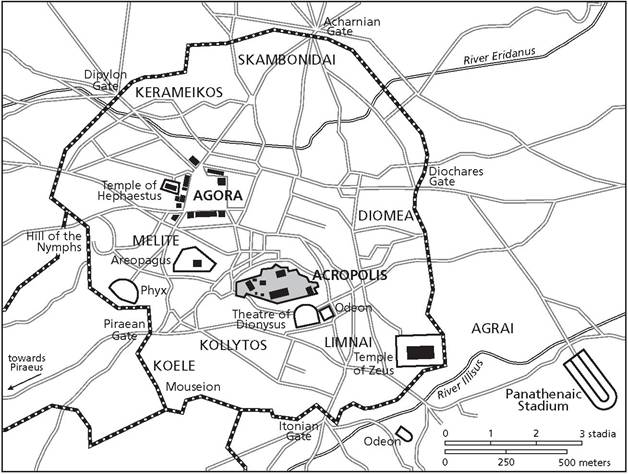
Map 13.i Athens in the fifth century bce
harbors in the entire Mediterranean.1 Indeed, the modern Piraeus is today the busiest passenger port in Europe and one of the busiest container ports anywhere in the world.
The Athenians enjoyed yet another advantage of natural resources: rich silver mines at Laurion in southeastern Attica. While the rest of central and southern Greece was devoid of precious minerals, Laurion provided Athens with a ready supply of coins that few Greek states at the time possessed and helped to make up for the poor quality of Athens' sparse farmland. Indeed, the discovery of a particularly rich vein of silver around 483 bce would enable Athens to build the largest naval force of any Greek polis of the time.
With these advantages of geography and natural resources, scholars estimate that by 430 bce approximately half a million people lived in Attica, though only about 12 percent of these enjoyed the benefits of Athenian citizenship and nearly half of the total population were chattel slaves.[477] [478] As was the case with most other preindustrial societies, most Athenians did not live in the city itself, but in one of the many demes, or towns, in the surrounding countryside. For much of the fifth century bce, this was the case; however, political, military, and economic factors would gradually urbanize the populace.
Historical overview
Athens had not only some advantages in geography and resources but also favorable historical circumstances and remarkable leadership on its side. During the sixth century bce, Athens had been either embroiled in civil conflict or living under the tyrannical reign first of Peisistratus and then of his son Hippias. While Athenian pottery and olive oil were prized commodities in the Mediterranean world, the city had played no role in the colonizing efforts that had seen Greek communities spread from the Black Sea to the Iberian Peninsula, nor did the city have a large navy or a particularly impressive army. Indeed, Athenians of earlier times had played only a passing role in the great epics of Homer, and other great mythical stories had centered on cities like Thebes and Mycenae.
Other than the sage Solon, Athens could boast of no great poets to rival Sappho of Lesbos or philosophers to rank with the Milesian Thales.This situation began to change in 507 bc e with the establishment of a new, radical political system that would come to be called demokratia. This new government would find itself tested when in 490 bce, at the bay of Marathon in northeast Attica, an outnumbered Athenian force decisively defeated an army sent by the Persian king to punish the city's support of Ionian rebels and to reinstall the aged former tyrant Hippias.[479] A decade later, a second and much larger force descended on Greece and sacked Athens in retribution. However, the wise use of Laurion silver to build a fleet of 200 triremes became key in the defeat of a Persian armada near Salamis.[480] Leadership of the allied Greek resistance to the invasion belonged to the Spartans, but following the defeat of the Persian army at Plataea in 479 bce and the bad behavior of the Spartan commander, the Athenians took over what came to be called the Delian League. While ostensibly formed to defeat Persia, this League placed Athens at the head of a powerful military machine to which most members contributed money rather than men. As hostilities with Persia wound down in the late 470s and early 460s, some allies such as Naxos and Thasos attempted to leave the league but were compelled by military force to remain members - secession was not an option.
With the move of the league treasury to Athens in 454 bce, the League transformed into an Athenian Empire (see Map 13.2) that often interfered with the internal affairs of its subject allies and used league funds for the building of some of the most remarkable architectural structures on the Athenian Acropolis.[481] During this period, expansionist Athens became embroiled in a series of conflicts with members of the Peloponnesian League led by Sparta. The first of the “Peloponnesian Wars” (460-445 bce) ended with a peace treaty that enshrined Athenian dominance at sea, and a resumption of hostilities fifteen years later continued this asymmetrical conflict between Athenian sea power and Peloponnesian superiority in land battles.
The fighting came to an end only with the decisive annihilation of the Athenian navy in 405 bce and the starvation of the city into submission by Sparta and its allies the following year.[482]Government
Interrupted by only two brief periods of oligarchic rule during the fifth century bce, the Athenian government was characterized by a participatory system that had come to be called demokratia. Scholars differ over whether this new regime was the creation of the political elite or a movement that arose from the lower classes, but in either case it enfranchised a larger part of the free male population than was the case in any other Mediterranean state. The Athenian Assembly, which met at least ten times per year on the Pnyx Hill and comprised whichever 5,000-6,000 Athenian citizens were present at a given meeting, was the sovereign body of state and was considered equivalent to the demos, or people of Athens.[483] Decisions passed by the Assembly had the immediate force of law and could only be overturned by the Assembly itself. Day-to-day operation of the state was controlled by a Council of 500 chosen by a lottery system for a one-year term and roughly representative of Attica. The Council could pass decrees concerning minor
Downloaded from https:Zwww.cambridge.org/core. Cornell University, on 07 Jan 2017 at 22:24:33, subject to the Cambridge Core term available at https:/www.cambridge.org/core/terms. http://dx.doi.org/10.1017/CBO9781139059251.015
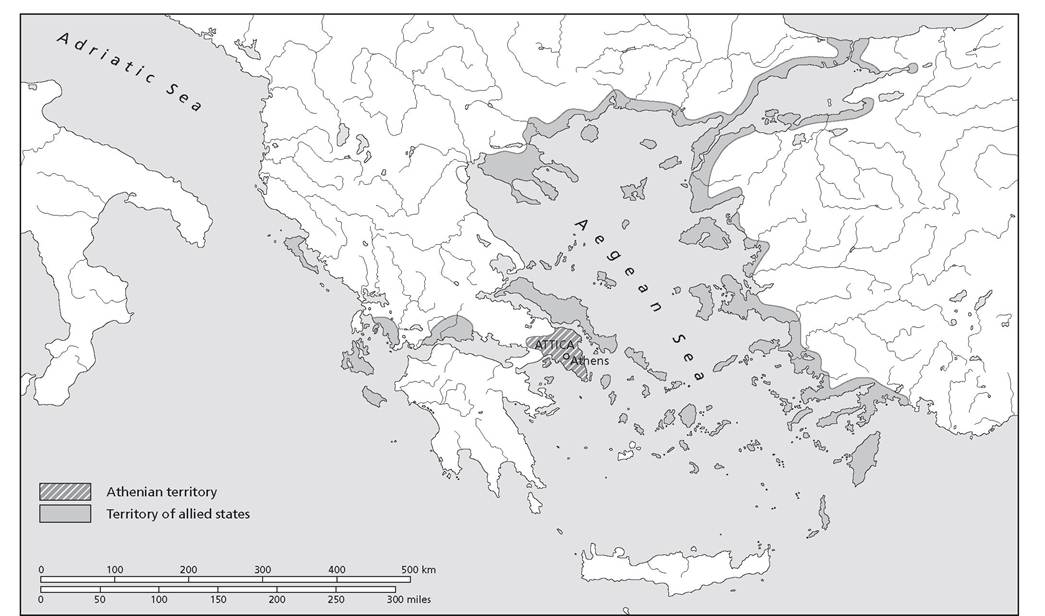
Map 13.2 The Athenian Empire
matters; it also prepared the Assembly's agenda and oversaw the mass of boards and committees that did much of the state's regular business. In addition, juries of 201 or more citizens - the jury that heard Socrates' famous trial was 501 - were also chosen by lot and heard each of their cases, whether on a small matter or a capital charge, in a single day.
It has been estimated that juries met between 175 and 225 days each year, making the Athenians a remarkably litigious society. Private citizens brought all prosecutions, the accused provided his or her own defense, and decisions were determined by a majority of the jury. Although laws concerning a matter would be read, the persuasiveness of one side against another could easily sway a jury.[484]The widespread use of the lot to empanel magistrates, governmental committees, and juries along with pay for public office saw rising numbers of the poorer classes taking power.[485] Though popular leaders like Cimon and Pericles often influenced the Assembly's actions, they ultimately owed their positions to the mercurial and sometimes fickle desires of the Athenian citizenry. While certain major offices, such as generalships and management of the water supply, were elective, most were filled by lottery, thus emphasizing the equality of one Athenian with another to a remarkable degree. Pay for service on juries beginning in 462 bce, a practice that gradually extended to office holding as well, made it possible, and indeed attractive, for poorer Athenian citizens to participate in the running of the state.[486] [487]
The rights and obligations of citizenship were limited to males of Athenian descent (after 450 bce one had to have both an Athenian father and an Athenian mother). Of this minority, Athenians belonged to one of four classes based on property: the pentekosiomedimnoi and hippeis were the wealthiest, the zeugitai mostly middling farmers, and the thetes men with little or no property. This system is attributed to the reforms of Solon in the early sixth century and allowed for changes of status, but even at the democracy's most radical stages thetes were barred from holding high office. For those with citizen status, however, there was not only remarkable freedom, but also a high level of participation in the operation of the state.
All citizens could attend and speak in the Assembly, the sovereign legislative body of the state; all had a right to freedom of speech; all could participate in the juries, boards, and offices that constituted the state (except sometimes the thetes and zeugitai).11Military
A key to understanding the reasons for this remarkable expansion of political enfranchisement lies in the connection between political rights and military service. As was the case in most Greek poleis, full citizenship in early Athens was tied to obligatory military service from the ages of 18 to 60 and to the ownership ofland that enabled a citizen-soldier to provide his own armor and weapons to fight as a hoplite (or infantryman). Indeed, in most Greek citystates political rights were restricted to those with land and the ability to provide one's own arms and time while on campaign.[488] [489]
However, the rise of Athenian power after the late 480s bce was guaranteed more by its navy of 200 to 300 triremes, each of whose 170 oars were manned largely by the poorer thetes, rather than by the wealthier classes who made up the hoplite infantry and cavalry. The success of Athenian sea power in defeating Persia and creating an empire of subject allied states led to greater participation in the running of the state by the poorer classes and, by extension, all the citizenry. 13
Society and economy
The city of Athens was not just a political and military center; it was also the focus of a commercial empire that controlled trade in the Aegean. Goods flowed into and through the city and people traveled from all over the Eastern Mediterranean to do business there. Democracy and empire transformed Athens from a primarily agrarian society into a progressively urbanized regional state with expanding manufacturing and trade that dominated the economy of the Aegean Sea and Eastern Mediterranean. Because much of Attica lacked good soil for growing staple crops like wheat and barley, olive oil was the major agricultural export. To support its relatively large population, grain had to be imported (mainly from ports in the Black Sea in what today is the Crimea). The excellent harbors at Phaleron and Piraeus facilitated trade in silver from Laurion, and tribute from its subject allies made it possible to support a rising standard of living. The commercial center of Athens itself was the Agora (see Fig. 13.1), a large open area north of the Acropolis that functioned as a marketplace but also
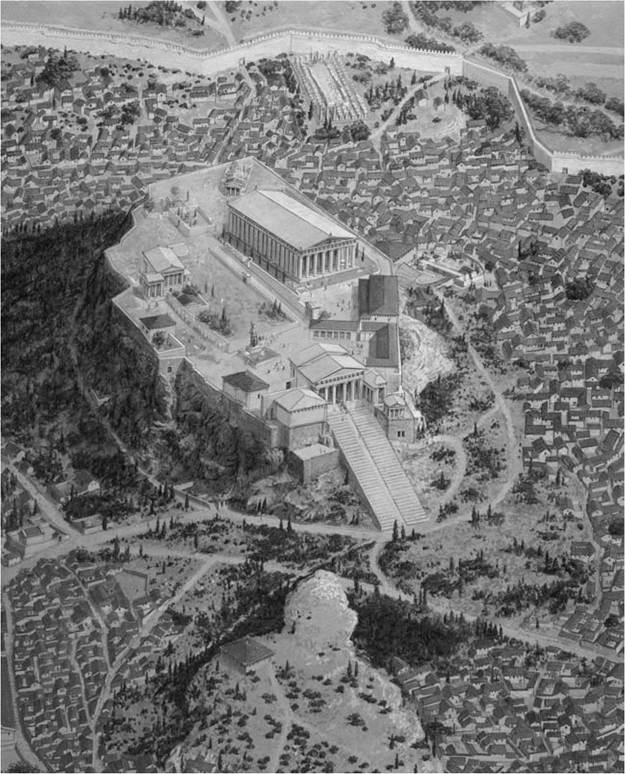
Figure 13.1 Reconstruction of the Acropolis in the early fourth century bce (akg-images / Peter Connolly)
included key parts of government, religious sites, and the state mint. By the fourth century bce, the trade emanating from these centers had grown into something akin to a modern market economy.[490]
As a result of this growing economy, Athens became increasingly urbanized and cosmopolitan with a small, but significant, number of metics, or resident aliens, who paid a special tax to live and work in the city, setting up various businesses. Houses in Athens tended to be small, semi-detached structures with little or no space between them.[491] Other than the Agora and some sacred precincts, there was little open space in the city that was not packed with houses, private businesses, or workshops run by citizens or metics that turned out many different types of finished products, such as fine pottery, military equipment, and leather goods. Working in these shops were both free persons and slaves.
The pervasive nature of slavery in Athens is difficult to overstate. Even a modest Athenian farmer may have owned a few slaves, as did state and religious organizations. Indeed, it has been reasonably estimated that nearly half of the total population of Athens were slaves. Slaves were the backbone of the Athenian economy; however, they had no rights under Athenian law and were treated as chattel property to be used and disposed of at the whim of their owners. Slaves might also be leased or sold by their owners to work in the silver mines or as skilled laborers in factories or on building projects. Others might be employed as secretaries and teachers, while most of the prostitutes in the city's many brothels were slaves.[492] [493] Suffice to say, without slave labor, the cradle of western democracy would have collapsed.
Athens also had a landed aristocratic elite, whose members often traced their ancestries back to a legendary Heroic Age and shared in a paideia, or culture, of poetry, music, and athletic competition that would have been immediately recognized by other aristocrats across the Greek world. Some nobles, like the philosopher Plato, were famously antagonistic toward the democracy; however, the aristocratic Pericles and Cimon served year after year as elected generals in service to the state and were champions of the democracy. Additionally, the wealthiest in Athens were expected to periodically pay liturgies or special taxes for a public service, such as the cost of fitting out and manning a trireme for a year. Despite having to share political power with their social inferiors and having to pay added taxes, a significant number of aristocrats lived in Athens and actively supported the democracy. Indeed, the wealthy often used their paying of liturgies as a key to their defense should they find themselves the object of a lawsuit or under political attack.17
Athenian women, on the other hand, had neither political rights - as was normally the case in the premodern world - nor legal rights and were among the most sequestered in the Greek world. Aside from attendance at religious festivals, free Athenian women of the upper classes would seldom leave their homes and should they do so would be accompanied by a male member of the household. The few instances of educated women that we know of are either among the wealthy elite - and these women inevitably were regarded with suspicion by the ancient sources - or expensive courtesans whose education was intended to make them more engaging to the men who paid for their services. Poorer women, whose families relied on their labor on the farms, selling produce and goods or being wet-nurses, had in many respects greater freedom of movement than their richer counterparts.[494]
Education and philosophy
The remarkable explosion of documents inscribed on stone for public view in Athens beginning in the middle of the fifth century bce attests to a rising number of literate Athenians. Indeed, education was key to power and wealth in a litigious, participatory democracy. Rhetorical training was of particular importance as a means to political power and for protecting one's wealth from predatory prosecutions.
This interest in persuasive speech attracted the best - and most expensive - teachers from all over the Greek world, like the long-lived Gorgias of Leontini (c. 483-375 bce) whose demonstrations of rhetoric's power to prove even the most absurd ideas had a profound impact on public speakers and on subsequent prose writers. Many of these sophists, as they were known, charged heavy fees and claimed that they could teach their pupils to win any argument.[495] In Plato's dialogue Protagoras, set in the house of an Athenian aristocrat whose wealth had grown from leasing slaves to work in the mines, Protagoras of Abdera engages with Athens' own Socrates (479-399 bce) in a spirited tete-a-tete over the sophist's claim to be able to teach excellence in making wise political decisions. The argument ends inconclusively, but more importantly Socrates demonstrates that Protagoras makes claims to knowledge that he does not actually possess.
The son of a stonemason and midwife, Socrates first pursued and then rejected the study of natural philosophy, which had been the chief pursuit of those seeking wisdom down to his day. He equally denounced the relativism and agnosticism of the sophists, preferring to seek ethical and moral principles grounded in knowledge and virtue.[496] Socrates' desire to seek knowledge through questioning and reason rather than authority established him as the founder of western ethical and moral philosophy. He wrote nothing himself, and much of what is known of Socrates comes down to us in the dialogues of students, principally Plato (428-348 bce).
Starting with his teacher's epistemological questions, Plato himself was a profound original thinker and argued for the existence of incorporeal “Forms” that make up reality, with the physical world around us being mere shadows.[497] Another great product of this intellectual cauldron was Aristotle (384-322 bce), a metic who was Plato's student and arguably the greatest polymath in the western tradition. He broke with his teacher's metaphysical concepts and undertook to systematically understand the physical world. As a result, he is justifiably seen as the founder of disciplines as diverse as biology, political science, and literary criticism, to name just a few.[498]
Religion
Despite being a nexus for theological skeptics like the sophists, the lives of most Athenians were circumscribed from birth to death by the worship of many gods. Devotion to the gods not only was practiced on an individual level but also was a profoundly societal phenomenon that played itself out in the large number of festivals and sacrifices put on at public expense. In addition, many of the most famous architectural achievements in Athens were constructed, at least in part, as religious dedications. Modern notions of “the separation of church and state” would have been an utterly alien concept to a fifth-century Athenian.
Religious practice in Athens had a pervasive and public character that followed every citizen from cradle to grave. In the fall of the year following a citizen's birth, a young boy would be registered in a phratry and a lock of his hair dedicated at the altar of Zeus Phratrios - a parallel deity, Athena Phratria, existed for girls - at the Apatouria festival.[499] His phratry membership would become critical proof of citizenship. Poorer Athenian youth normally learned a trade or worked in the fields from any early age, but if from a well-off family, a youth would attend a gymnasium for exercise and education, where he would find himself surrounded by altars to various gods such as Eros in the Academy or Apollo in the Lyceum. In the palaestrae, or wrestling schools, he would give sacrifices to other gods, such as Hermes and Heracles.[500] As he grew closer to adulthood, a young man might go through rudimentary military training as an ephebe, part of which included an oath not only to protect the borders of Attica but also to know where the city's important shrines were and to be pious.[501] A young woman might be chosen to go and perform rites at the temple complex of Artemis Brauronia, where she might dedicate a statue of a small child in the hope of healthy children.[502] As a politically active citizen, an Athenian would witness the sacrifice of a pig at the opening of a meeting of the Assembly[503] and attend many of the city's religious festivals, the most important of which was the Panathenaea that combined a spectacular torch race, a parade, athletic competitions, and spectacles with worship of the city's patron goddess Athena.[504] On a personal level, were an Athenian to make a binding contract, oaths might be taken to Zeus Horkios; his marriage would be overseen by Hera; the hearth in his home revered as sacred to the deity Hestia; and prayers for his children would be made to the goddess Eileithyia.[505] At some point in his adult life, he also might be invited to become an initiate in the Mysteries of Demeter at the nearby city of Eleusis.[506] In the case of illness, an Athenian or his family would pray or make sacrifices to Asclepius, the god of healing. At his death, a series of rites and the burial of his ashes would be performed to ensure that his soul made its proper journey to the underworld.[507] If anything, this brief narrative understates the numerous dedications, prayers, and sacrifices that even the most ordinary Athenian would expect to make throughout his or her life.
Religious festivals also represented one of the rare occasions that freeborn women could be seen in public, and in the case of the festival of the Thesmophoria for Demeter, which was held in the autumn, only married women could attend. Moreover, the service of women as priestesses of some of the key deities of the city represented the only public office that could be held by females in an overwhelmingly male-dominated society. Indeed, the priestess of Athena Polias was considered the most important religious office in the city and was held by a female member of one of Athens' oldest aristocratic families.[508]
Lastly, the most impressive buildings in fifth-century Athens were temples, such as the one to Hephaestus that still dominates the hill overlooking the western side of the Agora today. As was the case elsewhere in the Greek world, these buildings were constructed to house cult statues rather than as centers of worship. The most impressive array of such structures was on the Acropolis, which was the religious heart of the city and was covered with temples, altars, treasuries filled with dedications, as well as freestanding sculpture in honor of the gods.
Altars, such as the one to Aphrodite that one would have encountered standing on the road into the Agora from the north, were the centers of worship and sacrifice.[509] There one would find Athenians of every social class making sacrifices or saying prayers in the hopes of gaining the good side (or at least not the enmity) of a god.
Architecture and art
The combination of wealth, religious zeal, aesthetic and technical innovation, and a desire to display the power of Athens led to dramatic achievements in art and architecture during this period, as may be witnessed in mediums such as vase painting, sculpture, and buildings such as the Parthenon and Erechtheum.
From the late seventh century bce, Athens, along with neighboring Corinth, had been one of the great centers of black figure pottery, which was popular throughout the Greek world and has been found in quantity in sixth-century Etruscan tombs in northern Italy.[510] These fineware pots illustrated with motifs from mythology or scenes from daily life were
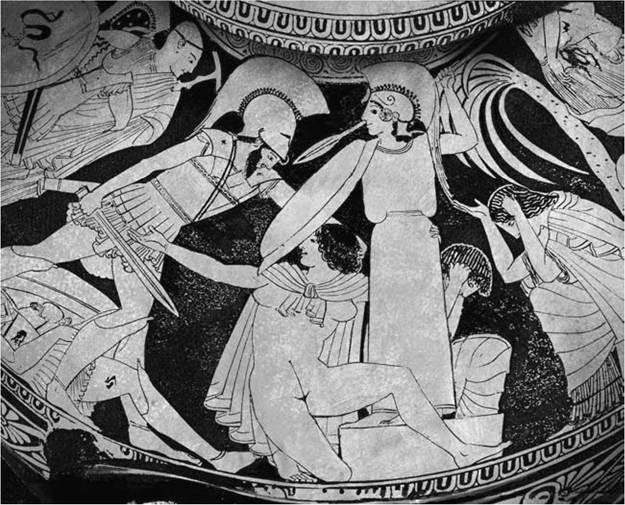
Figure 13.2 Vase painting showing the downfall of Troy (INTERFOTO / Alamy)
primarily used for symposia (male drinking parties) or for special occasions. Around 530 bce the Athenians pioneered a new technique of pottery decoration known as red figure that by the early fifth century had replaced the earlier black figure, save for special-purpose vessels such as the amphorae given as prizes in the Panathenaea.[511] The new red figure style had the advantage of giving an artist greater possibilities of showing motion and naturalism in his subjects and rapidly became popular throughout the Greek world. The depiction of the terrible sack of Troy by the Kleophrades painter includes the rippling musculature of the warriors, the broken body of young Astyanax, as well as a grieving King Priam, who is being sacrilegiously killed while sitting on the altar of Athena (see Fig. 13.2).[512] Only shortly before this work was completed, Athens itself had been sacked and its temples destroyed by the Persian army in 480 bce. Thus, the myth's depiction may be taken as a comment on contemporary events.
A similar, but more direct, mixing of mythical and contemporary subjects was displayed in the great panel paintings that were on display in the Stoa Poikile or Painted Stoa at the north end of the Agora from about the 460s bce. These panels, executed by famous artists such as Mikon, Panaenus, and Polygnotus, depicted the mythological sacking of Troy and the defeat of the Amazons by the great hero-king Theseus side by side with great paintings of the Athenian victories at Marathon over Persia and in what was a relatively minor clash at Oenoe over Sparta. Lost to the depredations of a Roman proconsul in the fourth century C e, we can only imagine the technical skill of these artists.[513]
In the realm of sculpture we are on firmer ground, though the originals of much of the greatest work of the fifth century are also lost. The great chryselephantine statue of Zeus that was probably over 40 feet high and housed in god's temple at Olympia by Phidias of Athens was ranked by later authorities as one of the famous Seven Wonders of the ancient world. Earlier, Phidias had made his mark as the director of the sculptural program - the most ambitious on any temple in Greek history - for the Parthenon on the Athenian Acropolis. The crowning jewel of this project was also an enormous chryselephantine statue, this time of Athena, now known to us only through later copies and the descriptions of later writers.[514] Significant parts, however, of the Parthenon's sculptural decoration have survived and are marked by not only tremendous skill but also innovation. The great sculptures that adorned the east and west pediments celebrated the birth of the goddess and the competition between Poseidon and Athena with a beauty that captures remarkable moments in the life of both the deity and Athens itself. Other sculpted reliefs on the temple's metopes depicted battles between the forces of civilization and barbarism, such as the Lapiths and Centaurs; but the most innovative and striking piece was a frieze depicting the Athenians themselves taking part in the great Panathenaic procession.[515] The figures of the horsemen are outstanding examples of the characteristic attention to
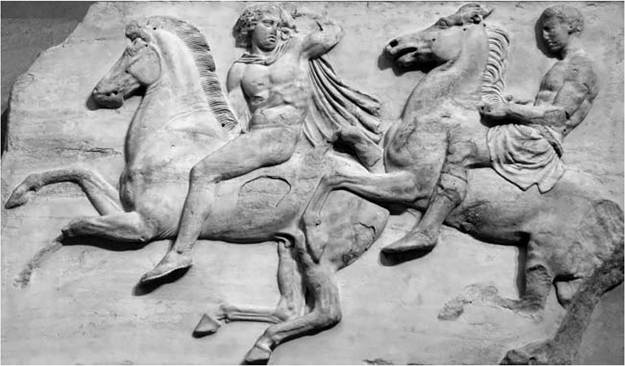
Figure 13.3 Cavalcade from the west frieze of the Parthenon, Athens (© Corbis)
detail in depicting animals and riders in a natural, if idealized, form and also in communicating a sense of motion and wonder (see Fig. 13.3).
As a building the Parthenon was a work of stunning genius. Built almost entirely from local marble from nearby Mt. Pentele, the structure contains a number of optical and structural refinements that make it to this day the most imposing building in the city and have helped it survive many earthquakes and human-created catastrophes over its more than 2,500-year history. Paid for mainly with funds from its subject allies, the building served primarily to house the great statue of Athena as well as the treasury for the Delian League (which had moved to Athens some seven years before construction began in 447 bce).[516] Thus, the Parthenon demonstrated Athenian power and dominance on a host of levels.
Literature and music
This combination of innovative daring and popular support could also be found in the literary achievements of the great Athenian tragic and comic poets, whose work was performed at state-supported religious festivals. Other areas of poetry and music also developed during this period in Athens, and new literary genres in prose, such as historical writing, blossomed from the mythographic and geographical works of earlier writers like Pherecydes and Hecataeus into the groundbreaking work of the analytical historians Herodotus and Thucydides.
During the last half of the sixth century, Athens had become something of a center for the literary arts under the Peisistratids, who had sponsored the festival of the City Dionysia for the performance of tragedy. While our knowledge about these early performances is limited, they appear to have consisted of a chorus and one actor playing all the roles. Under the democracy, the City Dionysia was put on at public expense in a theater on the south slope of the Acropolis, and the choice of plays to be performed was decided by state officials. Each playwright would be assigned a chorus, the expense of which was covered through a liturgy paid by a wealthy citizen.[517]
Many have identified the playwright and Persian War veteran Aeschylus (c. 525-456 bce) as the father of tragedy because he revolutionized these plays by adding a second actor and making the staging and costuming much more elaborate.[518] Another of Athens' great innovative tragedians was Sophocles (c. 496-405 bce), whose professional career spanned over fifty years. Taking the work of Aeschylus a step further, he added a third actor, creating even greater character development and complexity, and he even composed a treatise on the chorus, which unfortunately does not survive.[519] Like Aeschylus, whose participation in the Battle of Marathon was celebrated in the Painted Stoa, Sophocles was elected general at least once and in his eighties was also elected to high public office in the aftermath of a disastrous Athenian campaign in Sicily. However, the last of Athens' three great tragic poets, Euripides (480-406 bce), never held public office and had a more complex relationship with his public. Having grown into adulthood in the heyday of Athenian power and the intellectual world of the sophists, Euripides pushed the boundaries of tragedy by experimenting with the genre in the partly burlesque Alcestis and exploring the consequences of war in plays like The Trojan Women and female rage in Medea.[520] Unlike his predecessors, Euripides was more popular and influential after his death than he was during his own lifetime.
The work of dozens of other great Athenian tragedians like Pratinas and Agathon is lost to us, except for quotations in the works of later authors; lost also is the choreography - dance was an important element in choral performance - and the music that accompanied the chorus' singing, even in the handful of plays that we have. However, one Athenian musicologist, named Damon, wrote a treatise not only analyzing particular rhythms and meters but also covering music's effect on morals and, thus, the role of music in education.[521] While this work is now lost, we can say that music was yet another arena of intellectual debate in which Athenians were at the forefront.
Another literary genre that developed during the fifth century was comedy. Similar to tragedy in its production at public expense for religious festivals, competitions for comic plays were held annually either at the City Dionysia or at the Lenaea, which was held in January for the god Dionysus. Although we know the names of dozens of comic writers like Eupolis and Platon who wrote a great many plays, only eleven plays, by Aristophanes (c. 445-380 bce), survive to give us a taste of their often biting and obscene political and social commentary. Unlike the relatively tame nature of tragedy (no violence, for example, occurs onstage), the sometimes scatological and frankly sexual humor of plays like Lysistrata, which enacts a sex strike by the women of Greece to stop the war between Athens and Sparta, shocks even some moderns. Barring criticism of democracy itself, comic playwrights knew few bounds in questioning the sexual behavior of Athenian political leaders (Acharnians) or popular tragedians (Women at the Thesmophoria), the motives of leading intellectuals (Clouds) or even the wisdom of Athenian men (Lysistrata); and this they did with the objects of their ridicule right there in the audience.[522]
This tradition of literary innovation and questioning was not limited to poetry, public performance, and song; it was also to be found in the prose works - a relatively recent literary development itself - of the great historians Herodotus and Thucydides. Taking their start from Ionian philosophers seeking rational, non-theological explanations to phenomena in nature, by the end of the sixth century a number of writers began attempting to understand the world's geography and even to rationalize the bewildering mythological stories of gods and heroes that populated the Greek understanding of the past. Some of these logographers and mythographers like the Athenian Pherecydes wrote about more recent events and even connected living individuals to ancestors from the mythical past.[523] Herodotus (c. 484-25 bce) of Halicarnassus near Ionia, however, wrote an account of the Persian Wars that moved the Greek understanding of the past to a new level. This work was not merely an account of the conflict but a set of his historiai, or researches, providing the reader with a wealth of ethnographic and geographic material in addition to accounts of the early political and social history of Persia, Lydia, Sparta, and of course Athens, where he may have gained much of his knowledge of the Greek world. Not only did he throw a wide net in gathering and setting forth his material, but he presented multiple accounts of what he learned, sometimes sifting between conflicting evidence and at other times leaving it to his reader to decide. Imperfect and unsatisfying to modern scholars as he can be, Herodotus points the way to a critical analysis of the evidence of what happened in the past; and, if we choose to believe the anecdotes of later biographers, he inspired the Athenianpolitician/general Thucydides (c. 460-395 bce) to embark on the writing of the major conflict of his day.[524]
Thucydides' account of the Peloponnesian War differed from Herodotus' in some profound ways. He began writing an account of his subject from its beginning, and he himself participated in the war as an Athenian general, who was exiled by the people for his perceived failure on the battlefield. He tells us something of his methodology for constructing his narrative and for composing the majestic speeches that punctuate his story; however, he rarely tells us who his sources are and seldom provides conflicting accounts. His drier prose style and eschewing of myth and anecdote have often led scholars to see him as objective and dispassionate; however, his biases toward politicians like Pericles and against Cleon are hardly well hidden. Moreover, while for Herodotus retribution for injustices explains human events, Thucydides has a deeper and darker diagnosis of human nature that he sees as valid “for all time.” Influenced by the early medical writers of his day, Thucydides elevated the historian to a sort of physician of the human condition, which became an influential model for many historians to come.[525]
At the end of the fifth century bce, two other new genres that grew up in Athens and flourished into the fourth century were the philosophical dialogue and speeches. Although the Greek love of oratory may be traced back to Homer, it was with the sophistic movement that close analysis and construction of all types of rhetoric from political speeches to courtroom pleadings and even to epideictic (display) works began. With a close attention to the rhythms of language, avoidance of hiatus, word choice, and the proper use of metaphor and simile, Athenian writers such as Lysias (c. 445-380 bce) and politicians like Demosthenes (384-322 bce) in the fourth century would create masterpieces of persuasive speech.[526] Arguably the greatest writer of Athenian prose was not an orator - in fact he railed against rhetoric for its amorality - but the philosopher Plato, whose dialogues represented both compelling vignettes of intellectual life in late fifth-century Athens and powerful literary pieces[527] depicting the heroic struggle of his protagonist Socrates to save his fellow Athenians from thinking that they knew what they did not - something for which an Athenian jury repaid him with a sentence of death.
Connections with the world at large
Both in its own time and in the nearly two-and-a-half millennia that have followed, Athens has had an impact far greater than its size. While its military might extended the power of a democratic empire across the Aegean and into the Mediterranean world, the immense influence of the city's artistic, literary, and intellectual forces would have an even greater impact.
With the defeat of a Persian army at Marathon in 490 bce, Athens leapt onto the world stage. The Athenian Empire of the fifth century bce pushed Persia, the world superpower of the time, out of parts of the Aegean Sea and even destabilized Persian control over Egypt by midcentury. However, conflict with Sparta and its allies led to a disastrous collapse of Athenian power and even a brief collapse of the democracy in 404-403 bce. The city's fortunes would rise again during the fourth century, but gone were the days of unbridled Athenian daring and opposition to tyranny. Indeed, the Athenian failure to stand up effectively to the rise of the power-hungry dynast Philip II of Macedon would herald the end of the era of independent city-states in the Greek world at the Battle of Chaeronea in 338 bce.
The new political realities created by Philip opened the door for the meteoric rise of his son Alexander III of Macedon (356-323 bce), whose conquest of the Persian Empire spread Hellenism as far as Central Asia and into the Indian subcontinent. Although Alexander visited Athens only once, through his tutor Aristotle he was greatly affected by the city's intellectual movements. Taking with him scientists and scholars, the Macedonian king wanted to record all that was possible of the lands and peoples he was bringing under his rule. Athens also at times was found useful as a propaganda tool, such as in Alexander's claim that the fiery destruction of the Great King's palace at Persepolis was in revenge for the burning of the Acropolis more than a century earlier.[528] Here, then, one sees the beginning of a conception of Athens as an idea that went beyond a mere physical place.
Indeed, it was in Alexandria in Ptolemaic Egypt that scholars working in the new library, which had fast become the center of learning in the Mediterranean world, established the precedence of Athenian literature and with it Attic Greek over all others. Although differences in dialect would continue in the vastness of the Greek world, the language of classical Athens (fifth to fourth century bce) now became fixed as the standard for what educated Greeks used to write their treatises, histories, speeches, and poetry - a practice that would continue for nearly two millennia after the Athenian navy had last plied the waves of the Aegean.[529]
This adoption of Athenian literature and learning continued well throughout Rome's heyday, in no small part because by the second and first centuries bce Athens had become a college town populated with the children of the wealthy from across the Mediterranean taking classes in its various philosophical schools.[530] As a result the city had, to paraphrase Pericles' boast, become an education for the entire Mediterranean world. The plays of the great Athenian playwrights continued to be performed and read in the schools - the survival of many of these dramas was dependent on these selections - and it was the Athenian orations of Demosthenes, Lysias, and many others that continued to be read and imitated centuries after Athens' democracy had ceased to function. An example of this sort of
Regional study: Athens in the fifth century bce emulation may be seen in the twelfth-century ce Alexiad of Anna Comnena, whose approach to history was profoundly indebted to Thucydides and whose Greek would have seemed quite contemporary to an Athenian living 1,500 years earlier.
Athenian art and architecture also had a lasting impact across the Mediterranean. Wealthy Romans, for instance, not only sent their children to Athens for higher education but also brought back a great many works of art from Greece, incorporating them into their burgeoning empire. Athens, in particular, was a target for these sorts of depredations, especially with the sack of the city by the Roman general Sulla in 86 bc. Not only were the Roman elite interested in decorating their gardens, but in addition, Athens had now come to represent high culture and dynamism. This was so much the case that echoes of Athenian art are abundantly evident in the artistic propaganda initiated by Augustus, Rome's first emperor.[531]
The identification of Athens with the high culture of the ancient world was not without controversy and became a matter of debate within the early Christian church. Some early Christian apologists like Tertullian completely rejected everything but scripture, while others believed that a middle ground might be found. While some literary texts were lost as a result, more simply ceased to be copied as a result of the tremendous political and social upheavals of the middle of the first millennium. As the Roman Empire in the West was transformed into a series of Germanic kingdoms in the fifth century ce and Byzantine power contracted dramatically during the centuries that followed, Greek literature virtually disappeared from Western Europe.[532] In the Christian East, however, some pagans like Socrates and Plato were made Christian saints, and the privileged position of Athens meant that more of its literary output survived.[533] Christians were not the only monotheists who saw value in their pagan predecessors, and with the rise of the Islamic Empire the works of Aristotle and other scientists became especially important and were translated into Arabic (indeed in some cases the original Greek texts are entirely lost to us).[534]
It would be through this Arabic connection - particularly through the great centers of learning in Islamic Spain and with the renewed connections
that came with the Crusades in the twelfth century c e that the West became reacquainted with Aristotle, who along with other great thinkers of the Greco-Roman world would spark first the Renaissance and later the Enlightenment in Europe. At the core of these great and complex movements or art, literature, and thought were an active engagement with or a reaction against the culture of classical Athens. For good or ill, Athenian art and architecture became representative of an ideal for painters and builders during the Renaissance and Enlightenment, while later modern artists have actively sought to distance themselves from this heritage. The moral, ethical, and metaphysical ideas of Socrates and Plato have profoundly shaped western philosophy, and an analytical approach to the study of the past also begins in Athens, as do the traditions of dramatic performance in the West.
Even our understanding of what Athens means has changed over time. In the 1700s the Athenian democracy was emblematic for Enlightenment thinkers of what might be best understood as mob rule; hence, the founders of a new nation in North America were careful to call their new polity a Republic, which adorned itself more with Roman imagery and titles than Greek.[535] [536] It was not until the middle of the nineteenth century that the Liberal politician and historian George Grote would write a monumental History of Greece that would restore a greater luster to Athenian democratic values.
Since the end of World War II, an idealized portrait of ancient Athens has fallen away considerably. Historical research has balanced the city's substantial achievements in literature, politics, and architecture with new lines of inquiry examining the lives of women and noncitizens in a society that disenfranchised them and studying the brutal system of chattel slavery that supported the whole edifice. Working to understand this more clearly, social historians continue to explode many old myths, and literary theorists open many new horizons on old texts that find new audiences in ways that probably would have surprised and even shocked their authors - feminist readings of Antigone, for example, surely would have floored the conservative Sophocles. Without question Athens continues to have an impact far beyond its place or time.
Further Reading
Anagnostopoulos, Georgios, A Companion to Aristotle, Oxford: Wiley-BlackweU, 2009.
Asheri, David, Alan B. Lloyd, and Aldo Corcella, A Commentary on Herodotus Books I - iv, Oxford University Press, 2007.
Boardman, John, Athenian Black Figure Vases, London: Thames and Hudson, 1974.
Boegehold, Alan L., “Group and Single Competitions at the Panathenaia," in Jenifer Neils (ed.), Worshipping Athena: Panathenaia and Parthenon, Madison: University of Wisconsin Press, 1996, pp. 95-105.
Burkert, Walter, Greek Religion, Cambridge, ma: Harvard University Press, 1985.
Camp, John McK., The Archaeology of Athens, New Haven, ct: Yale University Press, 2001. The Athenian Agora, London: Thames and Hudson, 1986.
Canfora, Luciano, “Thucydides in Rome and Late Antiquity," in Antonios Regakos and Antonis Tsakmakis (eds.), Brill's Companion to Thucydides, Leiden: Brill, 2006, pp. 721-53.
Cohen, Edward E., Athenian Economy and Society: A Banking Perspective, Princeton University Press, 1997.
The Athenian Nation, Princeton University Press, 2000.
Colaiaco, James A., Socrates against Athens, New York: Routledge, 2001.
Davies, John Kenyon, Athenian Propertied Families 600-300 bc, Oxford University Press, 1971. Garland, Robert, The Greek Way of Death, Ithaca, ny: Cornell University Press, 2001. Grote, George, A History of Greece, London: J. Murray, 1888.
Grube, G. M. A., Plato's Thought, Boston: Beacon Press, 1958.
Guthrie, W. K. C., The Sophists, Cambridge University Press, 1971.
Habicht, Christian, Athens from Alexander to Antony, Cambridge, ma: Harvard University Press, 1997.
Hale, John R., Lords of the Sea: The Epic Story of the Athenian Navy and the Birth of Democracy, London: Penguin Books, 2010.
Hansen, Mogens H., The Athenian Democracy in the Age of Demosthenes, Oxford: Blackwell Publishing, 1991.
Hansen, Mogens H., and Thomas H. Nielsen (eds.), An Inventory of Archaic and Classical Poleis, Oxford University Press, 2004.
Herington, John, Aeschylus, New Haven, ct: Yale University Press, 1986.
Horrocks, Geoffrey C., Greek: A History of the Language and Its Speakers, London: Longman, 1997.
Hurwit, Jeffrey M., The Athenian Acropolis, Cambridge University Press, 1999.
Jordan, Borimir, The Athenian Navy in the Classical Period, Berkeley: University of California, 1975.
Krentz, Peter, The Battle of Marathon, New Haven, ct: Yale University Press, 2010.
Lambert, S. D., The Phratries of Attica, Ann Arbor: University of Michigan Press.
McCabe, Mary Margaret, “Form and the Platonic Dialogues," in Hugh H. Benson (ed.), A Companion to Plato, Oxford: Blackwell Publishing, 2006, pp. 39-54.
Meier, Christian, Athens, NewYork: Metropolitan Books, 1998.
Michelini, Ann N., Euripides and the Tragic Tradition, Madison: University of Wisconsin Press, 1987.
WILLIAM MORISON
Morison, W., "Pherekydes of Athens (3),” in Brill's New Jacoby, Leiden: Brill, 2011, http://referenceworks.brillonline.com.ezproxy.gusu.edv/entries/brill-s-new-jac oby/pherekydes-of-athens-3-a3?s.num=4.
Morison, W. S., "An Honorary Deme Decree and the Administration of a Palaistra in Kephissia,” Zeitschrift fur Papyrologie und Epigraphik 131 (2000): 93-98.
Mylonas, G. E., Eleusis and the Eleusinian Mysteries, Princeton University Press, 1961. Neils, Jenifer, The Parthenon Frieze, Cambridge University Press, 2001.
PoweU, Anton, Athens and Sparta: Constructing Greek Political and Social Historyfrom 478 bc, New York: Routledge, 2001.
Reynolds, L. D., and N. G. Wilson, Scribes and Scholars, Oxford University Press, 1991. Rhodes, P. J., A Commentary on the Aristotelian Athenaion Politeia, Oxford University Press,
1993.
A History of the Classical Greek World 478-323 bc, Oxford: BlackweU Publishing, 2006. Rhodes, P. J., and Robin Osborne (eds.), Greek Historical Inscriptions 404-323 bc, Oxford University Press, 2003.
Richard, CarlJ., The Founders and the Classics, Cambridge, ma: Harvard University Press,
1994.
Rusten, Jeffrey, The Birth of Comedy, Baltimore, md: Johns Hopkins University Press, 2011. Scodel, Ruth, Sophocles, Boston: Twayne Publishers, 1984.
Sourvinou-Inwood, Christiane, Athenian Myths and Festivals, Oxford University Press, 2011. Usher, Stephen, Greek Oratory: Tradition and Originality, Oxford University Press, 2007.
WaUace, Robert, "Damon of Oa: a Music Theorist Ostracized?” in Penelope Murray and Peter J. Wilson (eds.), Music and the Muses: The Culture of Mousike in the Classical Athenian City, Oxford University Press, 2004, pp. 249-67.
Worthington, Ian, Alexander the Great, Harlow: Pearson Longman, 2004.