Late antiquity in Europe c. 300-900 ce
CHARLES F. PAZDERNIK
Constantinople as a witness to world history
The city of Constantinople, among the most distinctive and consequential European creations of late antiquity, presents itself as a witness to the various transformations that take place between the fourth and the ninth centuries ce.
The city's fortunes provide one among many threads that lend coherence to the period as a whole and usefully interrogate the validity of “Europe” as a geopolitical concept at this point in history.Founded on the old Greek city of Byzantium on the European side of the Bosporus, Constantinople took its name as “Constantine's city” (Greek Konstantinoupolis, modern Istanbul) from the emperor Constantine I (r. 306337 ce), who dedicated it in 330. The development of the city's identity as a second or “new” Rome (nea Rhome) owes much to the decision of Constantius II, one of Constantine's sons and successors (r. 337-361), to elevate its senate to a level of parity with that of Rome itself, as well as to the inclination of subsequent emperors to embellish the city and to distinguish it from other great cities in the eastern Mediterranean. The mutual involvement of the governing structures of the empire with those of the Christian churches, consequent upon Constantine's adoption of Christianity as his personal religion, accounts for the ecclesiastical recognition, by the orthodox ecumenical council of Constantinople in 381, of that city's bishop, or Patriarch, as second in precedence to the Pope in Rome and above the Patriarchs of Jerusalem, Antioch, and Alexandria. The construction of its massive fortifications early in the fifth century at the behest of Theodosius II (r. 408-450) ensured that the eastern capital, by now firmly established as the seat of emperors, would withstand sieges and assaults throughout our period even as the empire itself became drastically diminished.
In the fourth century, the city of Rome retained its prestige as the head of empire and remained the home of a fabulously rich aristocracy with landholdings across the Mediterranean. Its population of probably half a million depended upon the importation of foodstuffs from north Africa, while Constantine had provided for the provisioning of Constantinople from Egypt. As security concerns in the west drew emperors closer to the frontiers, however, Rome lost its role as an imperial residence. In 476, following sacks by the Goths in 410 and the Vandals in 455, it was incorporated into the post-Roman kingdom of Italy. In the sixth century armies of the emperor Justinian (r. 527-565), resident in Constantinople, recaptured it in a much-reduced state and incorporated it within the provincial administration of the eastern empire. Even after eastern power receded, Rome remained both a center of consumption and trade in Italy and the seat of the papacy at the head of the western Christian churches, but the city's security would depend upon outside powers down to the end of our period.
Justinian's spectacular rebuilding of the great church of Hagia Sophia sealed Constantinople's status as the greatest city of the age. After its sixthcentury apogee, however, in the face of military and natural disasters and desperate sieges in the seventh and eighth centuries, the city appears as a shadow of its former self, its Greco-Roman amenities and monuments neglected and abandoned, its population decimated, the imperial pretensions of its rulers controverted. In the ninth century, military and economic recovery set the stage for the distinctive political and cultural achievements of the middle Byzantine period through to the thirteenth century, while the intellectual and literary accomplishments of figures such as the patriarch Photios I of Constantinople (d. c. 893) testify to the preservation, cultivation, and adaptation of classical learning.
In spite of - or, indeed, because of - these vicissitudes, Constantinople occupied a singular place in the minds of outsiders as well as those of its inhabitants.
Its capacity to withstand sieges and secular reverses vindicated it as a God-protected city, a place of immanent holiness enjoying the special protection of the Mother of God and housing a fantastic array of sacred relics and miraculous objects. Ceremonial formality and elaborately staged spectacle enhanced the transcendent mystery and ineffable majesty of the imperial office. Byzantine silks (themselves embroidered with Roman, Sasanian, and Islamic imagery) and other precious objects, manufactured in carefully regulated Constantinopolitan workshops, adorned palaces and treasuries throughout Europe and the Near East. Such tokens of prestige served as the currency of diplomacy and instruments of soft power, providing an alternative to - or masking the absence of - coercive power and displaying aesthetic and technical excellence to the world as hallmarks of spiritual and temporal authority.Byzantine emperors were hardly unique among late antique monarchs in claiming the special favor of divinity and aspects of sacrality. Indeed, the embrace of monotheism and universalist aspirations to imperial dominion by great powers is one of the distinctive aspects of the period. At the same time, Constantinople's identity as simultaneously a concrete place and an endlessly reimaginable and recoverable idea provides a point of intersection between the realia of material and cultural artifacts and their interrelationships, on the one hand, and the mentalities and ideologies that animate civilizations, on the other.1 The following discussion, owing to limitations of space and an attempt to trace patterns of development across a broad span of space and time, will concentrate on the former rather more than the latter, as a result of which the centuries under examination may seem to pale in comparison with those on either side of them. The lived experiences of individuals in discrete circumstances are shaped by much more limited horizons.[537] [538] Late antiquity is avowedly a study of reaction, accommodation, and adaptation in the face of changes that might have seemed inexplicable, on account of their scale, or imperceptible, on account of their slow and subtle unfolding, to those who experienced them at the time.
Such a study requires, and rewards, the close and careful analysis of invariably fragmentary and limited evidence, but such an analysis relies, implicitly or otherwise, upon ideas and assumptions and approaches about the big picture that are inescapably synthetic and composite. What follows is one sketch of that big picture.The conceptual framework
For the purposes of this discussion, the coherence of both “late antiquity” as a periodization and “Europe” as a geographical focus requires explanation, and explicitly positing and problematizing them as choices is a useful exercise.
Recapitulating the development of late antiquity as a field of study lies beyond our scope, but it should be observed that the period as it has been defined here - 300-900 ce - corresponds neither to Peter Brown's “long” late antiquity (150-750 ce in The World of Late Antiquity [1971])[539] nor to the period of the “later Roman empire” as defined by A. H. M. Jones (284-602 ce in The Later Roman Empire: A Social, Economic, and Administrative Survey [1964]) and others. Nor does it conform, for that matter, to Chris Wickham's Framing the Early Middle Ages (400-800 ce [2005]) or The Inheritance of Rome (400-1000 ce [2009]). The periodization adopted here is, in the first place, self-evidently bounded by a pair of rounded numbers that lends itself to a more or less straightforward century-by-century survey without, one hopes, falling into a facile over-schematization: the varying pace of events and their effects across space and time will become apparent. Second, the starting point usefully fudges the vitally important reigns of the emperors Diocletian (r. 284-305) and Constantine I while firmly establishing the fourth century as a turning point. Third, the ending point gets us more or less to the end of the Carolingian dynasty and well within the middle Byzantine resurgence and the fragmentation of the Abbasid caliphate, offering a rough conspectus of the three principal European powers of the time at key points of inflection.
Traditionally, economic and political historians distinguished “the end of antiquity” from “the birth of Europe,” coinciding with a shift from a so-called ancient mode of production based upon slaveholding to the feudalism of the high middle ages, that was completed by the end of the tenth century. The interstitial period, more or less overlapping with ours, was characterized as a time of cultural and economic backwardness - the “dark ages" - in which production and consumption was isolated within the closed and selfsufficient estates of entrenched aristocrats in western Europe. More recent work has emphasized the role of such estates as centers of both production and demand that stimulated the development of new networks of interregional exchange across Europe and beyond.[540] Moreover, it is increasingly appreciated that the end of antiquity was in no sense a unitary phenomenon. Even as Roman imperial authority was disintegrating in the western Mediterranean in the fifth century, the east continued to enjoy unprecedented levels of prosperity well into the sixth, characterized by the intensification of agricultural production and polycentric patterns of exchange that sustained a pan-Mediterranean commercial network down to the turn of the eighth century. The Roman state interacted, furthermore, with a range of societies on its peripheries, including a well-organized empire in Mesopotamia and Persia, with which its fortunes were closely linked.
Late antiquity, especially as it relates to Europe, may accordingly be characterized as a period of disruption, transition, and transformation away from a Mediterranean-centered, late Roman imperial political and socioeconomic order, the effects of which were experienced differently in the various post-Roman successor states that developed both within and beyond former, centrally administered imperial territories. On a cultural and ideological level, each of these successor states constructed greater or lesser perceptions of continuity with the Roman imperial past in proportion to the instrumental value they identified in perpetuating or rediscovering Greco-Roman literary and material culture and imperial institutions and infrastructure.
What may usefully be compared across these differentiated experiences and contexts is the manner in which each polity successfully extracted and concentrated the surplus production of a more or less comprehensively mobilized and exploited agricultural peasantry in order to maintain order, to develop and sustain elite patterns of consumption and ideological selffashioning, and to aggrandize itself at the expense of competing polities. The late Roman fiscal system, which organized and directed the productive capacities of its preindustrial Mediterranean heartland to an unprecedented extent,[541] supplies not only the baseline of such a comparison but also the material conditions which precipitated its own collapse, as outsiders attracted by the relatively greater prospects for wealth and advancement within the empire bid with varying degrees of success for their share of the bounty.
If, then, the validity of late antiquity as a period of study can be accepted at least provisionally, perhaps it can be admitted more frankly that the choice of Europe as a geographical focus for this discussion is, at root, arbitrary: at no point in the period is Europe, however it might be defined, a politically, culturally, or economically coherent entity. The historiologically salient point is, instead, that the western Eurasian landmass is the area, and these are the centuries, in which so many nationalist ideologies contributing to the overarching story of “the birth of Europe” are situated.[542] Acknowledging the accumulated baggage of so much of European history, as it has traditionally been framed, is perhaps the only justification for including a contribution on late antiquity “in Europe” in a twenty-first-century history of the world.
As a response to retrospective and teleological narratives that have attempted to recover the origins of modern national identities in the postRoman European centuries, attention to regional development and variation has become increasingly pronounced in late antique and early medieval studies. The expectation of, and appreciation for, differences has to inform any attempt to understand the period.
The Roman empire in the fourth century
While the Roman imperial order grew to embrace the entire Mediterranean basin - something never accomplished before or since - at no point in time did it comprehend the whole of Europe. Among the most consequential developments between the fourth and the ninth centuries ce were the reordering of political and economic relationships around the Mediterranean and, consequently, the development of new relationships linking formerly Roman territories with those beyond (see Map 14.1). Above all it was the Roman fiscal system, with its stimulative and capillary effects in extracting surplus and redistributing resources toward the imperial capitals and the frontiers, that accounted for the empire's resilience and success.
At the beginning of the fourth century, central authority had been reestablished over the empire's traditional territories following a period of political, military, and economic disorganization in the third century. The frontier swept from Hadrian's Wall in Britain into continental Europe along a line defined for the most part by the Rhine and Danube rivers, thence into Asia Minor and Syria and Palestine within a contested eastern boundary in Mesopotamia, and back to include Egypt and the coastal plains of north Africa. Frontiers were zones of cultural and economic interaction rather than exclusionary defensive lines.[543] Beyond the provinces they governed directly, the Romans cultivated buffer zones of client kingdoms which acknowledged imperial suzerainty in return for access to markets and the prestige accruing from diplomatic recognition. Along the northern and southern frontiers, the empire confronted outsiders, so-called “barbarians” (originally from the Greek barbaros, literally a speaker of gibberish), who were comparatively less organized and economically developed: for the most part, Iron Age agriculturalists to the north and pastoralists to the south. Beyond the
Downloaded from https:Zwww.cambridge.org/core. Cornell University, on 07 Jan 2017 at 22:26:16, subject to the Cambridge Core term available at https:/www.cambridge.org/core/terms. http://dx.doi.org/10.1017/CBO9781139059251.016
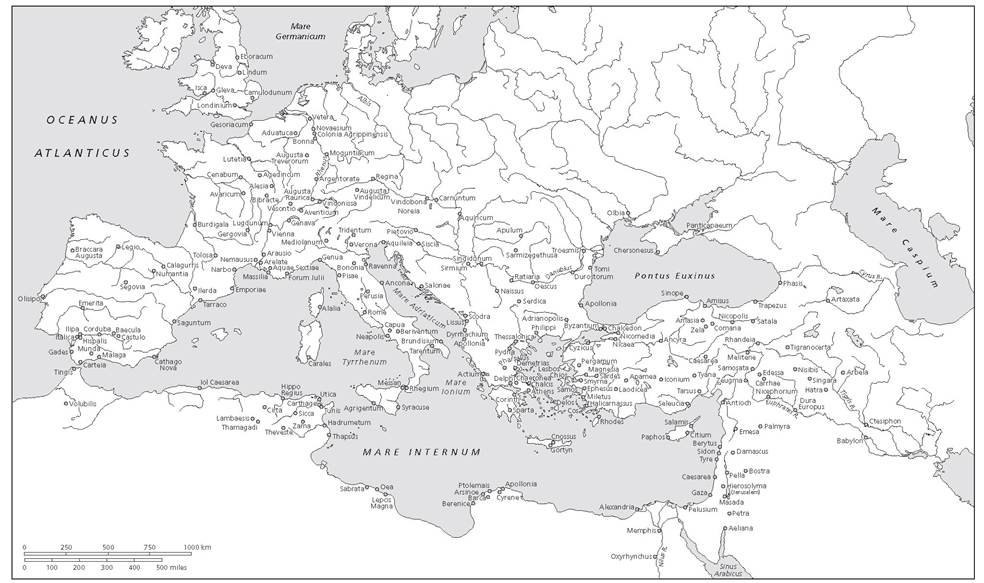
Map 14.i Europe and the Mediterranean in the third century
CHARLES F. PAZDERNIK
northern buffer zone, the Romans interacted indirectly with populations known to them chiefly as producers of raw materials such as amber and slaves and as objects of ethnographic speculation. In the east, in contrast, the empire sometimes contended and sometimes cooperated with a sophisticated and formidable territorial power - from the mid-third century, the Persian empire ruled by the Sasanian dynasty - which provided a geopolitical, economic, and cultural counterweight.
The Roman state was organized around a network of some 2,000 cities, supported by a fiscal system capable of gathering and concentrating agricultural commodities in bulk and distributing them over vast distances in order to feed urban populations and to supply troops on the frontiers. Taxes and rents underwrote an urban civilization that channeled elite consumption and competitive display toward the provision of amenities such as the bread dole, the provision of spectacles in theaters and amphitheaters, baths, and monumental public spaces. Communication by sea and riverine waterways facilitated the interregional transport of goods in bulk, enabling north African and Egyptian grain to feed Rome and Constantinople, respectively, while the southern Aegean and northern Italy provisioned garrisons along the northern frontier. Beyond that frontier there was nothing comparable in Europe.
Imperial government aimed at extracting revenues with a minimum of effort. Tax collection had long been in the hands of local elites, whose service as town councilors (curiales) and standing in their communities buttressed the system as a whole. The direction of taxation, in contrast, was controlled by centrally appointed, salaried officials. Recovering from the disorders of the third century obliged Diocletian and Constantine to undertake measures that increased outlay by expanding the imperial administration and the army. The threat from the militarily effective Sasanians in the east and the emergence of better-organized and more sophisticated groups in the north demanded the consolidation of the tax base and a larger share of the agricultural surplus. Standardized modes of registration and assessment were introduced, both monetary taxes and deliveries in kind (some increasingly commuted into gold as time went on) were levied, and all of these revenues flowed from the localities to centrally appointed provincial governors and then to the four great praetorian prefects, who by now were civilian fiscal and judicial officers responsible for sustaining an army of perhaps 600,000 men and more than 30,000 imperial officials.
Effective central control depended upon the fact that soldiers and officials were paid by the state and dependent upon the imperial fiscal system. The officials of the imperial administration were a self-regarding elite steeped in
the traditional Greco-Roman literary and rhetorical education, whose outlook, like that of Roman elites in prior centuries, remained fundamentally civilian. Successful military power-brokers, such as the soldier-emperors of the third and fourth centuries and the generalissimos who ruled in the name of juvenile or ineffective emperors thereafter, succeeded infrequently in devolving their influence upon their children, who in any event were raised as civilians.[544]
The expansion of the late Roman state apparatus and its increasing claim upon the economy have traditionally been seen as causes of economic crisis and decline. Yet economic activity in late antiquity was remarkably dynamic and widely diffused, and many places within the empire reached unprecedented levels of development in the period. The ability of the imperial government to meet pressing needs by linking centers of production with centers of consumption across the Mediterranean and beyond facilitated the expansion of distribution networks and stimulated the development of markets. The infrastructure underwritten and guaranteed by the state for the transportation of public goods from tax-exporting to tax-importing areas could be exploited for private interregional commerce by producers of surpluses in excess of their fiscal obligations, manufacturers of specialty goods, and exporters of high-demand local foodstuffs, piggybacking on the late Roman “tax spine” or “tributary nexus.”[545]
At the same time, commercial expansion and economic development driven by mercantilist motives were far from the horizon of imperial authorities. At root the Roman order fostered and protected a highly stratified social structure that supported the distinctive, urban-centered lifestyle of a pan-Mediterranean, Greco-Roman elite. Its members, whose wealth was invested in landholding on a local or interregional scale, as the case might be, cooperated with and were coopted by that order as a result of acculturation and the tangible benefits they received, far more than the sheer coercive power of the state. The price these elites paid in return was the share of extractable surplus generated by their landholdings that was captured by the state as taxation rather than by themselves in rents. The empire persisted where, and as long as, this value proposition remained an attractive one.
In late antiquity imperial government was more assertive and capable than ever before, though its resources and reach were paltry in comparison with those of the modern bureaucratic state. Threats to the fiscal integrity of the empire eroded the power of central authority and, if left unchecked, contributed to an accelerating spiral of decline. Third-century disorders had demonstrated the empire's tendency toward fragmentation and localization, which was arrested and reversed in the fourth by the strong and effective reassertion of central control. The breakdown of the late Roman fiscal system beginning in the west in the fifth century is attributable not only to mounting external challenges but also to the ability of local landowning elites to dispense with imperial government while accommodating themselves to new realities on the ground.
Exogenous shock as an explanation for fifth-century collapse
By the end of the fifth century, central imperial authority west of a line running roughly from Serbia to Cyrenaica had been effectively supplanted by a number of successor states ruled by military elites who traced their origins beyond the former northern frontier and whose identities had been forged in a long process of confrontation and accommodation with Roman authorities. The eastern half of the empire, in contrast, remained intact and securely within the control of an emperor seated in Constantinople.
Any explanation of “the fall of the Roman empire” must account for these divergent outcomes, in which geopolitics figures prominently. Its comparatively less exposed position with respect to the northern frontier equipped the east to weather, and to some extent to deflect upon the west, incursions by semi-peripheral outsiders seeking places for themselves within the empire. The destabilization of that frontier has been described as a series of exogenous “shocks” that led to the collapse of central authority in the west while leaving some landowning elites and some local and regional Roman institutions intact.[546]
Structural changes in the fifth and sixth centuries also altered relationships between the central government and localities. The expansion of the imperial administration represented an attempt by the state not only to extend its reach but also to conciliate and to coopt local elites, who were offered official titles and salaries, carefully graduated orders of rank and precedence, tax advantages, and exemptions from service on town councils. Advancement in imperial service became correspondingly more attractive than traditional forms of elite competition and display at home. The fortunes of the curial class as a whole suffered as more ambitious local elites evaded its obligations. Increasingly the central government interacted with groups of de facto local notables, including great landowners and bishops, and dispatched its own officials into the localities. Tax collection remained dependent upon the cooperation of landowners, whose incentives to enlarge their holdings and patronage by sheltering their dependants from fiscal obligations increased in line with their capacity to resist state interference.
The fiscal system withstood these changes until it was disrupted in the west in the fifth century and in the east in the seventh. The severing of transMediterranean links between tax-exporting and tax-receiving provinces effected an economic contraction, the extent of which varied dramatically from region to region, and altered the basis of interactions between the rulers of post-Roman successor states, some of which lost the power to tax altogether, and their landowning elites.
In the west these included kingdoms of Vandals and Alans in north Africa, Ostrogoths in Italy, Sueves in northwestern Spain, Visigoths elsewhere in Spain and in southwestern Gaul, Burgundians in southeastern Gaul, Franks in northern Gaul, and Anglo-Saxons in Britain. All of these newcomers represented a small minority of the total population. The manner in which they exploited economic assets within the successor kingdoms remains a controversial and much-discussed issue.11 Outright expropriation undoubtedly did take place, but other, less disruptive, approaches were available, such as rewarding supporters by allocating to them directly a share of the revenues formerly captured by the imperial center. In much of the west, the impact of the newcomers would have been experienced most directly in the particular and limited areas in which they established themselves. Drastic changes at the level of high politics threaten to obscure appreciable continuities in other aspects of life, however profound the cumulative effects became in the long run.
Outcomes varied. By the end of the sixth century, patterns of landholding in northern Gaul and post-Roman Britain had been wholly altered, shaping and reflecting the composition of a new or reconfigured landholding elite. Elsewhere in Gaul, in Italy, and in north Africa, landed assets remained more intact, offering evidence of accommodation between newcomers and indigenous landowners and indicating the persistence of Roman culture and [547] some institutions. In those successor states with the most staying power, formal distinctions initially observed between newcomers and local populations faded with the passage of time. While Theoderic exercised jurisdiction in late fifth-century Italy over both Goths and Romans, by the late seventh century “everyone in northern France was considered a Frank.”[548]
Relationships between the Roman empire and groups on the other side of the northern frontier were conditioned by the stimulative effect of stationing troops there between the first and fourth centuries ce. Access to the relatively developed Roman economy and to opportunities created by contact with imperial authorities encouraged groups to organize themselves in order to garner rewards and to advance their interests at the expense of others. Achieving the scale needed at first to win recognition from the Roman state, and eventually to resist and undermine it, favored the growth and consolidation of militarized coalitions or confederations organized under effective leaders. Such experiences characterize many of the groups that eventually founded successor states in the post-Roman west. Key to their resilience was their capacity to incorporate themselves into new and larger groupings, sustained by access to the wealth of the Roman world, with whom imperial authorities and local elites had little choice other than to reach an accommodation.
External pressure along the northern frontier, coupled with strategic miscalculations and political disorder within the Roman empire between the last quarter of the fourth century and the first third of the fifth, contributed to growing instability and led to the settlement of largely autonomous groups of outsiders upon Roman territory, effectively removing key provinces from imperial control. The coalition under the leadership of Alaric (r. 395-410) which moved around the Balkans and twice into Italy, sacking the city of Rome in 410, might have included among many others elements of Germanic-speaking Gothic groups who had crossed the lower Danube and annihilated the emperor Valens (r. 364-378) with his field army at the battle of Adrianople in 378. Alaric himself had led allied Gothic forces in support of the emperor Theodosius I (r. 378-395) at the battle of the Frigidus in 394. Following the settlement of Alaric's successors in southern Gaul in 418, the Visigothic kingdom emerged as a key player in imperial politics in the second half of the century. In 429 a group of Germanic-speaking Vandals and Iranianspeaking Alans, part of a larger alliance that had crossed the upper Rhine in 406 and established themselves in Spain by 412, crossed the Strait of Gibraltar under their king Geiseric (r. 428-477) and occupied Roman north Africa, capturing Carthage in 439 and sacking Rome itself in 455.
These movements have been plausibly interpreted as responses initiated by pressure from the Huns,[549] originally nomadic horsemen from the Eurasian steppe, who are attested raiding the east Roman and Persian empires through the Caucasus in 395 and were newly arrived on the middle Danube in c. 411. By the mid-440s they were effectively united at the head of a large, heterogeneous, and involuntary confederation under the leadership of Attila (r. 434453), whose growing power inspired attacks on the Balkans and invasions of Gaul and Italy in 451 and 452. His death in 453 precipitated the collapse of Hunnic hegemony in the middle Danube region and the dissolution of his confederation.
Various coalitions emerged in the aftermath of the Hunnic collapse. Germanic-speaking Sciri entered the western Roman empire in c. 469, including Odoacer/Odovacar, who made himself ruler of Italy from 476 (d. 493). Goths united under the incipient Amal dynasty entered the east Roman Balkans in c. 473. Their king, Theoderic, at the suggestion of the eastern emperor Zeno (r. 474-491), led them, with subsequent accretions, into Italy in 488, eliminated Odovacar, and established the Ostrogothic kingdom (r. 493526). By 511 Theoderic had made himself sole ruler of both the Visigothic and Ostrogothic kingdoms. Throughout his reign he governed in a manner that preserved and appropriated Roman customs and institutions and acknowledged the authority of the imperial seat at Constantinople.
The eastern empire, its revenues secure, proved capable of absorbing incursions into the Balkans and reestablishing its European frontiers once Hunnic power had collapsed. The outsiders found easier pickings in the west, as a result of which perhaps half of its tax base had been eroded by the middle of the fifth century, at which point resources were simply unavailing to counter ongoing threats. Most decisive of all, notwithstanding the depredations of the Huns in the Balkans and beyond, was the loss of the western empire's richest provinces, in north Africa, to the Vandals and Alans in the 440s. The gravity of the situation is demonstrated by the efforts of the western and eastern courts in mounting costly maritime expeditions between the early 440s and the late 460s, which failed to dislodge the invaders. Faced with the ebbing of central authority, local populations did their best to seek a modus vivendi with the newcomers in their midst.
CHARLES F. PAZDERNIK
Sixth- and seventh-century upheavals
Attempts in the sixth century to regain lost Roman territories in the western Mediterranean achieved limited success. The eastern emperor Justinian I, exploiting dynastic struggles in north Africa and Italy, destroyed the kingdom of the Vandals and Alans in 534 and that of the Ostrogoths, following twenty years of fighting, in 552; subsequently he established a toehold in the south of Spain. These interventions reestablished, for the time being, interregional distribution networks in western Europe for goods from Syria-Palestine and north Africa, but they were predicated upon a volatile strategic balance with the Sasanian empire in the east. Recrudescence of hostility with Persia, coupled with natural disasters and a virulent outbreak of plague, straitened the resources at Justinian's disposal, and in the following century the east Roman state faced existential challenges, exacerbated by civil war, from Persians, Avars, and Slavs, and most importantly Arabs.
Following catastrophic Sasanian incursions early in the seventh century and the Persian-Avar siege of Constantinople in 626, the emperor Heraclius (r. 610-641) campaigned through Armenia into Mesopotamia and brought Persia to the brink of collapse, recovering most of the empire. Arab groups had long been employed as clients by either side, and now the exhaustion of the two great powers opened the way for their advance under the unifying impetus of Islam. By the end of Heraclius' reign, Syria, Palestine, and Egypt had once again been lost and Asia Minor imperiled, and by 652 the Persian empire had been subsumed within an Islamic empire stretching by the early eighth century from northern India to Spain. The breaking of the first Arab siege of Constantinople from 674-678 checked the ambitions of the incipient Umayyad dynasty and offered a respite.
The loss of Egypt in particular, first to the Sasanians for the decade before 629 and then to the Arabs permanently after 641, delivered a blow comparable to the conquest of north Africa by the Vandals, dismantling the panMediterranean Roman fiscal system once and for all. Not only was Alexandria in Egypt politically and fiscally severed from Constantinople, but so too was Byzantine Carthage in north Africa, from which Heraclius had launched his bid for imperial power, Antioch in Syria, and Jerusalem in Palestine. Interregional exchange of foodstuffs and manufactured goods persisted until the end of the seventh century, as distributions of the ceramic storage vessels known as amphorae and north African fine wares demonstrate. A decisive change becomes evident, however, in the decades around 700 ce. The earlier of two well-dated ceramic assemblages from the Crypta Balbi in
Rome indicates the availability of African and eastern imports in some quantity around 690, while the later deposit, around 720, contains scarcely any items originating outside of Italy or Sicily.[550]
The erosion of interregional exchange apparent after 700 contributed to economic contraction, making elites less wealthy in general and leading to the regionalization and simplification of material culture. Rulers enjoyed greater autonomy in states in which elite status was determined by access to centrally controlled resources, such as offices and salaries, and were correspondingly more dependent upon cooperation in others in which elites controlled resources of their own and effectively dominated localities.
The western post-Roman successor states gradually lost the ability to register and tax their subjects in order to support a salaried army, resulting in political fragmentation and the de facto negotiation of power among monarchs, elite landholders, semi-independent towns, and the clergy. In no small part as a consequence of the decline of state institutions, the Christian church came to play a predominating role in the society and economy of western Europe. In contrast, both the Byzantine (to use the conventional designation of the eastern empire from these centuries onward; “Byzantines” called themselves Rhomaioi, Romans) and the early Arab states retained and adapted elements of the late Roman fiscal system, albeit in diminished form. Seventh- and eighth-century Byzantium struggled to maintain itself on a sharply reduced territorial basis, while tax collection and military organization in the Syria-based Umayyad dynasty (661-750 ce) was devolved upon the provinces, keeping a large share of revenues there.
Post-Roman points of reference
The seventh and eighth centuries should be approached not as “dark ages” but rather as a period of dislocation and realignment leading to the emergence of three key peer polities, which in overarching terms may be identified as the empire of the Franks, the Byzantine empire, and the Caliphate, this last term designating an Islamic empire headed by a caliph or “successor” (Arabic khalifa) to the Prophet Muhammad as supreme religious and political leader. Each of these polities was a European power, and all in distinctive ways were both inheritors of a Roman imperial legacy and responsible for integrating post-Roman and non-Roman areas into new structures. Correspondingly, all three imperial powers influenced the development of a constellation of monarchical states in Europe stretching by the end of the ninth century well beyond erstwhile Roman territories, from the Atlantic to the Volga and from the Arctic Circle to the northern Mediterranean. Our perception of the reality of economic regression within the post-Roman world in these centuries is to some extent balanced by an appreciation of growth and development outside it, culminating in the radically transformed Christian Europe of the central middle ages. Such a perspective was, of course, unavailable to those at the time.
In the western Mediterranean the final collapse of the Roman interregional exchange system around 700 C e contributed to relative economic stagnation. In Europe effects varied from region to region. Some urban areas in former Roman territories disappeared, and many others broke up into islands of smaller settlements, separated by ruins and spaces converted into market gardens and vineyards supporting a population of hundreds or a few thousands. Christian bishops provided community leadership within an ecclesiastical network of episcopal sees that perpetuated elements of the ancient urban network on which it had been founded. Monumental architecture was largely focused upon churches, which were constructed out of materials recovered from abandoned structures. In some places private buildings encroached upon formerly public spaces, altering urban centers. In the eastern Mediterranean a much diminished Byzantine empire and a flourishing, if frangible, Islamic empire maintained coherent state structures that adapted the surviving Roman fiscal infrastructure in increasingly distinctive ways. In the meantime new exchange networks and ports of trade became established in the North Sea region.
Byzantium
While the Byzantines maintained their universalist claims to world supremacy and perpetuated late Roman cultural patterns and attitudes toward legitimacy, the rump of the eastern Roman empire, now confined to Asia Minor, the Balkans, and a diminishing presence in Italy and Sicily, had become geopolitically a regional power in the eastern Mediterranean whose fortunes were inversely correlated with those of the Islamic powers around it. The failure of the second Arab siege of Constantinople in 717-718 concluded efforts on the part of the Caliphate to capture the city in our period, and gradually a frontier stabilized along the Taurus-Antitaurus range in southeastern Asia Minor. Ongoing threats required continual outlay on the army, in spite of the loss of two-thirds of the empire's territory and perhaps three-quarters of its revenue. Fiscal demands dictated patterns of production and distribution, while commercial activity was confined largely within localities and began to recover only in the mid-ninth century.
Political authority and social capital was concentrated in Constantinople, whose estimated population of 40,000 was reduced from perhaps half a million in the early sixth century. Centrally appointed and salaried imperial officials assessed and disbursed tax revenues, which continued to be extracted largely from agricultural production.[551] In the seventh century smallholders predominated, following the diminishment of large estates, while in the eighth and ninth centuries large landowners reemerge and resume their role as fiscal intermediaries. Elites derived status not only from landholding but from the possession of imperial positions and titles, which were prerequisites for social and material advancement.
The eighth century marked in key respects a nadir in relations between the Greek east and Latin west. The introduction of iconoclasm, a rejection of the veneration of religious images, by the emperor Leo III (r. 717-741) in the late 720s was vigorously opposed by the papacy. In the face of threats from the Lombards, who had been a rising power in Italy from the end of the sixth century, Rome pursued political alignment with the Franks, who conquered the Lombard kingdom in 774. Pope Leo III's coronation of the Frankish king Charlemagne as “emperor of the Romans” in St. Peter's Basilica in Rome on Christmas Day, 800, abetted Frankish efforts to appropriate Byzantine imperial imagery. The formal renunciation of iconoclasm in the east in 843 contributed, however, to a political and ecclesiastical rapprochement between Rome and Constantinople, while dynastic instability within the Frankish kingdom at mid-century created a security vacuum in the face of Arab attacks on Italy. In the meantime Byzantine power in the central Mediterranean was on the rise and would continue to increase under the emperor Basil I (r. 867-886) and his successors in the so-called Macedonian dynasty. Diplomatic missions resumed, and by the close of the century remaining points of ecclesiastical controversy appear to have been resolved, at which point the papacy itself entered into a period of political decline.
CHARLES F. PAZDERNIK
The Caliphate
Both the Umayyad dynasty, centered on Damascus between the 660s and the mid-eighth century, and the Abbasid dynasty, centered on Baghdad from the later eighth century down to its disintegration in the early tenth, at the end of our period, encompassed territories and disposed of resources that surpassed those of the Roman empire at its height. The Islamic empire influenced the history of Europe in late antiquity not only directly, through its possessions in Spain and its reduction of the eastern Roman empire, but also through the influence it exercised militarily, economically, and diplomatically throughout the Mediterranean and up through the Caucasus into eastern and northern Europe.
While the Umayyads exploited the local fiscal structures they inherited from the Romans, their state differed structurally from those of the Byzantines and the Franks, respectively, in that unlike the former its ruling elite was militarized and unlike the latter its armies, on the principle of keeping Arabs separate from non-Arabs, were settled for the most part in garrison towns and salaried; correspondingly, they were discouraged from acquiring land. Until c. 700 indigenous elites in Egypt and Syria-Palestine, including principal landholders and the officials of the civil administration, remained Greek-speaking and Christian. Thereafter the Arabization of these elites proceeded apace but remained incomplete at the end of the dynasty.[552]
Like the Romans, the Umayyads relied upon local elites for the collection of taxes. The presence of salaried garrisons in each province ensured, however, that most state revenues were both raised and consumed at the provincial level, leaving correspondingly fewer resources available for direction and disbursement from the center. The resulting divergence of interests between the caliphs and the provincial armies contributed to political instability, while the fiscal imperatives that had stimulated interregional exchange in the Roman period through the state-directed transport of commodities in bulk from tax-producing to tax-receiving provinces were lacking. Regional commercial networks in places such as Syria and Palestine remained intact, and elite consumption perpetuated long-distance trade in luxury goods from northern Europe and central and southeast Asia, but the disappearance of large-scale distributions of Syrian and Palestinian amphorae and north African fine wares is apparent in the eighth century within the Islamic empire no less than elsewhere throughout the Mediterranean. Well before the end of
the century, a new (and archaeologically less visible) basis of interregional exchange between Christian Europe and the Caliphate was in place, in the form of the mass export to the Muslim world of European slaves captured as fruits of Frankish conquests.[553]
The overthrow of the Umayyads by the army of Khurasan (a province in present-day northeastern Iran, Turkmenistan, and Afghanistan) and the installation of the Abbasids as a caliphal dynasty in the new city of Baghdad eclipsed Syria and its army and signaled growing political and cultural alignment between Arabs and Persians. Centralization of the military accompanied a consolidation of the fiscal system and its bureaucracy in Iraq; the resulting redirection and concentration of taxes at the center contributed to the flourishing of the Islamic golden age but also encouraged fragmentation during periods of political struggle, as breakaway provinces withheld revenues and recruited their own armies. Tax revolts fueled separatist regimes from the end of the eighth century, and by the 920s the Abbasid caliphate had effectively broken up, notwithstanding the survival of the dynasty itself until the thirteenth century.
The Franks
Following the collapse of Ostrogothic hegemony in the western Mediterranean in the sixth century, and in spite of the efforts of Justinian to reestablish direct imperial control from Constantinople over the west, the geopolitical center of western Europe shifted decisively north of the Alps during the sixth and following centuries. The emergence of a supraregional power under a series of Germanic-speaking Frankish dynasties on both sides of the former Rhine frontier between the Atlantic and the Elbe, in what is now France, the Benelux countries, and western Germany, was an unprecedented phenomenon. Lacking the ability to tax agricultural production systematically in order to maintain large standing armies, and relying instead upon forces supplied by militarized, landowning elites who controlled localities, the Frankish empire was less intrusive and resilient than the Roman: conciliating, mobilizing, and rewarding their supporters obliged its rulers to exercise patronage, fueled by the proceeds from predatory foreign conquests. Correspondingly, their authority waned when opportunities for expansion were lacking.
Childeric, the son of Merovech - the eponymous founder of the Merovingian dynasty, himself reportedly the offspring of a sea monster - appears in the middle of the fifth century as the leader of a Frankish subgroup called the Salii cooperating with Gallo-Romans in resisting incursions of Visigoths and others along the Loire Valley. Upon his death in c. 481, he ruled a principality in the former Roman province of Belgica Inferior. His son and successor, Clovis (r. 481-511), consolidated rival Frankish subgroups into a strong monarchy that had captured most of southwestern Gaul from the Visigoths, subjected the Burgundians, and conquered the Alamanni on the eastern bank of the Rhine. By the time of his death, his kingdom had become, together with that of the Ostrogoths, one of the most formidable post-Roman successor states in the west. In contrast with the heterodoxy of other barbarian rulers, which may be explained in part as a tactic of political and cultural resistance to the Roman imperial order, Clovis' conversion to orthodox Christianity contributed to receptiveness on the part of the Byzantines to the Franks as potential allies. Yet they adroitly exploited openings presented by Theoderic's death in 526 and consulted their own interests in the wake of Justinian's intervention in Italy. Clovis' grandson Theudebert (r. 533-548) usurped an imperial prerogative by issuing his own gold coinage.
Merovingian expansion reached its fullest extent late in the sixth century. By the second half of the seventh century, power had devolved upon regional elites in Neustria, Austrasia, and Burgundy, and peripheral areas had reasserted their independence. Resurgence occurred under the Carolingians at the end of the century. The first prominent member of the dynasty, Pippin (d. 714), achieved dominance as Mayor of the Palace (maior palatii, chief officer of the royal household) in both Austrasia and Neustria in northern Francia after 687. His son Charles Martel (d. 741) re-established control in Burgundy and conquered Aquitaine. His son, another Pippin, deposed the last Merovingian, Childeric III, and was crowned king in 752 (d. 768). Imperial expansion accelerated and reached its height under his son Charles “the Great” (Karolus magnus), better known as Charlemagne (r. 768-814), whose conquests included Saxony, the Lombard kingdom, and the central European empire of the Avars. Under his direct rule thus fell Gaul, parts of northern Spain, the territory between the Rhine and the Elbe, northern Italy, and much of the middle Danube region.
By the later ninth century, Carolingian power was effectively confined to a limited block of territory around Paris. Elsewhere in west Francia, power had devolved upon a constellation of local princes. In east Francia beyond the Rhine, however, one of Charlemagne's grandsons, Louis the German (r. 817876), enjoyed a long reign and created conditions that enabled the kingdom to survive the extinction of his line, in 911, evolving into the Ottonian dynasty in the tenth century.
South of the Loire, sixth-century successors of old Roman elites preserved their holdings and retained a recognizably urban culture. Cities, governed by local notables, remained in place, and evidence of Frankish settlement is limited. North of the Loire, in contrast, cities recede from view as places of elite consumption and display, and disruptions in patterns of aristocratic landholding and episcopal succession are apparent, consistent with the rur- alization of Frankish elites from the seventh century onwards. Evidence of so- called bipartite manors, the characteristic great estates of the Carolingian period, begins to appear between the Loire and the Rhine, under which the demesne land directly exploited by the landlord is developed and maintained through services imposed on the manses. The mansus was a unit of assessment, comprising a complete farm with its dwelling, outbuildings, fields and meadows, and inhabitants, in which the tenant was secure in his possession and could transmit his tenure to his children, in exchange for which he was liable for customary payments and services.
Frankish kings preferred to live in rural palaces in the heartlands of their kingdom where their own lands and followers were concentrated. Power was displayed not in the city, much less in a permanent capital, in contrast with the Lombard and Visigothic kings who held court and maintained a permanent administration at Pavia and Toledo, respectively. It was instead at the annual spring assembly that military and ecclesiastical elites gathered to confirm bonds of fidelity, to exchange gifts and tribute, and to assemble forces for military campaigns. The great landowners, lay and clerical, resided in palaces in rural estates, in abbeys founded in the countryside, or in villabased rural settlements surviving from the late Roman period.
Concentrations of elite wealth account for the comparative vitality of northern European exchange in the period, in contrast to the drying up of channels for the importation of olive oil and other Mediterranean products into northwestern Gaul from southern ports such as Fos, Toulon, Narbonne, and Marseilles at the end of the seventh century. The need to transport goods from peripheral estates to the central residences of their proprietors likely stimulated exchange on a regional and even international level and sustained demand for relatively rare prestige goods on the part of agrarian elites in northern Francia and their counterparts in England and Scandinavia. The development of the bipartite manor seems to reflect increasing demand and the intensification of the exploitation of peasant producers. Distributions of high-quality ceramics along the great river valleys between the Loire and the Rhine offer evidence of commercial production networks and internal exchange.
Exchange to and from the Frankish lands underpinned the prosperity of trading centers in the North Sea region, so-called emporia or “wics,” which prospered at the height of Carolingian prosperity and stability between the de facto rule of Charles Martel and the reign of Charlemagne's son and successor Louis the Pious (r. 814-840). River estuaries became points of entry for travelers from Ireland, Britain, and Scandinavia, including diplomats, merchants, missionaries, and pilgrims. The emporia situated there were centers of international trade. Kings collected customs dues, and workshops and agricultural markets developed in their vicinities. They included Quentovic in Neustria, close to the English Channel, and Dorestad, on the border between Austrasia and Frisia on the former course of the Rhine; in England, Lundenwic, near the site of Roman London, Hamwic, on the site of the future Southampton, and Ipswich in East Anglia; other sites, such as Dublin, Birka in Sweden, Hedeby on the Jutland peninsula, and Kiev, attest to the trading activities of Danes, Norwegians, and Swedes.
Other points of reference
Elsewhere in western Europe the localization and simplification of production and exchange following the cessation of imports from north Africa and the east in the seventh century varied considerably from place to place. Southern France offers evidence of continuity of occupation and examples of large-scale landowning, but few signs of new construction until the ninth century. In Italy the Lombard aristocracy was based in cities, and urban activity is apparent in the eighth century in Milan, Verona, Pisa, Venice, and elsewhere. Already in the early ninth century, Venice begins to emerge as a point of entry for eastern Mediterranean goods destined for the Franks.
Rome remained by far the largest city in the west, with a population of perhaps 25,000 in the eighth century. Church-building and artisanal production continued throughout the period to a greater degree than elsewhere, stimulated by internal demand and ongoing diplomatic links with Byzantium, which supported cultural interaction and perhaps some level of exchange there and with other cities in Byzantine Italy, such as Naples. The glazed fine ware known as Forum Ware that was locally produced in Rome in the eighth century and evidently inspired by Constantinopolitan forms and techniques enjoyed a long period of development and a wide influence, being
exported and imitated along the Tuscan coast and in southern France well into the ninth century.[554]
In Spain the destruction of the Visigothic kingdom by the Umayyads in 711 intensified a tendency toward localization already apparent in the sixth and seventh centuries, notably in inland areas that were already isolated from the Mediterranean exchange system, and precipitated a wholesale collapse of economic and settlement patterns in the most radically destabilized areas. Elsewhere local artisanal production of utilitarian ceramics continued, while finer wares are found in the southern cities in which the Umayyads initially established themselves on the peninsula, notably Merida, Cordoba, and Montefrio near Granada. By the end of the eighth century, the unification of al-Andalus under the Umayyad emirate, centered in Cordoba, signaled progress toward stabilization and economic recovery, as represented by new construction and the development of Islamic-influenced glazed fine wares in the later ninth century.
Conquest, conversion, acculturation
The ninth century presents itself as an opportunity for taking stock at or along several points of relative equilibrium. Given the limited space available, it is impossible to do justice to the development of every area on the periphery of the great European powers of the period. What follows is an attempt at a panoramic snapshot around 900 ce that takes in post-Roman Britain, Scandinavia, and the Slavs.
Post-Roman Britain
The Roman occupation of Britain ensured the prosperity of a relatively small class of villa owners, who exploited the English countryside more intensively than at any point prior to the high middle ages. About 407 ce an imperial usurper stationed in Britain proclaimed himself Constantine III (d. 411) and crossed over into Gaul in an effort to stabilize the Rhine frontier, following which effective imperial control over the island was never reestablished.
Absent a security presence to the north and on both sides of the Channel, the Romano-British were exposed to raiding by Picts and Scots and by Anglo- Saxons from the mainland. In the middle of the fifth century, they reportedly
CHARLES F. PAZDERNIK
appealed in vain for imperial support in suppressing the assaults of Saxons, apparently recruited as mercenaries, who had subsequently staged a revolt. A counteroffensive organized by a certain Aurelius Ambrosius (the prototype of King Arthur), crowned by a British victory at the unidentified Badon Hill, seems to have stabilized the situation down to the mid-sixth century, preserving for the time being an exiguous but culturally and linguistically postRoman elite. By the beginning of the seventh century, in any event, ten or more relatively small Anglo-Saxon kingdoms had been established in England, probably as a result of an extended, if relatively small-scale, flow of population from the continent.
The consequences of these changes are apparent in the countryside. While late Roman Britain was organized into a number of villa-centered estates, these had been broken up into smaller units of production by c. 600, as a result of which concentrations of wealth were reduced and former Roman towns lost much of their urban character. Whether this development preceded the Saxon incursions in the context of the imperial withdrawal from the province, or was instead the result of those incursions, is an unsettled question. It may be that the need to reward a larger number of followers than the Romano-British model of landholding could support persuaded Anglo- Saxon kings against maintaining and reproducing the old order, even if it were still extant.
Scandinavia
In the Roman period, trade in amber led from the southern shores of the Baltic to central Europe and the Black Sea. Some Jutland populations had been involved in the Anglo-Saxon takeover of Roman Britain. Yet trading and raiding in the later eighth and the early ninth centuries brought larger numbers of Scandinavians into closer contact with populations in both western Europe and European Russia than ever before.
Following the collapse of the western empire and the disruption of established interregional exchange networks between the Mediterranean and northern Gaul by the seventh century, the establishment of emporia along the English Channel and the North Sea coasts offered powerful incentives for Scandinavians to develop ocean-going naval technology and stimulated the expansion of the northern European exchange network into the Baltic region. Political instability in the aftermath of the collapse of the powerful Danish monarchy that had established itself by c. 700 in southern Jutland and some of the adjacent islands plausibly accounts for the migration of armed bands out of Scandinavia in the mid-ninth century and their
settlement on the western islands, in northern France, and in northern Russia.[555]
Viking raiding from Norway into northern Britain and Ireland and as far as Portland in the south, and again from Denmark along both sides and south of the English Channel, is well attested from the end of the eighth century. The island systems of Shetland, Orkney, and the Hebrides were colonized on a large scale by the middle of the ninth century, while the settlement of Iceland was well under way by the end of the century. During these decades monasteries within Ireland, which represented the largest concentrations of wealth and people anywhere on the island, were subject to attack both on the coasts and in the interior, as raiders ventured upriver. As attacks on either side of the Channel intensified - Paris was looted in 845 - Viking groups began to overwinter in western Europe, and individuals identified as kings appear in the sources for the first time.
In the 860s Viking forces conquered the Anglo-Saxon kingdoms of East Anglia, Northumbria, and Mercia in England until their progress was halted by the victory of King Alfred ofWessex (r. 871-899) at the Battle of Edington in 878, following which the Danish king Guthrum (d. c. 890) accepted baptism, Mercia was divided, and the Scandinavian presence in England recognized as the Danelaw. Frankish instability following the division of the empire among Charlemagne's grandsons offered fresh opportunities on the continent, and effective resistance was achieved only in 891 when a large Danish army was defeated at the River Dyle in Belgium. In England, Alfred withstood renewed Danish incursions in the 890s. The Irish kings united against the remaining Viking enclaves on the island, reducing their major stronghold, Dublin, in 902. Forces expelled from the British Isles turned upon western Francia, where Carolingian authority continued to recede. In 911, notably, land in and around Rouen was granted to a Viking leader named Rollo (d. c. 932), out of which would eventually evolve the Duchy of Normandy. Comparable settlements in the first quarter of the tenth century in England, Ireland, and northern France, including the resettlement of Vikings in Dublin, tied down most of the raiders.
Scandinavians also played a critical role in the emergence of the first Russian state. The name “Rus” is plausibly derived from the Finnish name for Swedes. Archaeological evidence suggests that in the mid-eighth century Scandinavian adventurers were moving south and east of the Baltic into European Russia. There they began establishing a trade in slaves and furs, as well as amber, honey, and wax, which they are documented conducting with both Muslims and Byzantines in the tenth century. Plausibly they interacted with the local Finn, Balt, and Slav populations - engaging in commerce or exacting tribute, as the case might be - in order to obtain trade goods which they were equipped to transport to distant markets.
Dendrochronology establishes that in 737 Scandinavians established a small colony on the River Volkhov close to Lake Ladoga. The initial market was Frankish elites in the west, but opportunities afforded by rivers in European Russia draining south into the Black and Caspian seas were soon realized. Muslim silver coin hoards were beginning to be deposited along the Volga from c. 800, by which point the Abbasid capital at Baghdad was the center of the Islamic empire. In 839 a delegation of Scandinavians from Russia reached the Carolingian court, having been sent along from Constantinople. Following a period of turmoil in the second half of the ninth century, during which another Scandinavian power base was emerging on the middle Dnieper at Kiev, a Scandinavian attack c. 860 from Russia on Constantinople is recorded, and the scale of Viking raids in the West was intensifying; the suituation, however, seems to have stabilized by the turn of the century.
At this point there were apparently three key Scandinavian settlements in eastern Europe: one on the Volkov in the north, commanding access to the Baltic Sea and routes west; another along the upper Volga, affording access to the Caspian Sea and the Islamic world; and the third at Kiev on the middle Dnieper, affording access to the Black Sea and Constantinople. Through these exchange networks linking areas rich in raw materials with centers of consumption in west and east, Scandinavians established themselves in Russia as a new elite, out of which the first Russian polity, Kievan Rus, would form, reportedly under the leadership of a certain Oleg of Novgorod, at the end of our period.
The Slavs
The collapse of the northern Roman frontier in the fifth and the sixth centuries reordered relationships not only within the empire but also along its periphery. The relocation of armed and organized, predominantly Germanic-speaking elites on former Roman territory in the west and on the lands between the Rhine and the Elbe created an opening for groups of Slavic speakers, previously unknown in Greco-Roman ethnographic writing, to engage in raiding across the Danube from c. 500 ce. By 550 they emerge as the main barbarian group confronting the eastern Roman empire in southeastern Europe. By 900, they dominated large parts of Europe east of the Elbe as well as the Bohemian basin, much of the Balkan peninsula, and elsewhere.
Evidence of the simplification of material culture by c. 700 across the former frontier east of the Elbe and north of the Danube is consistent with the hypothesis that, following the relocation of militarized elites, a numerous peasantry remained settled on the landscape. Literary testimony places Slavic-speaking Sclavenes and Antae north of the lower Danube frontier, in modern Wallachia and southern Moldavia, at the beginning of the sixth century. The absence of Slavs in accounts of prior events on this frontier, and in particular the lack of ascription of this identity to any of the groups swept up into Attila's empire, which occupied the same area in the middle of the fifth century, requires explanation.
Given the lack of conclusive linguistic or archaeological evidence pointing to a place of origin from which the Slavs suddenly migrated in the sixth century, it is plausible to suppose that Slavic identity emerges in situ, not as a result of ethnic self-description on the part of people who appear north of the Danube for the first time, but rather as an act of ethnographic definition imposed on indigenous groups beyond the frontier by imperial authorities and Byzantine authors in response to the altered security situation there.[556] The advent of the Avars, a Turkic-speaking group of nomadic horsemen who by 570 c e had established themselves on the Great Hungarian Plain, exacerbated these conditions by recapitulating the confluence of circumstances that had given rise to Attila's empire, prompting the Lombards to cross the Alps into northern Italy, where they established a kingdom at the expense of the Byzantines. Like the Huns, the Avars seem to have operated an unequal confederation holding a range of initially unwilling subjects in allegiance. War with the Persians in the 580s and again in the 610s obliged the Byzantines to concentrate their forces in the east, leaving the European provinces exposed to attacks by Avars and Slavs. By 614 the Danube frontier had collapsed, opening the way for Slavic settlement throughout the Balkans. Constantinople itself was besieged in 626.
The relationship between these developments and the diffusion of Slavic settlement into north-central Europe and western Russia by the end of our period remains unclear. Slavicization is plausibly explained as a process of cultural emulation, whereby a way of life spreads across large areas as a result of its adoption in progressive stages by a substantial indigenous population. Descriptions of early Slavic society in Byzantine sources stress its poverty, simplicity, and relatively egalitarian nature and suggest that at least some early Slavic groups were remarkable for their willingness to assimilate outsiders. Interaction with Roman authorities and with the Avar empire suggests that some degree of military organization and effectiveness was available, while the scale of cultural and linguistic change implies that the process was not free from conflict. The reach of the Slavic language itself may be explained as the dissemination of a lingua franca throughout the areas of Avar domination.
The destruction of the Avar empire by Charlemagne just before 800 precipitated the eventual emergence of successor states in central Europe. Areas that had earlier been among the least developed in western Eurasia come into focus, and an embryonic idea of Europe as a coherent, culturally interconnected network of polities begins to take shape. In the mid-ninth century, “Great” Moravia became the first Slavic state to convert to Christianity, resisting Frankish encroachment by receiving in the 860s the Byzantine missionaries Cyril and Methodius, who produced the first written form of a Slavic language in order to translate the Bible. As Carolingian power waned in the early 890s, the Moravians extended their hegemony over Bohemia, but their ambitions were curbed by the arrival of the nomadic Magyars in 896 as a major force in central Europe (see Map 14.2).
Key aspects of the period
The disruption of the late Roman exchange network linking the prosperous, revenue-producing areas of the Mediterranean heartland with militarized frontier zones in the north and east during the fifth century in the west and during the seventh century in the east resulted, to varying degrees, in the localization and simplification of economic production and trade in comparison with preceding periods. To the extent that post-Roman successor states lost the power to tax, the basis of military recruitment and organization was altered and the relationship between central authority and local elites transformed. In many areas late Roman patterns of landholding and elements of the urban network were preserved and adapted, but the fundamentally civilian character of the Roman aristocratic ethos, which had been preserved and diffused through the dissemination of Greco-Roman literary and rhetorical education and served as a badge of elite identity and the prerequisite for an official career, lost its raison d’etre. The militarization of lay elites in the
Downloaded from https:Zwww.cambridge.org/core. Cornell University, on 07 Jan 2017 at 22:26:16, subject to the Cambridge Core term available at https:/www.cambridge.org/core/terms. http://dx.doi.org/10.1017/CBO9781139059251.016
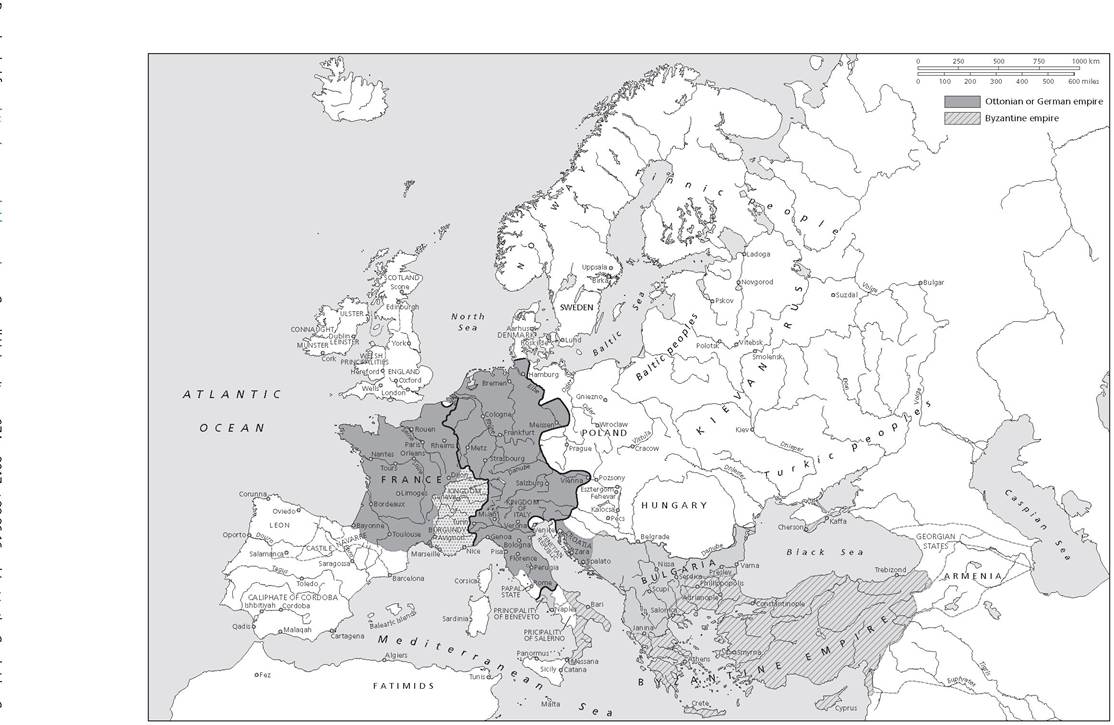
Map 14.2 Europe and the Mediterranean in the tenth century
post-Roman west was a consequence of these developments, while Byzantium and the Caliphate experienced different outcomes. The Byzantines, pressured by external threats, preserved a civilian administration focused upon the imperial court in Constantinople while resisting the centrifugal influences of increasingly dominant military elites settled in the provinces. The Caliphate experienced somewhat comparable tensions between the center and the periphery, which were conditioned, however, by the contingent circumstances of the Arab conquests and the consequent influences of subject populations upon the empire.
Charlemagne's imperial coronation represented not only the appropriation of a specifically Roman imperial legacy, especially as this had been received and transmitted by the Byzantines, but also a claim to universal supremacy implicit in the idea, which animated each of the great powers in the period, of the monarch as the personally chosen representative of God on earth. Within Europe, correspondingly, conversion to Christianity served variously as a strategy not only of assimilation and accommodation with but also of resistance to, and differentiation from, a hegemonic power. The institutional integrity of the ecclesiastical hierarchy offered alternative paths to advancement in both east and west, while in the latter the generally higher level of literacy on the part of clerics relative to lay elites made them valuable to monarchs as more complex and bureaucratic forms of organization developed.
Around 837 ce the iconoclast emperor Theophilus (r. 829-842) reportedly built a palace on the Asiatic side of the Bosporus at Bryas that was inspired by contemporary Abbasid palaces, as described by an envoy returning from an embassy to Baghdad, at a point at which such structures are notable for their apparent Sasanian influences. The caliph with whom the emperor communicated, al-Ma'mun (r. 813-833), was the founder of the great Abbasid library, the Bayt al-Hikma, and encouraged the translation into Arabic of the philosophical and scientific works of classical Greek authors such as Aristotle. Such exchanges did not prevent the two powers from warring with one another and are probably to be understood as acts of cultural appropriation, motivated not only by contemporary political and military rivalries but also by an appreciation of the legitimizing power of the past, be it that of imperial Persia or the early Greek enlightenment. In this respect perhaps these efforts can be compared with Charlemagne's imperial coronation in 800. If such accomplishments are broadly illustrative of (the end of) late antiquity, the period is remarkable because so much remained to be settled, and correspondingly so much was ripe for appropriation.
Further Reading
Bang, Peter Fibiger, and Christopher A. Bayly (eds.), Tributary Empires in Global History, New York: Palgrave Macmillan, 2011.
Brogiolo, Gian Pietro, Nancy Gauthier, and Neil J. Christie (eds.), Towns and Their Territories between Late Antiquity and the Early Middle Ages (Transformation of the Roman World), Leiden: Brill, 2000, vol. IX.
Brown, Peter, The Rise of Western Christendom: Triumph and Diversity, ad 200-1000, Oxford: Blackwell, 2003.
The World of Late Antiquity: ad 150-750, New York: Harcourt Brace Jovanovich, 1971.
Christie, NeilJ., “Forum Ware, the Duchy of Rome, and Incastellamento: Problems in Interpretation,” Archeologia Medievale 24 (1987): 451-66.
Curta, Florin, The Making of the Slavs: History and Archaeology of the Lower Danube Region, c. 500-700, Cambridge University Press, 2001.
Devroey, Jean-Pierre, Economie rurale et societe dans VEuropefranque (Vie-IXe siecles), Paris: Ed. Belin, 2003.
Duri, Abd al-Aziz, Early Islamic Institutions: Administration and Taxationfrom the Caliphate to the Umayyads and Abbasids, London: I. B. Tauris, 2011.
Geary, PatrickJ., The Myth of Nations: The Medieval Origins of Europe, Princeton University Press, 2002.
Goffart, Walter A., Barbarian Tides: The Migration Age and the Later Roman Empire, Philadelphia: University of Pennsylvania Press, 2006.
Haldon, John F., Byzantium in the Seventh Century: The Transformation of a Culture, Cambridge University Press, 1990.
Halsall, Guy, Barbarian Migrations and the Roman West, 376-568, Cambridge University Press, 2007.
Hansen, Ingle Lyse, and ChrisWickham (eds.), TheLongEighth Century, Leiden: Brill, 2000. Heather, Peter, Empires and Barbarians: The Fall of Rome and the Birth of Europe, Oxford University Press, 2010.
Jones, Arnold Hugh Martin, The Later Roman Empire, 284-602: A Social, Economic, and Administrative Survey, Oxford: Blackwell, 1964.
Loseby, Simon T., “The Ceramic Data and the Transformation of the Roman World,” in Michel Bonifay and Jean-Christopher Treglia (eds.), LRCW 2: Late Roman Coarse Wares, Cooking Wares and Amphorae in the Mediterranean: Archaeology and Archaeometry, Oxford: British Archaeological Reports, 2007, book 1662, pp. 1-14.
McCormick, Michael, Origins of the European Economy: Communications and Commerce ad 300-900, Cambridge University Press, 2001.
McEvoy, Meaghan A., Child Emperor Rule in the Late Roman West, ad 367-455, Oxford University Press, 2013.
Sagui, Lucia, “Roma, i centri privilegiati e la lunga durata della tarda antichita: dati archaeologici dal deposito di VII secolo nell'esedra della Crypta Balbi,” Archeologia Medievale 29 (2002): 7-42.
Skre, Dagfinn, “Towns and markets, kings and central places in south-western Scandinavia, c. ad 800-950,” in Dagfinn Skre (ed.), Kaupang in Skiringssal, Aarhus: Aarhus University Press, 2007, vol. I, pp. 445-69.
Smith, Julia M. H., Europe After Rome: A New Cultural History 500-1000, Oxford University Press, 2005.
Verhulst, Adriaan, The Carolingian Economy, Cambridge University Press, 2002.
Ward-Perkins, Bryan, The Fall of Rome and the End of Civilization, Oxford University Press, 2006.
Whittaker, C. R., Frontiers of the Roman Empire: A Social and Economic Study, Baltimore, md: Johns Hopkins University Press, 1994.
Wickham, Chris, Framing the Early Middle Ages: Europe and the Mediterranean, 400-800, Oxford University Press, 2005.
The Inheritance of Rome: A History of Europe from 400 to 1000, New York: Penguin, 2009.