East Asia
CHARLES HOLCOMBE
At first glance, the year 1200 bce seems to fall awkwardly in the middle of what is traditionally known as the Shang dynasty (c. 1570-1045 bce), the second of the legendary “Three Dynasties” of classical Chinese antiquity.1 The date might appear, therefore, to be a rather randomly arbitrary starting point for Chinese - and East Asian - history, except that it also coincides fairly closely with the archaeologically discovered first appearance of writing, and of the first known chariots (or wheeled vehicles of any kind).
Despite its lack of significance in the traditionally received chronology, 1200 bce actually does seem to mark some epochal changes, including the beginning of documented Chinese history.The chariot was apparently introduced to Shang China around this time from foreign origins in the northwestern steppes. The first evidence of its use for military purposes is associated with the activities of Shang enemies along their western frontier.[557] [558] Much of the jade that has been unearthed from the ruins of the late Shang capital at Anyang (in what is now north-central China) also originated in what is today the far northwestern province of Xinjiang, which was then still a remote foreign land. Clearly, the Shang dynasty did not exist in solitary isolation. Indeed, the original rise of Bronze Age civilization in northern China may have owed something to the region's position as a crossroads for trading networks that reached as far as Central Asia and the Indian Ocean.[559] Nevertheless, the writing system that the Shang produced is utterly unique, and the inscriptions that have been found from this earliest period are, moreover, already written in an archaic form of the same Chinese language that is still spoken today.
The continuous use of this Chinese language (with a few changes over time, especially in the earliest and most recent periods) may be the single most important element of continuity in the 3,000 years of recorded Chinese history.
In addition, the written Chinese language also played a critical role in shaping the emergence of a distinctively East Asian cultural zone. This is because the earliest writing in Japan, Korea, and Vietnam all employed the Chinese script - which, because it is not primarily a phonetic writing system, carried with it entire words and ideas. Not infrequently, also, the early Japanese, Koreans, and Vietnamese even used the Chinese written language itself.Writing was first introduced to the Japanese islands through inscriptions on material objects that were imported from the continent starting in the last century bce. InJapan, literacy long thereafter remained an immigrant specialty. By perhaps as early as the fifth or sixth century ce, however, people on the islands had begun experimenting with ways of (awkwardly) using Chinese characters to transcribe the sounds of the spoken Japanese language - a language that is completely unrelated to Chinese. Through standardization and simplification of the characters that were used to write phonetically in this way, by the ninth century ce two different sets of phonetic symbols had been devised (collectively known as kana), representing all the syllables of the spoken Japanese language. After that, it was possible to write Japanese easily without any further need for Chinese characters. Nonetheless, Chinese characters still continued to be commonly used for their meaning rather than for their phonetic value, and, in practice, the Chinese script has continued to be used in Japan (in conjunction with kana) even to the present day.
The Koreans, who had preceded the Japanese in literacy, also soon began developing ways of adapting Chinese characters to write their own native language, although extremely little survives in Korean from before the invention of the Korean alphabet (known as hangul) in the fifteenth century ce. The Vietnamese, too, developed new Chinese-style characters to express uniquely Vietnamese ideas. Despite these departures and innovations, however, Chinese characters remained the dominant means of writing throughout East Asia until the late nineteenth century.
Even today, not unlike the extensive legacy of Greek- and Latin-derived words in European languages, many modern Japanese, Korean, and Vietnamese vocabulary items still stem from Chinese. As a highly conspicuous symbol of East Asian cultural distinctiveness, the East Asian writing systems are said to be the only scripts in regular use anywhere in the world today that cannot be traced ultimately to the ancient Near East.[560] The development of writing in Bronze Age China is thus fundamental to both Chinese and East Asian civilization more broadly.The Shang and Zhou eras
Although tantalizing examples of markings that seem to resemble writing have been discovered from earlier periods, the first unmistakable examples of written language in China appear on the “oracle bones” that were used for divination at the late Shang court. During divination, intense heat was applied to points on tortoise shells or animal bones in such a way as to cause them to crack, and the shape of the cracks was interpreted as answers from the spirit world to questions posed by a diviner (who was frequently the king) (see Fig. 15.ι). After about 1200 bce, these questions, and occasionally also the spirit's alleged answers, began to sometimes be inscribed upon the bones as a permanent written record. Amazingly, the very existence of these oracle bone inscriptions had been forgotten in China until the late nineteenth century, when antique dealers began marketing them as ingredients for medicines. Eventually, curious scholars traced the source of these bones to the vicinity of the modern city of Anyang, and between 1929 and 1937 the site was scientifically excavated by archaeologists.
What the archaeologists found at Anyang, as verified by the oracle bone inscriptions, were the ruins of the last Shang capital, which appears to have become a major city from about 1200 bce. This exciting discovery spectacularly confirmed at least part of the traditional Chinese historical narrative, but subsequent archaeological investigations outside the core Shang area (modern northeastern Henan and western Shandong provinces) did not find evidence of any large, centralized, and unified Shang state, as traditionally expected.
Instead, there appear to have been several distinctive regional Bronze Age civilizations in the area that we now call “China.” The culture to the south of Shang, in the middle and lower Yangzi River valley region, for example, was characterized by large bronze bells that were struck with the mouth pointed upwards. In the upper Yangzi River basin, in modern Sichuan, archaeologists in 1986 discovered a wholly unexpected cache of unusual bronzes, notably including some remarkable large human figures, at a place called Sanxingdui. In other words, the traditional image of a solitary and uniform Shang dynasty “China” has been challenged somewhat by recent archaeology.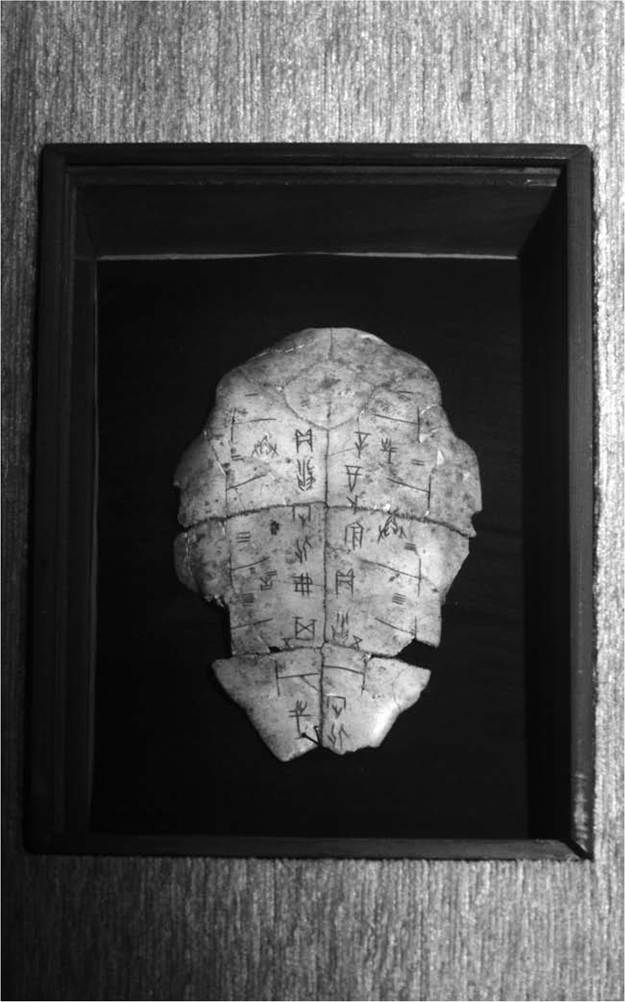
Figure 15.ι Taipei, Taiwan: Inscribed Turtle Plastron - Oracle Bone - National Museum. Ancient Chinese Writing Symbols Bone-shell Writing (Art Directors & TRIP / Alamy)
The best current interpretation of the archaeological evidence is that around 1500 bce a large state, characterized by the production of bronze ritual vessels, did emerge out of earlier foundations on north China's Central Plain and expand outward to create a huge empire (in the descriptive sense of the word, since the Chinese title “emperor” did not exist yet). Following the traditional chronology, some scholars are inclined to view this as an early phase of the Shang dynasty. Because there were no written records, however, we do not actually know what this state called itself, and archaeologists commonly refer to it by the name of an early type-site, Erligang. Erligang domination over this vast territory appears to have then stimulated the rapid development of local secondary civilizations in the outlying regions, and after about 1300 bce the Erligang empire collapsed back onto its core, resulting in the multicultural world of the late Shang era familiar from the oracle bone inscriptions.[561]
Of particular interest, one of the late Shang neighbors was a people called the Zhou.
Both archaeology and tradition suggest that the Zhou people had moved around, and possibly even lived a semi-nomadic existence for some time, before finally settling in the Wei River valley in the west of modern Shaanxi province (the region “within the passes”), perhaps around the twelfth century bce. This area was exposed to contacts both with northern nonChinese cultures, the distinctive southern civilizations of the Yangzi valley, and with the Shang kingdom to its east. From Shang, the Zhou derived bronze ritual vessel styles, the practice of oracle bone divination, and the written language. Zhou leaders initially accepted subordination to the Shang king as vassal dukes, but they soon claimed the supreme Shang title of “king” for themselves, coming into conflict with the Shang.Around 1045 bce, the second Zhou king, King Wu (“the Martial”), mobilized a large coalition and conquered the Shang. It is possible that large-scale use of war chariots, which at that time was still something of a novelty in China, may have contributed to the Zhou victory; 300 chariots were said to have led the Zhou army into the climactic battle. In Chinese tradition, however, the conquest is invariably portrayed as the moral triumph of virtue over depravity. Soon after the decisive battle, the Zhou king ritually announced his intention to assume rule over the “Central Country” (Zhongguo, or Middle Kingdom). From the oracle bone inscriptions, we know that the Shang had previously conceived of their state as “Central Shang,” surrounded by the outlying “four regions.” After the Zhou conquest, the new state was obviously no longer “Central Shang,” and the more generic label “Central Country” was applied. This term eventually became a standard Chinese-language name for China. Unlike Zhou or Shang (and the names of other subsequent dynasties), though, this was originally less a proper name than simply a geographic description.
This Zhou conquest was foundational. The Zhou dynasty that was established by this conquest survived for some eight centuries, the longest of any in Chinese history, and the early Zhou became an idealized model that was deeply revered throughout East Asia until modern times.
Zhou was the age of Confucius, and it saw the appearance of nearly all of the classic Chinese schools of thought and works of literature. Zhou also established the characteristically Chinese idea that a supreme deity known as “Heaven” (Tian) bestows its “Mandate of Heaven” (Tianming) upon a worthy monarch, as “Son of Heaven” (Tianzi), to legitimately rule all “Under Heaven” (Tianxia), while withdrawing it from previous ruling houses that had lost their virtue (like the decadent last Shang king).This key political concept validated (as reallocations of the Mandate of Heaven) all of the many changes of dynasty that occurred throughout premodern Chinese history, while also, perhaps, simultaneously encouraging a belief that at any given time there could be only one legitimate dynasty “Under Heaven,” and contributing to an exceptionally strong Chinese ideal of political unity. Curiously enough, however, this Chinese concept of a Heavenly Mandate exhibits close similarities to the steppe nomadic idea of a universal sky god, Tangri, and the beliefs of non-East Asian cultures to China's north and west.[562] Elsewhere in East Asia, on the other hand, imperial legitimacy in Japan was derived from a claim to divine descent from the Sun Goddess, while the Korean king's Chinese-style Mandate of Heaven was invested upon him as an autonomous vassal, or “tributary,” of the Chinese Son of Heaven.[563]
Though claiming ultimate sovereignty over all “Under Heaven,” the Zhou realm was never a strongly centralized state. Instead, Zhou kings delegated authority to local vassals, who ruled over what were initially hundreds of small semi-autonomous territories. These, in turn, were staffed by aristocratic officials sustained by their own hereditary estates. In 771 bce, the Zhou
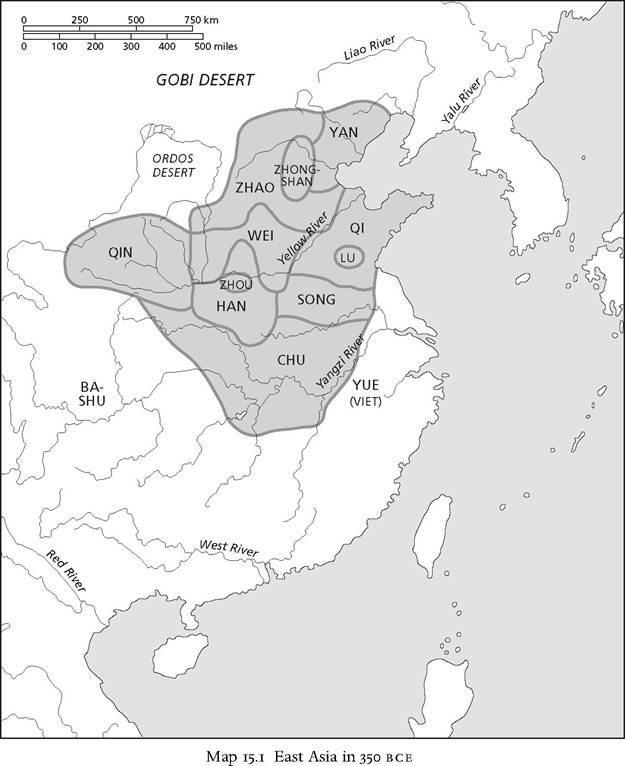
capital was sacked by foreigners, and the Zhou kings relocated their seat eastward to Luoyang, in modern Henan province. After this, the real power of the Zhou ruling house declined even further. The territories of the regional nobility became increasingly independent, and eventually, during the Warring States era (475-221 bce), they became fully sovereign kingdoms in their own right (see Map 15.ι). Successful regimes expanded their borders, and the number of states was consolidated, until finally there were only seven. Warfare evolved from a courteous pastime for chariot-riding aristocrats into mass confrontations between conscript armies of peasant infantrymen wielding deadly crossbows, sometimes numbering in the hundreds of thousands. The stage was set for China's first imperial unification.
In the meantime, as of late Zhou, East Asia beyond the northern Chinese heartland still lay shrouded in pre-history. The various peoples living beyond the frontiers of the Zhou realm remained preliterate, and their story can now be recovered only through archaeology, or from legends that were recorded later. In the vicinity of the Korean Peninsula, the year 1200 bce also corresponds roughly with some significant developments, including the appearance of a new style of plain pottery and the full maturation (though their origins may be considerably older) of dry-field rice cultivation, bronze metallurgy, and the construction of imposing stone dolmens. Thousands of these megalithic dolmens, often (but not always) marking grave sites, have been found on the Korean Peninsula, and extending from there into Manchuria, the northern Shandong Peninsula in China, and western Japan. This should not be surprising, because the boundaries of a Korean state - indeed, the very idea of “Korea" - had not been defined yet, and peoples related to those who later became Koreans lived scattered over a wide area. Manchuria is just across the Yalu River from Korea, Shandong might seem remote but is actually only 120 miles by sea from the nearest point on the Korean Peninsula, and, on a clear day, the Japanese island of Tsushima can be seen from the Korean shore.
At the same time, none of the bronze ritual vessels that are so characteristic of Shang and Zhou dynasty China have been found in the Korean Peninsula, and a distinctive type of bronze dagger known as the Liaoning dagger has been extensively uncovered in Korea and southern Manchuria, but not in China south of the Great Wall. Clearly, the ancient cultures of Korea were distinct from those of what became China. Vague legend sketches a shadowy kingdom in the area in antiquity called Old Choson, but archaeological evidence does not support the suggestion that there were organized states above the level of small village communities. Korea's rugged mountainous terrain was not encouraging to the early formation of large states.
By the end of the Zhou era, people crossing the water from the Korean Peninsula were beginning to transform life in the Japanese islands. Those islands had long remained only sparsely inhabited by largely pre- agricultural, seafood-consuming villagers, until new arrivals apparently began coming from the Korean Peninsula around 400 bce. This wave of migration initiated what is known as the Yayoi period (third century bce - third century ce), when wet-field rice cultivation and the use of both iron and bronze were introduced to Japan.[564] The Yayoi period witnessed rapid development in Japan, although until the end of the Yayoi there probably was no political organization above the level of scattered independent local communities.
What is now northern Vietnam also remained preliterate throughout this era, although both bronze and rice cultivation had long since made their appearance. The archaeologically identified Dong Son culture, which flourished in the area around 500-300 bce, was characterized by the production of superb bronze drums. Later Vietnamese histories claim the region was home to a kingdom they called Van Lang, which purportedly stretched deep into antiquity and was ancestral to modern Vietnam, but these written descriptions all date from very much later.[565] The characteristic bronze drums were also not confined to what is today Vietnam, moreover, but were distributed across much of Southeast Asia and remained conspicuous in parts of what is now south China until as late as the seventh century c e.
First empires
If neither Shang nor Zhou had been highly centralized large territorial kingdoms, great strides were made in forging the administrative machinery of statecraft during the Warring States era. Much of this development falls under the rubric of Legalism, an administrative philosophy that included the codification of actual written law. In the northwestern Warring States kingdom of Qin, which was based in the same area “within the passes” as the early Zhou homeland, Legalist techniques were especially perfected. The first systematic tax on agriculture in Qin was reportedly collected in 408 bce. In 375 bce, mandatory government registration of all households was imposed, providing a mechanism for universal taxation and conscription for military or labor service, and enabling Qin to effectively mobilize its entire population for government projects. Preexisting rural communities were reorganized into a kingdom-wide network of centrally administered “counties” in 350 bce, over which larger administrative “commanderies” were later established. A service-oriented bureaucracy of officials appointed based on ability replaced the old hereditary aristocracy.
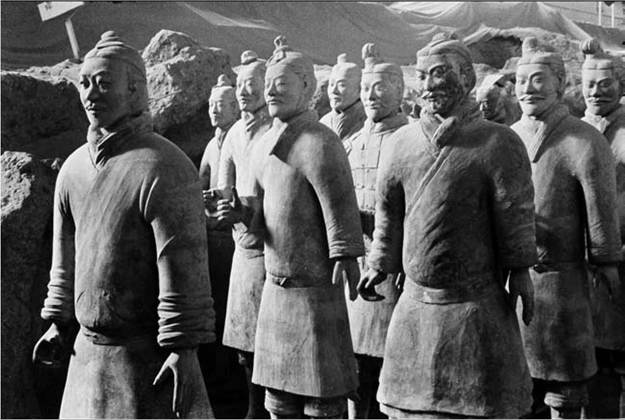
Figure 15.2 Terracotta Army, Qin Dynasty, 210 bce; warriors (detail) (Tomb of Qin Shi Huangdi, Xianyang, China / Bridgeman Images)
In a series of campaigns conducted between 230-221 bce, the last Qin king conquered the other six remaining Warring States kingdoms and unified China for the first time into a single centralized state. He capped this magnificent achievement by coining a grandiose new title for himself, huangdi, or emperor (more literally, “August Supreme Ruler”). He is best known to history as Qin Shi Huangdi - the “First Emperor of Qin" - and his imperial title and overall imperial system would survive, with some modifications, until 1912 (see Fig. 15.2, the tomb of Qin Shi Huangdi).
Qin not only unified the “Chinese” Warring States, but also extended its imperium well beyond. In 214 bce, for example, what is now southeast China, which had been largely beyond the pale of Zhou civilization, was brought into the Qin empire by a massive invasion. This new acquisition included much of what is now northern Vietnam. Although northern Vietnam would enjoy periodic autonomy thereafter, it would not achieve permanent independence from the Chinese empire until 939 ce. From about the first century ce until it was outstripped by the rise of Guangzhou (Canton) around the seventh century, moreover, a city on the Red River located not far from present-day Hanoi may have even been China's busiest southern port.
In the north, Qin conquered and attempted to colonize the Ordos desert region that lies inside the great northward loop of the Yellow River. This had the unintended consequence, however, of stimulating the military organization of the nomadic peoples living in that area into the first great nomadic empire, the Xiongnu, around 209 bce. Such steppe nomadic empires would thereafter typically provide premodern China's most important foreign adversaries.
During the Neolithic period, the cultures of Inner Mongolia and southern Manchuria had been predominantly agricultural, and not very different from those of northern China, but by the late Shang dynasty these lands already possessed a distinctly different material culture, oriented toward the northwest and away from China. Over the last millennium bce, then, a horse-riding, livestock-herding, pastoral nomadic lifestyle spread across the region. The gradual northward expansion of the Chinese world, meanwhile, and absorption of intermediary peoples, finally brought the Chinese into direct contact with true nomads around the fourth century bce, as illustrated by the famous story of the ruler of the Warring States kingdom of Zhao, deciding to adopt nomadic-style cavalry warfare in 307 bce. China's imperial unification provoked corresponding nomadic organization, and in 200 bce one Chinese emperor and his army found themselves surrounded and trapped on a mountaintop in northern Shanxi by hostile Xiongnu for a week.
By this time it was no longer the Qin dynasty, however, but the Han. According to tradition, the harshness and inflexibility of the Qin Legalist regime provoked rebellions against it. Within a year of the First Emperor's death in 210 bce, rebellions had begun. The Qin capital fell in 207 bce, and, following a brief civil war, a new imperial dynasty, called Han (202 bce - 220 ce), was established. The Han dynasty combined the rational efficiency of Qin Legalist administration with Confucian moral values, and elicited widespread willing participation in the imperial project from local elites. The dynasty proved to be so successful, and its memory so enduring, that to the present day the Chinese are still called the “Han” people.
For half a century after the Han founder's encirclement by Xiongnu warriors on a mountaintop in 200 bce, the Han pursued policies of appeasement toward the Xiongnu. When Emperor Wu (r. 141-87 bce) took the throne in 141 bce, however, he adopted a more aggressive approach. His grand strategy, which was eventually (if expensively) successful, involved outflanking the Xiongnu by expanding the Han Empire far into the northwest, reaching deep into what are now Gansu and Xinjiang provinces. In the northeast, the Han Empire also expanded into southern Manchuria and northern Korea.
The earliest reliable historical record involving Korea tells the story of a man named Wiman, who had been an official in a minor client kingdom of the Han dynasty called Yan, located in what is now southeastern Manchuria. When the Han founder died in 195 bce, the king of Yan, uncertain of the new disposition of the Han court, fled to the Xiongnu, while Wiman, with roughly a thousand followers, sought refuge in Korea. Wiman established his own kingdom there, called Choson, with its capital near the site of modern PTfmgyang. Adopting the hairstyle and clothing of the local natives, he ruled over a mixed population and accepted a subordinate diplomatic relationship with the Han dynasty. In 109 bce, as part of Emperor Wu's grand strategy of outflanking the Xiongnu, and with the excuse that Wiman's grandson had been preventing the passage of tribute from chieftains in southern Korea to the Han court, a Han invasion was launched. Within a year most of northern Korea had been conquered by the Han.
Four large Han dynasty administrative units, called commanderies, were established in northern Korea. Over time, the number and extent of these commanderies fluctuated. The most significant was Lelang, with its capital located south across the Taedong River from what is now P'yongyang. Chinese rule in northern Korea would last 400 years - roughly the same duration as Roman rule in Britain - and is a reminder that the early Chinese empire was not a modern-style nation-state, but a true empire.
In the southern half of the Korean Peninsula, meanwhile, beyond the zone of Chinese administration, loosely organized native communities existed that were collectively known as the “Three Han” (written with a different character from the name of the Chinese Han dynasty). Some linguistic variations reportedly existed between these Three (Korean) Han, and they each consisted of multiple small rural communities. Along the eastern coast of the Korean Peninsula further north, there lived yet other peoples (the Yemaek and Okcho), and north of the headwaters of the Yalu River, in southern Manchuria, there was a budding native kingdom called Koguryo.
The birth of East Asia
In 184 ce, a religious rebellion called the Yellow Turbans shattered Han dynasty China's imperial unity, although the last Han emperor would not formally abdicate until 220. After 184, multiple warlord armies contended for mastery, with the situation gradually stabilizing into three major rival
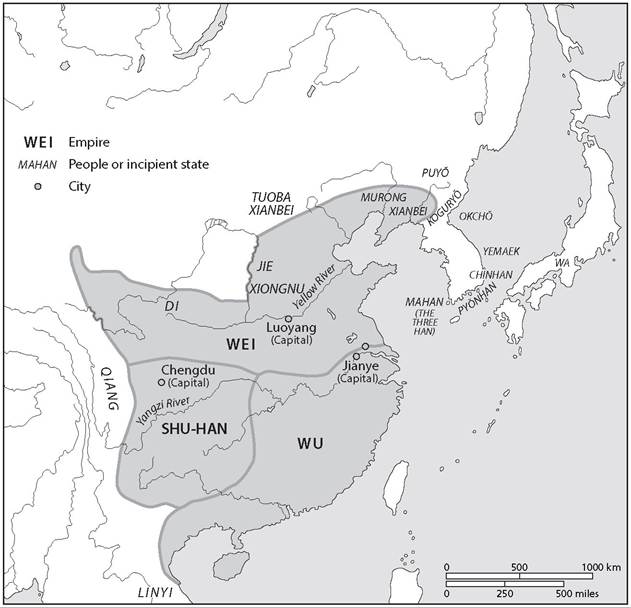
Map 15.2 East Asia in 250 ce
regimes, known as the “Three Kingdoms” (220-280), in the third century (see Map 15.2). The regime in the north proved strongest, and by 280 it had conquered the other two (although not until after an internal coup and another change of dynasties), and for a few years after 280 most of China Proper was reunified again. This reunified empire (the WesternJin dynasty) soon tore itself apart amid vicious civil wars, however, and by 316 centralized government in north China had collapsed entirely. Between the third century and the seventh, there would be some thirty-seven dynasties in China.
A surviving prince from this broken empire partially re-established his dynasty (now called the Eastern Jin) in the south after 317, with its capital located at what is today Nanjing (Nanking). This became the first in a succession of five Southern dynasties. (By including the earlier Three Kingdoms' southern state ofWu, these are sometimes alternatively called the Six Dynasties.) These Southern dynasties were an age of splendid cultural achievement - producing, for example, the man who was arguably the greatest calligraphic genius in all of Chinese history, Wang Xizhi (303-379). A taste for drinking tea also first began to spread in the Southern dynasties, and true paper replaced earlier writing materials, helping to make books more numerous than ever before. One mid-sixth-century southern imperial library, for example, reportedly held 140,000 rolls of documents.[566] [567]
At the same time, the agricultural development of south China, which until recently had still been something of a frontier region, surged. The volume of international maritime trade rose, and the southern economy became increasingly commercialized. As an index of economic development, it is likely that the Southern dynasty capital (modern Nanjing) may have been the largest city in the world by the early 500s, with a population of perhaps 1.4 million.11 Spurred by this southern development, after about 500 ce the Chinese economy may have become (and long remained) the largest in the world, even when measured on a per capita basis.[568]
Not all was well, however. Each of the Southern dynasties except for the first was founded by a usurping general, and of questionable legitimacy. There were vast disparities of wealth and poverty, and the southern governments and armies were all weak. In north China, meanwhile, for a couple of centuries after the disintegration of imperial unity in the early 300s commerce slowed to a crawl, fields were abandoned or given over to pasture, and beginning in 304, there was a profusion of non-Chinese military regimes.
The “foreign” intruders consisted of five major non-Chinese population groups, who were collectively known to the Chinese as “Hu.” Most had already been living near, or even inside, the borders of the Chinese empire for some time. All had been, to a greater or lesser extent, exposed to Chinese culture. The most historically important of these peoples were the Xianbei (who were themselves split into several major separately named subgroups). The Xianbei probably originated in the area of southwestern Manchuria. They spoke language(s) that may have been related to later Mongolic, possibly with Turkic infusions. The rise of the Xiongnu nomadic empire during the early Han dynasty had driven the Xianbei further north (to northeastern Inner Mongolia or northern Manchuria), but as the Han dynasty methodically broke the power of the Xiongnu, the Xianbei had drifted back south toward China's borders.
By the fourth century, the introduction of stirrups and armor for both horse and rider enabled northern pastoral tribes to mount particularly powerful heavy cavalry.[569] [570] Initially, such non-Chinese cavalry were recruited to serve as auxiliaries in China's own civil wars, but following the collapse of Chinese government in the early 300s, warrior leaders emerged as independent forces. Even then, successful warlords often justified their expansion in the name of “saving the [legitimate Chinese] throne.” Before long, however, various strongmen began claiming the supreme Chinese title “emperor” for themselves. They often also simultaneously invoked old Xiongnu titles, and Xianbei chieftains introduced another new non-Chinese title that would prove memorable: “khan.” Many of these regimes began building the administrative apparatus of a Chinese-style imperial bureaucracy, sometimes including schools to teach the Chinese classic texts.
During the fourth and early fifth centuries, Xianbei bands in the northeast established a series of dynasties in the area of southwestern Manchuria and northeastern China proper. The presence of Xianbei empires in this area had the effect of permanently sundering the Korean Peninsula from Chinese administration. Xianbei dynasties interacted dynamically both with Chinese culture and with the proto-Korean kingdom of Koguryo to their east. Koguryo, for example, may have learned the technique of cavalry warfare from the Xianbei. Koguryo-style cavalry armor then passed down to the southern tip of the Korean Peninsula, and across to the Japanese islands by the fifth century (where mounted archery would eventually become the characteristic combat style of later Japanese samurai). 14
A fascinating example of the hybrid cross-fertilization that was typical of this period is provided by the tomb, located in what is now North Korea, that is attributed by an inscription to Dong (or Tong) Shou (d. 357). This man may have been of Chinese descent, and the inscription claims magnificent Chinese titles for him (written in the Chinese language), but he had earlier served a Xianbei dynasty in the northeast. In the wake of a power struggle there, he had fled to Koguryo. His tomb is said by some experts to be in the Koguryo style, and its wall paintings offer excellent illustrations of the armored cavalry and lifestyle of fourth-century northeast Asia. Rather than being either “Chinese” or “Korean” in the modern nationalist sense, this tomb illustrates the cosmopolitan blurring of borders that was characteristic of this age.[571]
Chinese titles burnished the prestige of even thoroughly independent local strongmen (or, in the case of at least one third-century Japanese priestess-queen, women). The rulers of emerging Korean kingdoms were commonly invested with prestigious titles by dynasties based in China, and during the fifth century there were no fewer than thirteen recorded missions from Japan to Chinese courts, seeking Chinese titles. By the seventh century, however, Japanese monarchs had stopped accepting subordinate titles from China and, instead, were actively laying claim to rival Chinese-style supreme imperial titles.
Northern Wei
The spread of Chinese cultural influences to Korea and Japan during these centuries was crucial to the formation of what would become a culturally coherent East Asian region (see Map 15.2). At the same time, however, much of China itself had fallen under non-Chinese rule during these years. China, too, was profoundly exposed to foreign influences, especially from the north and west. In the early sixth century, there was reportedly a steady flow of merchants from the remote west arriving in the (Xianbei-ruled) Northern Wei dynasty (386-534) capital at Luoyang, in north-central China (see Fig. 15.3). One Northern Wei prince supposedly possessed horses from as far west as Persia, and there were said to be 10,000 households of foreigners in permanent residence in Luoyang. A silver pitcher found in a grave dated 569 in Ningxia, northwest China, is in the Persian style and is decorated with scenes from the Trojan wars. Another tomb in Shanxi, in north-central
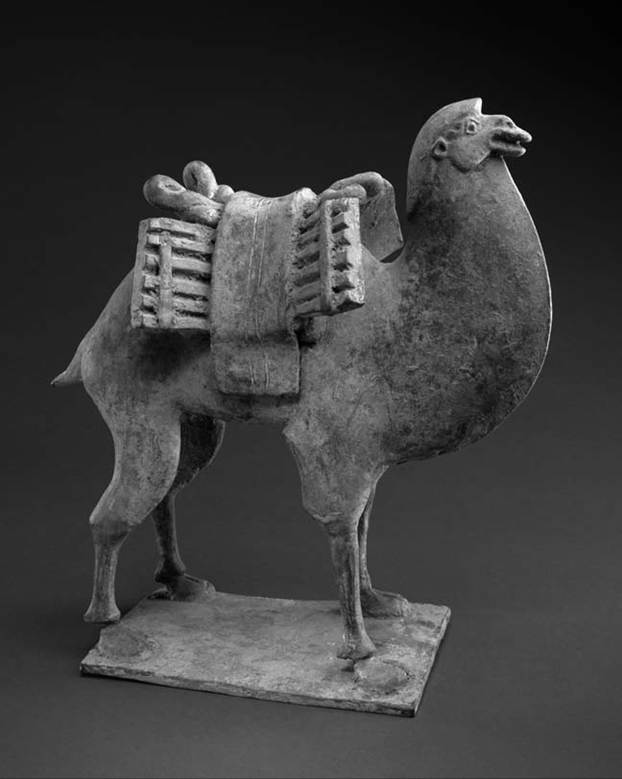
Figure 15.3 Mid- to late sixth-century Northern Wei or Northern Qi earthenware camel, China (Metropolitan Museum of Art / © SCALA)
China, dated 592, is decorated with carved stone depictions of such exotic figures as camel-riding hunters who may be Arabs, and Zoroastrian religious iconography.[572]
Foreign influences on China in this era included such things as the chair, which had been unknown in Chinese antiquity, and a stringed lute-like musical instrument called the pipa. The most overwhelming foreign influence undoubtedly was Buddhism. This originally Indian religion had been introduced during the mid-Han dynasty, via the “Silk Roads” trade routes, but it was not until the fourth century that Buddhism really flourished in China. Indian Buddhist scriptures were laboriously translated into Chinese, and a considerable body of original new Chinese compositions was added, forming what became the East Asian Buddhist canon.
To the influence of Gandharan Buddhist art from what is now northern Pakistan and eastern Afghanistan - where a fertile fusion of Greek, Persian, and Indian styles had emerged - were added Chinese touches. For example, the construction of Buddhist cave-temples had begun in India, but the world's largest Buddhist cave-temple statues were erected in Afghanistan (at Bamiyan), and the cave-temple style then spread from Central Asia to northern China. At Yun'gang, near the early Northern Wei capital in northern Shanxi, a spectacular complex of Buddhist statues was carved between 460 and 525. Here, in addition to western influences, Chinese styles and traditional motifs also appear, such as images of dragons and the taotie (a mysterious design characteristic of ancient Chinese bronzes). The Xianbei rulers of the Northern Wei dynasty may have felt a special affinity for cave-temples, since they had a pre-Buddhist tradition of locating their ancestral temples in caverns. After they moved their capital further south to Luoyang in 494, they began carving yet another remarkable complex of Buddhist cave-temples at nearby Longmen.
From China, Buddhism was introduced to the Korean Peninsula in the fourth century. The earliest organized native kingdom to develop in the area of Korea had been Koguryo, in the north. Beginning as a group of five tribes inhabiting the mountains north of the headwaters of the Yalu River, Koguryo is mentioned in Chinese sources by as early as 107 bce, and from 32 ce its rulers had begun claiming the Chinese title “king.” The early Koguryo capital was located, however, on what is now the Chinese side of the Yalu River, in Manchuria, and early Koguryo was as much a Manchurian as a Korean power. It was not until 427 that Koguryo moved its capital south to what is
(eds.), Monks and Merchants: Silk Road Treasuresfrom Northwest China, Gansu and Ningxia, 4th-7th Century (New York: Harry N. Abrams, 2001), pp. 98-100; and James C. Y. Watt, Angela F. Howard, AnJiayao, Boris I. Marshak, Su Bai, and Zhao Feng, China: Dawn ofa Golden Age, 200-750 ad (New York: The Metropolitan Museum of Art, 2004), pp. 256-57 and 276-83.
now P'yongyang and began to be more exclusively oriented toward the peninsula. Koguryo's contributions to what eventually became Korea are indisputable, though. For one thing, through an abbreviated version of its name as Koryo, it is the source of the English word “Korea.”
The rise of native kingdoms in the south of the Korean Peninsula is marked by the appearance of the earliest-known walled cities at the end of the third century, and by large mounded royal tombs, or tumuli, after about 300. It may be no coincidence that this was exactly the time when Chinese imperial administration in northern Korea was disintegrating. Four hundred years of Chinese government there had created a regional “interaction sphere” and initiated a process of secondary state formation that extended not only to Korea but also across to the Japanese islands.[573] [574]
The kingdoms of Paekche, in the southwest of the Korean Peninsula, and Silla, in the southeast, emerged in the fourth century. Together with Koguryo, they are known as the “Three Kingdoms,” and they represent Korea's earliest fully historical period. Sandwiched between Paekche and Silla in the south, there was also a confederation of six independent small communities known as Kaya, which was eventually absorbed by Silla.18 It is unclear to what extent Paekche, Kaya, and Silla were outgrowths from the earlier Korean “Three Han” (which are not to be confused with the Chinese Han dynasty further north) that had occupied the same territory as recently as the third century. In the case of Paekche, Korean legend claims that its founder was a son of the founder of Koguryo, and that they were both of Puyo descent. (Puyo was an older kingdom in the Sungari River basin of central Manchuria.) Despite this legend, the kingdom of Paekche probably really dates from very much later than the founding of Koguryo. Nonetheless, early Paekche royal tombs do resemble the distinctive Koguryo style of mounded step-pyramid stone sepulchers (while later Paekche tombs conform more to a Southern dynasty Chinese model). On balance, it seems not implausible that Paekche really may have been founded by a ruling elite coming from the north and imposing itself upon a preexisting local population, perhaps in the fourth century.
Buddhism was then introduced to Paekche by a Central Asian monk, Malananda, coming from Southern dynasty China in 384. Paekche developed particularly strong ties with the Chinese Southern dynasties and became fervently Buddhist. King Pop (r. 499-500), the “Dharma King,” was so devout that he banned the killing of animal life and ordered hunting falcons to be released and hunting and fishing equipment destroyed. One splendid Buddhist monastery, completed at the Paekche capital in 527, was named after the contemporary reign period of a Southern dynasty Chinese emperor (pronounced Taet'ong-sa in Korean). It was constructed on the Chinese model, with a rectangular cloister laid out along a north-south axis, and with a freestanding pagoda and icon hall, and a lecture hall set into the surrounding wall, running in progression from south to north. This Korean monastery, in turn, served as a model for Shitenno-ji in Japan a century later.[575]
It was from Paekche that Buddhism was introduced to Japan, in either 538 or 552. A priest from Paekche was even named the first official head of the Japanese Buddhist Church in 623, and Buddhist exchanges with Paekche were frequently the vehicle through which the Japanese learned about other developments on the continent. The relationship between Paekche and Japan also had political and military dimensions. When a king of Paekche died in 405, his son and heir was living at the time as a hostage at the Japanese court. The son was returned to Paekche with a Japanese escort, only to find that a younger brother had usurped the throne. With Japanese military support he was able to successfully reclaim his rightful throne.
More clearly than Paekche, Silla, in the southeast, seems to have been a direct outgrowth from one of the third-century (Korean) Three Han. Silla's first entirely historical ruler was probably Naemul (r. 356-402), who ruled under the native title maripkan (which may be related to the familiar steppe title “khan”).[576] It was not until 503, according to traditional Korean sources, that the Sillan ruler finally took the Chinese title “king.” During the sixth century, then, Silla began rapidly transforming itself into a Chinese-style state. Chinese-style codes of law were issued in 520. In 536, Chinese-style reign periods, which were used for dating purposes, were adopted. After China was reunified in 589 by the Sui dynasty (581-618) and suddenly became a looming regional superpower, Silla began exploring even more active ties with China. Members of the Sillan royal family went to study at the Chinese capital beginning in 640, and in 649-650 Chinese-style clothing and the reign-period names of actual Chinese emperors (as distinct from merely Chinese-style ones) began to be used in Silla. Silla was cultivating a military alliance with China that it could turn against its rivals on the peninsula.
By the mid-600s, Paekche had become perhaps the strongest of the three Korean kingdoms, and, in alliance with Koguryo, it was nibbling away at Sillan territory. Sillan anxiety is understandable. Meanwhile, the reunified Chinese Sui and subsequent Tang (618-907) dynasties had not been content with reunifying the Chinese heartland but continued to be aggressively expansive. They launched a series of massive invasions of Koguryo beginning in 612, which were repeatedly rebuffed. In growing frustration over the failure of frontal assaults on Koguryo, Tang dynasty China changed tactics to an alliance with Silla and an attack from the south - starting with Paekche.
A combined Tang Chinese and Sillan attack on Paekche in 660 captured the Paekche king and crown prince. A younger brother of the crown prince, who had been living as a hostage in Japan, was sent back with Japanese support to rally loyalist opposition against the invaders. At a great river battle in 663, however, the combined Chinese and Sillan forces annihilated a Japanese fleet, ending any hope of a Paekche restoration and terminating major Japanese influence on the continent for almost a thousand years.
Koguryo was next. In 668, the Tang-Sillan alliance finally conquered Koguryo. Although Tang China apparently hoped to subordinate the peninsula to its empire, by 676 Silla had expelled its former Chinese allies, and most of the Korean Peninsula was now unified, under native rule, for the first time ever. However, the current northern border of Korea was not finally stabilized until the fifteenth century, and roughly the northern third of the peninsula was long held by yet another new state, Parhae (713-926), which had been formed by refugees from Koguryo together with some other peoples.
Each of the Korean Three Kingdoms contributed to what eventually became Korea, although the modern Korean language probably derives most directly from Sillan. The Three Kingdoms had been frequent adversaries and were each culturally at least somewhat different. The mounded royal tombs of Silla lacked re-entry passageways, for example, unlike the Koguryo and Paekche tombs described earlier, and Silla had a distinctive type of antler-shaped gold royal crown. At the same time, the three were also all culturally distinct from China. The practice of tracing family descent through both male and female lines - unlike in China, where descent was always only through the male line - slowed the adoption of hereditary family names, for example, which occurred very much later in Korea than in China. Sillan royal authority was also balanced against a powerful aristocracy (graded into so- called “bone” ranks). To the end, premodern Korean society always remained more aristocratic than premodern China's.
Yet, after the Sillan unification and expulsion of Chinese troops, relations with China became, if anything, closer. Sillans were notably active in trade with Tang dynasty China, and Silla provided the single largest number of foreign students attending Tang schools. Some ninety Sillans are known to have won degrees through the Chinese civil service examination system in late Tang, and some even served in Tang as officials. Over the ensuing centuries Korea also steadily became more Confucian, and Korea remained an autonomous “tributary” of the Chinese empire until the nineteenth century.
Meanwhile, the same Sui dynasty reunification of China in 589 that had transformed the balance of power on the Korean Peninsula also threatened the Japanese islands (see Map 15.3). TheJapanese (who initially called their country Yamato - or, in writing, Wa) responded by strengthening and centralizing their government. The earliest written description of Japan, which is contained in a third-century Chinese history, had already depicted a loose coalition of thirty small communities presided over by a priestessqueen called Himiko. Her reign roughly corresponds with the beginning of an “old tomb” period in Japanese history (c. 250-552) that was marked by the erection of large earthen tumuli, not unlike those of contemporary Korea, but in a distinctive “keyhole” shape. As in Korea, the appearance of these tombs may indicate the emergence of larger political alignments, but it was probably not until about the sixth century that a truly centralized state appeared in western Japan.
The seventh century, then, witnessed explosive growth in the use of writing in Japan.[577] Even as late as the start of the seventh century, many regional chieftains may have remained little more than “autonomous allies of the king,” but over the course of the seventh century Japanese rulers appropriated Chinese-style imperial titles (including what became the standard Japanese variant, tenno) and began to formulate an imperial state that could rival China itself.[578] Significantly, the oldest surviving native Japanese history, the Kojiki (Record of Ancient Matters), which was completed in 712, used the ancient Chinese expression all “Under Heaven” ninety times - but in
Downloaded from https:Zwww.cambridge.org/core. Cornell University, on 07 Jan 2017 at 22:28:16, subject to the Cambridge Core term available at https:/www.cambridge.org/core/terms. http://dx.doi.org/10.1017/CBO9781139059251.017
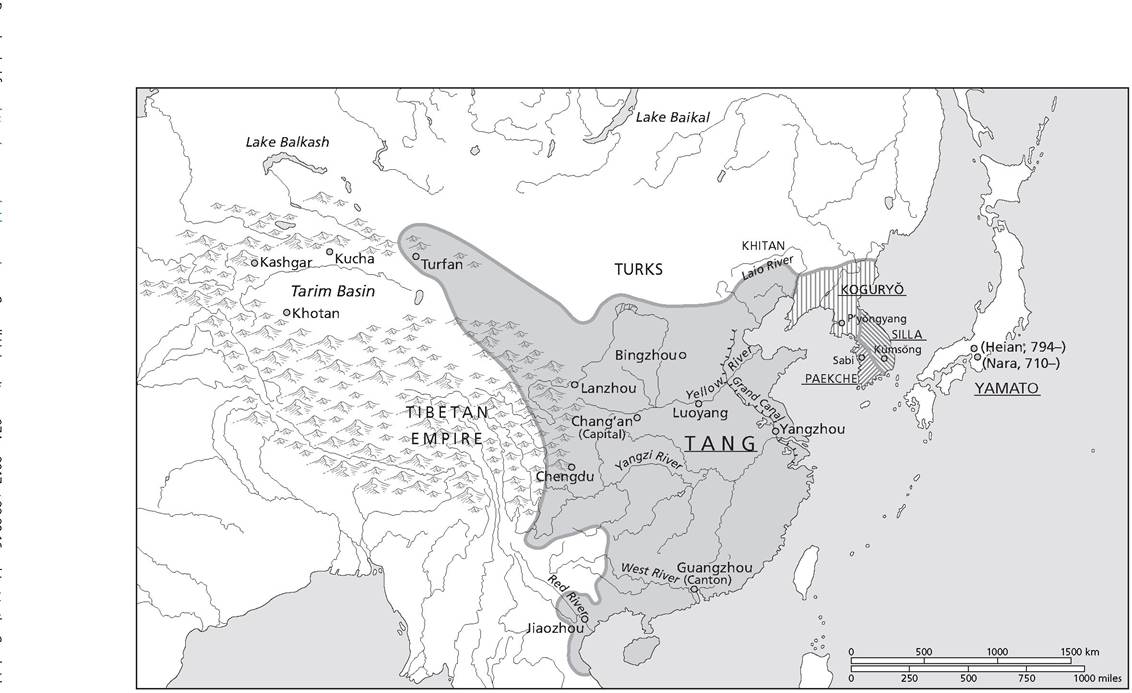
Map 15.3 East Asia in 650
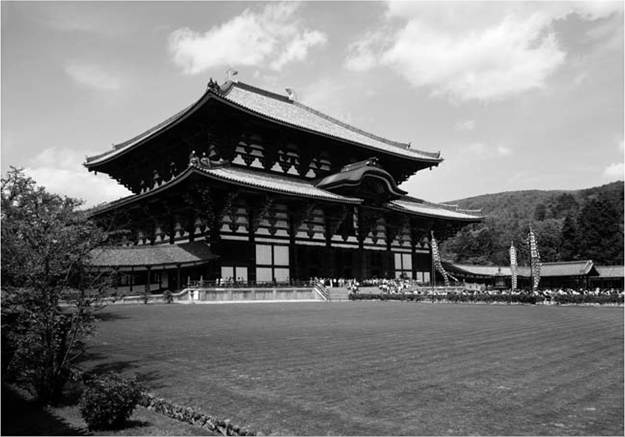
Figure 15.4 Todaji, Eastern Great Temple, Nara, Japan (Photograph © Luca Tettoni / Bridgeman Images)
reference to Japan, without even mentioning China.[579] The Chinese-style imperial administrative model was most clearly articulated in a series of codes of penal and administrative law that were compiled beginning as early as 668 (although the oldest surviving code dates from 718). Between 708 and 712 a great new continental-style Japanese capital city, Nara, was constructed, which gives its name to the Nara period (710-784) - the apogee of Chinese-style empire building in Japan (see Fig. 15.4).
The maturation of East Asia
The peoples of Koguryo, Paekche, and Silla all eventually became Korean, while the Xianbei in north China gradually became Chinese. During the first century of its existence, the Northern Wei dynasty, the most significant of all the various Xianbei dynasties, had remained a distinctly Xianbei-ruled state, though most of its subject population presumably were always Chinese. Beginning in the late fifth century, however, a series of deliberate sinicizing measures were adopted, including requiring the use of the Chinese language at court and the forced adoption of Chinese names. Interestingly enough, the Confucian temple that was built at the Northern Wei capital in 489 was apparently the first such explicitly Confucian temple (Kong miao) ever constructed in any Chinese capital. Although a distinction between Xianbei and Chinese identities remained sharp until the late 500s, a new cultural synthesis was brewing.
The ruling families of the Sui and Tang dynasties that reunified China after 589 are said to have been of Chinese descent, but their ancestors had long served Xianbei dynasties, and they had extensively intermarried with the Xianbei. Both the mother and the wife of the Tang dynasty's founder, for example, were Xianbei. The early Tang dynasty also remained richly cosmopolitan. In 630, for example, Tang defeated the Eastern Turks, and for some years thereafter Tang rulers posed simultaneously as Chinese-style emperors of China and Turkic-style qaghans (grand khans) of the steppe.[580]
If the early Tang was a “self-consciously multi-ethnic empire,” however, the Tang dynasty ended three centuries later, in 907, much more uniformly Chinese.[581] Fundamental shifts occurred over the course of this dynasty that initiated a new, late imperial, Chinese model, which would prove to be highly stable. After Tang, there would be noticeably fewer changes of dynasty in China. Formal examinations had been part of the official selection process in China since the beginning of the empire, but the prestige of the examination system soared during the Tang dynasty as it gradually became a defining institution. Written tests, and the education to prepare for them, became a powerful force for Chinese cultural cohesion. A great NeoConfucian revival also began in late Tang, while woodblock printing began to significantly increase the availability of written materials (see Fig. 15.5). Trade, both foreign and domestic, accelerated, and by end of the Tang dynasty in the tenth century, China was the world's most developed country, containing perhaps a third of the world's total population.
After the fall of Tang, the northern portions of what later came to be known as Vietnam achieved permanent independence in 939, and began to forge a new Indo-Chinese (and indigenous) cultural fusion that would straddle the boundary between East and Southeast Asia. In Korea there was also a
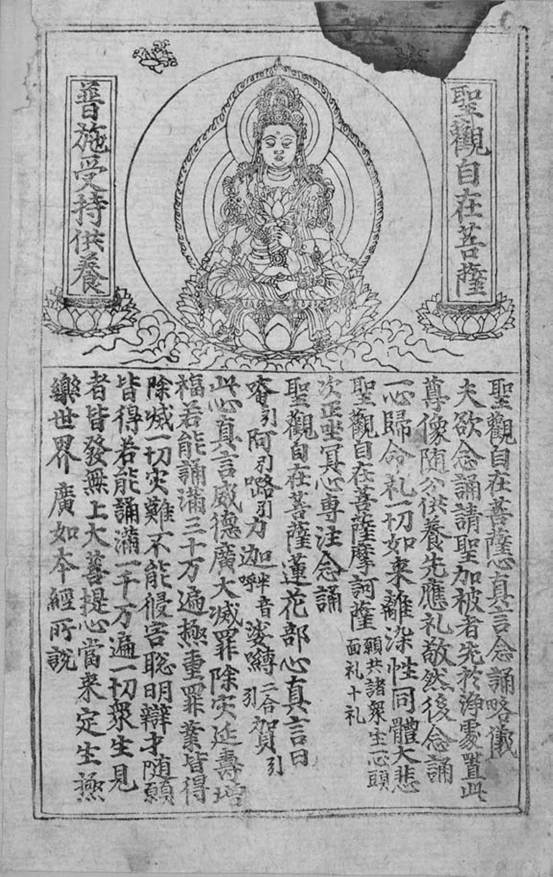
Figure 15.5 Ninth-century (late Tang) woodblock print on paper, the Bodhisattva Avalokitesvara and a prayer, from Qian Fo Dong (Thousand Buddhas Cave), Dunhuang (© Trustees of the British Museum. All rights reserved)
change of dynasty in the tenth century, as Sillan government weakened and the last Sillan king abdicated in 935. In Japan, the tenth century roughly coincides with a major watershed, as Chinese-style imperial institutions became increasingly irrelevant, imperial power atrophied, and a new and uniquely Japanese class of provincial warriors - incipient samurai - began to assert themselves. A distinctively Japanese culture also began to coalesce, exemplified by Lady Murasakfs (978-1016) classic novel the Tale of Genji. By the tenth century, the familiar outlines of “traditional” East Asia were beginning to take shape.
Further Reading
Adshead, Samuel Adrian M., T'ang China: The Rise of the East in World History, New York: Palgrave Macmillan, 2004.
Barnes, Gina L., China Korea and Japan: The Rise of Civilizatian in East Asia, London: Thames and Hudson, 1993.
Beckwith, Christopher I., Empires of the Silk Road: A History of Central Eurasiafrom the Bronze Age to the Present, Princeton University Press, 2009.
Brown, Delmer M. (ed.), The Cambridge History of Japan, Cambridge University Press, 1993, vol. I.
Chang, Chun-shu, TheRiseofthe Chinese Empire, 2 vols., Ann Arbor: University of Michigan Press, 2007.
Chang, Kwang-chih, Xu Pingfang, and Sarah Allan, The Formation of Chinese Civilization: An Archaeological Perspective, New Haven, ct: Yale University Press, 2005.
Di Cosmo, Nicola, Ancient China and Its Enemies: The Rise of Nomadic Power in East Asian History, Cambridge University Press, 2002.
Dien, Albert E., Six Dynasties Civilization, New Haven, ct: Yale University Press, 2007.
Farris, William Wayne, Sacred Texts and Buried Treasures: Issues in the Historical Archaeology of Ancient Japan, Honolulu: University of Hawai'i Press, 1998.
Gardiner, Kenneth H. J., The Early History of Korea: The Historical Development of the Peninsula up to the Introduction of Buddhism in the Fourth Century ad, Honolulu: University of Hawai'i Press, 1969.
Graff, David A., Medieval Chinese Warfare, 300-900, London: Routledge, 2002.
Holcombe, Charles, The Genesis of East Asia, 221 bc-ad 907, Honolulu: University of Hawai'i Press, 2001.
A History of East Asia: From the Origins of Civilization to the Twenty-First Century, New York: Cambridge University Press, 2011.
Kieschnick, John, The Impact of Buddhism on Chinese Material Culture, Princeton University Press, 2003.
Lee, Ki-baik, A New History of Korea, trans. Edward W. Wagner, Cambridge, ma: Harvard University Press, 1984.
Lewis, Mark Edward, China between Empires: The Northern and Southern Dynasties, Cambridge, ma: Harvard University Press, 2009.
China's Cosmopolitan Empire: The Tang Dynasty, Cambridge, ma: Harvard University Press, 2009.
The Early Chinese Empires: Qin and Han, Cambridge, ma: Harvard University Press, 2007. Loewe, Michael, and Edward L. Shaughnessy (eds.), The Cambridge History of Ancient China: From the Origins of Civilization to 221 bc, Cambridge University Press, 1999.
Ooms, Herman, Imperial Politics and Symbolics in Ancient Japan: The Tenmu Dynasty, 650-800, Honolulu: University of Hawai'i Press, 2009.
Pai, Hyung Il, Constructing “Korean ” Origins: A Critical Review of Archaeology, Historiography, and Racial Myth in Korean State-Formation Theories, Cambridge, ma: Harvard University Asia Center, 2000.
Piggott, Joan R., The Emergence of Japanese Kingship, Stanford University Press, 1997.
Seth, MichaelJ., A Concise History of Korea: From the Neolithic Period through the Nineteenth Century, Lanham, md: Rowman and Littlefield, 2006.
Shively, Donald H., and William H. McCullough (eds.), The Cambridge History of Japan. Cambridge University Press, 1999, vol. ii.
Taylor, Keith Weller, The Birth of Vietnam, Berkeley: University of California Press, 1983.
Trigger, Bruce G., Understanding Early Civilizations: A Comparative Study, Cambridge University Press, 2003.
Watt, James C. Y., AnJiayao, Angela F. Howard, Boris I. Marshak, Su Bai, and Zhao Feng, China: Dawn of a Golden Age, 200-750 ad, New York: The Metropolitan Museum of Art, 2004.