Community
When I try to stand back from the enormous array of detail for local and regional situations and sequences, what strikes me again and again about the evidence for Neolithic Europe is the recurrence of communal activity, shared effort, and mutual engagement.
I immediately need to qualify this, to allow for both diversity and change, but the sense of shared lives is everywhere very strong. An agricultural life was not one to embark on alone. I will look at questions of community especially through settlements, with particular emphasis on houses and households, with a glance at material culture and some burial practices. But in stressing community, I also want to keep open the possibility of internal difference, as one of the dynamics in rates and kinds of change may have been a tension between competing values.Time after time, we come across evidence for groups of houses.[1246] This simple statement also instantly needs qualification. Some regions and periods are ‘house-rich', such as southeastern Europe from the seventh to the fifth millennia cal bce, or central and parts of western Europe from the later sixth to the mid fifth millennium cal bce, or the Alpine foreland from the late fifth to the third millennium bce, while others are ‘house-poor', such as much of western Europe in the fourth and third millennia cal bce. There are real issues of visibility to deal with, in that absence of evidence is not necessarily evidence of absence. Fragile house floors and walls recently recovered from the mid-third-millennium cal bce context of Durrington Walls in southern Britain,[1247] or the unexpected waterlogged structures of the later sixth millennium at La Draga in northeast Spain,[1248] make the point well. Even within generally house-rich areas, such as southeastern Europe, there are differences in local and regional sequences.
Some sites in Greece and Bulgaria have groups of buildings from early on, while further north into the Balkans early phases generally seem to have smaller and less concentrated groupings of structures;[1249] with new investigations on a bigger scale, this impression too is changing, witnessed by discoveries in the Starcevo phase at Alsonyek of ovens, as well as very large pits and burials, even though the ground plans of buildings themselves were not recovered.[1250] In other situations, houses were a marker of community from the outset. The earliest LBK in central Europe, beginning in the mid sixth millennium cal bce, already had substantial post-framed longhouses, which from a date conventionally set at about 5300 cal bce became even larger.[1251] In Ireland, and arguably to some extent in Britain as well, solidly built and sometimes quite large rectangular houses were part of the process of the initial establishment of a new way of life, but were not found further into the sequence, disappearing after a surprisingly short time.[1252]Houses also varied considerably in their size, layout relative to neighbours, continuity from phase to phase, and duration.[1253] Virtually all identifiable buildings were rectangular (setting aside a long-running debate about whether some pits were used in early phases in southeastern Europe as a kind of semi-subterranean structure), often with one or two subdivisions or rooms. Some structures with two storeys are known. On both tells and flat settlements in southeastern Europe houses are normally rather uniform in size, rarely exceeding 15 m in length. In that area they are often set out in more or less straight rows, though the precision of layout varies. Concentric arrangement is also known, as in the uppermost levels of the tell at Uivar in western Romania, and throughout the tell layers at Csoszhalom-Polgar in northeast Hungary (the northernmost tell in Europe), both from the earlier fifth millennium cal bce.
Both sites illustrate a combination of uses of buildings. Each has the vertical accumulation of its tell, but with an accompanying flat settlement.[1254] At Csoszhalom, the houses in the flat settlement (here often about 12 m long) are set out in very rough rows, but share the same linear alignment, while those on the tell are concentrically arranged, a difference without doubt deliberate, and backed by contrasts in the nature of the finds and deposits in each.In the developed LBK, from about 5300 cal bce, groupings of generally larger longhouses are found, though smaller buildings are included in the range of structures. These can often be in excess of 20 m long, and structures over 30 m long are not that uncommon, though they may have been locally pre-eminent.[1255] The size and layout of settlements varied; it is tempting to use the modern vocabulary of hamlets and villages, but this is dangerous and does not encompass all the diversity evident. Some sites were small, with just a handful of buildings in use at any one time, and in some settings such groupings occur in ribbon-like settings along streams, classically in the case of the valleys of the Merzbach[1256] and Schlangengraben on the Aldenhoven plateau in northwest Germany, while others are more concentrated, as at Vaihingen in southwest Germany.[1257] Even in any one local situation there may be variation, since in the Merzbach valley what is probably the earliest occupied place, Langweiler 8, went on to become by far the largest local grouping of buildings. There is a very active debate about how LBK settlements were laid out, and there may be no single answer. One model, long dominant, proposes the independence of individual buildings, each set within its own working space or yard, with yards also combined in neighbourhoods or wards. This model is bound up with the view, in turn based on the close study of changing motifs on decorated pottery, that no one LBK building was occupied for more than about twenty-five years (despite the use of oak for the characteristic rows of posts), producing a dozen or more ‘house generations' in the case of the Aldenhoven plateau and seventeen or eighteen in the case of Vaihingen.[1258] This has been challenged by an alternative model of rows, though this may work better in parts of central Europe than elsewhere; longer durations have also been proposed.[1259] A further rather attractive variation is the idea of varying neighbourhood clusters.[1260] Whatever the outcome of such debate, the classical problem remains of the absence of preserved house floors or occupation levels, finds only generally surviving in any quantity in the LBK context in accompanying pits.
It is very hard, therefore, to estimate how many people inhabited an LBK longhouse. The yard model is normally accompanied by the view that only a rather modest-sized nuclear or small extended family filled the LBK longhouse, but in that case the routine ‘over-build' is puzzling compared to the structures found in southeastern Europe.In the Alpine foreland, the good conditions of preservation show a range of constructions, including buildings raised on stilts to sit above wet lake edges, but again these are all rectangular. Just occasionally, buildings occur in ones and twos, and often one or two structures can be shown by dendro- chronological analysis to have been built a year or two before others joined them, but the normal pattern is small groups of houses; there is evidence in some areas that by the later fourth millennium bce some settlements were larger than in earlier generations. Alpine foreland houses were rather regular in size, again not often exceeding 10-12 m in length, and often close set, both in almost grid-like patterns and in rows, both single and spaced out.[1261] One of their most surprising features is their brevity of use. We can certainly call their occupants farmers, though especially in early centuries they exploited plenty of red deer alongside cattle, pigs, and cereals,[1262] and we might expect buildings to signify sustained sedentary existence. It may be, however, that it was occupation of locality that endured in this cultural context, rather than individual settlements. The duration of settlements in some cases gradually lengthened with the passage of time, but repeatedly we find evidence for durations, especially but by no means only in earlier centuries, of not more than ten to fifteen years. The brief occupations of both Hornstaad-Hornle 1A and Arbon Bleiche 3 were brought to an end by fire,[1263] perhaps in both cases accidentally, and other endings may have been due to variations in lake levels, but there are plenty of other instances where no specific cause can be identified.
It seems unlikely that long-term permanence of particular buildings was planned or anticipated here, and a very different mindset can be proposed, difficult though that is to envisage from a modern, western perspective.[1264]These few examples do not of course exhaust the evidence available across Europe, but even this selection underlines the general observation that over and over again we see people living together. Was this always in the same way? Two kinds of evidence suggest not. Some of these communities may have been more important than others. Size and prominence have been suggested to be important factors. Notions of alliances and networks of connection and mutual support are attractive models for dispersed communities, but certain players and places may have held more cards than others. There is a recurrent idea that tells were significant locales, as a visible demonstration of continuity and ancestry, which the recent investigations of contemporaneous flat settlements only serve to underline.[1265] Some of the larger LBK settlements have been picked out as ‘central places', perhaps with specific roles in the distribution of raw materials such as stone and flint that needed to be imported into areas occupied.[1266] Simply keeping numbers of people together may have been significant, in providing shared labour and - in a world now with plenty of evidence for interpersonal, and from time to time intergroup, violence and conflict[1267] - the means of collective defence.
There is also intriguing new evidence for difference within settlements. We should not forget cases already mentioned like Uivar and Csoszhalom, though it might be argued there that the tells had a specialized ritual role within a unified social setting. But were householders on the tells in some way superior to those below? At the tell of Okoliste in Bosnia, neighbouring houses in the earlier fifth-millennium levels, set in rows, appear to have had different associated activities, some concentrating on agricultural production, others on craft production, and yet others on hunting.[1268] Does this hint at internal difference, or should the notion of household in fact be distributed across several buildings? Something similar is apparent at the late LBK settlement of Cuiry-les-Chaudardes in the Aisne valley, in northern France, where the remains of cattle and pigs were found preferentially in the pits flanking larger longhouses, which were grouped more centrally, while the remains of wild game, including red deer and boar, were associated with smaller houses, more on the periphery of the site.[1269] At Vaihingen in southwest Germany, analysis of site layout, pottery decoration, and plant remains has been combined to suggest groupings of houses, perhaps constituting something like clans. It is argued that these not only had varying connections regionally and beyond to other areas of settlement, part of the complicated networks and affiliations of LBK existence, but also had differential access to the best local soils; probably all the households and people involved were cultivating the same plants in broadly the same kind of way, but with subtle differences in how they could do this.[1270] In a wider study of diet and lifetime mobility in the LBK, it has been found that men buried with stones adzes are more likely to have been born and to have spent their lives locally, suggesting in another way the potential importance of access to and perhaps control of prime resources.[1271]
In the mid to later fifth millennium cal bce in central Poland (see also Chapter 23), it has been suggested that trapezoidal longhouses, at the very end of the longhouse tradition, may have been individually more independent economically, which is partly reflected in the greater space around each structure, though these buildings did still form larger and smaller clusters.[1272] Finally, in the later fourth-millennium bce context of Arbon Bleiche 3 on the Bodensee, two broad groupings are apparent within the closely set rows of near-identical houses; it is worth dwelling on the exceptional detail here.[1273] Some houses (1-4, 8, 20, and 24) had considerably more remains of wild animals than others (such as 7 and 23).
The largest quantities of deer were recovered from houses 3, 8, 20, and 24; wild cattle were very frequent in houses 3, 8, and 20; while houses 8 and 20 yielded additional concentrations of brown bear, marten/polecat, badger, and otter bones. Domestic cattle were dominant in the northern excavated part of the village, while domestic pigs were more frequent in the southern part, closer to the lakeshore. Sheep and goats were kept in both the northern and the southern parts (though they were present in bigger numbers only in certain houses). In addition, pottery of a style common at the eastern end of the Alps (the Boleraz style of the Baden culture) was more frequent in the lakeward and central parts of the excavated area; other pottery was in local style. In addition, in the landward part, pike, perch, and particularly fish of the carp family dominated; these were obviously caught in fixed nets close to the shore, which was also confirmed by finds of net sinkers. Whitefish dominated in the lakeward part of the village; these had to be caught from boats on the open water using trawled nets, without net sinkers. People here lived close together, but house by house they were not all doing the same things.Rich arrays of material culture are typical of Neolithic settlement across Europe. There may have been a general relationship between the increased quantities of things and the more settled nature of existence, but specific circumstances suggest variations. In house-poor areas, pottery for example may have been made seasonally or for special gatherings, rather than have been available in every context throughout the year; wells in the LBK show that people used wooden and birch bark vessels as well as clay containers. Pottery was probably mainly made and used locally, though there are plausible examples of imports from neighbouring and also from time to time more distant areas. Conversely, many things were brought in from varying distances, including a wider range of flint and other flakeable stone, and hard stone for adzes and axes. One of the most spectacular examples recently studied has been the fine jadeitite axes produced from specific boulders high in the western Italian Alps (Figure 22.8), starting in the later sixth and continuing into the earlier fourth millennium cal bce, which were then moved, by exchange or other means, widely into central and western Europe.[1274] Copper was also produced from restricted sources in increasing quantities in southeastern Europe by the fifth millennium cal bce, with specific mines identified, and the technology gradually spread westwards.[1275] A copper axe was carried by the Iceman, born south of the Alps in the later fourth millennium cal bce,[1276] and copper finds were significant in southern Iberia by the end of the fourth and into the third millennium cal bce.[1277] Some of the graves in the mid fifth millennium cal bce cemetery at Varna on the Black Sea coast of Bulgaria show developed metallurgy in the form of
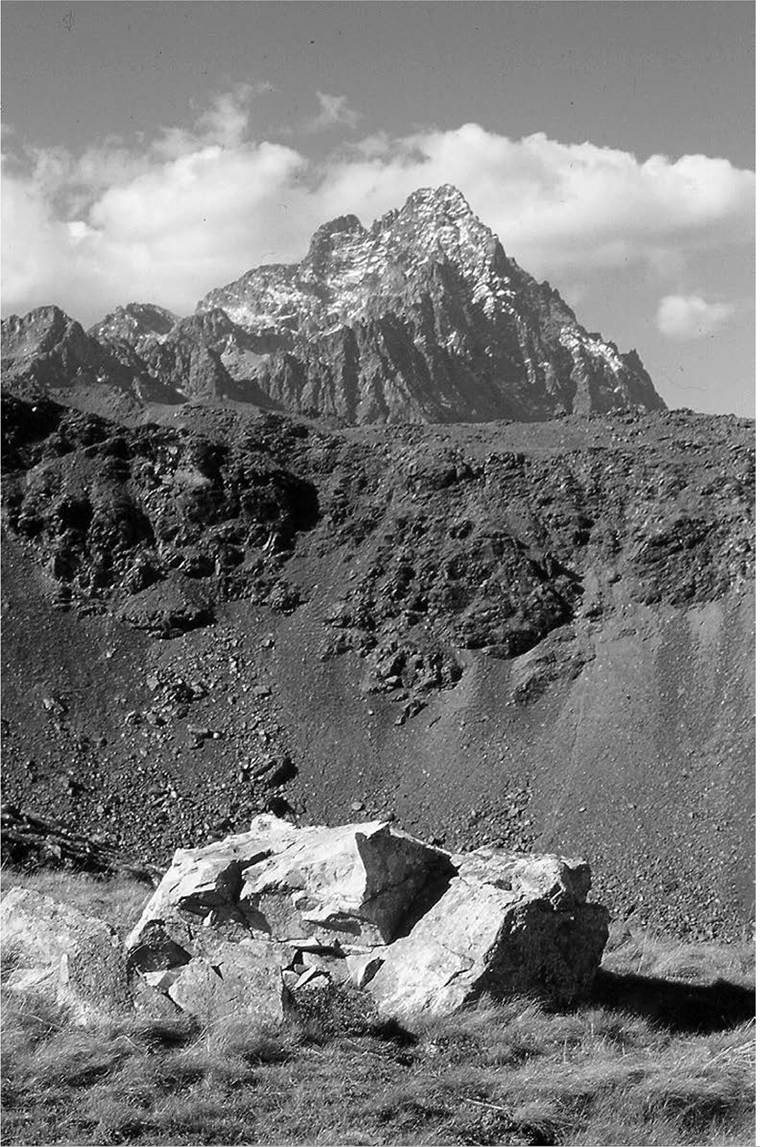
Figure 22.8 One of the boulders high in the western Italian Alps from which jadeitite axes were quarried: a block of rough jadeitite, at Vallone Porco, at 2,400 m above sea level; Mont Viso is in the background.
heavy cast copper tools, alongside technically simpler copper rings, needles and awls, and beaten sheet goldwork.[1278]
Things both connected and defined people. Two traditional approaches can be noted. An important one has been to seek spatial regularities and associations in successive phases, using the resulting ‘cultures' as a signature of shared identity in any one region and time, with population displacements and replacements a favourite past explanation of periodically abrupt changes in style. The other conventional approach has been to pick out particular objects and categories as both valuables (variously on the basis of distance from source, rarity, and the labour involved in manufacture) and individual possessions. Fine stone axes, and things in copper and gold, have been recurrent candidates, and a narrative is often presented of increasing differentiation through time. Neither approach should be lightly dismissed. It has been tempting to set aside old-fashioned ‘culture history', since the narratives in question are often based largely on pottery, and the areas in question are regularly so large that it is hard to envisage a single, bounded identity within them. When mapped, or set in chronological tables, the boundaries between cultures can seem hard and fast, but this is rarely the case on the ground. I believe that in many ways the materiality of Neolithic existence bound people together more than it set them apart, creating a sense of familiarity and security. Even where there are discernible differences in detail, such as within Vaihingen and Arbon Bleiche, community was maintained, even if for varying periods of time. Likewise, the jadeitite axes and rings in impressively large early monuments in Brittany, or the profusion and concentration of copper and gold at Varna, can obviously be taken as evidence of unequal access to desirable objects. It is not always easy, however, to pin down questions of possession and ownership. Varna stands out as an exception in its regional and wider setting,[1279] and several of its most abundantly furnished graves were cenotaphs. Jadeitite axes in Britain, possibly with the status of ancestral heirlooms brought by incomers, have very rarely been found in specific contexts (one was beside a trackway across wetland in Somerset, another in front of a chambered tomb in southwest Scotland). It is rather rare in general to find major accumulations of objects in single contexts, so I believe that even where valuables were desired and acquired, it was also important to give them away.
Similar tensions can also be seen in the last dimension of communality briefly to be discussed here, that of mortuary practices. The archaeologically visible dead of any one place and time were regularly treated in very similar ways. That varied through time, for example from diverse and scattered burials in and around settlements in southeastern Europe (but not, so far, much in Greece), to the emergence in the late sixth and fifth millennia cal bce, especially in the eastern Balkans, of separate cemeteries. Such burial grounds were a feature of the LBK in its developed phase probably from around 5300 cal bce onwards, and of its successors in the fifth millennium cal bce, with collective barrows and tombs emerging in western Europe, as already noted, from the fifth millennium cal bce onwards, becoming numerous especially in the fourth. Whether as individual burials in cemeteries, or collective deposits within formal, monumentalized tombs, there is again a strongly communal feel to these practices. Even by the later fourth millennium cal bce in northern France, a date by which some models would predict more pronounced social difference, there was repeated deposition of individual corpses, largely without grave goods, in above- and belowground chambers (allees sepulchrales and hypogees), forming substantial collectivities (often with more than a hundred people), perhaps over quite short periods of time.[1280]
We also have to deal again with questions of visibility and internal difference. Not everyone may be represented in cemeteries or monuments. Even the largest LBK burial grounds, with numbers of graves in the low hundreds, are unlikely to include the whole population,[1281] and the same may apply with many collective tombs. So in both cases we could be looking at pre-eminent individual members or groupings within the local community, such as particular families, households, or lineages, though there could be yet other dimensions such as sodalities or ritualized associations cross-cutting purely local community; isotopic studies of lifetime mobility show mixtures of locally and non-locally born people.[1282] Valencina de la Concepcion, above the Guadalquivir River near Seville in southwest Spain, nicely illustrates some of these challenges in the late fourth to earlier third millennium cal
bce. With an estimated area of over 400 ha, Valencina stands out locally and regionally. While there are settlement features principally in the form of pits, with some evidence for copper-working, many of the known features are to do with disposal of the dead. These include some of the most remarkable megalithic monuments of Iberia, such as the large dolmens and tholoi of La Pastora, Matarrubilla, and Montelirio.[1283] Other mortuary contexts include artificial caves and simple pits. In all these settings, successive deposition of individuals was made, forming various collectivities. Was this a place for everyone, or was it, perhaps more plausibly, a dominant locale, with particular groups or lineages able to control or otherwise acquire exotic materials, including here not only copper but also African and eastern Mediterranean ivory,[1284] for deposition in the most prominent monuments?
More on the topic Community:
- Tiwanaku urban origins: distributed centers and animate landscapes
- Judaism, Christianity, Islam, One or Three Religious Metaphysics?
- Bibliography
- 14 EXPERTISE AND AMATEURISM
- Early polities of the Western Sudan
- Western and Central Eurasia
- 62 Gonorrhea