Discourses on gender and sexuality
SCOTT WELLS AND PING YAO
Traditional discourses on gender and sexuality, even as they helped shape the processes of urbanization, commercialization and state-building in the ancient world, were themselves profoundly affected by the growth of political, economic, and religious networks across Eurasia and northern Africa between 1200 bce and 900 ce.
In this chapter, we explore the ways in which the development of states and trans-regional networks shaped how gender roles and sexual relations were perceived, prescribed, inculcated, and represented during these two millennia. We first examine literary representations of masculinity and femininity in “world-encompassing” genres like epic and romance, showing how imaginative models of male and female behavior increased in variety and complexity in conjunction with the evolution of trans-regional political and economic networks. This is followed by a related discussion of the reasons for and significance of the proliferation of women writers in conjunction with state formation and increasing literacy. The diversification of voices and models is also evident in medical, moral, philosophical, and spiritual discourses, which are covered in the following sections of the essay on the well-being of the body, the definitions of the exemplary spouse, and religious understandings of sex and gender. Finally, we examine the emergence of explicitly erotic texts, including an “art of the bedchamber,” that was a distinguishing feature of the cosmopolitan cultures associated with well-established and urbanized states and empires.Model men and women in epic, romance, and poetry
Literature produced in this axial age of empire-building, state-formation, and expanded commercial networks across Eurasia frequently expressed a longing for the end of conflict and competition, either in the restoration of a lost golden age or in the achievement of a promised but not yet attained future.
The restoration or achievement of perfect gender and sexual relations was an essential part of this vision, as well as the need to confront the possibility that attaining the desired goal would prove impossible.One of the characteristic genres of the period was the verse epic of multinational war fought over a woman, or a conflict generated by the difficulties of sexual reproduction and inheritance. In the Mahabharata (c. 400 ce in its final form, but with the core narrative dating back to before 500 bce), the Pandava brothers fight against their first cousins, the sons of Dhritarashtra, for the throne of the Kurus in a war caused by the royal line's inability to produce an undisputed line of succession. By the end of the conflict, which brings together all the rulers of the subcontinent, virtually all the participants except the Pandava brothers themselves are annihilated, and in the end the kingdom remains without a clear heir. In the Ramayana (c. 300 bce in the version attributed to Valmiki), a war is fought over the abduction of Rama's wife Sita by the demon-king Ravana, as the Trojan War was instigated by Paris's abduction of Helen. In both of these conflicts, the abducted woman is restored to her legitimate husband, but with doubts remaining about the costs of war and the purity of the abducted woman. The wrath of Achilles that forms the subject of the Iliad (c. eighth century bce) is prompted first against the Greeks because of Agamemnon's theft of his concubine Chryseis, and then against the Trojans after Hector slays his lover and intimate companion Patroclus. Achilles overcomes his wrath, but only by recognizing that his loss of Patroclus is mirrored by King Priam's loss of his son Hector, and the war itself continues. In the Odyssey (c. eighth century bce), Odysseus makes a long, difficult, and destructive return from war, losing all of his men and having been delayed several times by erotic relationships with women other than his wife: Circe, Calypso, Nausicaa.
Upon his eventual return to Ithaca, he must slaughter all the elite single men of the island as competitors to the hand of his wife Penelope. In the Aeneid of Virgil (70-21 bce), the eponymous hero loses his first wife in the conflagration at Troy, and at Jupiter's command must abandon his would- be second wife Dido at Carthage, where she commits suicide. Aeneas must fight yet another war in Latium to win his destined bride Lavinia against her mother's wishes and despite the fact that she is already promised to someone. The epic ends not with the expected marriage, but with the ambiguous morality of Aeneas' killing of Lavinia's earlier betrothed, Turnus. In the Persian epic narrative of Rostam and Sohrab, preserved as part of the Shahnameh of Ferdowsi (c. 935 - c. 1020), a father and son fight on opposing sides of a war between two states, their identities unknown to one another; the father kills the son and condemns himself to die without an heir.1Separation due to constant wars or forced relocations was also a prominent theme in the early Chinese poems collected in The Book of Songs. These often speak in the voice of a wife or consort left alone because of her husband's long service in the state's wars, bewailing, “My lord is on service, how can I not be sad?” (a poem in Airs of the Royal Domain),[247] [248] or lamenting, “For whom should I want to look nice?” (“Bo Is Brave,” in Airs of the Wei).[249] The military expansion under the first two Chinese empires, Qin and Han, gave birth to a particular poetic form called “The Song of the Yan” (Yan ge xing), in which the (usually male) poet expressed a woman's longing for her husband, who had been drafted to garrison the distant northern frontier region of Yan. The earliest extant “Song of Yan” was authored by Cao Pi (187-226 ce), Emperor Wendi of the State of Wei (220-266), and the form continued to be a popular poetry exercise during the Tang Empire.
Gao Shi's (706-765) “Song of the Yan,” for example, laments that “the young wife at home is heartbroken, the soldier husband in the northern frontier turning his head in vain.” Though women were rarely allowed to fight on the battlefield after the Shang Dynasty, heroic female warriors of post-Shang eras did appear in historical writings and literature. The most popular of these heroines was the renowned Mulan, daughter of an aging draftee, who fought the nomads of the northern steppe for twelve years under the disguise of a male soldier during the Northern Wei Dynasty (386-534 ce). The beloved story was vividly told in The Ballad of Mulan, a lengthy sixth-century poem.If many of the verse epics and ballads respond to state-formation and increased trans-regional networks and conflicts by describing the effects of war on gender relations, other literary genres emerged in this period that emphasized different themes, particularly in states and empires where warrior elites were replaced with or supplemented by bureaucratic elites of scribes and literati. These new genres constructed new ideals of masculinity and femininity, and tended to emphasize greater parity and balance between the sexes, including concern with the proper understanding and fulfillment of erotic and emotional attachments between men and women in a complex and dangerous world. In the Greek world, this shift can already be witnessed in the differences between the Iliad, set at the siege of Troy and dominated by descriptions of combat between men, and the journey of the hero's return to and reception at home in the Odyssey, a narrative in which many of the most memorable and well-developed characters are women.[250] A new gender dynamic is particularly evident, however, in the new and popular genre of the Greek novel, which began to be written during the first centuries ce at the heyday of the pax Romana. They present that world as far from peaceful. The heroes of the novel are always a pair: an innocent young man and woman of high status who fall in love only to be separated by courtesans, pirates, bandits, soldiers, merchants, healers, priests, magicians, and jealous love-rivals in a series of misadventures that often find the loving pair seeking one another throughout the major ports and religious centers of the Eastern Roman Empire, places like Tyre, Alexandria, Delphi, and Ephesus.
The young man and still-virginal woman find bliss only when they manage to return home together, get married, and stay put.[251]The novelistic biblical books of Judith and Esther (fourth-second century bce) narrate the hazards faced by the Jews in a world of aggressive empires, and praise Jewish women who skillfully develop and manipulate an erotic relationship with an enemy general or Persian emperor to rescue the Hebrew people from the dangers posed by that foreign leader.[252] Early Christian stories of apostles, hermits, and martyrs similarly narrated the threats and stumbling blocks posed by commerce, empire, and the obligations of mundane social and economic networks, and portrayed holy men and women who had redirected their erotic attachment away from the world and its pleasures to God and the delights of the afterlife.[253] Contemporaneous Tamil and Sanskrit romances from South Asia, such as Kalidasa's play The Recognition of Shakuntala (fifth century ce) and the verse narrative Shilappadikaram attributed to Ilango Adigal (third century ce), describe the happy marriage of a couple, and then narrate the separation of that couple by the jealousy, temptations and status-consciousness of the human world of cities, trade, and states. The couples are reunited, but only to face further suffering; lasting happiness can be found only through the redirection of desire to the goal of liberation from the cycle of death and rebirth.[254] In Chinese and Japanese literature, however, erotic pleasure is usually represented as entirely good, in accord with the Daoist, Tantric, and Mahayana Buddhist ideas about the positive spiritual qualities unleashed through sexual intercourse, as well as with the cultivation of sensual pleasures advocated in the sexual manuals authored by Tang literati. In the “Poetic Essay on Great Bliss,” for example, Bo Xingjian (776-826) depicts a pair of newlyweds who felt increasingly harmonious with each other after exploring their intimacy in various settings (music, room decoration, fine foods, etc.) throughout spring, summer, autumn, and winter.[255]
The first millennium ce witnessed a transformation of ideal masculinity and femininity in Chinese literature as well.
While in early poetic works, battlefield heroes were idolized, the protagonist in Tang vernacular literature was typically a literary man who passed the civil service examination and held imperial or regional offices. Similarly, early Chinese poems emphasized women's physical appearance (such as facial features) and attire, with such ideal beauty usually being portrayed as enchanting yet elusive. The most frequently used phrases are: silkworm eyebrows (emei), beautiful eyes (meimu), white teeth (haochi), red lips (zhuchun), jade-like fingers (yuzhi), artful smiles (qiaoxiao), light skirts (qingju), fragrant dress (xunyi), and slender waist (xiyao). A Han poem, for example, laments that “the beauty is in the clouds; the path to the sky is forever blocked.”[256] The Book of Songs, Qu Yuan’s (c. 340-279 bce) The Songs of the South (Chuci), and New Songs From a Jade Terrace (Yutai xin yong), a collection of poems from the Eastern Zhou period (771-221 bce) to the Liang Dynasty (501-57) complied by Xu Ling (507-83), contain many descriptions of so-called jiaren, the image of the beautiful but unattainable woman.The open attitude toward sexuality during the Tang Dynasty would eventually expand the repertoire of how women were depicted (see Fig. 7.1). In addition to graphic narratives in erotica, Tang poems ventured to adore the
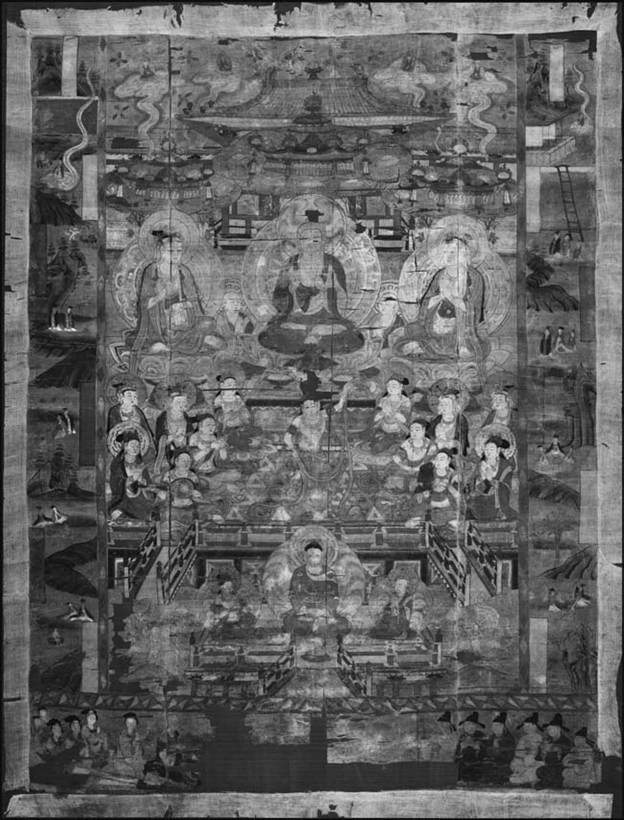
Figure 7.1 Tang dynasty painting of the Paradise of Sakyamuni. Below Sakyamuni are musicians and dancers with low-cut, tight dresses. © The Trustees of the British Museum. All rights reserved.
sight of half-exposed bosoms (Bo Juyi, “The Song of Wu Palace”)11 or hotspring-bathed female flesh (BoJuyi, “The Song of Everlasting Lament”).[257] [258]
The biggest change in Tang literature's idealizing femininity, however, is the pairing of physical beauty with literary ability, a trend particularly noticeable in the emergence of popular literature that envisions a female readership. In “The Tale of Yingying” (Yingying zhuan) by Yuan Zhen (779-831), for example, Yingying not only is extraordinarily beautiful in appearance, but also “excels in writing.” She would “often ponder over verses.”[259] In “The Tale of Nanke Governor” (Nanke taishou zhuan) by Li Gongzuo (c. 770-850), the protagonist Chunyu Fen meets a group of women who are bewitchingly pretty and speak eloquently.”[260] [261] And in Shen Yazhi's (781-832) “Xing Feng,” Beauty, the female protagonist, is described as “walking in a composed and leisurely manner, holding books and reciting poems” and identifies herself as a poetry lover.15 The depiction of bookish beauty as an idealized trait of femininity is very much parallel to the rise of a literati elite of men educated to pass the Civil Service Exam, and women educated to be teachers to their sons and companions to their husbands. As the men of the state bureaucracy prized poetry, the most prestigious subject in the examination system, they also idolized the learned woman who could share and appreciate their knowledge.
Women as writers
Women, indeed, wrote, and their writing on gender relations and sexuality can be found in a variety of the genres that emerged in the context of states, empires, and networks. Sappho's lyrics (seventh century bce) make several references to themes from the Homeric epic. One of the longer surviving fragments of her poetry describes in joyous terms the arrival of Andromache at Troy and her marriage to Hector, which is starkly in contrast with how the war between Greeks and Trojans would transform this happiness into sorrow with Hector's slaying by Achilles, followed by the murder of their son Astyanax and Andromache's own enslavement after Troy's defeat. The epigrams of the Greekpoet Anyte (c. 300 bce) eloquently and sincerely praise the bravery of men who die in battle for their fatherland, though one poem, perhaps wrongly attributed to her, commemorates three virgins of Miletus who committed suicide rather than face capture by the invading Gauls.[262] The Roman woman Vibia Perpetua (d. 203 c e), while in prison awaiting execution as a Christian, recorded how her father attempted to use his love for her, and her responsibilities to her family and infant son, to dissuade her from accepting martyrdom. Her dreams helped her reaffirm her commitment to the new faith and rejection of both Roman norms and the claims of kin and home by showing how her martyrdom would redeem her deceased younger brother from postmortem suffering and symbolically transform her from a maternal woman to a warrior man.1[263] Such rejections of family and home in favor of dedication to God or a higher spiritual calling can also be found in mystical poetry by Muslim, Buddhist, and Hindu women, such as Rabi'a (eighth century ce), Patacara (sixth century bce), and Antal (eighth century ce).[264]
Elite women of Tang China and Heian Japan wrote both poems and essays. Although many of their writings tended to conform to the themes of their male counterparts, others reflected a distinctive theme of longing for sisterhood: the cultivation of networks among women in a male-dominated society. The Tang Daoist poetess Yu Xuanji (844-868) composed several poems celebrating women's beauty as a means of establishing emotional rather than sexual intimacy. For instance, Yu expresses amazement at the outward beauty of three sisters who lived next door to her convent. She highlights a sense of camaraderie and pride in shared femininity, by imagining that these sisters chose to be born as women: “coming in exile to this dusty world, they did not become males.” She claimed, “If I were looking at their pink faces, even dying would be sweet.”[265] In HeianJapan, discouraged from learning men's writing (Chinese), women conveyed their thoughts, emotions, and observations using hiragana, the set of alphabetic characters developed during the ninth century and associated specifically with women as a shared community of writers and readers. These texts demonstrated a quite subtle, sophisticated, yet unrestrained self-expression. By the end of the tenth century, Japan would produce renowned female poets, Lady Ise (?-959) and Izumi Shikibu (b. c. 976), as well as the prose masters Sei Shctnagon (c. 966-1017), author of The Pillow Book, and Murasaki Shikibu (973-1014?), author of the Tale of Genji, which describes an aesthetically and erotically sophisticated court where men and women interact as equals in intellect, sensibility, and shouldering the burdens of moral responsibility for how they treat one another.
While women writers remained far fewer than men through the period from 1200 bce to 900 ce, their numbers always grew in contexts where state bureaucracies, court and civic cultures, and developing commerce gave increased prominence and value to literacy. A greater number of literate women led to more women writing. Equally importantly, the greatness of authors like Sappho and Murasaki Shikibu was widely acknowledged among both men and women, and they became literary models for subsequent writers, both male and female.[266]
Sex, health, and well-being
Trans-regional networks connected human beings across communities and cultures, and thereby created trans-regional relations of gender and sexuality. Trans-regional moral and ethical discourses arose to articulate and manage these new relations in the form of philosophical systems, cultic practices, and religious beliefs which claimed a universal validity that transcended local particularities and therefore made sense of the diversity of the sexual practices and gender identities that had been interconnected by expanding states, empires, and trade routes. Some of these discourses identified the reproductive conjugal bond as the universal norm for gender relations and sexual practices. Some emphasized the equality of all human beings with respect to aspirations focused on meeting the needs of the mind, spirit, or soul which every woman and man shared alike despite physical differences in their bodies. Still others endeavored to articulate and define the parameters and implications of sexual practices and pleasure. The major universal belief systems that emerged in this period weighed discourses that regarded nonprocreative sex as aberrant against those that regarded sexual reproduction as a lesser good, even a distraction or impediment to achieving the higher spiritual goal, and came up with a variety of solutions and compromises.
In the Greco-Roman world, the healthy male body was regarded as firm, hot, and dry, while the female body was soft, cold, and wet. In sexual reproduction, the heat and energy of the male semen warmed the damp womb, and the conceived offspring fructified there like the seed of a plant in damp, heated earth. In this scientific discourse, any behaviors that challenged this norm - virile women, effeminate men, hermaphrodites - were deviations from the ideal universal type. Effeminate men include those who indulged too much in sex, because, instead of being dry and hard like a true man, they produced and leaked excessive fluid through frequent intercourse. Greek and Roman ethnographers such as Herodotus (c. 484-425 bce), Strabo (c. 64 bce - c. 21 ce), and Tacitus (56 ce - c. 120 ce) used this model to categorize the diversity of cultures (real and imaginary) with which their world came into contact. These historians and geographers lauded any practices that approximated the norm while chiding, marginalizing, critiquing, or condemning practices that deviated, effeminate Persians and virile Amazons being the best-known examples.[267]
Greek and Roman philosophers likewise offered understandings of gender and sexuality presented as universally applicable. While Aristotle (384-322 bce) argued that men were both physically, mentally, and spiritually superior to women, other schools argued that the human intellect transcended gender differences and took as their goal liberation of the mind from the desires of the body. The Pythagorean emphasis on contemplating the harmonious geometry that underlay the perfect proportions of the universe allowed men and women to participate as equals, and several writings survive by and attributed to female Pythagoreans from the sixth century bce through the Hellenistic Era.[268] Platonic dialogues and neo-Platonist writings present the material world and its sexual reproduction as distractions that prevent human beings from recognizing their true spiritual nature or soul and its proper home in the non-material universe of ideas. In this respect, as Plato (429-347 bce ) argues in the Symposium and Phaedrus, male-female sexual desire, because linked to reproduction, is actually inferior to male-male (or, by implication female-female) sexuality, in which the partners can more easily detach themselves from physical sex to recognize the true spiritual nature of their love, soul for soul rather than body for body. Women as well as men could achieve this philosophical mastery, at least in theory. Since men were encouraged to form relationships with other men rather than women, it may be that (like Plato himself) most Platonists took only male pupils: unlike the Pythagorean school, there are no surviving texts by Platonist women.[269]
In early Chinese philosophical thinking, the use of metaphors and the terminology of sexual intercourse in such texts as The Book of Songs (Shijing, attributed to Confucius) and The Zuo Commentaries (Zuozhuan, compiled in the early fourth century bce) reflect an openness and matter-of-fact attitude about sexuality in early China. The Han Dynasty witnessed a substantial increase in writings about gender and sexuality. The most important Han texts are undoubtedly the so-called Mawangdui Medical Manuscripts (Mawangdui yishu), the fifteen medical texts discovered at the Mawangdui Han tomb. Among them, “Ten Questions” (Shiwen), “Discourse on the Culminant Way under Heaven” (Tianxia zhidao tian), and “Conjoining Yin and Yang” (He yinyang) are explicit texts about the art of the bedchamber. These texts, along with rituals relevant to sexuality, represented the dominant discourse on sexuality in the Han and the earliest sexual culture in Chinese history. Universally associating the female body as yin and the male body as yang, the Mawangdui Medical Manuscripts have the distinctive tendency of combining Daoist beliefs with medical knowledge: some texts stress sexual intercourse as resembling the union of yin and yang, while others discuss its benefits for physical well-being.[270] Perceptions of gender and sexuality as seen in these texts are twofold. On the one hand, these texts emphasize the importance of the pleasure of the female partner during sex, and recommend that all human beings need a healthy balance of yin-qi and yang-qi, which can be achieved through male-female intercourse. On the other hand, the texts were clearly written for men: for the sex act to have any medical value, the male had to make sure that the female reached orgasm and emitted her yin-qi. This probably is the main reason why there are so few instances in ancient Chinese literature ofhomoeroticism. Nevertheless, none of these texts addressed the moral issue of non-procreative sex versus sexual reproduction, probably because the Chinese did not consider that there could be much of a conflict between sexual pleasure and continuing the family line.
The exemplary spouse
In China during the Han Dynasty, intellectuals began to write treatises specifically for women on how they could best fulfill the responsibilities of their position in family and society. Most of these writings drew on Confucianism as the source of moral authority. Liu Xiang's (77-6 bce) Lienil zhuan (Biographies of Exemplary Women), for example, showcases women in the past who were filial daughters and daughters-in-law, helpful wives to their husbands, or wise mothers to their sons. Liu also appended a chapter of “Depraved Favorites,” listing evil and dangerous imperial consorts who destroyed their husband's empire. Lienu of this kind would eventually be included in every series of dynastic biographies and became a genre of its own. It served as moral guidance for women throughout Chinese imperial history.[271] Ban Zhao (45-116), sister of the renowned historian and Confucian moralist Ban Gu (32-92), authored Nujie (Admonitions for Women), advocating seven womanly virtues as ideal for a future bride: humility, resignation, subservience, self-abasement, obedience, cleanliness, and industry.[272] During the Tang Dynasty, this “exemplary woman” tradition continued, with Ban Zhao's Admonitionsfor Women becoming a must-read for girls of elite families. In addition to such didactic classics, epitaph writing also served as a conduit of public discourse on women's role and womanly virtue. Compared to the women in lienu biographies who were known for their heroic actions, or to princesses remembered in dynastic biographies for the political consequences of their self-indulgence and waywardness, epitaphs exalted Tang elite women for their diligence, capability, and wisdom in managing domestic affairs, and for their literary and religious acumen. Accordingly, the seven womanly virtues defined by Ban Zhao were the most common attributes ascribed to the deceased.
In the Greco-Roman world, Stoicism emerged in the Hellenistic period, providing an ethical system of guidelines for marriage and procreation in the context of a complex, interconnected world of kingdoms and empires. As Rome expanded and consolidated its empire between the first centuries bce and ce, Stoicism was likewise adopted by many members of the Roman political class. Stoicism articulated a concept of male-female companionship in a loving, mutually supportive marriage. The self-control required to discipline the body and its desires, along with the related emotions of pleasure and suffering, was seen as essential to survival and success in a complex, large-scale society where genuine intimacies had to be carefully and deliberately cultivated. Stoicism emphasized the man's obligation to fulfill his public duties and social responsibilities, including marrying and having children, but also to meet those obligations without ever losing self-control or behaving irrationally. The wife's ethical responsibilities were to her marriage partner: she should exhibit moderation, and be a worthy friend to her husband. Faced with a disturbing or upsetting occurrence, such as the death of one of their children (not uncommon in this age of high infant and childhood mortality), the spouses were expected to support one another in accepting the circumstance with self-disciplined equanimity.[273]
In India, Brahmanical religion developed two contrasting dharmas, or paths of moral and ethical instruction. Texts such as the Laws of Manu (roughly dated c. 200 bce - 200 ce) and Kautilya's Arthashastra (traditionally dated c. 300 bce) perpetuated the Vedic tradition of caste hierarchy. These authorities emphasized male-female reproduction as the sexual and gendered norm, stipulating the sacred responsibility of men to engender and women to bear and nurture legitimate children of their varna or jati. The codes (or dharmashastras) explicitly condemn non-procreative sexuality as immoral and polluting, with acts like adultery and male-male sex harshly punished. The laws also highlight the subservience and inferiority of women to men. By contrast, the Upanishads, compiled between the tenth and fifth centuries bce, emphasize the gender- and caste-neutrality of brahman (soul), universally shared by all beings. These texts instructed men and women in ascetic disciplinary practices (yoga) that would enable them to achieve liberation (moksha) from the sufferings, desires, and distractions of the material world and body. The contrasting paths of the dharmashastras and Upanishads were eventually reconciled in classical Hinduism by encouraging upper-caste men first to fulfill their worldly dharma with their wives by producing and raising children to adulthood and then to withdraw from the world, seeking liberation through asceticism. Wives were expected to accompany their husbands into retreat for meditation and spiritual preparation, but orthodox Hindu doctrine argued that women could not achieve liberation. However, a woman could be born again as a man by fulfilling her wifely dharma, assisting her husband in the performance of his duties, and doing nothing that would bring him dishonor. Gender- and caste-neutrality was preserved in classical Hinduism primarily through the practice bhakti, or personal veneration of a deity, who would reward the loving, enamored devotee with ecstatic liberation.[274]
Sex, gender, and religion
As the example of Hinduism highlights, the universalizing religions that emerged out of the cosmopolitan environment of states, empires, and networks both built upon and profoundly reshaped pre-existing discourses on sex and gender relations. The Greeks and Romans, for example, tried to universalize their religious beliefs and cultic practices by equating the gods and goddesses of other cultures with their own pantheon, including the gods and goddesses of peoples they conquered and integrated into their empire. So not only were the Olympian gods of the Greek pantheon merged with Roman deities, but their persons and cults were syncretized as far as possible with those of neighboring and subjugated peoples to the east (Egypt, Babylon) and north (Scythians, Celts, Germans).[275] Panhellenic devotions like the cult and oracle of Apollo at Delphi, and the celebration of the Mysteries in honor of Persephone and Demeter at Eleusis brought together men and women from throughout the Greek (and later Roman) world and beyond.[276] On the other hand, cultic practices whose gendered or sexual elements were regarded as without parallel in the Greco-Roman world were considered to fall outside the normal into the realm of the excessive. The supposed “sacred prostitution” that Greek authors claimed could be found at temples dedicated to love goddesses in Mesopotamia and Syria - the dedication of one's body to having sex with devotees of the god - was one such practice much commented on as something alien and strange that demonstrated the effeminate excessive sexuality of the east. Sacred prostitution was practiced at the temple of Aphrodite in the Greek polis of Corinth as well, according to Strabo: further evidence, alongside its fondness for luxury, of that port city's status as an Asiatic outlier.[277]
Other sexually transgressive foreign religious practices, however, were openly introduced into the center of Greek and Roman life, notably the devotion to Bacchus and to the Magna Mater (the Great Mother, Cybele). While associated with fertility, these “eastern” imports explicitly encouraged devotees to achieve an ecstatic state of erotic and mystical attachment to the divinity by inverting the normal gender roles: women by aggressively pursuing Bacchus through the wilderness beyond the bounds of household and polis, men by donning women's clothing and even castrating themselves in the service of Cybele. These practices, by reversing “universal” gender norms, both reinforced the idea of those norms as universal and presented an intensely shared homosocial devotion to the god (men among men, women among women) as an alternative to the production of offspring.[278] The similarly imported cult of the Persian god Mithras, whose adherents were almost exclusively men, offered to male devotees the promise of individual immortality by participating in the homosocial rites of the god. Mithraism became popular in the Roman army during the late first and early second centuries ce, exactly the period when Roman law required soldiers to remain unmarried for their entire term of service. Devotion to Mithras within the Roman army remained widespread, however, even after the marriage-prohibition on soldiers was lifted in the early third century ce, and continued until the Christianization of the Roman Empire over the course of the fourth century.[279]
Christianity, while having its roots in Judaism, drew on Stoicism, neoPlatonism, Zoroastrianism, and other philosophical and religious systems in articulating its own emphasis on the norm of male-female reproductive sex, including the subordination of woman to man, simultaneously with an articulation of the human soul and its pursuit of salvation as gender-neutral phenomena that transcended and rejected sexuality. Christianity condemned non-procreative sex, highlighted the woman's primary worldly and public function as that of wife and mother, and embraced the definition of adultery as sex between a married woman and a man other than her husband. If a wife had sexual intercourse with anyone other than her husband, she was therefore an adulteress; whereas a husband who had sex with women other than his wife, including prostitutes, would be guilty of the less serious offense of fornication as long as those women were unmarried. The Church Fathers of the fourth and fifth centuries ce privileged the needs of the soul over the desires of the body, but also tended to gender the virtuous, ascetic soul as manly and the weak, corrupting body as feminine. Women were seen as having an additional hurdle to overcome in their pursuit of spiritual athleticism, because of the greater softness and porousness of their bodies. The polluting essence of women's menstruating bodies was part of the justification (following Mosaic law) for excluding women from access to the altar and priestly office. Nevertheless, both men and women could dedicate their chastity or virginity to God, abandoning or foregoing sexual reproduction for the higher purpose of joining in a shared spiritual struggle. Without considering sexual reproduction to be evil (though the discharge of semen, like menstruation, was polluting), Christians shared with Zoroastrianism and Gnosticism a vision of the cosmos as a battleground between the forces of light and darkness. For Christian ascetics, abstention from sexual activity constituted, alongside martyrdom, one of the two most important ways of engaging in this fight on the side of good. Groups of monks and nuns, living in monasteries as sacred warriors dedicated to spiritual combat on behalf of all the faithful, became the defining feature of the Christian landscape in late antiquity and the early Middle Ages.[280]
The idea of an ascetic monastic elite was also a defining feature of Buddhism. The first Buddhist communities of monks and nuns were established by the Buddha himself, part of the general emergence of monasticism in India between the sixth and fourth centuries bce also associated with Jainism. Buddhist monks and nuns were expected to dedicate themselves entirely to the cessation of desire, the cultivation of right action by overcoming all negative emotions such as anger and hatred, and the achievement of correct mental concentration by replacing ignorance with knowledge. Through this process of meditation and study, monks and nuns could achieve enlightenment, and gain wisdom they could communicate to others through preaching and writing. Laypeople, living in the world as husbands, wives, and householders, would gain inspiration and merit by attending monastic sermons and by providing the monks and nuns with material support. The positive karma accrued through these good works would help laymen and women eventually achieve enlightenment themselves, usually after subsequent rebirth.35
Islam shared the same roots as Christianity, and the same emphasis on a universal struggle between good and evil, but produced a discourse on gender and sexuality that (like rabbinic Judaism) embraced the pleasures of male-female reproductive intercourse as an absolute good. In the system articulated in the Quran, and developed in the schools of Islamic law that emerged between the seventh and ninth centuries ce, all men and women were expected to get married and produce offspring. Non-procreative sex was forbidden as polluting, and a man who could not afford the bride-gift or dower to marry a free woman was instructed to wed a slave. Christianity's lauding of celibacy and asceticism was one of the principal critiques Islam made of that religion, alongside the worship of Jesus as God: the Qur'an stipulates that the delights of sex will continue to be enjoyed by the saved in paradise. In the context of the male-female reproductive union, women could inherit and manage their own property as they wished, while men were expected to use their financial resources to benefit their wives. Men could have up to four wives, while women could have no more than one husband; but the male's right to polygyny was contingent on his being able to
(eds.), Eve and Adam: Jewish, Christian, and Muslim Readings on Genesis and Gender (Bloomington: Indiana University Press, 1999).
35 Mohan Wijayaratna, Buddhist Monastic Life: According to the Texts of the Theravada Tradition, trans. Claude Grangier and Steven Collins (Cambridge University Press, 1996), and Mohan Wijayaratna, Buddhist Nuns: The Birth and Development of a Women's Monastic Order (Kandy, Sri Lanka: Buddhist Publication Society, 2010).
support all the wives equally, emotionally and sexually as well as financially. Extramarital sex was absolutely forbidden to women, but allowed for a man with his unmarried slaves in the form of concubinage. The spiritual practices associated with right belief - prayer, alms, fasting, pilgrimage - were incumbent on all Muslims equally; and the mystical path of Sufism was also open to both genders. But in mundane public matters, women were subordinate. 36
to men.
In China, post-Han discussions of the “life nurturing” benefits of sex began to incorporate the Daoist concept of uniting yin and yang through intercourse. The most influential texts during the post-Han era were Sunujing (Scripture of the Plain Woman), Yufang bijue (Secret Instructions of the Jade Bedchamber), and Huangtingjing (Scripture of the Yellow Court) of the third or fourth century, as well as Shangqing huangshu guodu yi (Liturgy of Passage of the Yellow Writ of Highest Clarity), which dates to the fourth or fifth century. All of these reflect a profound Daoist influence on the art of the bedchamber as well as on perceptions of sexuality in early medieval China. Some scholars argue that since Daoism considers attaining yin-qi crucial for reaching this-worldly immortality, and since sexual intercourse constitutes a prominent technique to reach this goal, early literature on the art of the bedchamber appeared to promote a sexual vampirism of women by men. Other scholars cite texts such as The Liturgy of Passage of the Yellow Writ of Highest Clarity as evidence that women were considered critical and “functioned as equal partners” in the early Daoist tradition. In this Liturgy, sexual intercourse was stipulated as part of the ritual of Daoist initiation. The sexual component of this process was called “the harmonization of qi” (heqi), that is, combining the male's sexual energy (yellow qi) with the female's sexual energy (red qi) to realize the harmony of the universe. Whether vampiric or harmonious, the sexual theory of yin and yang provided the primary basis for erotic practice and the intellectual/religious interpretation of sexuality during the Division Period (220-581 ce) between the Han and Tang dynasties.[281] [282]
However, Daoism was not the only voice in discourse on sexuality during this period. Scholars have suggested that Buddhist monks also enjoyed popularity as teachers of the art of sex. Weishu (The History of the Wei), for example, claims that the famous monk and translator of the Mahaparinirvana- sutra, Tanwuchan (384-433), had taught “the art of intercourse between man and woman” to young wives of eminent families. In addition, early Buddhist sutras provided Chinese laymen with a spiritual foundation for defining gender relations and sexual fulfillment. For example, in the Srgalavadasutra, whose translation into Chinese is attributed to An Shigao (mid-second century), the satisfying husband-wife relationship was singled out as one of the ethical cornerstones of a blessed family. The Srgalavadasutra received three other translations in South China during the fourth and fifth centuries. The popularity of this text indicates that Buddhism was considered the source of wisdom for managing household life, and especially for sexual life between husband and wife.
The art of the bedchamber
Rather than competing with the Daoists and Buddhists, Confucianists during that period seemed to happily embrace their guidelines. Such endorsement was probably due to the fact that their interpretation of sexuality answered a real need within Confucian tradition, since patriarchs of Confucian families depended on such advice to manage their inner chambers with multiple concubines. Indeed, the importance of the continuation of the family line propelled Confucians to become strong supporters of such guidance, and this approval certainly contributed to the rise of sexology in pre-Tang China.[283]
Overall, early texts on the art of the bedchamber, dominated by Daoist theories and practices, reflect a rational rather than romantic perspective on sexuality. Discourses on gender and sexuality underwent an extensive transformation during the Tang Dynasty. Such change was brought by the increased impact of Buddhism as well as the introduction of new elements into the Chinese ruling class thanks to the Tang civil service examination. To be sure, Daoist knowledge of sexology thrived throughout the dynasty; nevertheless, it did not experience the same vigorous development that it had during the Han Dynasty and Division Period. In assessing religious influence on Tang sexual discourses, it was probably the popularity of Buddhism in general and the introduction of Vajrayana Buddhism, also
known as Tantric Buddhism, in particular that added a new dimension to the Tang ideal of body, gender, and sexual intercourse.
While most schools of Mahayana Buddhism advocate refraining from human desires, it was generally understood that sexuality was, nevertheless, central to Buddhist teaching. Discourses on sex were a key component in the Buddhist hermeneutics of desire. Liberation, salvation, or awakening has always to do with sex, whether sexuality is denied, affirmed, or displaced.[284] In early Indian Buddhism, continence was an absolute necessity because of the fear that sexuality binds human beings to existence, while in classic yoga disciplines, abstinence was prescribed to discard perturbations of self-mastery and to find an increase of energy through renunciation. In Tantric Buddhism, however, sexuality was used as a source of spiritual energy. Tantric Buddhism drew this association from the cardinal tenet of Mahayana teaching, that is, the identity of passion and awakening at the level of ultimate truth. “But it goes even further when it asserts that the energy of the passions is the necessary catalyst of awakening.”[285]
By emphasizing the identity of passion and awakening, Tantric Buddhism developed the notion of Wisdom as Bliss and asserted the possibility of reaching Buddha-hood in one's present body. In Tantric texts, Wisdom was commonly paired with Meditation, or with Passion through sexual allegories (for example, male and female sex organs). And the perfect union of the pair can be realized by the union of a male practitioner with a female partner: “the Great Bliss (mahasukha) that ensues coincides with the realization of Emptiness.”[286] One of the most important Tantric texts on the theory of Anuttarayoga, Cakrasamvara Tantra, for example, opens with the following claim: “And now I will explain the secret, concisely, not extensively. Union with Sri Heruka (Sriherukasam yoga) is the means of achieving all desired aims.” The sutra discloses that the secret is none other than the act of sex.[287]
Tantric Buddhism has been regularly translated into Chinese as Mizong, which is also the Chinese translation of Esoteric Buddhism. During the seventh century, although Tantric Buddhism began to be systematized and increasingly came to stress philosophical contemplation in India, its original fervency was not lost; it found its way to China along the Silk Roads and was officially introduced to the Tang court during the eighth century. By the ninth century, Tantric Buddhism had penetrated all sectors of Tang society. In emphasizing body as the means of reaching Buddha-hood, Tantric Buddhism thus profoundly affected Tang representations and perceptions of sexuality.
The Tang Dynasty also represented a departure point in the history of the art of the bedchamber with the emergence of a culture of erotica. Writings about sexuality, especially erotic and romantic literature, were much more candid in advocating sexual pleasure, and focused more on sensuality and emotional fulfillment. Such an unprecedented development in Chinese literary history was largely due to the rise of the examination culture and a new elite class of literati. To distinguish themselves from the old power bloc (the seventeen eminent clans), the examination graduates publicly associated with courtesans and wrote about their pursuit of sexual pleasure. It is probably not a coincidence that the first two extant examples of erotica in Chinese history, Bo Xingjian's “Poetic Essay on Great Bliss” and Zhang Zhuo's (660-740) “Merry Making in a Fairy Dwelling,” were both produced by examination graduates of the Tang Dynasty. In Chinese and Japanese literature, erotic pleasure is usually represented as entirely good, in accord with the Daoist, Tantric, and Mahayana Buddhist ideas about the positive spiritual qualities unleashed through sexual intercourse, as well as with the cultivation of sensual pleasures advocated in the sexual manuals authored by Tang literati.[288]
The famous Kama Sutra and its reputed author, Mallanaga Vatsyayana, emerged from a similar milieu: the group of male bureaucrats that came into being as administrators of the Gupta Empire in India (c. 320-550 ce). Here too, the cultivation of erotic expertise was associated especially with the new elite class who had gained social prestige and political power as a result of their literary education and government service. Both the Kama Sutra and the Tang erotic manuals presented elaborate and sensuous descriptions of color, sound, scent, image, food, and nature in their depictions of sexual intercourse. They also articulated an understanding of gender that regarded literary knowledge, learned etiquette, aesthetic sensibility, sophisticated taste, and spiritual sensitivity as ideals for both men and women, with the possession of such qualities by both partners considered indispensable in achieving sexual bliss. The Kama Sutra even recognizes that such pleasures can be achieved by male-male and female-female sexual pairings
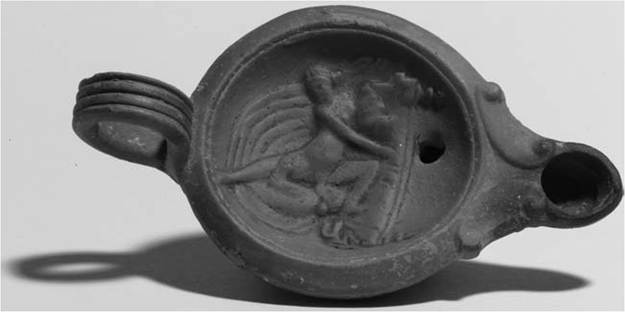
Figure 7.2 Roman terracotta lamp, manufactured in Asia Minor during the first century c e. It is decorated with a scene of one woman performing cunnilingus on another woman. © The Trustees of the British Museum. All rights reserved
and also identifies a “third sex” of individuals who combine masculine and feminine qualities.[289]
A similar increase in the art and literature of eroticism is evident among the literate classes of Greece and Rome (see Fig. 7.2). The widespread practice and taste for erotic cultivation among the political, mercantile, and cultural elites of these societies was frequently parodied or ironically praised in works of literature that are among the most influential survivals from classical antiquity, including the plays of Menander (341-290 bce) and Plautus (254184 bce), as well as the Satires of Horace (65-8 bce ) and Juvenal (fl. 100 ce). The two wealthiest, largest, and most diverse cities of the Mediterranean basin, Alexandria under the Ptolemies and Rome as the capital of an expansive empire, were each extremely productive centers of erotic poetry, produced by self-consciously sophisticated and worldly writers like Callimachus (310-240 bce), Catullus (84-54 bce), and most famously Ovid (43 bce -18 ce) and his Art of Love. The production of novels such as Petronius' Satyricon (first century ce) or Apuleius' The Golden Ass (second century ce), as well as the enduring vogue (from the Hellenistic era to the heyday of Rome's empire and beyond) for a pastoral literature that contrasted the sexual overindulgence of the city with the natural and pure eroticism of shepherds and shepherdesses, give further indication of the range and vitality of Greek and Roman discourses focused specifically on how to navigate the enticing, dangerous, degrading, and delightful varieties of sex on offer to the traveler or citydweller in an urbane and interconnected world.[290]
Conclusion
Whether in discourses devoted to erotic pleasure, bodily health, spiritual progress, marital duty, or the modeling of ideal masculinity and femininity, the development of states, empires, and trans-regional networks represented both a source of danger and a source of opportunity. The invention of new forms of bureaucratic organization to address the problems of administering complex and geographically expansive political systems led to the spread of literacy and the increased prestige of the literate. This produced new ideals of male and female accomplishment that both opposed and expanded previous notions of masculine and feminine roles associated with physical prowess. The exposure to multiple cultural practices and belief systems that resulted from the spread of economic and diplomatic networks sometimes promoted reinforcement of pre-existing gender and sexual norms, and sometimes a radical revision or rejection of those norms. In particular, the new quest for personal immortality through sex (or its avoidance) gained widespread appeal, whether in the celibacy associated with Christianity or the harmonizing of qi associated with Daoism. Increased urbanization and travel - whether for governmental service, business and trade, religious pilgrimage, or simple tourism - meant increased opportunities to escape (or be driven from) the responsibilities and securities of marriage and familial reproduction. This helped lead to the increased anxiety about securing a stable and happy marriage that one finds in the Greek novels or Ban Zhao's Admonitions for Women. It also contributed to the emergence of perspectives that regarded the purpose of sexual intercourse as primarily erotic rather than reproductive. Preserving the well-being and wholeness of the body in this complex, enticing, interconnected world that brought men and women together in a variety of often unprecedented ways became a paramount concern. How this was to be done - whether by embracing epic, romantic, medical, philosophical, bureaucratic, domestic, monastic, and/or erotic models of gender relations and sexuality - was a challenge faced by men and women alike in these unprecedentedly cosmopolitan societies.
Further Reading
Primary sources
BirreU, Anne, New Songsfrom a Jade Terrace: An Anthology of Early Chinese Love Poetry, New York: Penguin Classics, 1987.
Cahill, Suzanne, Divine Traces of the Daoist Sisterhood, St. Petersburg, F l: Three Pines Press, 2006.
Kalidasa, The Recognition of Sakuntala, trans. W. J. Johnson, New York: Oxford University Press, 2001.
Kraemer, Ross Shepard (ed.), Women's Religions in the Greco-Roman World: A Sourcebook, New York: Oxford University Press, 2004.
Kvam, Kristen E., Linda S. Shearing, and Valarie H. Ziegler (eds.), Eve and Adam: Jewish, Christian, and Muslim Readings on Genesis and Gender, Bloomington: Indiana University Press, 1999.
Swann, Nancy Lee, Pan Chao: Foremost Woman Scholar of China, Ann Arbor: Center for Chinese Studies, University of Michigan, 2001.
Waley, Arthur, The Book of Songs: The Ancient Chinese Classic of Poetry, New York: Grove Press, 1996.
Secondary sources
Black, Brian, The Character of the Self in Ancient India: Priests, Kings, and Women in the Early Upanishads, Albany: State University of New York Press, 2007.
Blackstone, Kathryn R., Women in the Footsteps of the Buddha: Strugglefor Liberation in the Therigatha, Richmond, UK: Curzon Press, 1998.
Brown, Peter, The Body and Society: Men, Women, and Sexual Renunciation in Early Christianity, New York: Columbia University Press, 1988.
Coon, Lynda L., Sacred Fictions: Gender and Hagiography in Late Antiquity, Philadelphia: University of Pennsylvania Press, 1997.
Cooper, Kate, The Virgin and the Bride: Idealized Womanhood in Late Antiquity, Cambridge, ma: Harvard University Press, 1996.
Dhand, Arti, Woman as Fire, Woman as Sage: Sexual Ideology in the Mahabharata, Albany: State University of New York Press, 2008.
Doniger, Wendy, Splitting the Difference: Gender and Myth in Ancient Greece and India, University of Chicago Press, 1999.
Greene, EUen (ed.), Women Poets in Ancient Greece and Rome, Norman: University of Oklahoma Press, 2005.
van Gulik, R. H., Sexual Life in Ancient China: A Preliminary Survey of Chinese Sex and Society from ca. 1500 bc till 1644 ad, Leiden: Brill, 2003.
Heitman, Richard, Taking Her Seriously: Penelope and the Plot of Homer's Odyssey, Ann Arbor: University of Michigan Press, 2008.
SCOTT WBLLS AND PING YAO
Jones, Meriel, Playing the Man: Performing Masculinities in the Ancient Greek Novel, New York: Oxford University Press, 2012.
Keith, A. M., Engendering Rome: Women in Latin Epic, Cambridge University Press, 2000.
Nussbaum, Martha C., and Juha Sihvola (eds.), The Sleep of Reason: Erotic Experience and Sexual Ethics in Ancient Greece and Rome, University of Chicago Press, 2002.
Parker, Joe, “Dreaming Gender: Kyδgoku SchoolJapanese Women Poets (Re)Writing the Feminine Subject,” Tulsa Studies in Women's Literature 27 (2007): 259-89.
Pomeroy, Sarah, Pythagorean Women: Their History and Writings, Baltimore, md: Johns Hopkins University Press, 2013.
Raphals, Lisa Ann, Sharing the Light: Representations of Women and Virtue in Early China, Albany: State University of New York Press, 1998.
Sayeed, Asma, Women and the Transmission of Religious Knowledge in Islam, Cambridge University Press, 2013.
Schulenburg, Jane Tibbetts, Forgetful of Their Sex: Female Sanctity and Society, ca. 500-1100, University of Chicago Press, 1998.
Sheffield, Frisbee, Plato's Symposium: The Ethics of Desire, New York: Oxford University Press, 2009.
Skinner, Marilyn B., Sexuality in Greek and Roman Culture, Malden, ma: Blackwell Publishing, 2005.
Wijayaratna, Mohan, Buddhist Nuns: The Birth and Development of a Women's Monastic Order, Kandy, Sri Lanka: Buddhist Publication Society, 2010.
Young, Serenity, “Female Mutability and Male Anxiety in an Early Buddhist Legend,” Journal of the History of Sexuality 16 (2007): 14-39.
Zhou, Yiqun, Festivals, Feasts, and Gender Relations in Ancient China and Greece, Cambridge University Press, 2010.