Regional study: Pataliputra
Shonaleekakaul
Given the sway it came to enjoy over much of the Indian subcontinent in ancient times, it is a matter of surprise that not a great deal is directly documented about Pataliputra, the imperial city of the great Nandas and Mauryas of early historic India.
It was situated on the banks of the iconic river Ganga, at the site of modern Patna, the capital of the eastern Indian state of Bihar. Perhaps the earliest reference to Pataliputra is a passing one from the Buddhist canonical texts, the Tripitaka, which were composed over the second half of the first millennium bce. There we are told of a village (grama) named Patali where, in circa fifth century bce, a town (nagara) was founded when it was selected by Ajatashatru, the Haryanka king of Magadha, as his base to launch the conquest of the neighbouring people, the powerful Vrijjis. A fortification wall seems to have been built around it for the purpose. This modest beginning as a fortified settlement was also a portentious beginning, for Pataliputra's fortunes came to be inextricably linked to the political destiny of the kingdom to which it belonged and which it had served. Within a generation of the success of the Vrijji campaign, Udayin, Ajatashatru's grandson and successor, took the historic step of shifting the royal capital from the hill-fortified Rajagriha to the river-encircled Pataliputra. From then on the city went from strength to strength, becoming the seat of the spectacular expansion of Magadha under the Nanda dynasty in the fourth century bce and of its emergence as an empire under the Maurya dynasty in the third century bce. Thus, though there are several facets to this first imperial city of South Asia, it is appropriate to begin by charting its political history.[DCXCII]In the sixth-fifth century bce, political formations known as the mahaja- napadas, or great states, had come into being all over north, north-west, and central India.
Distinguishable into monarchies (rajya) and non-monarchies or oligarchies (gana-sangha), sixteen of these are enumerated by the Buddhist texts. They appear to have been in a constant state of aggression with one another, the strong gradually expanding at the cost of the weak.Out of this process four monarchies finally emerged as contenders for supremacy: Koshala with its capital at Shravasti, Vatsa, its capital at Kaushambi, and Magadha, all based in the middle Gangetic valley, and the fourth, Avanti, with its seat at Ujjayini, in west-central India. One by one, between the sixth and the fourth centuries bce, Magadha came to best the others, sometimes directly by war and annexation, sometimes through indirect means of diplomacy and marriage alliances. A number of factors proved to be assets for Magadha. It was situated not only in the fertile Gangetic basin where intensive agriculture yielded ample revenues, but also on the mineral-rich Chhotanagpur Plateau; historians believe Magadha' s favourable geographic location gave it easy access to abundant iron ore and coal, which, in turn, gave it an edge in the manufacture of weaponry, such as the catapult and a covered chariot with swinging mace. Similarly, Magadhan forests yielded war elephants, a crucial factor in ancient Indian warfare. And her riverine location, girdled by the Ganga and two of her tributaries, the Champa and the Son, facilitated the movement of troops as well as traders.
Bringing these natural advantages together was a series of enterprising and vigorous dynasties that occupied the throne first at Rajagriha and then at Pataliputra. Though the Barhadrathas are mentioned in the dynastic lists contained in the Puranas, texts composed in the first half of the first millennium ce, as the earliest Magadhan dynasty, we know little about them. The Haryankas appear to have been the first major ruling family of Magadha. Bimbisara of this dynasty was a contemporary of the Buddha and he, together with (ironically) his parricide son Ajatashatru, laid the foundations of Magadha's early success.
Bimbisara contracted matrimonial alliances with princesses of various mahajanapadas, like Koshala, Videha, Madra, and the Vrijjis. This fortified Magadha's position tactically as well as yielded territorial gains, such as a part of the kingdom of Kashi in dowry from the Koshalan king, Prasenajit, who had annexed Kashi earlier. Bimbisara also seems to have been on cordial terms with the powerful king of Avanti, Pradyota, since he is said to have sent the latter his court physician, Jivaka, to attend on him in illness. Thus neutralizing his main opponents, Bimbisara gained a free hand to pursue military expansion against others, like the kingdom of Champa to the east, which was now included in Magadha. Not for nothing did he enjoy the title of Seniya (martial). Interestingly, however, we are told by Jaina texts like the Uttaradhyayana Sutra that Bimbisara along with his wives converted to Jainism, a steadfastly pacific faith; he is believed to have met Mahavira, the last and most famous tirthankara (teacher) of that faith, who belonged to one of the Vrijji ruling families into which Bimbisara had married. Buddhist texts like the Sutta Nipata, on the other hand, claim he was a devout follower of the Buddhist faith; he is represented as having been in frequent and close contact with Gautama, the Buddha, who visited the capital Rajagriha and was gifted a park called the Venuvana by the Magadhan king, who hosted him and his retinue (the sangha).
Bimbisara ruled from approximately 545 to 493 bce. He was succeeded, in fact deposed, by his son Kunika, also known as Ajatashatru (493-462 bce). Ajatashatru is also associated later in his life both with Jainism and with the Buddha and his teaching of ahimsa (non-violence), and is credited with organizing the first Buddhist Council at Rajagriha for compiling the Buddha's preachings. His inclination towards non-violent creeds notwithstanding, for most of his reign, Ajatashatru was an aggressive campaigner for Magadha's territorial expansion.
He opened military fronts one by one with Koshala, the Vrijjis, as well as Avanti, and achieved difficult but decisive victories in battles that spanned many years.We have noted Ajatashatru's role in the fortification of Pataliputra; in the Puranas his grandson and successor Udayin is credited with the founding of the city. He seems to have shifted the royal capital to Pataliputra, which perhaps also means he had it laid out and built up, and various administrative, artisanal, and trading groups settled there. With the increasing power of Magadha and the development of trade and commerce along the Ganga, Pataliputra, located at the confluence of the Ganga and the Son rivers, must have seemed a suitable choice. More on this later. In c. 430 bce the Haryankas were replaced by the Shaishunaga dynasty named after Shaishunaga who was a minister (amatya) at the royal court and apparently ascended the throne with popular consent. In the Shaisunaga reign the kingdoms of Vatsa and Koshala may have been annexed by Magadha. The second Buddhist Council was also held at Vaishali now.
The Shaishunaga dynasty came to a bloody end; the last king and his sons were murdered in circa 364 bce by a man named Mahapadma who started the powerful line of the Nanda rulers of Magadha. Ironically, his origins were by all accounts obscure and dubious. The Greek chronicler Curtius says he was a barber who became the queen's lover and deposed the king. The Jain textual tradition also calls him the son of a barber born of a courtesan. Buddhist texts say the Nandas were of unknown lineage (annatakula), while the Puranas describe them as adharmika, loosely translated as outcasts or those who did not conform to society's religio-moral principles and practices.
Despite his unorthodox character, or some would say because of it, Mahapadma seems to have attained unprecedented heights of power. He is described in the Puranas as ekarat, or the sole sovereign, the first king in the history of South Asia to have merited such an epithet.
He is also called sarvaksatrantaka, or the uprooter (destroyer) of all warriors. He established an empire and an army that continued till his ninth and last descendant, Dhanananda, to deter and inspire fear in enemies. Thus in 326 bce, even Alexander's forces saw cause to pause their invasion of the lands to the east of the Indus River at the prospect, among other factors, of facing the might of the Nandas. Curtius stated that the Nanda army consisted of 2,000 chariots, 3,000 elephants, 20,000 cavalry, and 200,000 infantry. There are also references to the fabulous riches of Dhanananda's court. Clearly, Magadha's might under the Nandas was based on effective extraction and deployment of resources by the state and the creation of formidable military force on this foundation. We do not, however, have details of the administrative, revenue, or military organization at Pataliputra in this period. Much of what we know of the early rulers of Magadha is based on legends in literature.It seems that the last Nanda ruler of Pataliputra was oppressive and cruel, and this in part played a role in bringing him down. Tradition has it that the atrocities committed by him on a learned brahmana of Taxila, Vishnugupta, caused the latter to vow to bring about his downfall. This Vishnugupta is believed to be the same as Kautilya Chanakya, the famed author of the Arthashastra, among the earliest and most brilliant treatises in the world on statecraft and empire building. He is also believed to be the wily but moralistic prime minister of Chandragupta Maurya, the man who felled Dhanananda and founded the great Mauryan Empire. The story is captured in a Sanskrit work of historical drama from the fifth century ce called Mudrarakshasa, written by Vishakhadatta. The play is set retrospectively in Pataliputra in what would be c. 321 bce. The young Chandragupta, under Chanakya's inspiration and instructions, has defeated and secured as ally Seleucus Nikator, Alexander's Greek governor in the north-west of the Indian subcontinent.
Thereafter, he has brought down the last Nanda king, and entered, triumphant, the city of Pataliputra. The play re-creates, in a terse, fast-paced sequence of events, the machinations of Chanakya by which he checkmates and wins over remaining loyalists of the Nandas, thereby quashing chances of a coup and fortifying the nascent regime of the prince he has just enthroned. The highlight of the play is the many spies and agents in action all over the city of Pataliputra who often do not know of each other even as their moves interlock and bring about the success of Chanakya's larger plan. This, incidentally, conforms to the importance placed on espionage in the prescriptions of the Arthashastra.The Arthashastra is a strictly theoretical work and does not mention Pataliputra, Magadha, or the Mauryas. Hence, we do not draw on it in any detail for a discussion of the historical reality of Pataliputra in this chapter. It is significant, however, that the text, some part of which is believed to have been composed in the Mauryan period, sets out imperial ideals and ambitions, and discusses statecraft from the point of view of a particular kind of king, the vijigishu - the would-be conqueror who desires to conquer the whole earth. This has parallels with the kind of ruler Chandragupta became in history.
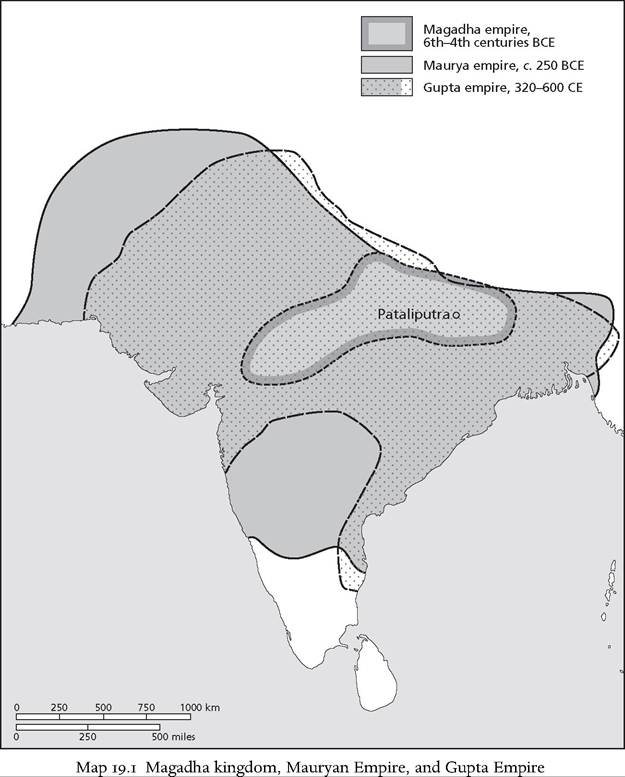
Under Chandragupta (321-297 bce) the Magadhan kingdom spread out into an empire, stretching from Gandhara (modern Afghanistan) in the north-west to Girnar (Gujarat) in the west of the subcontinent to Anga (Bengal) in the east and Karnataka (Deccan) in the south, across the Vindhyan mountains that cut the subcontinent in half, as it were, separating north from south (see Map 19.ι). Plutarch, the Roman chronicler, states that Sandrocottus (the Roman name for Chandragupta) overran and subdued the whole of ‘India' with an army of 600,000. He is believed to have travelled to Karnataka in the south and embraced the Jain faith towards the end of his life.
His son and successor Bindusara (297-273 bce) is best known for the diplomatic outreach of the Mauryan Empire under him. According to Strabo, an ambassador of Antiochus, the king of Syria, was at Bindusara's court at Pataliputra; the latter apparently asked Antiochus for some wine and dried figs as well as a sophist to be sent to him! Similarly Pliny mentions that Ptolemy the Second, the ruler of Egypt, sent an envoy to Bindusara.
The accession of Ashoka (272-232 bce) - grandson of Chandragupta and the greatest of the Mauryas - seems to have been accompanied by a great deal of fraternal conflict and bloodshed over the throne of Pataliputra. Soon after coming to power, Ashoka annexed the Kalinga region (on the coast of Orissa) that had resisted Mauryan takeover till then. The empire now encompassed the entire subcontinent but for the extreme south. The extent and boundaries of Ashoka's empire are marked out, as it were, by the large number of rock edicts engraved by Ashoka at over two dozen sites. These proclamations are addressed to his subjects and officials and convey a
unique message of the king's power and piety. They espouse a set of ethical principles, such as non-violence and concord, that the king claims to practise himself and admonishes his populace, who are like his children, to follow. Scholars believe these principles, termed dhamma in the edicts, were inspired by Ashoka's personal faith in Buddhism, which he patronized with a vengeance by numerous donations to the sangha, for the construction of Buddhist stupas and monasteries, and for proselytizing missions to other lands like Sri Lanka. But dhamma also seems to have been an imperial strategy to pacify and ideologically unify his sprawling, variegated realm.
In any case, consensus among historians is that the Mauryan king, based at Pataliputra in the eastern corner of the subcontinent, did not exercise uniform power over the length and breadth of the empire and that there were at least three tiers of state control which diminished from the metropolitan area, Magadha, in the centre, to core areas, the Gangetic valley, and finally to the periphery, which were all the hilly and forested extremities of the south which were not under direct Mauryan administration.
Ashoka was succeeded by a few ‘weak' kings, the last of whom, Brihadratha, seems to have been murdered in 185 bce by his commanderin-chief, a brahmana named Pushyamitra, who founded the Shunga dynasty at Pataliputra. The kingdom under the Shungas shrank considerably: it seems to have extended from Magadha to Ayodhya and Vidisha. The Shungas ruled for about a hundred years and were replaced in quick succession by the Kanvas and the Mitras, who were short-lived. The next major political formation to be based in Magadha was only in the fourth century c e, under the Gupta rulers.
Pataliputra is historically best associated with the period of Mauryan rule when it seems to have come into its own as an imperial city. Quantitatively too, sources from this time begin to be available more generously and tell us specifically and at some length about the great Mauryan capital. It is desirable, therefore, to pause the political narrative at this juncture and situate it within a larger material and cultural background, which would also flesh out the discussion so far.
Concomitant to the process of state formation and expansion that began in the sixth century bce, and significantly interacting with it, was a complex of socio-economic advances that fructified between the sixth and the third centuries. Chief among these were agrarian expansion, demographic growth, craft specialization and artisanal production, monetization of exchange, burgeoning of long-distance trade, and the spread of writing. The foundations of civilization in South Asia, ancient and unbroken, as we know it today, were laid in this period. These processes together signified what has been termed ‘Second Urbanization' or the emergence of a large number of towns and cities especially but not only in the fertile Gangetic valley. These included, in rough order from the north-west to the south-east of the subcontinent, Takshashila (Taxila), Hastinapura, Mathura, Ayodhya, Shravasti, Varanasi, Vaishali, Kaushambi, Rajagriha, Pataliputra, Champa, Tamralipti, and, in the south-west, Ujjayini, Pratishthana, and Mahishmati, among several others that we read of in the Buddhist texts as well as find in the archaeological record. Some of these appear to have been regarded as megalopoleis (mahanagaras), while others occurred on a smaller scale. As excavations have shown, most had ramparts built around them which, “by their massiveness, constructional care, and elaborately laid out gateways, bastions, and moats, were meant to mark out and defend a settlement whose significance in the social, political, and economic landscape was far greater than that of a village.”[DCXCIII] Indeed, two of the terms for ‘city' in early Indian literature, durga and pura, imply a fort or citadel. Within the fortification walls, the city was generally laid out along main and subsidiary streets and divided into various quarters (individual sites show considerable variety and detail).
Many of these urban centres emerged around markets or nodes of exchange and were centres of manufacture, apart from being political capitals. They were located along a dense network of overland and riverine commercial routes that came to crisscross the subcontinent at this time, for example, the Northern route (Uttarapatha) that ran from Takshashila in the north-west to Tamralipti on the south-east coast, through all the major nagaras in between like Mathura, Kaushambi, Shravasti, and Rajagriha, which served as both suppliers and consumers for the raw materials as well as finished goods travelling up and down. Similarly, the Southern route (Dakshinapatha) connected practically the entire Northern route through Kaushambi to Ujjayini and Pratishthana in the Deccan, and onwards to the port of Bhrigukaccha on the west coast. From the coasts, sea routes extended the lines of trade to other lands like West Asia on the one hand and SouthEast Asia on the other.
The cities that lay on these routes within the subcontinent were thus woven together in a great web of interregional contact, both commercial and cultural (see Map 19.2). This is reflected by the archaeological culture associated with, and named after, the fine, glossy deluxe pottery, the Northern Black Polished Ware (NBPW), which has been recovered from excavations at very many Second Urbanization sites between the seventh and second centuries bce. Striking amidst the NBPW assemblages were punch-marked silver coins and cast copper coins, the first metal money in South Asia. Burnt- brick buildings with drains, ring wells, iron artefacts, semi-precious beads,
Downloaded from https:Zwww.cambridge.org/core. Cornell University, on 07 Jan 2017 at 22:32:38, subject to the Cambridge Core term available at https:/www.cambridge.org/core/terms. http://dx.doi.org/10.1017/CBO9781139059251.021
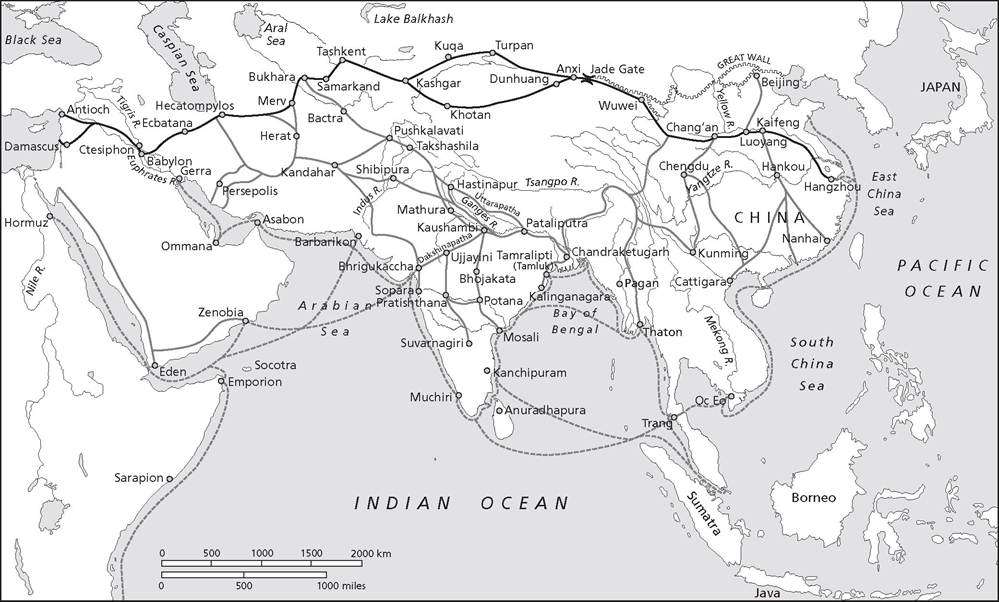
Map 19.2 Asian trade routes in c. third century bce
and terracotta figurines and seals are other material remains found at several NBPW sites.
Pataliputra can be understood as a product par excellence of the Second Urbanization. From its location at the confluence of two major rivers, the Ganga and the Son, three great routes radiated to the frontiers of the Mauryan Empire: the south-western to Bhrgukaccha by Kaushambi and Ujjayini, the northern to Nepal by Vaishali and Shravasti, and the northwestern, the longest, to Bactriana by Mathura and Takshashila. Downstream, Pataliputra was connected to Tamralipti and thus perhaps with Myanmar and South-East Asia, called Suvarnabhumi (golden land) in the Buddhist texts that describe the difficult sea voyages of intrepid merchants to these lands.
It was not just goods, but also people and ideas, that travelled along these routes, tending to converge on an imperial capital like Pataliputra. For example, Panini, the great Sanskrit grammarian of Taxila in the fifth or fourth century bce, is associated with the Nanda court at Pataliputra by one textual tradition. So also Megasthenes, the Greek ambassador to the court of Chandragupta Maurya, arrived in Pataliputra from Arachosia in modern Afghanistan. It is in his account, titled Indica, that we get a first- person description of the city. Though the Indica has not survived in its original form, parts of it were reported by later Greek chroniclers Strabo and Arrian. Here is what they said citing Megasthenes:
According to Megasthenes the mean breadth (of the Ganges) is 100 stadia, and its least depth 20 fathoms. At the meeting of this river and another is situated Palibothra, a city eighty stadia in length and fifteen in breadth. It is of the shape of a parallelogram, and is girded with a wooden wall, pierced with loopholes for the discharge of arrows. It has a ditch in front for defence and for receiving the sewage of the city. The people in whose country this city is situated is the most distinguished in all India, and is called the Prasii. The king, in addition to his family name, must adopt the surname of Palibothros, as Sandrakottos, for instance, did, to whom Megasthenes was sent on an embassy. [Strabo]
It is farther said that the Indians do not rear monuments to the dead, but consider the virtues which men have displayed in life, and the songs in which their praises are celebrated, sufficient to preserve their memory after death. But of their cities it is said that the number is so great that it cannot be stated with precision, but that such cities as are situated on the banks of rivers or on the sea-coast are built of wood instead of brick, being meant to last only for a time, - so destructive are the heavy rains which pour down, and the rivers also when they overflow their banks and inundate the plains, - while those cities which stand on commanding situations and lofty eminences are built of brick and mud; that the greatest city in India is that which is called Palimbothra, in the dominions of the Prasians, where the streams of the Erannoboas and the Ganges unite, - the Ganges being the greatest of all rivers, and the Erannoboas being perhaps the third largest of Indian rivers, though greater than the greatest rivers elsewhere; but it is smaller than the Ganges where it falls into it. Megasthenes informs us that this city stretched in the inhabited quarters to an extreme length on each side of eighty stadia, and that its breadth was fifteen stadia, and that a ditch encompassed it all round, which was six hundred feet in breadth and thirty cubits in depth, and that the wall was crowned with 570 towers and had four-and-sixty gates. [Arrian][694]
On the basis of these statistics, one modern estimate puts the size of Palimbothra or Mauryan Pataliputra at a little over 9 miles in length and nearly 2 miles in breadth, with a circumference of around 21 miles[695] - by far ‘the greatest city in India' of the time. Sadly, actual finds from the ancient site, corresponding to modern-day Patna city, hardly help us reconstruct the observed greatness. Though there are said to be ruins scattered over the length of the modern habitation, dense population and constructions above and subsoil water below have prevented extensive archaeological excavation, making Pataliputra one of the most important cities of the ancient world to have been least explored!
However, of the uncovered ruins, findings from two sites within are significant. At Bulandibagh remains of a wooden palisade have been found. Two parallel walls of wooden uprights, 24 feet high, separated by some 12 feet and resting on a gravel foundation, formed this timber rampart which must have had a filling of gravel, mud, or perhaps stone. Intermittent excavations traced this complex for about 350 feet, initially in an east-west alignment followed by a north-south one where the wall must have taken a bend. A wooden drain was also discovered running mostly along this wall. While the full extent and the stratigraphy of the rampart remain uncertain, circumstantial evidence suggests this may have been the wooden wall surrounding Pataliputra that Megasthenes referred to.
The size of the total area enclosed by the wooden ramparts has been conjectured to enclose anywhere between 1,200 hectares in one estimate and
2,200 hectares in another. The urban area proper enclosed by the city moat would have been less, about 340 hectares according to one scholar. Compare this with some of the other mahanagaras of the Mauryan Empire which, it has been calculated in the same study, would have enclosed, respectively, no more than 240 hectares for Rajagriha, the old Magadhan capital; no more than 180 hectares for Toshali (the site of Shishupalagarh), which was the centre of the eastern province of the Mauryan Empire, or 120 hectares for Ujjayini, the western provincial headquarters, or 60 hectares for Taxila, the north-western one. If these estimates are even near correct, it is abundantly clear that ‘Pataliputra would have been far larger than any other south Asian city of its day, and on this score alone would certainly qualify for the title of Metropolis.'[696] Though hazarding population estimates for ancient times is much more difficult, Pataliputra's size would suggest that well over 40,000 people inhabited the city in the Mauryan period, and this would be a conservative figure.[697]
From the other site, Kumrahar, remains of a pillared hall and a series of wooden platforms nearby have been found. The hall, open from all four sides, seems to have rested upon a substructure of timber and consisted of pillars of sandstone, some 32 feet tall, bearing a distinctive polish. Historians believe that in the early Mauryan period there would have been ten rows of pillars with eight pillars in each row when the monument was erected. It seems to have been burnt down circa 150 bce under the Shungas, who succeeded the later Mauryas. There has been much conjecture concerning the nature and function of this magnificent monument. Its resemblance to Achaemenid structures at Persepolis and elsewhere has often been noted and has led some to believe it was part of the royal palace. But others have seen it as a religious edifice, perhaps a Buddhist hall, while one scholar has suggested that it was more probably an open-air pavilion for royal relaxation and that the wooden platforms nearby may represent a broad staircase used by distinguished visitors.[698]
As yet, no comparable stone monuments associated with the Mauryan period are known from Pataliputra, perhaps because of the sparseness of excavations, but the discovery of a number of fragments of polished stone sculptures and architectural elements is strongly suggestive. It can be seen in conjunction with the evidence of the great Ashokan polished stone pillars, more than 40 feet tall, topped with massive animal capitals and often bearing royal edicts, that were erected by the Mauryan king at some half a dozen places in the Ganga valley (though not at Pataliputra). Without a doubt, monumental architecture and sculpture in stone both made their first appearance in South Asia in the Mauryan period.
In this context one should also mention the Didarganj yakshi, the glossy, perfectly moulded, voluptuous sandstone image in the round of a female chauri-bearer or fly-whisk bearer that was found from a village near Patna and is believed to be from around the Mauryan period (see Fig. 19. ι). It is testimony to the high standards of art and aesthetics, and indeed related technologies, practised and patronized in the Mauryan Empire, including by the state itself. At the same time, a number of largely hand- modelled terracotta figurines have also been found from Pataliputra, depicting a variety of animals and birds and, most strikingly, female figures with headgear, often in dancing poses. Their sophisticated treatment, despite the earthy medium (fired clay), has been interpreted as pointing towards specialized urban crafts production catering to a thriving popular urban cultural scene in Pataliputra.
We can get a far more evocative picture of urban culture and ambience in the royal city of Pataliputra from literature. While there may be a paucity of archaeological evidence, in texts we find a celebration of cities generally and, among all cities, of Pataliputra in particular. In this regard, significant portrayals are found in a genre of Sanskrit texts known as bhana. These are erotico-comic monologue plays composed probably in the fourth-fifth century ce. At least two of these plays, the Ubhayabhisarika and Dhurtavitasamvada, are explicitly set in Pataliputra, which is called here Kusumapura, or the city of flowers. The monologist in the plays, walking about the city, declaims on the sights and sounds thus:
How wonderful is the supreme beauty of Kusumapura! Here between the rows of houses the streets, which are well-watered, well-cleaned, and are scattered over with flower offerings... look like the (floors) of dwelling houses! And at intervals, shop fronts have become interesting due to the people engaged in buying and selling of various commodities. By the recitation of the Vedas, musical performances, and the twangs of bow-strings, palaces are calling out to one another, as it were, like the ten mouths of Ravana. Sometimes, lightning-like women, curious to have a look at the streets, open the windows of cloud-like palaces... Moreover, important
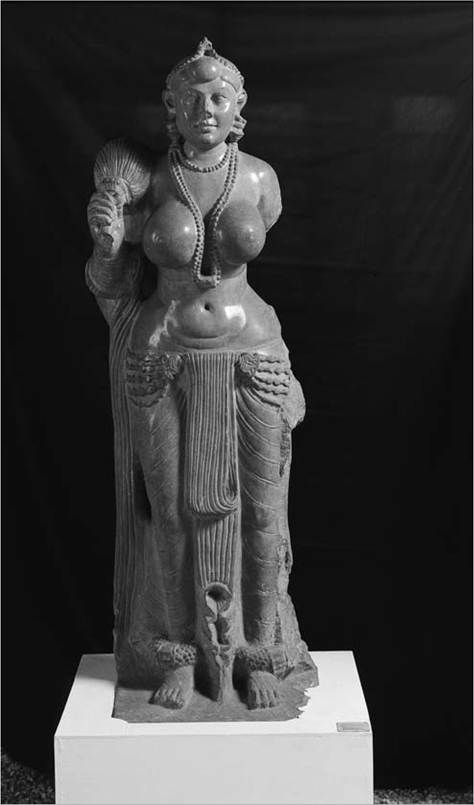
Figure 19.ι The Didarganj Yakshi, Patna Museum, Patna, India / DEA / G. Nimatallah (Getty Images)
high officers of the king, mounted on horses, elephants and chariots, add to the beauty of the scene. And young serving-maids wearing ornaments are going about with attractive movements. They are able to catch the eyes of young men and to carry off their mind... Daughters of courtesans, the beauty of whose lotus-like faces is being drunk by the eyes of all people, are gracefully walking up and down, as if to bestow favours on the thoroughfare.
Due to lack of any fear among the people, their constant participation with happy faces in festivals, their graceful wearing of jewels, and their gorgeous decoration of the body with garlands, scents, and fine clothes, their interest in various diverting sports, and for their other equally well known qualities, the earth with Pataliputra as her tilak (head mark), appears like heaven.[699]
It is in the fitness of things that the city of Kusumapura, unlike other cities, enjoys in the world, an unexceptionable reputation. Many are the high buildings in it. From its very dense population as well as its heaps of merchandise, people are astonished to mark its special opulence. But what is there to be astonished at?! There are other wealthy cities too. [Here now] are some of its features that are not found commonly. It has been said:
Here donors are plentiful. Arts are prized. The company of women can be enjoyed through polished manners. The rich are neither conceited nor jealous. Men are not without learning. All speak politely. They esteem highly one another's merits and are grateful (to their benefactors). (In short,) even gods can find happiness in this city after quitting heaven.
It is a pleasure to pass along the royal road of Kusumapura, even though it is very crowded and appears frightening like the ocean with (surging) waves.
Here nobody, seeing me, rushes off breaking his conversation with me even if he is in a hurry. Even in a crowd, room is made for me to move about. Everyone is joyful, no one detains me for long, lest it should spoil my business. To be sure, the fame that has accrued to this great city is maintained by people well versed in worldly ways...[700]
Even allowing for poetic fancy and embellishment, the point to note is the emphasis the bhanas self-consciously place on associating Pataliputra, as distinct from other cities, with a high degree of urbanity and sophistication, where liberality and etiquette are cherished, and with participation in a civic culture, where arts and sports are cultivated and prized. It is reasonable to conjecture that cities like Pataliputra, affluent, cosmopolitan, and cultured, inspired the ideal of the urban connoisseur in the Kamasutra. Vatsyayana's Kamasutra is a third-century ce Sanskrit treatise on sexual pleasure. Its protagonist, the nagaraka (literally, ‘of the city'), is the man-about-town who is ‘a sophisticated connoisseur of the good life in general, of pleasure in particular, and of sex even more particularly'.[701] The Kamasutra describes his daily routine thus:
He gets up in the morning, relieves himself, cleans his teeth, applies fragrant oils in small quantities, as well as incense, beeswax and red lac, looks at his face in a mirror, takes some mouthwash and betel, and attends to the things that need to be done. He bathes everyday, has his limbs rubbed with oil every second day, a foam bath every third day, his face shaved every fourth day, and his body hair removed every fifth or tenth day. All of this is done without fail. And he continually cleans the sweat from his armpits.
In the morning and afternoon he eats;... After eating he passes the time teaching his parrots and mynah birds to speak; he goes to quail-fights, cockfights, and ram fights; engages in various arts and games; and passes the time with his libertine, pander and clown. And he takes a nap.
In the late afternoon, he gets dressed up and goes to salons (goshthi) to amuse himself. And in the evening, there is music and singing. After that, on a bed in a bedroom carefully decorated and perfumed by sweet-smelling incense, he and his friends await the women who are slipping out for a rendezvous with them... And when the women arrive, he and his friends greet them with gentle conversation and courtesies that charm the mind and heart. If rain has soaked the clothing of women who have slipped out for a rendezvous in bad weather, he changes their clothes himself, or gets some of his friends to serve them. This is what he does by day and night.
He amuses himself by going to festivals, salons, drinking parties, picnics and group games... A salon takes place when people of similar knowledge, intelligence, character, wealth, and age sit together in the house of a courtesan, or in a place of assembly, or in the dwelling place of some man, and engage in appropriate conversation with courtesans. There they exchange thoughts about poems or works of art, and in the course of that they praise brilliant women whom everyone likes... They have drinking parties in one another's houses.
Picnics can be described in the same way. Early in the morning, men dress with care and go out on horse-back, attended by servants and accompanied by courtesans. They enjoy the daytime events there and spend the time at cockfights, gambling, theatrical spectacles... and then in the afternoon they go back in the same way, taking with them souvenirs of the pleasures of the picnic. And in the same way, in the summer, people enjoy water sports in pools built to keep out crocodiles.[702]
The urban behavioural ideal thus consisted in cultivation and refinement of every aspect of human personality: body, mind, spirit, senses, and etiquette. Moreover, it did not envisage the nagaraka as an isolated instance. He is seen to belong to a like society - ‘people of similar knowledge, intelligence, character, wealth and age’ - in which he circulates and interacts. In housing the man-about-town, then, the city houses an ideal community, in the perspective of the Kamasutra, not only ideal individuals, whose twin central concerns, rising above quotidian pursuits, seem to be: sexual attainment and cultural accomplishment.
This seems to be the representation of urban culture in yet another body of Sanskrit literature from the first millennium ce: kavya or highly aesthetic and creative poetry, drama, tale, and biography. With their themes and narratives relating single-mindedly to paradigmatic cities of the Second Urbanization, like Pataliputra, Varanasi, Ujjayini, and Shravasti, and mostly composed in that period too, kavya texts constitute themselves as preeminently urban literature. Therefore their representations may come close to being the self-perception or self-projection of an urban culture, albeit relating to largely elite vantages.
Based on a study of literary representations of the city in this textual genre, it has been argued that the quintessential city in early India was the site of a culture of desire, an ethos centred on the ethic of pleasure.[703] This extended not only to the embracing of a full-blooded materialistic hedonism attested in the literature but also prominently to the pursuit and cultivation of erotic activity. Thus, the city seems always full of beautiful women and men who look like Kama, the love god. The women are always in love dalliance or busy preparing for it by enhancing their beauty, and the men flock to the courtesans' quarter or flirt with maids on the highway or in pleasure haunts. Drinking and gambling, music and dance are favourite depicted occupations. The home of all the arts (sakalakalah dadhanah), the city is always in festival - sex itself is celebrated as one, while one of the popular festive occasions is the worship of Kamadeva, the god of love. Pleasure groves are cherished urban assets frequented in droves. The city is likened to Bhogavati, the asuric (demonic) capital, as well as to Amaravati, the heavenly city, both for the pleasures it affords - pleasures that could implicate even the ascetic. For indeed, nuns and monks are routinely shown serving as messengers of love in the city.
Kavya thus seems to present the ancient Indian city as essentially a site for gratification. Is the kavya representation to be taken literally or were the texts trying to say something more? For instance, together with the Kamasutra, kavya seems to render erotics as a form of art rather than instinct - something that is to be assiduously cultivated by the connoisseur; this then may define the city as a civilizational centre where urges of ‘nature' could be tamed and exalted to ‘culture'. Moreover, together with the attention to kama, or pleasure, we also see in kavya a tension between kama and dharma, or virtue, a concern for mediating or reconciling the former with the latter. This suggests that it is not a notion of unadulterated gratification that is attributed to the city; there does seem to be a consciousness of socio-moral constraints. But at the same time, the kama-centric characterization of the city may show that kavya perceives the city as an unstrictured social space - not an immoral or amoral world but one that could be free, without resorting to rebellion, of the often repressive concerns of religion and society.
This quality, in turn, may be attributed to what appears to be, in kavya's assessment, the attenuated force of any concerted socio-religious authority in the city, like the brahmanas or the caste system. Contributing to the diminution in the voice of socio-religious power in the city, and to the unfettering of social behaviour, is the fact that the city is the projected seat of the king, whose power in practice is more coercive than ethical. Also the big merchants in a city like Pataliputra, referred to in the Mudrarakshasa as nagaramukhyah or pradhanapurusah, exerted great influence on the urban socio-political structure. Having access to the king, these men can be expected to have wielded enormous clout either in alliance with him or separately in their own right. The merchant's power being the power of wealth, and the open nature of commerce as a specialization, meant it was another secular factor in the displacement of traditional brahmanical institutions in urban society. In this context it is worth recalling that Buddhist Pali texts, which provide us with our first references to Pataliputra of the sixth century bce, are replete with references to the great merchants known as gahapatis and setthis, who seem to have taken to heterodox faiths like Buddhism that emerged as a challenge to the orthodox brahmanical order. We have also noted the considerable vogue that Buddhist and Jaina faiths were in with dynast after dynast on the throne of Magadha.
It has been argued that perhaps the most significant historical factor shaping the urban social order was the concentration of variety in the city. The literary study in question speaks of a vibrant miscellaneous sociological congregation within the paradigmatic city, the impression of a random, crowded, jostling-together of the multiple castes, professions, ethnicities and religious faiths it was possible to find in a city, which yielded a quite unorthodox, heterogeneous texture to the urban social fabric. This is especially plausible for Pataliputra, the metropolis of a sprawling and highly differentiated empire. Heterogeneity also spelt congestion and intermingling, and a great ideological and behavioural complexity. This, perhaps, lay at the heart of civilization as represented by the ancient imperial city.
The high point of early Indian urban culture reached by a cosmopolis like Pataliputra is believed to have been the post-Mauryan period, that is, between the second century bce and the third century ce. Thereafter, Magadha came under the sway of the Gupta line of kings. We know this from a reference in the Vishnu Purana's dynastic lists to the Guptas ‘enjoying' all the territories along the Ganga including Saketa (Ayodhya), Prayag (Allahabad), and Magadha. Historians believe this would refer to the early Gupta kingdom under the first important king of the dynasty, Chandragupta I (319-335 ce). Chandragupta I seems to have derived some of his power from a matrimonial alliance that Gupta coins suggest he contracted with the Licchavis, who were apparently still an influential ruling group in the foothills of the Himalayas. We do not have specific information on whether or not Pataliputra was his capital. Similarly, though from the Allahabad pillar inscription we know of a vast expansion of Gupta realms across north and central India that took place under his later successor, Samudragupta (350-370 ce), a great war general, we cannot say where his capital was. Under the third king, Chandragupta II (375-415 ce), when the empire spread westwards in a major way, it is likely that Ujjayini in Malwa became the seat of Gupta royal power. Numerous legends link this king with an eponymous king Vikramaditya who populated his court at Ujjayini with luminaries from the world of scholarship.
Gupta kings adopted imperial titles like paramabhattaraka (supreme lord) and maharajadhiraja (great king of kings); historians maintain, however, that they did not administer their entire empire directly but established a network of relations of paramountcy through their numerous battles and conquests. They were great patrons of culture and brahmanical religion, particularly the worship of Vishnu, which was in the ascendant since the post-Mauryan centuries; land grant charters attest to their donations to temples and brah- manas. Buddhism also continued to flourish, more now in its Mahayana and Vajrayana forms.
It is in the Gupta period that the earliest Chinese monk-traveller to visit the subcontinent, Faxian, arrived and travelled between 405 and 411 ce to many different Buddhist centres in the subcontinent. He left a record of these (Gaoseng Faxian Zhuan), which briefly mentions Pataliputra, again in the context of being among the greatest cities and towns in the ‘Middle Kingdom', with prosperous inhabitants who competed with each other in the practice of (the Buddhist virtues of) benevolence and righteousness.[704] Faxian also refers to an annual procession in Pataliputra where images of the Buddha were carried through the city with much fanfare; it saw the participation, interestingly, of brahmanas apart from rich merchants.
Some 55 miles from Pataliputra, the Buddhist monastery at Nalanda achieved great renown as an educational centre in the late Gupta period. A vast complex of stupas and viharas has been unearthed which has been declared a UNESCO World Heritage Site. A veritable residential university with a famed, multi-storeyed library (which was burnt down by Turkish invaders in the twelfth century), it attracted scholars and students from various parts of the Buddhist world, including China (notably Tibet), Korea, and Sri Lanka, serving as a site of cross-cultural encounters. Among the subjects taught were grammar, logic, metaphysics, astronomy, and theology. Several big names of the field of ancient South Asian philosophy, like Nagarjuna, Vasubandhu, Dinnaga, Dharmakirti, and Padmasambhava, have been associated with the Nalanda school.
In astronomy and mathematics, mention must be made of Aryabhata, who seems to have migrated to Pataliputra from the Deccan in the fifth century C e and has several firsts to his credit, such as the concept of zero, the decimal, and the pi, and the discovery that the earth rotated on its axis, that there were almost exactly 365.25 days to a year, and how eclipses are caused.
The Gupta Empire declined by the middle of the sixth century c e, battling the rise of various regional rulers and Huna invasions from the north-west. Towards the end of that century, the Pushyabhutis had risen to power, based in Thaneshwar (Punjab). Their most famous king, Harshavardhana (606-644 ce), pushed eastwards and set up his capital at Kanyakubja or Kanauj in the middle Ganga valley, which emerged over the next three centuries as an imperial city in its own right. Magadha was a part of Harsha's dominions which extended up to Gauda (Bengal) at one point. A major source for Harsha's reign is the account (Si Yu Ki) left behind by Xuan Zang, the Chinese pilgrim who travelled extensively across the subcontinent and stayed many years at Harsha's court. He seems to have been in close proximity to Harsha, who comes across as a devout patron of Buddhism. The king donated the revenues of two hundred villages for the upkeep of the Nalanda mahavihara.
Nalanda continued to receive royal support under the Palas, a dynasty that in the eighth century came to rule over a fairly large territory extending into north and north-east India under Dharmapala (770-810 ce) and Devapala (810-850 ce) but the nucleus of which lay in Bihar and Bengal. Their capital shifted from ruler to ruler, possibly once at Mudgagiri, modern Munger, some 180 miles from Pataliputra. The Palas founded a network of great monasteries (mahaviharas), including Vikramashila and Odantapuri in Bihar, which, along with Nalanda, gained great renown as centres of Buddhist learning and education. Pala power had declined by the late ninth century under the strain of constant conflicts for paramountcy with other regional powers. However, it left a striking legacy in the form of a vibrant school of art in Bihar: a large number of sculptures in stone and metal, especially depicting the Buddhas, bodhisattvas, and other Buddhist deities like Tara, have been recovered.
What became of Pataliputra, the imperial city, after its halcyon days? Archaeology of the early medieval period is virtually non-existent at the site; does literature continue after the Gupta period to record an imprint of Pataliputra’s significance and novelty? We know that the city certainly existed at the time al-Biruni, the Persian traveller, visited parts of the subcontinent in the eleventh century. His Kitab-al-Hind mentions Pataliputra among other cities of ‘India’.[705] [706] However, we also know that already in the seventh century, Xuan Zang, on his visit to the city, had found it fallen on bad days. Zang records in his Si Yu Ki: ‘To the south of the river Ganges there is an old city about 70 li round. Although it has been long deserted, its foundation walls still survive. Formerly... it was called Kusumapura, so called because the palace of the king had many flowers. Afterwards... its name was changed to Pataliputra.'15
One superficial reason for the downturn in Pataliputra’s fortunes could be that it ceased to be a capital city, or was at best one of other such capitals under the Guptas and the Palas. But historians have spoken of a general urban decline in the subcontinent from the fourth century ce onwards, consequent on postulated commercial and monetary shrinkage after the high-water mark reached in the early historic period. It has been argued that there was a corresponding change in the nature and composition of centres of the Second Urbanization, like Pataliputra: fewer merchants and artisans resided there now, more administrators and military men did, and towns were transformed into centres of pilgrimage rather than of production.[707]
This hypothecated series of changes can be and has been questioned on several counts. Historians have widely urged qualifying this picture of pervasive urban decay. They suggest visualizing perhaps a partial urban exhaustion for cities of the upper and middle Ganga valley due to persistent and extensive resource use accompanied by the pressure of demographic increase. Others have offered an alternative perspective: they speak of simply a shift in the epicentre of urbanization away from the Ganga valley to other, more regional, contexts (like Bengal and Malwa) that were crystallizing in the early medieval period as the site of new political formations and localized (as opposed to subcontinental) economic patterns.[708] Pataliputra was thus no longer in the thick of things as it had been in the sixth century bce, and as it had stayed till at least the fifth century c e, as much in popular imagination as on the ground. It did live to fight another day, though, and, in a display of exemplary civilizational continuity, reinvented itself as a provincial centre under Afghan and Mughal rule in and after the fourteenth century, acquiring its modern nomenclature. Patna remains among the largest cities of east India and, once again, a capital city of independent India's state of Bihar.
Further Reading
Primary texts in translation
Ahmad, Qeyamuddin (ed.), India by Al-Biruni, Abridged edition of Dr. Edward C. Sachau's English Translation, Delhi: National Book Trust, 1983.
Ghosh, Manomohan (ed. and trans.), Glimpses of Sexual Life in Nanda-Maurya India: The Caturbhani, Calcutta: Manisha Granthalaya, 1975.
Kangle, R. P. (ed. and trans.), The Kautiliya Arthasastra, 3 vols., University of Bombay, 1960-65.
Legge, James, The Travels of Fa Hien: A Record OfBuddhistic Kingdoms, Being an Account by the Chinese Monk Fa-hien of His Travels in India and Ceylon (ad 399-414) in Search of the Buddhist Books of Discipline, New Delhi: Master Publishers, 1981.
Majumdar, Ramesh Chandra (ed.), The Classical Accounts of India, Calcutta: Firma KLM, [i960] 1981.
McCrindle, John W. (ed. and trans.), Ancient India as Described by Megasthenes and Arrian, Calcutta: Thacker and Spink, 1877.
Si Yu Ki Buddhist Records of the Western World, Translated from the Chinese of Hieun Tsiang (ad 629), trans. Samuel Beal, 2 vols., Delhi: Motilal Banarsidass, [1884] 2004.
Vatsyayana Mallanaga Kama Sutra, trans. Wendy Doniger and Sudhir Kakar, Oxford University Press, 2002.
Secondary works
AJlchin, F. Raymond, The Archaeology of Early Historic South Asia: The Emergence of Cities and States, Cambridge University Press, 1995.
Chakrabarti, Dilip K., The Archaeology of Ancient Indian Cities, Delhi: Oxford University Press, 1995.
Chattopadhyaya, Brajadulal, ‘Urban Centres in Early Medieval India: An Overview', in Sabyasachi Bhattacharya and Romila Thapar (eds.), Situating Indian History for Sarvapalli Gopal, Delhi: Oxford University Press, 1986, pp. 10-33.
Kaul, Shonaleeka, Imagining the Urban: Sanskrit and the City in Early India, Delhi: Permanent Black, 2010.
Nandi, R. N.,‘Client, Ritual and Conflict in Early Brahmanical Order', The Indian Historical Review 6 (1979-80): 64-118.
Raychaudhuri, Hemachandra, Political History of Ancient India: From the Accession of Parikshit to the Extinction of the Gupta Dynasty, Delhi: Oxford University Press, [1923] 2000.
Sarao, Karam Teg S., Urban Centres and Urbanisation as Reflected in the Pali Vinaya and Sutta Pitaka, Delhi: Department of Buddhist Studies, University of Delhi, 1990.
Sharma, Ram Sharan, Urban Decay in India c. 300-1000 ad, New Delhi: Munshiram Manoharlal, 1987.
Sinha, Bindeshwari Prasad, The Decline of the Kingdom of Magadha 455-1000 ad, Patna: Motilal Banarsidass, 1953.
Thakur, V. K., ‘Decline or Diffusion: Constructing the Urban Tradition of North India during the Gupta period', The Indian Historical Review 24 (1997-98): 20-69.
Thapar, Romila, Asoka and the Decline of the Mauryas, Delhi: Oxford University Press, [1963] 1987.
The Mauryas Revisited, Calcutta: K. P. Bagchi and Co., 1984.